“All he could do was stand there and watch it happen, his own life, and the lives of those he loved, falling apart around him like a house in an earthquake.”
— Wade's feeling of powerlessness as his life unravels.

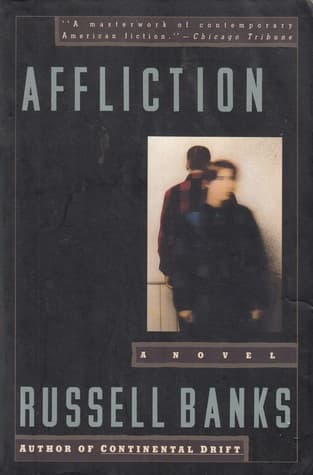
Russell Banks (1989)
Genre
Literary Fiction / Thriller / Mystery
Reading Time
7 hours 30 min
Key Themes
See below
Sign in to track this book
In desolate New Hampshire, a former high-school football star turned bitter well-digger and part-time cop descends into violence, exposing the inherited trauma of a small-town macho legacy, seen through his younger brother's haunted eyes.
Rolfe Whitehouse, the narrator and Wade's younger brother, returns to their childhood home in New Hampshire after being away. He immediately sets a somber tone, reflecting on the town's bleakness and the dread tied to his family name. Rolfe introduces Wade as a local well-digger and part-time police officer, known for his volatile temper and a history of violence, especially from his relationship with their abusive father, Glen Whitehouse. Rolfe hints at a tragic event involving Wade, framing the story as an attempt to understand his brother's descent into madness and violence. He describes Wade's current life, marked by a strained second marriage to Lillian and a complicated relationship with his daughter, Jill, from his first marriage.
The main event happens during deer season when Evan Twombly, a respected local union boss and Wade's former high school coach, is found dead in the woods. Initially, his death is ruled a hunting accident, with a single bullet wound to the chest. However, inconsistencies at the scene and the unusual circumstances of Evan's hunting trip with Wade raise questions. Wade, who was hunting with Evan, is the main witness, and his account is vague. Rolfe, watching, notices Wade's increasing agitation and paranoia after the incident, suggesting the 'accident' might hide something more sinister. The local community, while accepting the official ruling, has unspoken doubts.
After Evan Twombly's death, Wade's already fragile mental state quickly worsens. He drinks heavily, which makes his aggression worse and fuels growing paranoia. He starts to believe he is being watched and plotted against, convinced that various townspeople, including Lillian's ex-husband, Gordon LaRiviere, are conspiring against him. His relationship with Lillian becomes increasingly strained and abusive, mirroring the violence he saw and endured from his own father. Wade's interactions with his daughter, Jill, also suffer, as his unpredictable behavior frightens her. Rolfe describes several instances of Wade's erratic behavior, showing his descent into a dangerous, isolated state, tormented by inner demons and external pressures.
Rolfe's story often flashes back to his and Wade's childhood, revealing the constant, brutal abuse from their father, Glen Whitehouse. Glen was a cruel, domineering man who regularly beat his wife and children, causing deep trauma in both brothers. Rolfe emphasizes how this upbringing shaped Wade, giving him a violent streak and an inability to process emotions healthily. These flashbacks explain Wade's current behavior, showing his aggression and paranoia as a direct result of his traumatic past. The cycle of violence, passed from father to son, becomes a main theme, illustrating how Wade is trapped in the same patterns of abuse he endured.
Wade's domestic violence against his second wife, Lillian, dramatically increases. Driven by alcohol, paranoia, and deep-seated psychological issues, he abuses her physically and emotionally. Lillian, initially trying to cope, eventually reaches her breaking point. The violence peaks in a brutal attack where Wade severely beats Lillian, leaving her badly injured. This act is a horrific echo of his father's abuse of his mother, showing how Wade has become what he hated. The severity of the assault forces Lillian to flee, seeking safety and protection, effectively ending their marriage. This event further isolates Wade and pushes him closer to the edge.
In his increasingly paranoid state, Wade fixates on Gordon LaRiviere, Lillian's ex-husband, believing Gordon is involved in a conspiracy against him, possibly even connected to Evan Twombly's death. Wade's delusion comes from Gordon's perceived influence in town and his past relationship with Lillian. This leads to a tense confrontation where Wade, fueled by alcohol and rage, threatens Gordon. The incident further solidifies Wade's reputation as a dangerous, unstable person in the community. Gordon, fearing for his and Lillian's safety, becomes a significant figure in the unfolding drama, representing the town's growing apprehension and the potential for more violence from Wade.
Amidst the rising tension, Wade's elderly, ailing father, Glen Whitehouse, mysteriously disappears from his home. Wade claims his father simply wandered off, but his erratic behavior and their history of abuse immediately raise suspicions. The townspeople, already wary of Wade, openly question his involvement. Rolfe, while trying to stay objective, notes Wade's strange calm and evasiveness about his father's whereabouts. The search for Glen begins, but it is complicated by the community's reluctance to fully trust Wade, who is the main person of interest. This disappearance adds another layer of mystery and dread to the unfolding tragedy, pointing to a dark secret Wade holds.
Glen Whitehouse's body is eventually found, hidden in a well on his property. The manner of death suggests foul play, confirming the town's worst fears. Confronted with the evidence and his own collapsing mental state, Wade begins to confess, though in a fragmented, deluded way, to Rolfe. He reveals he killed his father, driven by a lifetime of resentment, the cumulative trauma of abuse, and a twisted sense of justice. Wade describes the act as an attempt to 'cleanse' himself and his family of his father's evil, but his narration is colored by psychosis and a deep inability to tell reality from his own projections. This confession is the turning point, solidifying Wade's descent into irreversible madness and violence.
After confessing to his father's murder, Wade commits one final, horrifying act of violence. Believing that Evan Twombly was somehow involved in a conspiracy against him and that killing him was necessary, Wade takes revenge on the town's police chief, who was investigating Glen's death and Evan's 'accident.' This act is a desperate lashing out, a complete break from reality. Following this, Wade, now a wanted fugitive, tries to flee the town, convinced he is being pursued by a vast, unseen network of enemies. His escape is chaotic and desperate, highlighting his complete mental collapse and his utter alienation from society.
As the full extent of Wade's crimes comes to light and authorities close in, Rolfe Whitehouse decides to leave New Hampshire. He has seen his brother's complete destruction, a tragedy rooted deeply in their shared past and the cycle of abuse from their father. Rolfe leaves with deep grief and an understanding of the 'affliction' that has plagued his family for generations. His narrative ends with a reflection on violence, trauma, and the inescapable influence of one's origins. He carries the burden of his family's history, but also the clarity gained from meticulously recounting Wade's story, hoping to understand rather than just condemn.
The Protagonist/Antagonist
Wade descends from a troubled, repressed man into a full-blown psychotic killer, driven by the unresolved trauma of his childhood abuse.
The Narrator/Supporting
Rolfe moves from a position of relative detachment to a deeper, albeit painful, understanding of his family's generational trauma and his brother's fate.
The Supporting
Lillian attempts to build a stable life with Wade but is ultimately forced to flee for her safety as his abuse escalates.
The Supporting/Antagonist
Glen's physical decline and eventual murder by Wade represent the culmination of the generational trauma he inflicted.
The Supporting
Jill's arc is one of increasing fear and avoidance of her father as his mental state deteriorates.
The Supporting/Victim
Evan's arc is brief, serving as the initial victim whose death triggers the unraveling of Wade's sanity and the community's suspicions.
The Supporting
Gordon's role shifts from a background character to an increasingly threatened individual as Wade's paranoia focuses on him.
This is the main theme of 'Affliction,' exploring how trauma, especially physical and emotional abuse, passes through generations. Wade's brutal childhood from his father, Glen, directly leads to his own violent behavior towards Lillian and ultimately his father. The story constantly shows parallels between Glen's abuse of his family and Wade's actions, demonstrating how victims can become perpetrators. Rolfe's analysis highlights the inescapable nature of this cycle, suggesting Wade is not just an evil man, but a product of an 'affliction' that has plagued his family for decades, as seen in Lillian's brutal beating, eerily similar to his mother's experiences.
“What had happened to Wade was, in its own way, hereditary, a disease passed from father to son, an affliction.”
The novel examines a toxic form of masculinity, common in the rural, working-class setting. This masculinity involves emotional repression, reliance on physical strength and aggression, and an inability to show vulnerability. Glen embodies this destructive ideal, and Wade, despite his suffering, internalizes and continues it. Wade's inability to communicate feelings, his reliance on alcohol, and his violent outbursts are all signs of this flawed masculine code. The hunting ritual, a traditional male bonding activity, ironically becomes the scene for the first murder, symbolizing the darker aspects of male identity when unchecked by empathy or emotional intelligence.
“He was a man, after all, a Whitehouse man, and a Whitehouse man knew how to handle his problems. Or he thought he did.”
Wade's gradual descent into paranoia and psychosis is a central theme, showing the fragility of the human mind under extreme stress and trauma. After Evan Twombly's death, Wade's suspicions about conspiracies against him grow, fueled by alcohol and his unresolved past. He starts to see enemies everywhere, from Gordon LaRiviere to the local authorities. This mental breakdown is not sudden but a slow process, detailed by Rolfe, showing how Wade's grip on reality loosens until he is consumed by delusions. This theme is clear in Wade's increasingly erratic behavior and his belief that he is being watched and plotted against, leading to his isolation and further violence.
“The world was closing in on him, he believed, a net of small-town gossip and long-held resentments tightening around his throat.”
The past, especially the trauma of childhood abuse, heavily affects Wade and, to a lesser extent, Rolfe. The novel argues that people are deeply shaped by their upbringing and that escaping the 'burden of the past' is incredibly difficult, if not impossible. Wade's current violence and mental state are direct results of the abuse he suffered from Glen. The desolate New Hampshire setting itself seems to embody this theme, a place where history lingers and change is slow. Rolfe's story tries to uncover this past, to understand how it led to Wade's tragic end, showing that the past is not just a prelude but an active force shaping the present.
“The past, for Wade, was not a place he'd left behind. It was a place he carried inside him, always.”
The novel often explores the gap between objective truth and individual or community perception. Rolfe, as narrator, tries to piece together the 'truth' of what happened to Wade, but he constantly acknowledges the subjective nature of memory and the influence of small-town gossip and ingrained biases. Wade's own perceptions are heavily distorted by his paranoia and mental illness, leading him to create elaborate conspiracy theories. The community also operates on a mix of facts, rumors, and long-held judgments, making it hard to discern what truly happened, especially regarding Evan Twombly's death and Glen's disappearance. This theme highlights how easily truth can be obscured by personal demons and collective assumptions.
“In a town like this, the truth was less important than what people believed to be true.”
Rolfe Whitehouse recounts the events of his brother's downfall from a future vantage point.
The story is told by Rolfe Whitehouse, Wade's younger brother, retrospectively. This allows Rolfe to present Wade's story with a degree of analytical distance and a clear understanding of the tragic outcome. Rolfe acts as a kind of literary detective, sifting through memories, testimonies, and his own insights to construct a comprehensive account of his brother's descent. This device provides a layer of interpretation and reflection, allowing the narrator to explore the psychological and sociological factors contributing to Wade's actions, rather than simply presenting a chronological sequence of events. It also establishes a somber, reflective tone from the outset.
Hints and clues about Wade's ultimate fate and the dark secrets of the Whitehouse family are woven throughout the narrative.
From the very beginning, Rolfe's narration is riddled with foreshadowing, hinting at the tragic and violent end that awaits Wade. Phrases like 'affliction' and references to a 'fuse burning' create a sense of inevitable doom. The early descriptions of Wade's temper and the pervasive dread associated with the Whitehouse name prepare the reader for the unfolding horrors. This device builds suspense and emphasizes the deterministic nature of Wade's fate, suggesting that his actions are not random but deeply rooted in his past and personality, making the tragedy feel inexorable rather than accidental.
Recollections of Wade and Rolfe's abusive childhood under Glen Whitehouse.
The narrative frequently employs flashbacks to the Whitehouse brothers' childhood, detailing the brutal abuse inflicted by their father, Glen. These flashbacks are crucial for understanding Wade's psychological makeup and the origins of his violence and paranoia. They serve to explain his present-day actions, not as isolated incidents, but as a direct consequence of deep-seated trauma. This device helps the reader empathize with Wade's internal struggle, even as his actions become increasingly monstrous, by providing context for his 'affliction' and highlighting the generational cycle of violence.
The bleak, isolated New Hampshire town reflects the characters' inner lives and limited options.
The desolate and economically struggling New Hampshire town serves as more than just a backdrop; it is a symbolic representation of the characters' lives, particularly Wade's. The isolation, the lack of opportunities, and the pervasive sense of stagnation mirror Wade's emotional and psychological entrapment. The harsh landscape and the insular community reinforce the idea that characters are often trapped by their circumstances and their pasts. The town's atmosphere contributes to the feeling of hopelessness and inevitability, intensifying the tragic nature of Wade's story and suggesting that his fate is deeply intertwined with his environment.
“All he could do was stand there and watch it happen, his own life, and the lives of those he loved, falling apart around him like a house in an earthquake.”
— Wade's feeling of powerlessness as his life unravels.
“The past was not merely prologue; it was the whole damn play.”
— Reflecting on how past trauma dictates present actions.
“He knew, with a certainty that chilled him to the bone, that he was his father's son.”
— Wade's terrifying realization of his inherited violence.
“It wasn't just the cold, it was the silence. The kind of silence that makes you feel like you're the only living thing left on earth.”
— Describing the isolating winter landscape of New Hampshire.
“There was a kind of freedom in finally having nothing left to lose.”
— Wade's mindset as he reaches the depths of his despair.
“Memory, he thought, was a kind of disease, a slow, debilitating poison.”
— Wade's struggle with traumatic memories.
“The truth was not a single, solid thing, but a shifting, shimmering mirage.”
— The elusive nature of truth in the narrative, especially regarding the murder.
“He often felt as if he were watching his own life from a great distance, an uninterested spectator.”
— Wade's sense of detachment from his own experiences.
“Every man carried his own private hell around with him.”
— A philosophical observation on the internal struggles of individuals.
“The only difference between a madman and a sane one was that the sane man knew he was mad, and kept it hidden.”
— A cynical view on mental health and societal expectations.
“It was the kind of cold that got inside you and stayed there, a permanent ache in your bones.”
— Describing the pervasive cold, mirroring Wade's internal state.
“He understood then that some things, once broken, could never be truly mended, only carefully arranged to look whole.”
— Wade's realization about the irreparable damage in his life.
“The silence of the woods was not peaceful; it was a heavy, watchful silence, full of things unsaid and undone.”
— The oppressive atmosphere of the natural setting.
“He was a man who had been taught, from birth, that the world was a hard place, and that the only way to survive it was to be harder.”
— Explaining the origins of Wade's hardened personality.
Ready to see how well you understood this book? Take our interactive quiz with 10 questions.

Biography coming soon.







