“The greatest enemy of truth is very often not the lie—deliberate, contrived, and dishonest—but the myth—persistent, persuasive, and unrealistic.”
— A reflection on political discourse and public perception.

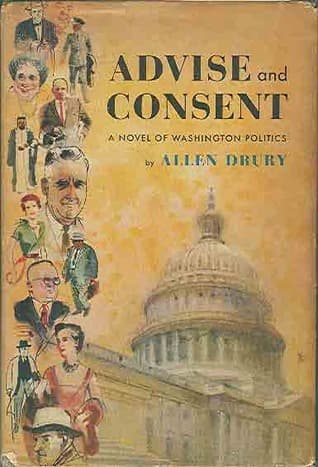
Allen Drury (1959)
Genre
Literary Fiction / Politics / Thriller / Historical Fiction
Reading Time
15-20 hours
Key Themes
See below
Sign in to track this book
In 1950s Washington, a President's choice for Secretary of State starts a political battle, full of betrayals and moral compromises, that threatens the country.
President Hudson, a charismatic but ill leader, nominates Robert Leffingwell, an intellectual but controversial academic, to be his Secretary of State. The nomination immediately divides the Senate, especially the powerful Foreign Relations Committee. Senator Seabright 'Seab' Cooley of Wyoming, a conservative and the committee chairman, has strong doubts about Leffingwell's past and liberal views. Senator Brigham Anderson of Utah, a respected and moral figure, struggles with his conscience as he reviews the complex political situation and Leffingwell's seemingly clear public record. The stage is set for a dramatic and political confirmation hearing, with the President determined to get Leffingwell approved.
The confirmation hearings begin, and Robert Leffingwell presents himself as a qualified and dedicated public servant. He explains his vision for American foreign policy, which matches President Hudson's more liberal international agenda. However, Senator Seabright Cooley, using his experience and cleverness, subtly questions Leffingwell's past, hinting at inconsistencies and undisclosed information. Cooley's questions, initially dismissed as political showmanship, start to chip away at Leffingwell's polished image, creating tension and suspicion in the committee room. Other Senators, including the influential Southern Senator Fred Van Ackerman, watch with varying degrees of interest.
The hearings take a dramatic turn when Senator Cooley introduces a surprise witness: Herbert Gelman, a timid and troubled former college associate of Robert Leffingwell. Gelman, under pressure and with clear reluctance, testifies that Leffingwell was a member of a communist group in his youth at the University of Chicago and that Leffingwell had lied under oath by denying this past association. Gelman's testimony shocks the committee and the nation, instantly turning the confirmation battle into a national scandal. Leffingwell strongly denies the accusations, calling Gelman a mentally unstable fantasist, but doubt has been planted, threatening to completely derail his nomination.
After Gelman's explosive testimony, the Senate, particularly Senator Brigham Anderson, faces a moral dilemma. Questions arise about Gelman's credibility, given his history of mental illness and how he was brought to testify. President Hudson and his allies, including Senator Fred Van Ackerman, strongly push to discredit Gelman, portraying him as an unreliable witness manipulated by political opponents. Senator Anderson, however, feels a deep responsibility to find the truth, regardless of political consequences. He starts his own quiet inquiries into Gelman's background, trying to figure out if Gelman's claims, however sensational, have any basis in fact.
Senator Brigham Anderson, driven by his commitment to honesty and justice, investigates the allegations against Leffingwell further. He travels to Chicago and carefully interviews former associates and witnesses, independently checking parts of Gelman's story. To his dismay, Anderson finds strong evidence that supports Gelman's claims about Leffingwell's youthful communist ties. This discovery puts Anderson into a deep moral crisis. He is torn between his loyalty to the President and the Democratic party, his wish to avoid a national political disaster, and his absolute belief that a man who lied under oath cannot serve as Secretary of State. The weight of this secret affects him greatly.
As the truth about Leffingwell's past becomes clearer to Senator Brigham Anderson, he faces immense pressure from all sides. President Hudson, desperate to secure his nomination and maintain his political agenda, personally appeals to Anderson, urging him to prioritize national stability over a potentially damaging revelation. Senator Fred Van Ackerman, a ruthless and ambitious politician, uses more forceful tactics, subtly threatening Anderson's political future and hinting at personal scandal if he shares his findings. Anderson feels increasingly alone, caught between the demands of political practicality and his own conscience, knowing his decision will have significant consequences.
Overwhelmed by the ethical problem and the constant political pressure, Senator Brigham Anderson finds himself in an unbearable situation. He cannot bring himself to betray his principles by hiding the truth about Robert Leffingwell's perjury, nor can he bear to destroy the President's agenda and cause deeper turmoil in the nation. In a tragic and desperate act, Anderson takes his own life. His death shocks Washington, deeply affecting his colleagues and the public. The tragedy changes the focus of the confirmation battle, turning it into a somber reflection on political integrity and the human cost of power struggles.
Following Senator Brigham Anderson's suicide, a letter is found that reveals a personal and painful secret: a youthful homosexual encounter. This revelation, meant to explain his despair, is immediately seized upon by Senator Fred Van Ackerman. Van Ackerman, ruthless and opportunistic, had previously uncovered this information and used it to blackmail Anderson into silence about Leffingwell's past. Anderson's death, while tragic, accidentally exposes Van Ackerman's vile tactics and the extremes some politicians will go to achieve their goals. The scandal surrounding Anderson's personal life further complicates the already tense political climate.
Senator Brigham Anderson's death and the revelation of Senator Fred Van Ackerman's blackmail tactics spark outrage in the Senate. Even those who had supported President Hudson's agenda are appalled by Van Ackerman's ruthlessness and the perceived moral corruption. Senator Seabright Cooley, deeply affected by Anderson's death and his own role in bringing Gelman forward, leads the charge against Van Ackerman. The political maneuvering takes on a new, more serious tone, as senators consider the ethical limits of power and the personal toll of political conflict. The Leffingwell nomination, once central, now symbolizes a deeper moral crisis.
After Senator Brigham Anderson's suicide and the exposure of Senator Fred Van Ackerman's blackmail, the political landscape is permanently changed. Public outcry and strong moral indignation within the Senate make Robert Leffingwell's confirmation impossible. President Hudson, facing immense pressure and a deeply divided party, is forced to withdraw Leffingwell's nomination. At the same time, the Senate, in a rare show of collective moral outrage, moves to censure or expel Van Ackerman for his reprehensible behavior. The crisis, though resolved in terms of the nomination, leaves a lasting mark on the Senate and the individuals involved, highlighting how fragile integrity is when facing power.
With Leffingwell's nomination withdrawn and Van Ackerman's political career ruined, the Senate enters a period of serious reflection. Senators like Seabright Cooley, despite getting their immediate goal, are left to deal with the tragic cost of their victory, especially the loss of Brigham Anderson. The President, though having suffered a significant political defeat, continues to appear strong, but the events have clearly weakened his position. The novel ends with a sense of lingering unease and a deep look at the compromises in political life, leaving the reader to consider the true meaning of 'advise and consent' in a system often driven by personal ambition and moral uncertainty.
The Protagonist/Antagonist
Starts as an unassailable leader, but his authority is challenged and ultimately diminished by the scandal, forcing him to make a political retreat.
The Central Figure
From a confident, seemingly unblemished nominee, he is exposed as perjurious, leading to the withdrawal of his nomination and public disgrace.
The Protagonist
Starts as a respected, principled senator, becomes a tragic figure crushed by political pressure and moral compromise, ultimately sacrificing himself.
The Protagonist/Antagonist
Begins as a partisan antagonist, but evolves into a figure fighting for institutional integrity, deeply affected by the human cost of the political battle.
The Antagonist
From a rising political star, he is exposed as a blackmailer and disgraced, leading to the end of his political career.
The Supporting
A reluctant witness, he is thrust into the national spotlight, his testimony igniting the central conflict.
The Supporting
Represents the evolving conscience of the Senate, initially swayed by political winds, but ultimately influenced by the moral gravity of events.
The Supporting
Maintains his role as a respected elder statesman, providing a steady, experienced perspective throughout the crisis.
The novel explores how power works in the highest levels of American government, both openly and subtly. It shows how seeking power can corrupt individuals, leading them to compromise ethics, blackmail others, and manipulate truth for political gain. President Hudson's drive to get Leffingwell nominated, and Senator Van Ackerman's vile tactics against Brigham Anderson, show the moral decay that can come with unchecked ambition. Anderson's tragic end highlights the devastating personal cost of these power struggles.
“''Advise and Consent.' Two little words that mean so much. They mean the Senate is a check on the President. They mean the Senate is a bulwark against tyranny. They mean the Senate is the conscience of the nation.”
This theme is central to the novel, most clearly seen in Senator Brigham Anderson's struggle. He must choose between his commitment to truth and honesty, and the immense pressure to prioritize political stability and party loyalty. The novel shows how difficult it is to maintain moral integrity in a system that often demands compromise and practicality. Anderson's tragic choice highlights the ultimate price one can pay for refusing to compromise one's core values, while other characters, like Leffingwell, show the results of lacking such integrity.
“There are times when a man must stand alone, and that is what I must do now.”
The novel looks closely at how the U.S. Senate works, showing it not just as a lawmaking body, but as a check on presidential power. The confirmation hearings for Robert Leffingwell are the main way this is explored, showing the 'advise and consent' clause in action. The debates, investigations, and political maneuvering highlight the tension between the executive and legislative branches, and the Senate's role in scrutinizing presidential appointments. The institution itself is presented as both flawed and vital, capable of both greed and strong moral courage.
“The Senate, sir, is not a rubber stamp. It is the conscience of the American people.”
Secrets, both personal and political, drive the plot. Robert Leffingwell's hidden communist past and Brigham Anderson's undisclosed homosexual encounter are central to the unfolding drama. The novel shows how trying to hide the truth inevitably leads to greater complications, blackmail, and ultimately, destruction. The web of deception around Leffingwell's nomination unravels with devastating consequences, proving that secrets, once exposed, can shatter careers, reputations, and even lives. The story shows that truth, however inconvenient, eventually comes out.
“A lie, sir, is a lie, no matter how eloquently it is told.”
A structured public inquiry that exposes character and conflict.
The Senate confirmation hearing for Robert Leffingwell serves as the central dramatic engine of the novel. It provides a formal, public arena for the clash of ideologies, the exposure of secrets, and the testing of character. The structured nature of the hearings, with its questioning, testimony, and cross-examination, allows for the gradual revelation of information and the escalation of tension. It also highlights the procedural intricacies of the Senate and its role in the checks and balances of American government, making the political process itself a key element of the plot.
Undisclosed personal histories that drive conflict and character development.
The hidden past of key characters, specifically Robert Leffingwell's youthful communist affiliation and Brigham Anderson's homosexual encounter, acts as a powerful plot device. These secrets create vulnerability, provide leverage for antagonists, and force characters to make agonizing moral choices. Leffingwell's perjury about his past triggers the entire crisis, while Anderson's secret is used for blackmail, directly contributing to his tragic downfall. This device underscores the novel's themes of integrity, deception, and the personal cost of political ambition.
A profound ethical conflict faced by a central character.
The moral dilemma faced by Senator Brigham Anderson is arguably the most potent plot device. He is caught between his unyielding commitment to truth and justice, and the immense pressure to protect the President, his party, and the nation from scandal. This internal conflict creates profound psychological tension and drives Anderson's actions, ultimately leading to his tragic suicide. His struggle externalizes the novel's central themes and forces the reader to confront the complexities of ethical decision-making in a high-stakes political environment.
The use of damaging information to coerce and control.
Blackmail is a crucial plot device, most notably employed by Senator Fred Van Ackerman against Senator Brigham Anderson. Van Ackerman's discovery of Anderson's past secret allows him to exert immense pressure, attempting to force Anderson into silence regarding Leffingwell's perjury. This device highlights the darker, more corrupt aspects of political maneuvering and the lengths to which some characters will go to achieve their aims. It directly contributes to Anderson's tragic fate and serves as a catalyst for the Senate's moral outrage against Van Ackerman.
“The greatest enemy of truth is very often not the lie—deliberate, contrived, and dishonest—but the myth—persistent, persuasive, and unrealistic.”
— A reflection on political discourse and public perception.
“There are no easy answers in politics, only hard choices.”
— A senator contemplating a difficult decision.
“Power is a dangerous thing. It can corrupt the best of men, and it can reveal the worst in others.”
— Observation on the nature of power in Washington D.C.
“The world is not run by saints, nor is it run by devils. It is run by ordinary men and women who do the best they can.”
— A pragmatic view of leadership.
“The Senate is a place where you learn patience, if you learn nothing else.”
— A veteran senator reflecting on his time in office.
“Democracy is not something that happens; it's something that you make happen, every day.”
— A call to civic engagement and vigilance.
“A man's private life is his own, until it affects the public trust.”
— Discussion around the vetting of a presidential nominee.
“There is a vast difference between what is legal and what is right.”
— A moral dilemma faced by a character.
“Washington is a city of whispers, and sometimes the whispers are louder than the shouts.”
— Describing the political atmosphere and gossip in the capital.
“The truth, like murder, will out.”
— A character's belief that secrets cannot be kept forever.
“Compromise is not a dirty word. It is the lifeblood of democracy.”
— Advocacy for finding common ground in political discourse.
“Every man has his price, but for some, the price is not money.”
— An observation on human motivations and vulnerabilities.
“History does not repeat itself, but it often rhymes.”
— A character reflecting on patterns in political events.
“Fear is a powerful weapon, and it is often wielded by those who have the least to lose.”
— Analysis of political tactics involving manipulation and intimidation.
Ready to see how well you understood this book? Take our interactive quiz with 10 questions.

Allen Drury was an American journalist and novelist, best known for his Pulitzer Prize-winning novel "Advise and Consent" (1959). This political thriller offered a gripping, behind-the-scenes look at the U.S. Senate and became a bestseller. Drury's work often explored themes of power, politics, and morality within American institutions.







