“He bought a concertina from a German who had lost his fingers to a saw. The man was glad to sell it, said it had a whine to it that got on the nerves.”
— The protagonist's first acquisition of a squeezebox, setting him on his musical path.

Annie Proulx (1996)
Genre
Historical Fiction
Reading Time
540 min
Key Themes
See below
Sign in to track this book
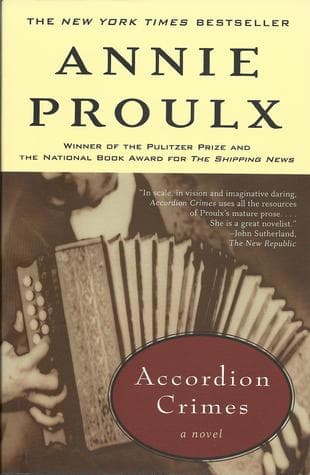
From the Louisiana bayou to the Alaskan wilderness, a single green accordion weeps and rejoices through a century of American immigrant struggles, linking the disparate lives and forgotten dreams of those who sought a new beginning.
The story begins in Sicily in 1890 with a deformed boy, whose clubfoot makes him an outsider. He is apprenticed to an accordion maker and proves to be a prodigy, creating a distinctive green accordion with a unique sound. As a young man, he falls in love with a woman betrothed to another. In a fit of jealous rage, he murders her betrothed during a festival. He flees Sicily with his beloved accordion, leaving his homeland and his past behind, bound for America to escape the consequences of his crime and seek a new life, carrying the instrument that will link many lives over the next century.
The green accordion eventually makes its way to New Orleans, a city with diverse immigrant communities. It comes into the possession of a Cajun musician, whose lively music reflects the city's unique cultural blend of French, African, and Caribbean influences. Through his ownership, the accordion is present at boisterous parties, street performances, and even clandestine gatherings. The musician, like many others, struggles with poverty, discrimination, and the constant threat of violence in the bustling, often lawless, port city. The accordion is a symbol of both joy and hardship, played to soothe sorrows and incite revelry.
After a series of transfers, the green accordion finds itself in the hands of a Tejano vaquero in the harsh, beautiful landscape of the Texas-Mexico borderlands. He plays traditional corridos and rancheras, his music echoing the struggles and resilience of the Mexican-American community. The accordion is a constant companion during cattle drives, community fiestas, and solitary nights under the vast desert sky. It witnesses the cultural clashes and economic hardships faced by those living on the border, caught between two worlds. The vaquero's music often expresses a deep nostalgia for a vanishing way of life and the injustices his people endure.
The accordion's journey continues north, arriving in the coal-mining towns of Pennsylvania. Here, it is owned by a Polish immigrant, a miner who toils in dangerous conditions underground. The accordion is a vital link to his homeland, played during community gatherings, weddings, and wakes, its polkas and mazurkas a balm against the harsh realities of his existence. It provides a sense of belonging and cultural continuity for the Polish community, struggling to adapt to a new country while enduring grueling labor and anti-immigrant sentiment. The music offers a brief escape from the ever-present threat of mine accidents and poverty.
The green accordion eventually makes its way into the remote logging camps of Maine, where it is played by a Franco-Canadian logger. His music, often plaintive and melancholic, reflects the isolation and danger of his work in the vast, unforgiving forests. The accordion is a source of entertainment and solace during long, cold nights, bringing the sounds of home to a transient, male-dominated world. It witnesses the camaraderie and rivalries among the loggers, as well as their struggles against harsh weather, dangerous machinery, and exploitative employers. The music is a cultural anchor in a physically demanding and culturally isolating environment.
Deep in the Appalachian Mountains, the green accordion comes into the possession of an Irish-Scots fiddler, who integrates its unique sound into traditional mountain folk music. The instrument becomes part of the community's musical heritage, played at square dances, church gatherings, and family reunions. It witnesses the deep-seated poverty, feuds, and fierce independence of the mountain people, many of whom are descendants of early European immigrants. The accordion's music, often mournful and resilient, reflects the enduring spirit of a people shaped by generations of hardship and a strong connection to their land and traditions.
The accordion travels south to the Mississippi Delta, where it is acquired by an African-American bluesman. He adapts its sound to the raw, expressive power of the blues, playing in juke joints, fields, and on street corners. The accordion is a voice for the suffering, resilience, and spiritual yearning of the Black community in the Jim Crow South. It witnesses racial injustice, economic exploitation, and the cultural expression that arose in response. The bluesman's music, infused with the accordion's unique timbre, tells stories of hardship, love, and the enduring human spirit.
As the Great Depression and the Dust Bowl grip the American heartland, the green accordion finds itself with a family of impoverished migrants heading west. It provides a fragile source of comfort and entertainment during their arduous journey across the parched plains, its music a reminder of the homes they were forced to abandon. The accordion is played around campfires, in Hoovervilles, and along dusty roads, offering a brief respite from the relentless struggle for survival. It witnesses the despair and resilience of those displaced by environmental catastrophe and economic collapse, clinging to hope and their cultural heritage.
The accordion eventually makes its way into urban centers and the burgeoning world of popular entertainment. It is acquired by a minstrel, who incorporates its sound into vaudeville acts and early forms of popular music. The instrument, once a symbol of specific immigrant cultures, begins to transcend its origins, adapting to new genres and appealing to a wider audience. It witnesses the changing landscape of American entertainment, the blending of diverse musical traditions, and the commercialization of art. The minstrel, often a figure of both entertainment and exploitation, uses the accordion to connect with and sometimes caricature various cultural groups.
As the decades pass, the green accordion continues its journey, passing through the hands of various owners, each adding a new layer to its history. It might be found in pawn shops, flea markets, or passed down through families. It witnesses the suburbanization of America, the rise of rock and roll, and the continued influx of new immigrant groups, each bringing their own musical traditions. The accordion, sometimes forgotten, sometimes cherished, maintains its unique identity. Its journey suggests a cyclical nature to the immigrant experience, with new waves of arrivals continually shaping and being shaped by the American landscape, much like the accordion absorbs and reflects new sounds and stories.
In a more contemporary setting, a young musician discovers the old green accordion in a dusty antique shop or a forgotten attic. Intrigued by its unique appearance and sound, they begin to play it, unknowingly tapping into a century of diverse musical traditions and human experiences. This new owner represents the continuation of the accordion's journey, suggesting that the stories and struggles of its previous owners are not lost but continue to resonate through its music. The accordion is a tangible link to the past, a silent chronicler of the American immigrant saga, its future unwritten but forever tied to its rich, complex history.
The First Owner/Protagonist of the opening scene
From a gifted but ostracized artisan, he becomes a desperate fugitive, forever marked by his crime and his creation.
The Owner/Supporting
He remains a vibrant cultural preserver, using music to navigate the complexities of immigrant life in New Orleans.
The Owner/Supporting
He uses his music to preserve cultural identity and express the quiet dignity of his people amidst changing times.
The Owner/Supporting
He endures hardship through the spiritual nourishment provided by his music and community.
The Owner/Supporting
He uses the accordion as a source of comfort and connection in a physically demanding and isolated life.
The Owner/Supporting
She helps to weave the accordion's sound into the rich tapestry of Appalachian folk music, preserving and evolving tradition.
The Owner/Supporting
He transforms the accordion into a powerful instrument of blues expression, giving voice to profound suffering and hope.
The Owners/Supporting
They carry the accordion as a symbol of enduring hope and cultural memory amidst profound displacement.
The Owner/Supporting
He adapts the accordion for mass entertainment, reflecting the evolving and sometimes problematic nature of popular culture.
The Central Object/Protagonist surrogate
From a newly crafted instrument, it becomes a living archive of American immigrant history, continuously absorbing and transmitting stories.
The novel is a sprawling exploration of the American immigrant experience, showing the diverse origins, struggles, and contributions of various ethnic groups. Each owner of the accordion represents a different wave or facet of immigration – from the desperate flight of the Sicilian accordion maker to the resilience of the Polish miner, the cultural preservation of the Tejano vaquero, and the spiritual expression of the African-American bluesman. The book highlights themes of displacement, cultural adaptation, discrimination, the search for belonging, and the enduring human spirit in a new land. The accordion itself acts as a constant, linking these disparate lives.
“The accordion, green as a frog, passed from hand to hand, a history of the nation in its bellows.”
Music is a vital force for cultural preservation and expression. For each owner, the green accordion is more than an instrument; it's a direct link to their homeland, their ancestors, and their community. It provides solace in hardship, joy in celebration, and a voice for stories that might otherwise be forgotten. The distinct musical traditions (Cajun, polka, corrido, blues, folk) played on the accordion show how immigrants maintain and adapt their cultural identities in a new country, creating a rich American music. It shows how art transcends language barriers and historical divides.
“The music was their last link with the past—voice for their fantasies, sorrows and exuberance.”
The novel repeatedly demonstrates the presence of violence, both personal and systemic, throughout American history, particularly as it impacts immigrant and marginalized communities. The opening crime in Sicily sets a precedent, and subsequent owners encounter violence stemming from racial prejudice, economic exploitation, and interpersonal conflict. However, juxtaposed against this violence is an unwavering human resilience. Characters endure harsh labor, displacement, and discrimination, finding strength and continuity through their communities and, through the music of the accordion. The instrument itself survives countless hardships, mirroring the resilience of its owners.
“The accordion, a thing of beauty, a thing of terrible history, continued its passage.”
Proulx vividly portrays the diverse American landscape, making it almost a character in itself. From the humid bayous of Louisiana to the arid plains of Texas, the coal country of Pennsylvania, the dense forests of Maine, and the dusty roads of the Great Plains, each setting profoundly shapes the lives and music of the accordion's owners. The novel emphasizes regional identities, dialects, and traditions, showing how different environments shape unique cultural expressions. The accordion's journey across these varied landscapes underscores the vastness and complexity of America, and how geography influences the immigrant experience.
“The land itself, in all its brutal beauty, seemed to absorb the music, give it back in altered form.”
Throughout the narrative, characters grapple with various forms of loss: loss of homeland, family, traditional ways of life, and innocence. The accordion often serves as a repository of these memories, both joyful and sorrowful. Each owner's story is tinged with what has been left behind or taken away. The instrument itself, as it passes from hand to hand, accumulates a collective memory, connecting disparate individuals through shared experiences of migration and adaptation. The novel suggests that while things are lost, memory, particularly through music, can preserve and transmit the past.
“Every note was a whisper of a forgotten home, a ghost of a dance.”
The green accordion serves as the sole narrative link between disparate stories and characters.
The green accordion is the primary plot device, acting as a silent protagonist and the central unifying element of the novel. It literally connects generations of diverse immigrant characters across a century of American history. Its physical journey dictates the narrative structure, allowing Proulx to shift settings, time periods, and ethnic groups seamlessly. The accordion isn't just an object; it's a repository of cultural memory, carrying the echoes of every song played on it and every life it has touched. It symbolizes the continuity of the immigrant experience and the enduring power of cultural heritage.
The narrative is composed of distinct, self-contained stories linked only by the accordion's ownership.
The novel employs an episodic or picaresque structure, where each major section focuses on a different owner of the green accordion. While there's a chronological progression, each episode functions almost as a short story, introducing new characters, settings, and conflicts. This structure allows Proulx to explore a vast array of immigrant experiences and regional cultures without being tied to a single character's arc. The accordion's journey provides the only consistent through-line, emphasizing the collective, rather than individual, immigrant narrative.
Subtle hints and recurring motifs subtly connect the seemingly disparate lives of the accordion's owners.
Proulx uses subtle foreshadowing and recurring motifs to create a sense of interconnectedness between the various episodes. While direct connections between characters are rare, certain themes, types of hardship, or even snippets of melodies might echo across different chapters. The initial act of violence and passion committed by the accordion's maker, for instance, subtly resonates through the struggles and sometimes violent ends of subsequent owners. These echoes reinforce the idea that the accordion carries a cumulative history, and that human experiences, though varied, share fundamental patterns of suffering, resilience, and hope.
The narrative style often mimics the storytelling of folk tales and oral histories.
The novel's prose often adopts a style reminiscent of folk tales and oral traditions, characterized by a certain timelessness, directness, and a focus on essential human experiences. Proulx uses rich, descriptive language, often employing regional dialects and vivid imagery that ground each story in its specific cultural context. This style enhances the sense that each episode is a fragment of a larger, collective history being passed down, much like a traditional song or story. The accordion itself, as a musical instrument, directly embodies this theme of oral and musical transmission of culture and memory.
“He bought a concertina from a German who had lost his fingers to a saw. The man was glad to sell it, said it had a whine to it that got on the nerves.”
— The protagonist's first acquisition of a squeezebox, setting him on his musical path.
“The accordion was a thing of the devil, for it made men dance and women sway, and brought out the worst in their natures.”
— A recurring sentiment from conservative characters regarding the accordion's perceived corrupting influence.
“He understood that he was a small thing, a speck, and that the world was vast and indifferent to his struggles.”
— A moment of existential reflection as the protagonist faces hardship and anonymity.
“Life was a series of small, brutal adjustments, and the trick was to keep moving, even if you didn't know where you were going.”
— A philosophical observation on resilience and adaptation in the face of relentless change.
“The music was a river, pulling him along, sometimes gentle, sometimes raging, always moving toward an unknown sea.”
— A metaphor describing the protagonist's deep connection to his music and its unpredictable journey.
“He played for the dead and the living, for the ghosts of what had been and the shadows of what might be.”
— Describing the profound emotional resonance of the protagonist's music, reaching across time and memory.
“The accordion was a portable home, a repository of memories, a voice for the voiceless.”
— Reflecting on the accordion's multifaceted significance to the protagonist and other immigrants.
“Every note was a drop of sweat, a tear, a laugh, a memory, squeezed out of the bellows and into the air.”
— Emphasizing the emotional labor and personal history embedded within the music.
“The world was a rough place, full of sharp edges and sudden drops, and you had to learn to dance around them.”
— A pragmatic view of survival and navigating life's inherent dangers.
“He learned that silence could be louder than any music, especially the silence that followed a song.”
— An observation on the power of absence and the lingering impact of musical performance.
“The accordion was his passport, his language, his only true friend in a world that spoke a thousand tongues.”
— Highlighting the accordion's role as a tool for communication and connection in an alien environment.
“It was a crime, he thought, to let such music die, to let the stories fade into the wind.”
— A lament for lost traditions and the importance of preserving cultural heritage.
“The past was a heavy cloak, and sometimes you just had to shrug it off and keep walking.”
— A reflection on the burden of history and the necessity of moving forward.
“He was a small ship on a vast ocean, and the accordion was his sail, catching every breath of wind, no matter how faint.”
— A metaphor for the protagonist's journey and how his music propels him through life.
Ready to see how well you understood this book? Take our interactive quiz with 10 questions.

Edna Ann Proulx is an American novelist, short story writer, and journalist. She has written most frequently as Annie Proulx but has also used the names E. Annie Proulx and E.A. Proulx.







