“Time is a thief, stealing moments when you're not looking.”
— Duncan reflects on the passage of time and missed opportunities.

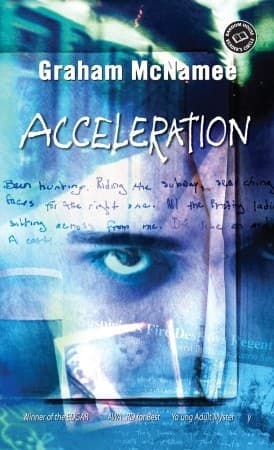
Graham McNamee (2003)
Genre
Thriller / Mystery / Young Adult
Reading Time
240 min
Key Themes
See below
Sign in to track this book
Trapped in the sweltering Lost and Found, a 17-year-old uncovers a serial killer's diary, plunging him into a desperate race against time to unmask the murderer stalking Toronto's subway before another victim falls.
Seventeen-year-old Duncan has a boring summer job at the Toronto Transit Commission's Lost and Found department, in the stuffy basement of the Bay Street subway station. His supervisor is Jacob, an old man who mostly ignores him. Duncan spends his days cataloging forgotten items, feeling disconnected. One hot afternoon, sorting through a box of personal items, he finds a small, leather-bound diary. Curious, he opens it and starts to read. The entries, by someone who calls himself 'The Roacher,' are not typical thoughts; they describe women, their routines, and disturbing plans, suggesting a predator in the subway system.
As Duncan reads more of the diary, his initial curiosity turns into a horrifying realization: 'The Roacher' is real, and his plans are not imaginary. The entries describe potential victims, their looks, habits, and the subway stations they use. The writer expresses a twisted sense of justice and a desire to 'cleanse' the city. Duncan recognizes place names and specific details, confirming that the events are happening in his city, possibly now. He feels a growing sense of dread and responsibility, knowing he has unique insight into a dangerous mind, but unsure what to do with this terrifying information.
Overwhelmed by the diary's contents, Duncan decides he must tell the authorities. He approaches a police officer he often sees at the subway station, trying to explain his discovery. However, the officer dismisses him, thinking Duncan is a bored teenager playing a prank or has found a made-up story. Without concrete evidence beyond the diary itself, and given how it was found in a Lost and Found, his story is not taken seriously. Frustrated and feeling alone, Duncan realizes he is on his own. The police's doubt only makes him more determined, but also makes him consider less conventional ways to act.
Realizing he cannot do this alone, Duncan tells his friend, Vinny. Vinny, at first doubtful and more interested in summer fun, slowly believes Duncan because of his seriousness and the disturbing details from the diary. Together, they start to analyze the Roacher's entries, looking for patterns, codes, and clues that might reveal the killer's identity or next target. Vinny, with his more practical and street-smart approach, helps Duncan think about the Roacher's methods and possible motives. Their teamwork marks a change from simply reading to actively investigating, driven by a shared sense of urgency.
With the diary, Duncan and Vinny start their own secret investigation. They use the Roacher's detailed descriptions of subway routes, times, and victim profiles to try to predict his movements. They watch stations mentioned in the diary, observing passengers and looking for anyone who matches the Roacher's descriptions or acts suspiciously. Their pursuit is full of tension and fear, as they realize they are putting themselves in danger. Each clue they decipher or observation they make in the subway system strengthens their belief that they are getting closer to a real and dangerous threat, and that time is running out for the Roacher's next potential victim.
During one of their stakeouts, Duncan and Vinny see a woman matching a description from the diary being followed by a suspicious man. They intervene subtly, trying to deter the man without showing what they are doing. This incident is a terrifying near-miss, confirming the diary's truth and the immediate danger to people in the city. This close encounter pushes their efforts, changing their investigation from curiosity to a desperate race against time. The stakes become very real, and their sense of responsibility grows heavier, making them take bigger risks in their pursuit of the Roacher.
As Duncan carefully re-reads the diary, comparing details with his own experiences, a pattern appears. He notices subtle references to the Lost and Found department, comments that only someone very familiar with the place would make. He remembers small, odd behaviors from his supervisor, Jacob. A chilling realization hits him: the Roacher is not a stranger but Jacob, the grumpy old man who works next to him every day. The diary was not lost but deliberately left, perhaps even for Duncan to find, by a killer who enjoys playing games and involving others in his twisted story. This discovery is a deep shock, turning his workplace into a terrifying trap.
With the horrifying truth, Duncan confronts Jacob in the Lost and Found. Jacob, instead of denying it, calmly admits to being the Roacher, giving a chillingly rationalized reason for his crimes – a desire to 'cleanse' society of those he deems unworthy. He explains that he left the diary for Duncan, finding amusement in the boy's amateur detective work. Jacob then springs his trap, locking Duncan in the secluded Lost and Found basement. He says he intends to make Duncan his next 'project,' turning the tables on the young investigator. The confined space, once a normal workplace, becomes a terrifying prison as Duncan realizes the full extent of Jacob's manipulation and depravity.
Trapped and scared, Duncan desperately looks for a way out of the Lost and Found. He uses his knowledge of the cluttered basement and the tools and objects around him to defend himself and try to escape from Jacob. The confrontation is tense and dangerous, with Jacob showing a chilling calm. Meanwhile, Vinny, worried about Duncan's long absence and the growing danger, puts clues together and realizes Duncan is in great danger at the Lost and Found. He rushes to the subway station, determined to help his friend, unaware of the full extent of the danger waiting for him.
Vinny arrives at the Lost and Found just as Duncan is struggling with Jacob. His timely arrival distracts Jacob, letting Duncan gain an advantage. A final, chaotic struggle happens in the cluttered basement, with both boys fighting for their lives against the killer. They manage to subdue Jacob, and the police, alerted by Vinny's earlier attempts or the commotion, arrive to arrest him. Afterward, Duncan is seen as a hero, but the experience leaves him deeply affected. He struggles to process the horror he has seen and the fact that evil can hide in plain sight, forever changing his view of safety and his city.
The Protagonist
From a disengaged teenager, Duncan transforms into a determined, courageous, and ultimately traumatized individual who confronts evil head-on.
The Supporting
Vinny evolves from a skeptical friend to a brave and essential partner in Duncan's dangerous quest.
The Antagonist
Jacob remains a static character, a fully formed antagonist whose evil is revealed rather than developed.
The Mentioned
Serves as a plot device to demonstrate the hurdles Duncan faces.
The Mentioned
Collectively, they symbolize the unsuspecting public.
The Mentioned
Their descriptions serve to drive the plot and heighten the stakes.
This theme explores how deep evil can exist in ordinary settings and in seemingly normal people. Jacob, the serial killer, is Duncan's supervisor in the unremarkable, dusty Lost and Found. He appears as a gruff, elderly man, making his true nature more horrifying. The setting, the forgotten basement of a subway station, supports this idea – evil hiding beneath the surface of everyday life. The diary entries further show this, detailing careful observations of ordinary people in their daily routines, turning the commonplace into something sinister. This theme suggests that monsters do not always look like monsters.
““The city hums, but underneath, there are always secrets. Always things lost, and things found. And sometimes, what you find is worse than anything you could imagine.””
Once Duncan finds the diary, he deals with the large moral burden of knowing about a serial killer's plans. Even though his first attempts to tell the police were dismissed, he feels a strong responsibility to act. This theme explores the inner conflict of an ordinary person put into an extraordinary situation, forced to decide how far they will go to prevent harm to others. Duncan's decision to actively pursue the killer, despite personal danger and lack of support, shows his growing sense of civic and moral duty, changing him from a passive observer to an active agent of justice.
““What would you do with a book like that? How far would you go to catch a madman?””
Duncan starts the story feeling alone and disconnected, bored with his summer job and without strong social ties besides Vinny. His discovery of the diary increases this isolation, as he struggles to convince adults and feels he must carry the burden alone. However, this isolation eventually leads him to confide in Vinny, strengthening their friendship and creating an important connection. The theme shows how extreme crises can either deepen one's feeling of being alone or create strong bonds, demonstrating the human need for connection when facing overwhelming threats. The subway system itself, a place of temporary, anonymous crowds, further emphasizes this duality.
““The city was full of people, a million stories brushing past each other, and no one knew the dark one he was holding in his hands.””
The book looks into the chillingly rational mind of a serial killer. Jacob's entries show not random acts of violence, but a methodical, almost philosophical approach to his crimes, driven by a desire to 'cleanse' society. This theme explores the cold, calculating nature of psychopathy and how a killer can appear normal. It challenges the simple view of evil, presenting it as something that can be carefully planned and justified by the person doing it, rather than just impulsive or chaotic. The diary is a window into this disturbed worldview, forcing Duncan and the reader to confront its unsettling logic.
““The Roacher saw himself as a gardener, pruning the weeds. And the weeds were everywhere.””
A leather-bound journal that serves as both a murder blueprint and a psychological portrait of the killer.
The diary is the central plot device, driving the entire narrative. It acts as the catalyst for Duncan's investigation, providing him with direct, unfiltered access to the killer's mind, plans, and observations. Its entries are not just clues; they are chilling insights into 'The Roacher's' twisted motivations and methods. The diary's discovery in the Lost and Found is ironic, as it's a 'lost' item that reveals a hidden, dark truth. It functions as a ticking clock, as Duncan must decipher its contents to prevent future crimes, and also serves as a direct form of communication between the killer and Duncan, making Duncan an unwilling participant in Jacob's game.
The literal and symbolic setting where forgotten items and hidden evils converge.
The Lost and Found department is more than just a setting; it's a symbolic space. Physically, it's a cluttered, forgotten basement beneath the bustling city, mirroring the hidden nature of the killer's crimes. Symbolically, it represents things overlooked, discarded, or forgotten by society – much like the victims Jacob preys upon. The irony of finding a serial killer's active diary among lost umbrellas and forgotten wallets underscores the theme of the banality of evil. It's a place where mundane objects hold hidden stories, and in Duncan's case, a horrifying secret, making it a crucial element in the book's atmosphere and plot.
The primary hunting ground for the killer and the backdrop for Duncan's investigation.
The Toronto subway system is integral to the plot, serving as both the killer's hunting ground and the primary stage for Duncan and Vinny's investigation. Its anonymity, constant flow of people, and predictable routes make it an ideal environment for 'The Roacher' to stalk his victims. For Duncan, the subway transforms from a mundane mode of transport into a place of intense observation and fear. The descriptions of specific stations, trains, and passenger types from the diary immerse the reader in this urban landscape, making the threat feel immediate and real. It symbolizes the hidden dangers within everyday urban life.
Jacob's deliberate act of leaving the diary for Duncan, turning the investigation into a personal challenge.
Jacob's decision to leave the diary where Duncan would find it transforms the situation from a simple crime into a psychological 'game' of cat and mouse. This device heightens the tension and makes the conflict deeply personal for Duncan. Jacob derives twisted pleasure from watching Duncan's attempts to decipher his clues, effectively inviting him into his world. This manipulation makes Duncan not just an investigator but also a target and a pawn in the killer's narrative. It reveals Jacob's profound psychopathy and his need for an audience, making the confrontation between them far more than just an arrest; it's the culmination of a deliberate intellectual and psychological duel.
“Time is a thief, stealing moments when you're not looking.”
— Duncan reflects on the passage of time and missed opportunities.
“Sometimes the quiet ones are the ones you have to watch out for.”
— Duncan observes a suspicious character at the subway station.
“Fear is a cage, and I've been living in it for too long.”
— Duncan confronts his own anxieties and fears.
“The past has a way of catching up with you, no matter how fast you run.”
— Duncan realizes he cannot escape his history.
“In the darkness, even the smallest light can guide you home.”
— Duncan finds hope in a difficult situation.
“Truth is a puzzle, and every piece matters.”
— Duncan pieces together clues about the diary.
“We all have secrets, but some are more dangerous than others.”
— Duncan discovers the dark nature of the diary's contents.
“The line between hero and villain is thinner than you think.”
— Duncan grapples with moral ambiguity in his investigation.
“Loneliness is a heavy burden, but it makes you stronger.”
— Duncan reflects on his isolated life and its impact.
“Every action has a reaction, and sometimes it's explosive.”
— Duncan faces the consequences of his decisions.
“The world is full of monsters, but the scariest ones are human.”
— Duncan realizes the true threat comes from people.
“Courage isn't the absence of fear, it's moving forward despite it.”
— Duncan finds the strength to confront the antagonist.
“Sometimes the only way out is through.”
— Duncan decides to face his problems head-on.
“The truth can set you free, but first it might destroy you.”
— Duncan uncovers a painful revelation.
Ready to see how well you understood this book? Take our interactive quiz with 10 questions.

Biography coming soon.







