“Grandma Dowdel wasn't one to let a little thing like the law stand in her way.”
— Mary Alice observes her grandmother's unconventional approach to rules.

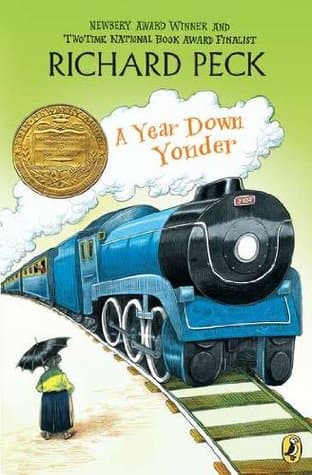
Richard Peck (2001)
Genre
Children's / Historical Fiction / Young Adult
Reading Time
180 min
Key Themes
See below
Sign in to track this book
Sent to live with her eccentric, shotgun-toting Grandma Dowdel in rural Illinois during the Great Depression, fifteen-year-old Mary Alice navigates a year of unexpected adventures, community antics, and self-discovery.
In the fall of 1937, Mary Alice Peed, a fifteen-year-old from Chicago, is sent by her parents to live with her Grandma Dowdel in a tiny, rural Illinois town for a year. The Great Depression has hit her father's business hard, and her parents believe she will be safer and better fed in the country. Mary Alice arrives expecting a quiet, dull existence, but is immediately confronted by Grandma Dowdel's unconventional and often shocking methods. Her grandmother, a large, imposing woman, rules her household and the town with an iron fist, a sharp wit, and a surprising sense of justice. Mary Alice quickly realizes that life with Grandma Dowdel will be anything but boring, as her grandmother's reputation for shaking things up precedes her.
Mary Alice's first major experience with Grandma Dowdel's unique approach to problem-solving occurs on Halloween. Grandma Dowdel, with Mary Alice reluctantly in tow, topples an outhouse onto the car of Royce McNabb, a local bully who had been harassing Mary Alice and other girls. This act of vigilantism is a display of power and a clear message to Mary Alice about her grandmother's protective nature. The incident solidifies Grandma Dowdel's reputation as someone not to be trifled with, and Mary Alice begins to see a method to her grandmother's ways, slowly adjusting to the rural life and her grandmother's eccentricities.
Christmas in the small town brings another of Grandma Dowdel's schemes. During the annual Christmas pageant, where Mary Alice is coerced into playing the Virgin Mary, Grandma Dowdel orchestrates a shotgun wedding. She forces the reluctant O.B. Dickey to marry his pregnant girlfriend, Mildred Burdick, right there on stage, in front of the entire congregation. Grandma Dowdel's actions, while scandalous and unorthodox, are driven by a desire to ensure the young couple does the right thing and to provide a stable future for the unborn child. Mary Alice is mortified but also witnesses her grandmother's deep sense of moral responsibility, even if her methods are extreme.
When the local bank announces it will be closing, potentially causing many townspeople to lose their savings, Grandma Dowdel acts. She had been holding the town's Halloween money—funds collected from the pranks—and rather than depositing it in the failing bank, she orchestrates a dramatic, public withdrawal of all her own money and then uses the Halloween funds to pay off everyone's outstanding debts at the general store. This shrewd move saves the town's money and shows her resourcefulness and her commitment to the community, showing Mary Alice that her grandmother is a protector and a provider, even in economic hardship.
In a display of compassion, Grandma Dowdel takes in Junior Stubbs, a neglected and often abused young boy from a struggling family. Junior is a scrawny, shy child who rarely speaks, but Grandma Dowdel provides him with food, shelter, and a sense of belonging that he has never known. Mary Alice, initially wary, observes her grandmother's quiet kindness towards Junior, teaching him to read and providing him with the stability he needs. This act of charity reveals a softer, more nurturing side to Grandma Dowdel, proving to Mary Alice that her grandmother's tough exterior often hides a caring heart, especially for those in need.
Mary Alice and Grandma Dowdel attend a Boy Scout camp where Junior Stubbs is a participant. To help Junior gain confidence and win the talent show, Grandma Dowdel devises a plan. She has Mary Alice teach Junior to play a simple tune on a saw, and then has him perform it dressed as a ghost, complete with a sheet and a hat. The performance is a success, winning Junior first prize and boosting his self-esteem. This event shows Grandma Dowdel's ingenuity and her dedication to helping those she cares about, as well as Mary Alice's growing involvement in her grandmother's schemes and her developing affection for Junior.
Mary Alice attends the high school homecoming dance, a social event in the small town. She goes with a local boy, and the experience provides her with a glimpse into the social dynamics of rural youth. While she still feels somewhat an outsider, she is beginning to integrate into the community. The dance is a typical teenage experience, but it's framed by her year in the country, showing her gradual adaptation to a life different from Chicago. This scene marks a point where Mary Alice is not just observing, but actively participating in the town's events, further solidifying her place, however temporary, in the community.
A severe flood strikes the region, isolating many homes. Grandma Dowdel, with Mary Alice's help, takes her boat out to rescue a family stranded in their home. The dangerous mission shows Grandma Dowdel's bravery, resilience, and commitment to her neighbors. Mary Alice, initially frightened, assists her grandmother, demonstrating her own growing courage and resourcefulness. This harrowing experience deepens Mary Alice's respect and admiration for her grandmother, as she witnesses firsthand Grandma Dowdel's selflessness and leadership in a crisis, cementing their bond in the face of adversity.
As the year draws to a close, Mary Alice's parents return to take her back to Chicago. The farewell is bittersweet. Mary Alice has transformed from a city girl who resented being sent away into a more resilient, observant young woman with an appreciation for her grandmother and the rural community. She has learned lessons about life, courage, and true character. While she is eager to return to her familiar life, she carries with her the mark of Grandma Dowdel's influence, knowing that her year down yonder has shaped her in lasting ways, making her a stronger, wiser individual.
The Protagonist
She evolves from a naive, self-absorbed city girl into a more resilient, compassionate, and independent young woman who appreciates the value of family and community.
The Supporting/Mentor
Her character remains largely consistent, serving as a catalyst for Mary Alice's growth, though her softer, more compassionate side is revealed through her actions.
The Supporting
He transforms from a neglected, timid boy into a more confident and engaged child thanks to Grandma Dowdel and Mary Alice's influence.
The Antagonist/Supporting
His character serves as a static antagonist, receiving a swift and effective punishment, and then largely fades from the active plot.
The Supporting
Her immediate future is secured by Grandma Dowdel's intervention, allowing her to marry O.B. Dickey.
The Supporting
Forcibly marries Mildred Burdick, accepting his responsibility under Grandma Dowdel's direct orders.
The Supporting
His decision to close the bank serves as a plot device for Grandma Dowdel's actions, and he remains a static character.
The Mentioned
They serve as the initial instigators of the plot, remaining static off-screen figures.
The novel charts Mary Alice's journey from a naive city girl to a more mature and resilient young woman. Her year with Grandma Dowdel forces her to confront harsh realities, adapt to a different lifestyle, and develop a stronger sense of self. She learns about independence, courage, and compassion through her grandmother's unconventional lessons. Events like the Halloween prank, the Christmas wedding, and the flood all contribute to her understanding of the world and her own capabilities, shaping her identity.
“A year down yonder. I was fifteen, and I’d never been anywhere. I’d never known anyone like Grandma Dowdel. I’d never been this far from home. And I’d never been so alive.”
Despite its small size, the town is a community where people rely on each other. Grandma Dowdel, through her often-unorthodox actions, acts as a protector and enforcer of community values, ensuring justice and support for her neighbors. Mary Alice, initially an outsider, gradually integrates into this community, participating in local events like the homecoming dance and witnessing the collective spirit during the flood. The novel explores the strengths of small-town life, where everyone knows everyone, and a strong sense of mutual responsibility exists.
“Grandma Dowdel wasn't just a part of the town. She was the town.”
Grandma Dowdel embodies a unique brand of wisdom and justice that often defies societal norms and legal procedures. Her methods, such as toppling an outhouse onto a bully's car, orchestrating a shotgun wedding, or outwitting the bank, are shocking but consistently aim to achieve a moral outcome or protect the vulnerable. She operates on her own code of ethics, showing that true justice isn't always found in rules and regulations, but in decisive, often dramatic, action driven by a strong moral compass. Mary Alice learns to appreciate this practical, often humorous, approach to problem-solving.
“There's right, and there's wrong. And then there's Grandma Dowdel.”
The story is set during the Great Depression, and the characters, particularly Grandma Dowdel, show resilience in the face of economic hardship. Mary Alice's parents send her away because of their own financial struggles, and the town itself faces challenges like the closing bank. Grandma Dowdel's resourcefulness, her ability to make do with little, and her community-mindedness in protecting the town's money and taking in Junior Stubbs, all show the adaptive strategies used by people during this difficult era. The narrative shows how people found ways to survive and even thrive.
“In a time when some folks barely had enough to eat, Grandma always had plenty. She just knew how to make things stretch, and how to get things done.”
The story is told by an older Mary Alice reflecting on her teenage year.
The entire novel is narrated by an older Mary Alice, looking back on her fifteenth year with Grandma Dowdel. This allows for a blend of youthful immediacy and mature reflection. The retrospective lens enables the narrator to provide insightful commentary on her past self's reactions and to highlight the lasting impact of her experiences. It also allows for humor and a deeper understanding of Grandma Dowdel's character, as the adult Mary Alice can appreciate the wisdom behind her grandmother's eccentricities more fully than her teenage self could at the time.
Her unconventional behavior drives much of the plot and character development.
Grandma Dowdel's unique and often shocking methods are not just character traits but a central plot device. Her eccentricity creates conflict, provides humor, and acts as a catalyst for Mary Alice's growth. Each of her major interventions—from the Halloween prank to the shotgun wedding and the bank rescue—propels the narrative forward and forces Mary Alice to reassess her understanding of right and wrong, justice, and effective problem-solving. Her unpredictable nature ensures that the plot remains dynamic and engaging, constantly challenging Mary Alice's expectations.
The small-town, rural Illinois setting during the Depression shapes the characters and events.
The setting of a small, isolated Illinois town during the Great Depression is more than just a backdrop; it is a crucial plot device. It provides the context for Mary Alice's displacement, the economic hardships faced by the characters, and the close-knit, self-reliant nature of the community. The 'yonder' signifies a world completely different from Mary Alice's urban upbringing, forcing her to adapt and learn new values. The specific challenges and opportunities presented by this rural environment, from floods to community gatherings, directly influence the plot's events and the characters' actions.
Food represents survival, comfort, and Grandma Dowdel's provision.
Throughout the novel, food serves as a powerful symbol, especially in the context of the Great Depression. Grandma Dowdel is consistently portrayed as an abundant provider, her house always filled with delicious, hearty meals, contrasting sharply with the scarcity faced by others. The descriptions of her cooking and the generous portions she offers symbolize comfort, security, and her ability to sustain and care for those under her roof. For Junior Stubbs, food represents basic survival and the first step towards a stable life. It underscores Grandma Dowdel's nurturing side and her practical approach to well-being.
“Grandma Dowdel wasn't one to let a little thing like the law stand in her way.”
— Mary Alice observes her grandmother's unconventional approach to rules.
“You can't get a cat to do anything it doesn't want to do.”
— Grandma Dowdel explains her philosophy on dealing with stubbornness.
“A body's got to look out for themselves in this world.”
— Grandma Dowdel advises Mary Alice on self-reliance.
“There's more than one way to skin a cat, and I know most of them.”
— Grandma Dowdel boasts about her resourcefulness.
“You can't judge a book by its cover, but you can by its first chapter.”
— Grandma Dowdel shares her take on first impressions.
“Sometimes you have to be a little bit bad to do a whole lot of good.”
— Grandma Dowdel justifies her mischievous actions.
“A quiet town is a town with nothing going on, and that's the worst kind.”
— Grandma Dowdel comments on small-town life.
“You don't need money to be rich. You just need a good story.”
— Grandma Dowdel values experiences over wealth.
“The past is always with us, whether we like it or not.”
— Reflection on how history shapes the present.
“A little mischief keeps the world turning.”
— Grandma Dowdel defends her playful antics.
“You can't change the wind, but you can adjust your sails.”
— Advice on adapting to circumstances.
“Home isn't a place, it's the people who make you feel like you belong.”
— Mary Alice realizes the meaning of home.
“Sometimes the best way to help someone is to let them help themselves.”
— Grandma Dowdel's approach to aiding others.
“Life is full of surprises, and most of them are good if you look at them right.”
— Optimistic view on unexpected events.
Ready to see how well you understood this book? Take our interactive quiz with 10 questions.

Biography coming soon.

Dan Gemeinhart
4.5

Kate O'Hearn
4.4

Jeanne Birdsall
4.4

Jen Wang
4.4

Wendelin Van Draanen
4.3

John Marsden
4.3

Chris Van Allsburg
4.3
Jennifer A. Nielsen
4.2