“A wolf does not beg. A wolf does not whine. A wolf does not wait for permission. A wolf takes what he needs.”
— Wander's internal thoughts on survival and independence.

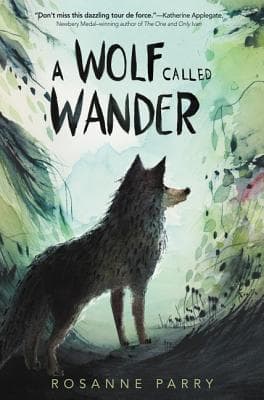
Rosanne Parry (2019)
Genre
Children's
Reading Time
240 min
Key Themes
See below
Sign in to track this book
Separated from his pack by a rival attack, a young wolf named Swift embarks on a thousand-mile journey across the Pacific Northwest to find a new home, mirroring the true story of OR-7.
Swift, a young wolf pup, lives with his pack in the mountains of Oregon, known as the OR-7 pack. He is part of a litter of five, including his brother Sharp and sisters Pounce, Wag, and Warm. Swift is the smallest, but quick and observant. He learns the pack's ways from his mother, father, and the other adults, including howls and scent marking. His first successful hunt for a deer with the pack is a moment, affirming his place and showing his growing skills. He feels a strong sense of belonging within the family unit, learning the hierarchy and the rules of survival in their territory.
One day, while Swift and his pack are hunting, they encounter a rival wolf pack, larger and more aggressive, encroaching on their territory. A fierce battle ensues. In the chaos, Swift's pack is overwhelmed and scattered. His father fights bravely, but the family is forced to flee in different directions. Swift, disoriented and terrified, loses sight of his mother, siblings, and the rest of his pack members. He is left alone, a young, inexperienced wolf separated from the only family he has ever known, with no clear direction or guidance.
After the attack, Swift is alone. He is consumed by hunger, a feeling he rarely experienced with his pack. He tries to hunt small prey like mice and voles, but his inexperience makes it difficult. He learns to rely on his senses, following scents and listening for sounds of potential food or danger. The loneliness is deep, and he often howls, hoping for a response from his lost family, but hears nothing but the echoes of the wilderness. This period is the beginning of his desperate search for sustenance and safety, forcing him to adapt to a solitary existence.
As Swift travels, his journey brings him closer to human settlements, a new and terrifying threat. He encounters paved roads, a bewildering and dangerous barrier where fast-moving vehicles pose a constant threat. He learns to cross them cautiously, usually at night. He also passes by farms and ranches, where he smells domestic animals but is wary of the humans and their dogs. These encounters reinforce the idea that human territory is dangerous and unpredictable, forcing him to be stealthy and avoid direct contact whenever possible, a shift from his wild mountain upbringing.
Swift's journey takes him through a dense forest that suddenly becomes engulfed in a wildfire. The air fills with smoke, and the heat is intense. Panicked animals flee in every direction, and Swift must use all his speed and instinct to escape the fire. He runs for his life, dodging falling trees and burning embers, driven by the urge to survive. The fire consumes vast stretches of the land, leaving behind a scorched environment. This event is a test of his resilience, forcing him to adapt to an altered land and find new sources of food and water amidst the devastation.
While struggling to hunt, Swift encounters a lone coyote. Initially, he views the coyote as a competitor, but observing it hunt smaller prey gives him new strategies. Later, he tracks a wounded doe, an opportunity. However, another, older wolf approaches, and Swift, remembering his pack's rules, defers to the elder. He watches the older wolf successfully take down the deer, and is allowed to share in the feast. This encounter teaches Swift about the etiquette of the wild, respect among predators, and offers a brief rest from his constant hunger.
Swift's journey continues to push his physical limits as he encounters major geographical barriers. He faces a wide, powerful river that he must swim across, a daunting task for a lone wolf. He also crosses several mountain ranges, enduring harsh weather conditions, including snow and bitter cold. These crossings show his endurance and determination. Each successful navigation of a natural obstacle builds his confidence and reinforces his growing self-reliance, proving his capability to survive in diverse and challenging environments far from his original home.
After months of solitary travel, Swift's keen sense of smell picks up a new, unfamiliar wolf scent – a female. This discovery excites him with a mix of caution and hope. He follows the scent, cautiously at first, knowing that not all encounters with other wolves are friendly. The possibility of finding a mate and establishing a new pack is a motivator, driving him forward with renewed purpose. This scent marks a turning point in his journey, shifting his focus from survival to the potential of a new beginning.
Swift tracks down the source of the scent: a lone female wolf. Their initial interaction is tense and cautious, as both are wary of newcomers. Swift uses the communication he learned as a pup – body language, whines, and tentative approaches – to signal his peaceful intentions. Slowly, a mutual curiosity and then a tentative trust begins to form between them. They share a hunt, and the success of hunting together reinforces their potential as a pair. This meeting is the culmination of Swift's long journey for companionship.
Swift and the female wolf, whom he comes to know through her scent and presence, establish a new territory in an unfamiliar but bountiful land. They mark their boundaries, hunt together, and begin to form the foundation of a new pack. Swift, having traveled over a thousand miles from his birth territory, embraces his new role as a leader and mate. He is no longer just Swift, the pup who was lost, but Wander, the wolf who journeyed far and found a new home and family. They howl together, a sound of belonging and new beginnings.
The Protagonist
Swift transforms from a dependent pup into an independent, strong, and wise wolf, ultimately establishing his own pack and finding his true identity as 'Wander'.
The Supporting
Remains a steadfast and strong leader, serving as a foundational memory and guide for Swift's journey.
The Supporting
Remains a nurturing and central figure in Swift's memories, symbolizing home and family.
The Supporting
Represents the initial challenges and dynamics within Swift's birth pack.
The Supporting
Represent the lost innocence and familial bonds of Swift's early life.
The Supporting
Becomes the catalyst for Swift establishing a new pack and finding his purpose.
The Mentioned
Serves as a temporary mentor figure, offering a lesson in deference and survival.
The Antagonist/Mentioned
Represent an external, omnipresent challenge and source of danger for Swift.
The core theme of the book is Swift's will to survive against odds. From the initial attack that scatters his pack, through hunger, forest fires, dangerous roads, and harsh weather, Swift continuously adapts and finds ways to endure. His journey of over a thousand miles is a sign of his resilience, driven by instinct and a desire to live and find a new home. This theme is in his persistent hunting, his cautious navigation of human territories, and his ability to overcome natural obstacles.
“He was a wolf. He was built for this. He would keep going.”
Swift's initial life is defined by his pack and the strong bonds of family. The loss of his pack leaves him with loneliness and a yearning for connection. His entire journey is a quest to find a new family and a place where he belongs. The memories of his parents' howls and the warmth of his siblings sustain him. The establishment of a new pack with the female wolf fulfills this need, showing that family, in its broadest sense, is essential for a wolf's well-being and purpose.
“A wolf without a pack was a shadow, a ghost.”
Initially known as Swift, a small pup within his family, his solitary journey forces him to forge a new identity. Stripped of his pack role, he must learn to rely solely on himself, making his own decisions and facing consequences. By the end of his journey, having traveled vast distances and overcome challenges, he earns his new name, Wander, signifying his transformation from a lost pup to a strong, independent wolf who found his own way. His journey is about discovering his inner strength as much as finding a new physical home.
“He was no longer Swift. He was Wander.”
The book portrays the beauty and harsh realities of the wilderness. It also shows the impact of human civilization. Swift constantly encounters roads, fences, and the scents of humans and their domestic animals, which are obstacles and threats to his survival. The story critiques habitat fragmentation and the challenges wildlife face in a world dominated by humans, emphasizing the need for wild spaces and respect for nature's inhabitants.
“The human world was a maze of hard paths and loud monsters.”
Swift's survival relies on his wolf instincts – his keen sense of smell, hearing, and sight, as well as his hunting prowess. Beyond instinct, he learns wisdom from observing other animals and from his own experiences, such as how to cross a river or avoid human dangers. The book celebrates the inherent knowledge in wild creatures and the lessons taught by the natural world itself, showing how animals navigate and understand their environment efficiently.
“His nose knew more than his eyes, and his ears more than his nose.”
Giving human-like thoughts and emotions to a wolf, while maintaining animalistic realism.
The author employs a limited form of anthropomorphism, allowing readers to access Swift's internal thoughts, feelings, and motivations (like loneliness, hope, fear, determination). This helps create empathy and connection with the wolf without fully humanizing his actions or behaviors, which remain true to wolf biology and ecology. For example, Swift experiences 'sadness' at the loss of his pack, but his responses are always animalistic: howling, searching by scent, and driven by primal needs.
The central narrative structure of a character's physical and spiritual quest.
Swift's entire story is structured as a classic journey motif. He begins in a familiar home, is cast out, faces numerous trials and tribulations across a vast landscape, and ultimately finds a new home and a transformed self. This device allows for episodic adventures, character development through challenges, and a clear progression of the plot. The journey is not just physical but also a metaphorical quest for identity and belonging.
Extensive use of descriptions appealing to senses, particularly smell and sound.
The narrative frequently uses vivid sensory details, especially focusing on Swift's heightened senses of smell and hearing, crucial for a wolf. This immerses the reader in Swift's perspective, allowing them to experience the world as a wolf would. Descriptions of 'the sharp tang of pine,' 'the metallic scent of human,' or 'the whisper of deer hooves' are prevalent, making the wilderness and its dangers palpable and immediate.
The howl represents communication, family, loneliness, and belonging.
The wolf's howl is a powerful symbol throughout the book. Initially, it represents the unity and communication of Swift's pack. When Swift is alone, his unanswered howls symbolize his profound loneliness and desperate longing for his lost family. Towards the end, when he howls with the female wolf, it symbolizes the establishment of a new bond, a new pack, and the joy of belonging, bringing his journey full circle.
“A wolf does not beg. A wolf does not whine. A wolf does not wait for permission. A wolf takes what he needs.”
— Wander's internal thoughts on survival and independence.
“Home is not a place. It is a pack.”
— Wander reflecting on the loss of his family and the meaning of home.
“The moon is my compass, the stars my map.”
— Wander navigating the wilderness alone after being separated from his pack.
“Fear is a scent that every predator knows.”
— Wander observing prey and the instincts of the wild.
“A lone wolf is a dead wolf. But I am not dead yet.”
— Wander's determination to survive despite being alone.
“The wind tells stories if you know how to listen.”
— Wander using his senses to understand his environment.
“Every step is a choice: to live or to die.”
— Wander's realization about the constant decisions in survival.
“My howl is not a cry for help. It is a promise that I am still here.”
— Warden howling to assert his presence in the wilderness.
“The river does not ask for permission to flow. It just moves.”
— Wander observing nature and drawing parallels to his own journey.
“Hunger is a teacher. It teaches you what you are made of.”
— Wander enduring starvation and learning about his own strength.
“I am not lost. I am exploring.”
— Wander reframing his solitary journey in a positive light.
“The pack is not just family. It is strength, it is safety, it is song.”
— Wander reminiscing about the importance of his pack.
“Courage is not the absence of fear. It is moving forward in spite of it.”
— Warden facing dangers in the wild, such as predators and harsh conditions.
“The land remembers. It remembers the tread of paws, the fall of rain, the passage of time.”
— Wander reflecting on the history and memory of the wilderness.
Ready to see how well you understood this book? Take our interactive quiz with 10 questions.

Dan Gemeinhart
4.5

Kate O'Hearn
4.4

Jeanne Birdsall
4.4

Jen Wang
4.4

Wendelin Van Draanen
4.3

John Marsden
4.3

Chris Van Allsburg
4.3

Jennifer A. Nielsen
4.2