“A person can't be a good citizen if they don't know how to take care of themselves.”
— Mr. Maxwell explaining his philosophy on self-reliance to his students.

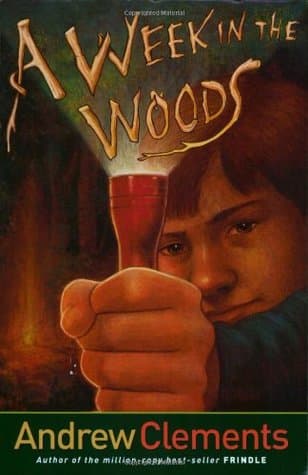
Andrew Clements (2002)
Genre
Children's / Young Adult
Reading Time
240 min
Key Themes
See below
Sign in to track this book
During an annual school camping trip, a privileged fifth-grader and his cynical teacher, who dislike each other, must work together to survive after a reckless act leaves them lost in the wilderness.
Mark Chelmsley IV arrives at Hardy Elementary as a new fifth-grader, having recently moved from a private school. He quickly gets a reputation for being smart but also bored, distant, and a bit lazy, often finishing work fast and then reading his own book. His teacher, Mr. Maxwell, a dedicated educator who loves nature, immediately dislikes Mark. He sees Mark as another privileged, unmotivated child who does not appreciate his chances. Mr. Maxwell's first thought is that Mark is a 'snooty' rich kid, which causes immediate tension and dislike between them, setting up their future conflict.
Mr. Maxwell, with enthusiasm, announces the 'Week in the Woods,' an annual five-day camping and learning trip for fifth graders. He explains that it is a chance to experience nature, learn survival skills, and connect with the environment. For Mr. Maxwell, this trip is the best part of the school year and a personal tradition, showing his love for the outdoors. He talks about teamwork, respecting nature, and self-reliance, warning students it will be hard but good. Mark, at first not interested, sees the trip as just another school activity, but a small interest starts because it is an escape from the classroom and a chance to prove himself, even subtly, to Mr. Maxwell.
During lessons before the Week in the Woods, Mark sometimes shows surprising knowledge about plants and animals, often correcting Mr. Maxwell or adding details from his reading. However, Mr. Maxwell is not impressed. He sees these contributions as Mark showing off or trying to challenge his authority. He dismisses Mark's ideas, thinking they come from memorization rather than real understanding. This constant dismissal of Mark's intelligence makes Mark more resentful and strengthens Mr. Maxwell's negative opinion of him. The teacher's prejudice stops him from seeing Mark's true abilities or unique perspective, creating a barrier between them.
The 'Week in the Woods' starts. At the campsite, Mr. Maxwell sets strict rules for safety, saying it is important to stay with the group and never go off alone. Mark, feeling restricted by the rules and Mr. Maxwell watching him, decides to explore a nearby stream alone while others set up camp. He thinks he is being careful and his knowledge of nature will keep him safe. However, Mr. Maxwell sees him. When he finds Mark has disobeyed, Mr. Maxwell gets angry. This act confirms Mr. Maxwell's worst thoughts about Mark, leading to a public argument where the teacher scolds Mark harshly, further embarrassing him.
After the public scolding, Mr. Maxwell talks to Mark privately, but just as intensely. He expresses his disappointment and frustration with Mark's behavior, repeating his belief that Mark is a spoiled, irresponsible child. Mark, feeling unfairly targeted and humiliated, reaches his limit. In anger and wanting to escape his teacher's gaze, Mark runs from the campsite, deep into the woods, ignoring calls to stop. Mr. Maxwell, realizing Mark is in danger and feeling responsible, immediately goes after him, determined to bring him back before he gets seriously lost or hurt.
Mark, running on adrenaline and anger, goes for a long time, eventually getting lost as the forest gets thicker and harder to move through. He knows he is lost but is too proud to admit it or turn back. Meanwhile, Mr. Maxwell, following Mark's tracks, also loses his way while trying to catch up. As evening comes, the woods get darker and colder, and the reality of their situation becomes clear to both of them. Mark, alone and vulnerable, starts to feel afraid, while Mr. Maxwell, despite his frustration with Mark, worries for the boy's safety and realizes they are both in a dangerous situation, far from camp.
As darkness falls completely, Mark, cold and scared, finds Mr. Maxwell, who has been looking for him. The first meeting is tense, with lingering anger and mistrust. However, the immediate need to survive outweighs their personal dislike. Mr. Maxwell, using his outdoor knowledge, quickly takes charge, telling Mark how to build a basic shelter and start a fire. Mark, though still resentful, sees Mr. Maxwell's skill and follows his instructions. They spend a cold, uncomfortable night in the makeshift shelter, the shared difficulty forcing them to depend on each other and slowly start to connect, focusing on tasks rather than their conflict.
The next day brings new problems, including hunger and a coming storm. Mr. Maxwell teaches Mark how to find edible plants and water, while Mark, using his observation skills, helps spot animal trails and possible dangers. As they move through the wilderness together, their talks slowly change from accusations to practical discussions about survival. Mark shares some of his knowledge, which Mr. Maxwell, now seeing Mark's insights differently, starts to appreciate. The shared struggle against nature's harshness makes them look past their initial ideas and see each other's strengths, building a respect that slowly becomes mutual understanding.
After another night in the woods, a search party from the camp, led by other teachers and rangers, finds Mark and Mr. Maxwell. Both are tired but safe. Back at the main camp, they are met with relief. The experience has changed both of them. Mr. Maxwell, seeing Mark's endurance and intelligence in a real crisis, realizes his first judgment was wrong. Mark, seeing Mr. Maxwell's courage and dedication, gains a new appreciation for his teacher. The dislike that defined their relationship is replaced by a quiet understanding and respect from their shared time in the wilderness.
After the 'Week in the Woods,' Mark and Mr. Maxwell return to Hardy Elementary. Their relationship is clearly different. The tension is gone, replaced by quiet respect. Mr. Maxwell no longer sees Mark as just a 'snooty' rich kid, but as a capable, smart, and resourceful young man. Mark, in turn, sees Mr. Maxwell not just as a strict teacher, but as a dedicated, passionate, and brave person. While their personalities are still distinct, they have found common ground. Mark starts to engage more genuinely in class, and Mr. Maxwell supports his independent learning. The incident in the woods becomes a turning point, creating an unexpected bond between student and teacher that goes beyond their initial conflict and assumptions.
The Protagonist
Mark transforms from a defiant, misunderstood boy into a more self-aware and respected individual, learning to trust and appreciate others while gaining confidence in his own abilities.
The Protagonist/Antagonist
Mr. Maxwell learns to overcome his prejudices and see beyond surface appearances, realizing his own fallibility and growing in empathy and understanding towards his students.
The Supporting
Her character remains largely consistent, serving as a stable, supportive presence.
The Mentioned
Not applicable, as he is not present in the main narrative.
The Mentioned
Not applicable, as she is not present in the main narrative.
The Supporting
Not applicable, as they are a collective group.
The novel explores how initial ideas can prevent people from seeing the truth. Mr. Maxwell first judges Mark based on his wealth, assuming he is spoiled and unmotivated. He dismisses Mark's intelligence and interest in nature, thinking it is arrogance or memorization. Mark also sees Mr. Maxwell as a rigid, unfair teacher. Their shared experience in the woods makes them drop these ideas, showing each other's true character and abilities. This shows that real understanding means looking past appearances and assumptions.
““Mr. Maxwell had made up his mind about Mark Chelmsley on the first day of school, and he hadn't changed it since.””
The 'Week in the Woods' and getting lost are central to this theme. The realities of nature — cold, hunger, being lost, and needing shelter — remove social norms and force Mark and Mr. Maxwell to face their need to survive. Nature is a neutral, demanding teacher, requiring cooperation and practical skills. Through their shared struggle against the elements, their true characters appear, and they learn to rely on each other. This shows nature's power to humble and change people.
““The woods didn’t care who you were or what your father did for a living. The woods just were.””
Both Mark and Mr. Maxwell learn about themselves. Mark, weighed down by his parents' expectations and Mr. Maxwell's labels, struggles to show his true self. Getting lost in the woods lets him show his resourcefulness, intelligence, and endurance, proving to himself and his teacher that he is more than a 'rich kid.' Mr. Maxwell, in turn, must confront his own biases and realize his judgment of Mark was flawed, leading to a deeper understanding of himself as an educator. The experience helps both characters see themselves and each other more clearly.
““He had spent his whole life trying to be what other people wanted him to be, or what they thought he was. Now, out here, he was just Mark.””
Poor communication and understanding cause the conflict between Mark and Mr. Maxwell. Mark's attempts to share knowledge are seen as showing off, and Mr. Maxwell's concerns are seen as unfair criticism. They do not connect, unable to overcome their initial ideas. Only when forced into a dangerous situation, where clear communication is needed for survival, do they start to truly listen to and understand each other, leading to a change in their relationship and a lesson in empathy.
““It was amazing how much more clearly you could hear someone when your life depended on it.””
The central setting and catalyst for conflict and resolution.
The annual 'Week in the Woods' program is not just a school trip; it's the primary plot device that drives the entire narrative. It serves as the unique environment where the conflict between Mark and Mr. Maxwell can escalate and, ultimately, be resolved. By taking the characters out of the structured classroom and into the unpredictable wilderness, the program strips away their usual roles and forces them to confront each other and themselves in a raw, authentic way. It provides the perfect backdrop for survival, self-discovery, and the breaking down of prejudices, making it indispensable to the story's development.
The natural environment that strips away social hierarchies and forces genuine interaction.
The deep woods act as a powerful neutralizer, stripping away the social constructs and hierarchies that define Mark and Mr. Maxwell's relationship in the school setting. In the wilderness, wealth, social status, and teacher-student roles become irrelevant; only practical skills, cooperation, and resilience matter. This device forces both characters to rely on each other as equals in the face of danger, allowing them to see beyond their prejudices and appreciate each other's inherent worth and capabilities, something that would have been impossible in their usual environment. It's the crucible in which their characters are forged anew.
Early classroom clashes hint at the deeper conflict to come.
Clements uses the early classroom interactions between Mark and Mr. Maxwell as a form of foreshadowing. Mark's initial boredom, his quick completion of assignments, his occasional corrections of Mr. Maxwell, and Mr. Maxwell's immediate negative judgment all build the tension and hint at the deeper conflict and misunderstanding that will later explode in the woods. These seemingly minor incidents establish their antagonistic dynamic and make their later, more dramatic confrontation and subsequent reconciliation feel earned and believable, as the groundwork for their opposing personalities has been carefully laid.
The narrative subtly shifts to reveal the internal thoughts and motivations of both Mark and Mr. Maxwell.
While not explicitly switching first-person narrators, the story often delves into the internal thoughts and feelings of both Mark and Mr. Maxwell. This device allows the reader to understand their individual motivations, frustrations, and prejudices from both sides. We see Mark's resentment at being misunderstood and Mr. Maxwell's genuine, if misguided, concern and frustration. This dual perspective is crucial for building empathy for both characters and for demonstrating how their individual biases contribute to their conflict, ultimately making their journey towards mutual understanding more impactful.
“A person can't be a good citizen if they don't know how to take care of themselves.”
— Mr. Maxwell explaining his philosophy on self-reliance to his students.
“Sometimes the hardest part of an adventure is just getting started.”
— Mark reflecting on his initial reluctance to join the camping trip.
“Nature doesn't care about your plans. It just is.”
— Mr. Maxwell teaching the class about respecting the wilderness.
“You can learn more from a week in the woods than from a month in a classroom.”
— Mr. Maxwell justifying the educational value of the outdoor trip.
“Being prepared isn't just about having the right gear; it's about having the right attitude.”
— Mark realizing the importance of mindset during the trip.
“In the woods, every decision matters. There's no undo button.”
— A lesson learned after a minor mishap during the camping trip.
“Friendship isn't about being the same; it's about standing together when things get tough.”
— Mark and another student bonding over shared challenges.
“The quiet of the woods can be the loudest teacher of all.”
— A moment of reflection during a silent hike.
“You don't have to love the woods to learn from them.”
— Mr. Maxwell encouraging a reluctant student to participate.
“Sometimes getting lost is the best way to find yourself.”
— Mark's personal realization after a disorienting experience.
“Respect for nature starts with respect for each other.”
— A group discussion about teamwork and environmental care.
“The woods don't judge you. They just show you who you are.”
— A reflective thought during a solo activity.
“Adventure is what happens when plans fall apart.”
— Dealing with an unexpected change in the camping schedule.
“Learning to listen is more important than learning to speak.”
— Mr. Maxwell teaching a lesson on observation and patience.
Ready to see how well you understood this book? Take our interactive quiz with 10 questions.

Andrew Clements was a prolific author of children's literature, celebrated for his engaging and relatable stories. His notable works include the beloved "Frindle," "A Week in the Woods," and the "Jake Drake" series, which often explored themes of school, friendship, and growing up. Clements' accessible writing style and keen understanding of young readers earned him widespread critical acclaim and a dedicated fanbase.

Dan Gemeinhart
4.5

Kate O'Hearn
4.4

Jeanne Birdsall
4.4

Jen Wang
4.4

Wendelin Van Draanen
4.3

John Marsden
4.3

Chris Van Allsburg
4.3

Jennifer A. Nielsen
4.2