“Oh, God, I'm going to live, I'm going to live, I'm going to live!”
— Francie's internal thought as she feels the joy and promise of life despite her hardships.

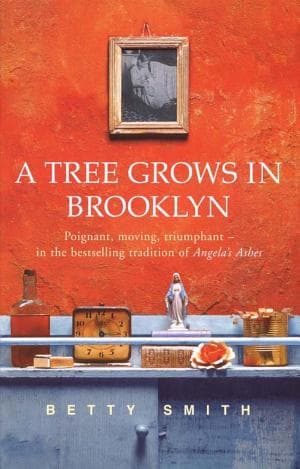
Betty Smith (1992)
Genre
Historical Fiction / Young Adult
Reading Time
10-12 hours
Key Themes
See below
Sign in to track this book
In turn-of-the-century Brooklyn, a determined young girl with an unwavering spirit grows up amidst poverty, her dreams as strong as the tree pushing through concrete.
The story begins with ten-year-old Francie Nolan and her younger brother, Neeley, collecting junk to sell for pennies. They live in a tenement in Williamsburg, Brooklyn, with their parents, Katie and Johnny Nolan. Francie loves her weekly trips to the library, where she reads every book from A to Z, developing a deep love for literature. Their mother, Katie, is practical and hardworking, always trying to provide for her children, often at great personal cost. Their father, Johnny, is a charming but alcoholic singing waiter who struggles to keep a job, causing financial trouble and stress for the family, especially Katie. Despite being poor, Francie finds beauty in everyday life, observing the world with a sharp, imaginative eye.
The Nolan family's Christmas Eve traditions show their poverty but strong family bonds. Johnny, despite his drinking, brings home a small, imperfect Christmas tree. Francie and Neeley are sent to buy stale bread and penny candy, seeing the reality of their financial situation. A scene shows neighborhood children gathering, hoping for a free tree after the Christmas tree seller gives up for the night. The seller, a gruff but kind man, throws the trees at the children, making them fight for them. Francie, though scared, endures this humiliation to get a tree for her family. This event highlights the family's strength and Francie's growing awareness of the world's unfairness, while also showing the simple joys they find despite hardship.
Katie Nolan's character develops further, showing her great strength and practicality. She makes many sacrifices for her children, saving every penny for their education. She cleans the tenement building carefully, putting up with the disdain of wealthier tenants, all to secure a better future for Francie and Neeley. Her resourcefulness shows in how she manages the small household budget, often going without herself. Katie also teaches Francie the importance of education and self-reliance, wanting her children to have chances she never had. She is a strict but loving mother, often seeming stern, but her actions always come from a deep wish to protect her family. Her determination inspires Francie but also puts pressure on her.
Johnny Nolan's fight with alcoholism gets worse, making him unable to keep steady work and causing him to pull away from family duties. Despite his charm and deep love for his children, his addiction takes over. He tries various jobs, often failing because of his drinking, which causes great stress and disappointment for Katie. Francie, though she loves her father, sees his decline and the pain it causes her mother. Eventually, Johnny dies from pneumonia, made worse by his alcoholism. His death is a great loss for the family, especially for Francie, who valued his dreams and his ability to see beauty in the world, even as it leaves Katie to carry the family's burdens alone.
After Johnny's death, the Nolan family faces even greater financial trouble. Katie takes on more work, cleaning and sewing, to support her children. Francie and Neeley also help by working after school, selling junk and doing odd jobs. Francie takes a job in a flower factory, experiencing the harsh realities of child labor. The family moves to a smaller, cheaper apartment, showing their difficult circumstances. Despite the grief and increased struggles, the family remains strong. Katie's resolve to provide for her children remains firm, and Francie, though sad about her father's absence, continues her pursuit of knowledge and her observations of the world, growing up quickly under new responsibilities.
Francie's experiences in public school are detailed, showing her intelligence and her awareness of social inequalities. She struggles with the impersonal nature of crowded public schools but finds comfort in writing and reading. She often feels misunderstood by her teachers, who sometimes favor her brother Neeley or do not see her unique perspective. Francie eventually decides to transfer to a different school, hoping for a better learning environment. Her love for books and her wish to become a writer grow stronger, becoming a main goal in her life. Despite the family's poverty, Francie is determined to get an education, even if it means working extra jobs to afford school supplies or tuition for higher education, showing her strong ambition.
Aunt Sissy, Katie's older sister, is a lively and unconventional character who contrasts with Katie's practicality. Sissy is known for her many marriages (though she always introduces her current partner as 'her husband'), her generosity, and her deep affection for Francie. She is a kind and loving figure who offers Francie unconditional love and a sense of freedom that Francie often lacks at home. Sissy's stories and her way of life, though sometimes scandalous, teach Francie about compassion, acceptance, and living life on her own terms. She often gives Francie small gifts and comforts her, acting as a needed emotional support and a source of joy amidst the family's struggles.
As Francie enters her teenage years, she experiences her first romantic interest in a young soldier named Lee Rhynor. She is charmed by him and the attention he gives her, imagining a future together. They spend time together, and Francie falls in love. However, Lee is soon deployed to fight in World War I. Before he leaves, he tells Francie that he has a fiancée back home and that his feelings for Francie were just a brief wartime romance. This news breaks Francie's heart, leaving her sad and disappointed. This experience is a significant coming-of-age moment for Francie, teaching her about love's complexities and pain, and adding to her growing understanding of the world's harsh realities.
Despite the heartbreak and the family's ongoing financial struggles, Francie remains determined to pursue higher education. She works hard, saving money and studying diligently. She eventually takes the entrance exams for the University of Michigan, a major achievement for a girl from her background. Her acceptance shows her intelligence, perseverance, and her mother's sacrifices. This marks a turning point for Francie, symbolizing her potential escape from the cycle of poverty that has defined her family for generations. The idea of college fills her with hope and excitement, representing a future with learning and opportunities that were once unimaginable, though she feels a bittersweet sadness about leaving her familiar Brooklyn behind.
After years of being a widow and facing hardship, Katie Nolan finds love and stability with Sergeant McShane, a kind and reliable police officer. McShane is a good, steady man who provides the financial security and emotional support that Katie and her children have long needed. Their marriage brings peace and normalcy to the family. They move into a more comfortable home, a sharp contrast to their previous tenement life. This new chapter means a significant improvement in the family's fortunes. While Francie is happy for her mother, she also feels a sense of detachment, knowing that her own path is now separate, leading her towards an independent future away from the familiar struggles of her childhood. The family's journey from extreme poverty to relative comfort is complete.
As Francie prepares to leave for college, she takes a final walk through her old neighborhood in Williamsburg, Brooklyn. She revisits familiar places, thinking about her childhood, her family's struggles, and the people who shaped her. She sees a young girl, much like herself, collecting junk, a reminder of her own past. Francie feels a mix of sadness and hope, acknowledging the bittersweet nature of leaving her roots behind. She realizes that while she is moving on to a different life, the experiences and lessons learned in Brooklyn will always be a part of her. She carries with her her mother's strength, her father's dreams, and her neighborhood's spirit, ready for her future's challenges and opportunities, symbolizing her successful coming-of-age.
The Protagonist
Francie transforms from a naive child into a mature, educated young woman, finding her voice and forging her own path while never forgetting her roots.
The Supporting
Katie evolves from a young wife struggling with her husband's alcoholism to a resilient widow who finds stability and a second chance at happiness.
The Supporting
Johnny's arc is tragic, as his alcoholism leads to his decline and premature death, leaving his family to cope with the aftermath.
The Supporting
Neeley grows into a responsible young man, embodying the stability and practical success his mother desired for her children.
The Supporting
Sissy remains a steadfast source of unconventional wisdom and unconditional love for Francie, providing a contrast to Katie's pragmatism.
The Supporting
McShane brings stability and security to Katie and her children, acting as a catalyst for their improved living conditions.
The Supporting
Miss Tynmore remains a quiet symbol of artistic aspiration and the enduring power of music, even amidst hardship.
The Mentioned
Mr. Jenson remains a static symbol of the daily grind and the necessity of resourcefulness in Francie's impoverished childhood.
Education, especially through books, is Francie's main escape from poverty and a path to a better future. Her weekly trips to the library are important, offering her comfort, knowledge, and a look into worlds beyond Williamsburg. Books spark her imagination, teach her about life, and inspire her to become a writer. Katie, though she cannot read, strongly supports education for her children, making great sacrifices to ensure they attend school. This theme appears when Francie transfers schools to find a better learning environment and ultimately works to put herself through college, seeing it as her only true way to improve her life and find self-fulfillment.
“From that time on, the world was hers for the reading. She would never be lonely again.”
The Nolan family, especially Katie and Francie, shows great strength when facing extreme poverty. They constantly find ways to survive, whether selling junk, making do with stale bread, or Katie's constant work cleaning tenements. Despite constant hunger, poor housing, and the emotional toll of Johnny's alcoholism, they never completely lose hope. Francie's ability to find beauty in her surroundings, even a small Christmas tree, shows this strength. The family's enduring spirit is a central message, showing how people can adapt and keep going even in the hardest situations, always hoping for a better tomorrow.
“Each day was a survival. But Katie Nolan, she was a survivor.”
The novel looks at how hard it is for immigrant and working-class families to achieve the American Dream in early 20th-century America. The Nolans, Irish immigrants, struggle to move up in society. While Johnny has grand dreams, it is Katie's practical, constant efforts and Francie's dedication to education that slowly break the cycle of poverty. Francie's journey from a tenement child to a college-bound young woman symbolizes the difficult possibility of achieving the American Dream through hard work. The difference between Francie's goals and her environment's limits highlights the big challenges poor people face in seeking a better life.
“She wanted to be a writer. She wanted to be able to tell the truth. And she wanted to write a book about Brooklyn.”
The novel shows family love as a strong, but often complicated and painful, force. Katie's love for her children drives her many sacrifices, but her quiet nature sometimes creates distance. Francie's deep love for her charming but flawed father, Johnny, exists alongside the pain and disappointment his alcoholism causes. The relationship between Francie and Neeley involves both affection and rivalry. Aunt Sissy's unconventional love gives Francie warmth and acceptance. The family's love is not always shown openly or perfectly, but it is the bond that holds them together through great hardship and provides the emotional base for Francie's growth. It shows how love can last and appear in many forms, even during struggle.
“It was a good thing to be a Nolan. It was a good thing to be a Rommely.”
Francie's story is a classic coming-of-age tale, tracing her growth from a naive child to a thoughtful young woman. She tries to understand her place in the world, her family's struggles, and her own goals. Her experiences with poverty, her father's death, her first heartbreak, and her pursuit of education all help her develop her identity. She learns to deal with social injustices, to find her voice through writing, and to balance her love for her Brooklyn roots with her desire for a different future. By the end, Francie has a strong sense of self, shaped by her unique experiences, ready to start an independent life, yet always marked by the tree that grew in Brooklyn.
“She was an individual, and she had to live her life her own way.”
The ailanthus tree symbolizes resilience, growth, and the enduring spirit of life in harsh conditions.
The 'tree of heaven,' or ailanthus, that grows in the impoverished Brooklyn neighborhood is a central symbol. It thrives in concrete, pushing through cracks and surviving in conditions where other plants would perish. This tree mirrors Francie Nolan's own journey: growing up in a harsh, unforgiving environment, yet managing to flourish, learn, and aspire to something greater. It represents resilience, the enduring nature of life, and the ability to find beauty and strength even in the most difficult circumstances. The tree is a constant, silent witness to Francie's life, reflecting her own quiet strength and perseverance.
The story is told primarily through Francie Nolan's perspective, offering intimate insight into her thoughts and feelings.
The novel uses a first-person limited narration, focusing almost exclusively on Francie Nolan's experiences, perceptions, and emotional responses. While technically a third-person narrative, the perspective is tightly bound to Francie's viewpoint, allowing readers to deeply empathize with her struggles, joys, and internal growth. This device makes Francie's coming-of-age journey incredibly personal and intimate, as readers witness her observations and evolving understanding of the world. It also highlights her imaginative and sensitive nature, as we see the world through her unique, often poetic, lens, making her growth feel authentic and impactful.
Early hints and Francie's passion for writing foreshadow her eventual path as an author.
From a young age, Francie demonstrates a profound love for reading and a burgeoning talent for writing. She meticulously copies compositions from a book, practices writing stories, and observes the world with a keen eye for detail, constantly formulating narratives in her mind. These early inclinations serve as clear foreshadowing of her future aspirations and eventual success as a writer. This device builds anticipation and provides a sense of purpose to Francie's intellectual development, showing that her early passions are not just childish whims but fundamental aspects of her identity and destiny. It underscores the theme of education and self-actualization.
The stark contrast between the Nolans' poverty and Francie's rich inner life and aspirations.
The novel frequently employs juxtaposition to highlight the stark contrast between the Nolan family's extreme poverty and Francie's vibrant inner world, her dreams, and her intellectual aspirations. Scenes depicting hunger, tattered clothes, and the grim reality of tenement life are often immediately followed by Francie's imaginative flights, her deep engagement with books, or her poetic observations of beauty. This device emphasizes the power of the human spirit to transcend difficult circumstances and the role of imagination and education as an escape. It underscores that despite external hardships, Francie's spirit and intellect remain undiminished, creating a powerful emotional impact on the reader.
“Oh, God, I'm going to live, I'm going to live, I'm going to live!”
— Francie's internal thought as she feels the joy and promise of life despite her hardships.
“The world was an oyster, but it was an oyster that had to be pried open with a crowbar.”
— A reflection on the difficulty of achieving one's dreams and making progress.
“It was a good thing to be a child, to be an animal, to be a tree, to be a house, to be a street.”
— Francie's imaginative and empathetic view of the world around her, finding beauty in the mundane.
“Look at everything always as though you were seeing it either for the first or last time: Thus is your time on earth filled with glory.”
— A piece of advice Francie remembers, emphasizing the importance of presence and appreciation.
“I shall be a writer. I shall write about my life, I shall write about Brooklyn, I shall write about the poor.”
— Francie's declaration of her future aspirations, showing her determination to use her experiences.
“Dear God, let me be something every blessed day. Let me be a human being, let me be a person, let me be a Francie Nolan.”
— Francie's prayer, expressing her desire for individuality and self-worth.
“The tree in the yard was the only thing that grew in Brooklyn.”
— A common refrain in the book, symbolizing resilience and growth amidst poverty and hardship.
“From that time on, the world was hers for the reading.”
— After Francie learns to read, opening up a world of knowledge and escape for her.
“It was a good thing to be poor. It made you want to get rich.”
— Katie Nolan's pragmatic perspective on their poverty, seeing it as a motivator.
“She was made of sugar and spice and everything nice, and he was made of snips and snails and puppy-dog tails. But they were made for each other.”
— A description of Francie's parents, Katie and Johnny, highlighting their contrasting personalities but deep bond.
“Everything in the world was in the books.”
— Francie's belief in the power of books to contain all knowledge and experience.
“She wanted to be a woman, not a girl, not a child, but a woman with a purpose and a place.”
— Francie's aspiration for maturity and independence as she grows up.
“She knew that it was time to leave Brooklyn, but she also knew that she would never really leave it.”
— Francie's bittersweet realization as she prepares to move on, acknowledging Brooklyn's lasting impact.
“The world had a million roads to choose from, and she was going to walk down every one of them.”
— Francie's expansive view of her future, full of possibilities and adventures.
Ready to see how well you understood this book? Take our interactive quiz with 10 questions.

Betty Smith was an American playwright and novelist, who wrote the 1943 bestseller A Tree Grows in Brooklyn.







