“I want to tell you a story. It's about a little girl walking home from the grocery store one sunny afternoon.”
— Jake Brigance's opening statement to the jury, setting the emotional tone for the trial.

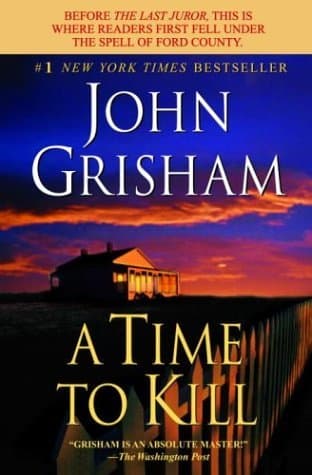
John Grisham (1989)
Genre
Thriller / Mystery
Reading Time
10-12 hours
Key Themes
See below
Sign in to track this book
In a racially charged Mississippi town, a father's violent revenge for his daughter's rape ignites prejudice, forcing a young lawyer to defend the indefensible amid threats of mob rule and a trial that could tear the community apart.
In Clanton, Ford County, Mississippi, ten-year-old Tonya Hailey, an African American girl, is abducted and raped and beaten by two white men, Billy Ray Cobb and Pete Willard, after they force her off a dirt road. The men are drunk and high on drugs. They leave Tonya for dead, hanging from a tree, before dumping her in a creek. She is found alive by a truck driver. The crime sends horror through the predominantly white town, and the two perpetrators are quickly apprehended by Sheriff Ozzie Walls.
While Billy Ray Cobb and Pete Willard are being transported from the courthouse to the jail for their arraignment, Tonya's father, Carl Lee Hailey, ambushes the police escort. Using an M-16 rifle, Carl Lee shoots and kills both Cobb and Willard in the courthouse basement, wounding a deputy in the process. He then surrenders to Sheriff Walls. Carl Lee's act of vigilante justice ignites racial tension in Clanton, dividing the town and setting the stage for a sensational trial.
Despite the immense odds and potential for career ruin, Carl Lee asks Jake Brigance, a young, white lawyer who has previously represented Carl Lee, to defend him. Jake, feeling a moral obligation and a sense of injustice regarding Tonya's assault, accepts the case. His decision is met with skepticism and hostility from many in the community, including his own family, who fear for their safety and reputation in the racially charged atmosphere.
News of Carl Lee's crime and the trial attracts the attention of the Ku Klux Klan, led by Freddie Lee Cobb (Billy Ray's brother). The Klan establishes a strong presence in Clanton, holding rallies, burning crosses, and openly intimidating the black community and anyone associated with Carl Lee's defense. Jake Brigance and his family become targets, receiving death threats and experiencing acts of vandalism, including the burning of Jake's office.
Jake, overwhelmed by the case and the threats, enlists the help of several individuals: Lucien Wilbanks, his alcoholic former mentor; Harry Rex Vonner, a cynical divorce lawyer; and Ellen Roark, a law student. Together, they formulate a defense strategy based on temporary insanity, arguing that Carl Lee, traumatized by his daughter's ordeal, was not in his right mind when he committed the killings. This strategy aims to appeal to the jury's empathy, despite the clear premeditation of the act.
The trial begins with Judge Omar Noose presiding, a pragmatic but fair judge. District Attorney Rufus Buckley, an ambitious prosecutor, leads the state's case, seeking the death penalty for Carl Lee. The courtroom is packed daily, and the trial garners national media attention, turning Clanton into a focal point for racial debate. Security is tight, with armed guards present to prevent further violence from the KKK or any other groups.
During the trial, the prosecution presents evidence of Carl Lee's premeditation. The defense, however, focuses on the details of Tonya's rape, calling witnesses like Dr. Wilbert Rodeheaver to describe her injuries and the psychological impact. Meanwhile, the threats against Jake and his family intensify. His house is shot at, and his daughter, Hannah, is nearly kidnapped by Klan members. Jake sends his family away for their safety, further isolating him.
The KKK's presence in Clanton results in a series of violent acts. They bomb Jake Brigance's house, destroying it, though fortunately, his family is not inside. The bombing shows the danger Jake and his team face. In retaliation, the black community, led by Reverend Agee, organizes protests and prepares for conflict, further polarizing the town and increasing the pressure on the trial's outcome.
In his powerful closing argument, Jake Brigance does not dispute the facts of Carl Lee's actions. Instead, he asks the all-white jury to close their eyes and imagine Tonya Hailey's ordeal, then to imagine she is white. He challenges them to consider whether they would have acted differently if it were their own white daughter, appealing to their shared humanity and asking them to apply the same emotional understanding to a black father. It is a risky, emotionally charged plea for empathy.
After deliberation, the jury returns a verdict of not guilty by reason of insanity. Carl Lee Hailey is acquitted of murder, sending shockwaves through the courtroom and across the nation. While the verdict is controversial, it brings a sense of relief to many and a quiet victory for justice in the eyes of Carl Lee's supporters. The KKK's power in Clanton lessens, and though the town is scarred, it slowly begins to heal and move forward from the racial turmoil and violence that gripped it for weeks.
The Protagonist
Jake transforms from an inexperienced small-town lawyer into a courageous and determined advocate who risks everything for justice.
The Central Figure/Defendant
Carl Lee takes justice into his own hands, leading to his trial and eventual acquittal, becoming a symbol of a father's desperate love.
The Antagonist
Buckley relentlessly pursues a conviction, representing the strict interpretation of the law and the political pressures of the community.
The Supporting
Judge Noose strives to ensure a fair trial amidst extreme pressure, upholding the integrity of the court.
The Supporting
Carla grapples with fear and loyalty, ultimately standing by her husband through extreme adversity.
The Supporting
Lucien provides critical legal guidance and cynical wisdom, helping Jake navigate the treacherous trial.
The Supporting
Harry Rex offers pragmatic advice and unwavering, if sometimes gruff, support to Jake during the trial.
The Supporting
Ellen provides crucial research and intellectual support, proving her value to the defense team.
The Antagonist
Freddie Lee escalates racial violence and intimidation, becoming the physical embodiment of the KKK's threat.
The Supporting
Sheriff Walls maintains order and justice in a town on the brink of racial war.
The novel explores the conflict between what is legally permissible and what feels morally right. Carl Lee Hailey's act, while illegal, is an understandable, if extreme, response to an unbearable injustice within a system perceived as biased. Jake Brigance's defense relies on appealing to a jury's sense of 'justice' over the strict 'law,' showing the inadequacy of legal frameworks to fully address moral grievances, especially in the context of racial inequality. The verdict questions whether true justice can always be found within the letter of the law.
“What if she was white?”
Racial prejudice is a central theme, present in every aspect of the story. From the assault on Tonya Hailey to the immediate assumption of guilt for Carl Lee, the racism of the American South is clearly depicted. The novel shows how racial bias influences the legal system, community reactions, and the threat of violence from groups like the KKK. Jake's struggle to secure a fair trial for Carl Lee confronts deeply entrenched racial inequalities and the legacy of racism.
“This is a black man killing two white men in a town where the Klan still marches.”
Carl Lee's decision to take justice into his own hands raises questions about vigilantism. The novel explores the motivations behind such acts — grief, a sense of powerlessness, and a lack of faith in the established system. While the narrative does not explicitly condone Carl Lee's actions, it provides a human context that makes his retribution understandable to many, forcing the audience to grapple with the moral complexities of an individual seeking vengeance when the system fails to deliver perceived justice.
“He waited for them. He planned it. He executed it. He killed them.”
Jake Brigance shows courage and moral conviction. Despite the personal danger, threats to his family, destruction of his home and office, and potential ruin of his career, Jake refuses to abandon Carl Lee. His commitment to his client and to his belief in a just outcome, even when unpopular and dangerous, highlights the power of individual moral strength in the face of societal pressure and fear. His courage inspires others.
“I will not quit him. I will not quit this case.”
The climax of the novel, Jake's closing argument, shows the theme of empathy. By asking the jury to imagine Tonya Hailey as white, Jake attempts to transcend racial barriers and appeal to a universal human understanding of a parent's pain. This plea for empathy is designed to break through prejudices and allow the jury to connect with Carl Lee's emotional state, rather than just the facts of the law. It shows that empathy can be a potent force in achieving a deeper form of justice.
“Now imagine she is white.”
A rhetorical device used to appeal to the jury's emotions and empathy.
Jake Brigance's closing argument is a pivotal plot device. It serves as the dramatic climax of the trial, where Jake, with nothing left to lose, makes a direct and controversial appeal to the all-white jury's empathy by asking them to imagine the victim, Tonya Hailey, as white. This rhetorical strategy aims to bypass racial prejudice and force the jurors to consider Carl Lee's actions from a universally human, parental perspective, thereby influencing their verdict more profoundly than legal technicalities might.
An external antagonist representing overt racial hatred and violence.
The presence and actions of the Ku Klux Klan (KKK) serve as a major plot device, representing the extreme, overt racial hatred and violence that underpins the story's conflict. The KKK's intimidation, cross burnings, and ultimately the bombing of Jake's house, escalate the stakes for Jake and his family, providing constant external conflict and emphasizing the dangerous environment in which the trial takes place. They are a tangible manifestation of the racial prejudice Carl Lee and Jake are fighting against.
The central setting symbolizing the battleground for justice.
The Ford County Courthouse is more than just a setting; it's a symbolic battleground. It represents the legal system itself, where justice is supposed to be dispensed, but also where racial biases and political ambitions play out. The basement where Carl Lee commits his act, the courtroom where his fate is decided, and the surrounding square where protests and Klan rallies occur, all highlight the courthouse as the epicenter of the town's racial and legal drama.
A narrative device that amplifies the trial's stakes and societal impact.
The intense media coverage of Carl Lee Hailey's trial is a significant plot device. It elevates the local tragedy into a national spectacle, highlighting the broader societal issues of race and justice. The media's presence brings external pressure, scrutiny, and public opinion to bear on the proceedings, influencing the actions of the prosecution, defense, and even the judge. It underscores the high stakes of the trial, not just for Carl Lee, but for the racial discourse of the entire nation.
“I want to tell you a story. It's about a little girl walking home from the grocery store one sunny afternoon.”
— Jake Brigance's opening statement to the jury, setting the emotional tone for the trial.
“He was a father first, a killer second.”
— Description of Carl Lee Hailey's actions and motivations after his daughter's assault.
“In Mississippi, justice is a little different.”
— Reflection on the racial and social dynamics influencing the legal system in the novel's setting.
“You can't kill a man for what he might do.”
— A legal argument made during the trial about preemptive violence.
“The law is the law, but sometimes the law is wrong.”
— A character's musing on the imperfections of the legal system.
“We are all victims of our own prejudices.”
— Observation about the biases affecting characters and the community.
“A man's home is his castle, and he has the right to defend it.”
— Reference to self-defense laws in the context of Carl Lee's actions.
“The truth is rarely pure and never simple.”
— Comment on the complexities of the case and the characters' motivations.
“In the eyes of the law, all men are created equal, but in the hearts of men, they are not.”
— Reflection on the disparity between legal ideals and societal attitudes.
“Sometimes you have to fight fire with fire.”
— A justification for aggressive or violent actions in pursuit of justice.
“The jury is the conscience of the community.”
— Explanation of the jury's role in reflecting societal values in the trial.
“Fear is a powerful motivator, but so is love.”
— Analysis of the driving forces behind characters' decisions in the novel.
“You can't change the past, but you can damn sure learn from it.”
— A character's advice about dealing with history and moving forward.
“In the end, we are all just trying to do what we think is right.”
— A concluding thought on the moral dilemmas faced by the characters.
Ready to see how well you understood this book? Take our interactive quiz with 10 questions.

Biography coming soon.







