“The human being, if you look at him closely, is a much wilder animal than we.”
— The tiger, Raja, observing humans for the first time.

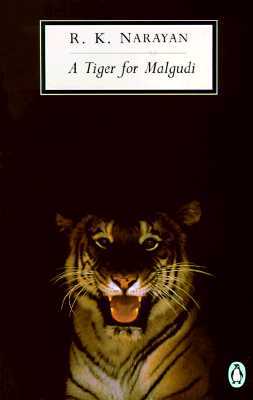
R.K. Narayan (1983)
Genre
Fantasy
Reading Time
160 min
Key Themes
See below
Sign in to track this book
An old tiger, Raja, tells his life story, from the wild jungle to human entertainment, and his unexpected spiritual change in Malgudi.
The story begins with Raja, an old tiger, thinking about his life. He describes his youth in the deep jungle with his family. His early days were about learning to hunt, the excitement of the chase, and the strict order in his tiger family. He remembers the rich environment of the Mempi Hills, the sounds and smells of the forest, and his parents' constant survival lessons. This part establishes Raja's basic nature as a wild animal, driven by instinct and nature's rhythm, before he is forced to interact with humans.
As Raja grows, he becomes a respected and feared predator. He describes his solitary life as a grown tiger, marked by successful hunts of deer, wild boar, and sometimes buffalo from nearby villages. He recalls the respect and fear he commanded from other animals, and the thrill of the chase. His territory was wide, and he saw himself as its king. This period shows his raw power and independence, as he lives purely by jungle laws, free from human problems. He notices humans moving into his territory, becoming cautiously aware of them.
One day, driven by hunger and growing boldness, Raja goes near a human village. He watches the villagers and their cattle, and eventually, he raids them. This causes fear among the humans, who start organizing hunting parties to find him. Raja finds himself increasingly against human civilization, viewing their actions with disdain and a growing sense of threat. This starts his direct conflict with humanity, moving from just watching to active involvement, which eventually seals his fate for a time.
After his raids, Raja is captured by Captain, the owner of a traveling circus. The capture is a terrible experience for Raja, involving nets and a cage, a complete loss of his freedom. He is renamed 'Raja the Magnificent' and forced to learn humiliating tricks under Captain's cruel teaching. Circus life is very different from his wild existence, filled with loud noises, small spaces, and the constant threat of Captain's whip. He performs for audiences, doing tricks against his tiger nature, living a life of disrespect and control.
Life with Captain is one of constant fear and physical abuse for Raja. Captain is a harsh master, using whips and hunger to break Raja's spirit. Raja sees other circus animals suffer, including a bear, an elephant, and a monkey, all similarly controlled. He also watches the human performers, noting their own worries and obedience to Captain. This period deepens Raja's understanding of human cruelty and the power structures in their world, strengthening his dislike for his captor and his desire for freedom.
During a chaotic performance in Malgudi, Raja, unable to stand Captain's cruelty, snaps. He breaks free from his chains and escapes the circus tent, causing panic in the town. The sight of a wild tiger in the streets makes everyone frantic, with people running in terror. Raja enjoys his new freedom, feeling a temporary return to his basic instincts as he causes chaos, knocking over stalls and scaring everyone. This escape is a turning point, moving Raja from captivity back to a semblance of his wild state, but in a human-dominated place.
Amid his escape, Raja meets a Sanyasi, a spiritual master, who is meditating peacefully. Unlike the scared villagers, the Master shows no fear. Instead, he speaks to Raja calmly and kindly, looking at him with compassion. To Raja's surprise, he feels an unexplained peace with the Master. The Master gently leads Raja away from town, guiding him to a quiet spot where he can rest without causing more alarm. This meeting is life-changing, starting Raja's spiritual awakening and his first experience of true kindness from a human.
Raja begins a new life with the Master. The Master treats him not as an animal to be tamed, but as a thinking being capable of spiritual growth. He teaches Raja to control his hunting instincts, encouraging him to eat vegetarian food and live in peace. Raja spends his days quietly reflecting with the Master, watching his meditation and listening to his philosophical lessons. This period changes Raja deeply, as he sheds his predatory nature and embraces a life of peace and non-violence, finding a deeper connection to the world under the Master's gentle guidance.
The Master teaches Raja important lessons about the illusions of the material world, self-control, and how all living things are connected. Raja, at first confused, slowly understands these ideas through the Master's patient explanations and his own experiences. He learns to stop his natural urges for aggression and hunting, finding contentment in a simple, peaceful life. This change is not just in behavior but spiritual, as Raja's inner world shifts from basic instinct to enlightened awareness, guided by the Master's wisdom.
As Raja ages, his teeth wear down, and his strength lessens, but his spirit stays calm and content. He lives his final days peacefully with the Master, thinking about his journey from a fierce jungle predator to a spiritually awakened friend. The Master eventually decides to enter 'jiva samadhi' – a conscious departure from the body – and arranges for Raja to live at a zoo, ensuring his comfort in old age. Raja accepts this final change calmly, having found his true purpose and peace through his bond with the Master, leaving a legacy of spiritual change.
The Protagonist
Raja transforms from a fierce, instinct-driven predator into a peaceful, spiritually awakened being under the guidance of the Master.
The Supporting
The Master remains a consistent beacon of spiritual wisdom, facilitating Raja's development without undergoing a personal arc himself.
The Antagonist
Captain remains static in his cruelty, serving as the oppressive force Raja must overcome.
The Supporting
Jaggu's arc is minor; he remains a figure of quiet compassion amidst the circus's brutality.
The Mentioned
N/A, a minor character who serves a plot function.
The novel shows the conflict between the wild and the human world. Raja's journey from the free jungle to the circus and then to Malgudi's streets shows how human development disturbs natural homes and forces wild animals into unnatural lives. Circus life, in particular, symbolizes humanity's desire to control and use nature for fun, while Raja's escape and the panic in Malgudi show the wildness that civilization struggles to contain. This theme is central to Raja's early suffering and his later search for a peaceful life.
“I was accustomed to the jungle, where I was king, but here I was a slave.”
At its core, the book is a story about spiritual awakening. Raja's change from a basic predator to a peaceful, thoughtful being under the Master's guidance is the main part of this theme. The Master teaches Raja about self-control, non-violence, and the illusion of worldly desires, leading Raja to go beyond his animal instincts. This journey reflects Hindu ideas of karma, dharma, and the chance for freedom (moksha) through spiritual practice, suggesting that enlightenment is possible for all beings, no matter their form. Raja's ability to overcome his natural tendencies symbolizes the power of spiritual practice.
“The Master told me that I was not my body, but something beyond it, eternal and indestructible.”
An important theme is the value of compassion and the ability to feel empathy across species. The Master's interaction with Raja contrasts sharply with Captain's cruelty and the villagers' fear. The Master sees Raja not as a dangerous animal but as a thinking being capable of spiritual growth, treating him with respect and kindness. This compassionate approach leads to Raja's deep change and highlights the power of understanding and non-violence. The book criticizes the human tendency to treat animals as objects and use them, suggesting a more empathetic relationship with nature.
“He looked at me without fear, without anger, but with a profound understanding that pierced through my tiger heart.”
The novel explores different forms of freedom and captivity. Raja's early freedom in the jungle is physical, but he is also 'bound' by his instincts. His capture by Captain represents actual physical captivity and the loss of dignity. His escape from the circus is a return to physical freedom, but still within human society. True freedom is found not just in physical liberty but in spiritual release, as Raja finds inner peace and self-mastery with the Master. This suggests that freedom is ultimately an internal state, regardless of outside conditions.
“I had been free in the jungle, but I was also a slave to my hunger. Now, I was truly free.”
The story is told entirely from the perspective of Raja, the tiger.
This device allows the reader to experience the world through the senses and understanding of an animal. It provides a unique, often humorous, and insightful commentary on human behavior, societal norms, and spiritual concepts from an 'outsider's' perspective. Raja's observations, initially instinctual and later increasingly philosophical, offer a fresh lens through which to examine themes of nature vs. civilization and the meaning of existence. It creates empathy for the animal protagonist and enables the allegorical nature of the story.
The story of Raja's life serves as a symbolic representation of a spiritual journey.
Raja's transformation from a wild beast to a peaceful, enlightened being is an allegory for the human spiritual path. His initial existence in the jungle represents a state of primal ignorance and attachment to worldly desires (hunting, dominance). His captivity and suffering symbolize the trials and tribulations one faces on the path to self-realization. His eventual guidance by the Master and subsequent inner peace represent the attainment of spiritual enlightenment and liberation from the cycle of suffering. The entire narrative can be read as a parable for Hindu philosophy.
Captain and The Master serve as direct contrasts to highlight different human approaches.
Captain, with his cruelty, greed, and desire for control, acts as a foil to The Master, who embodies compassion, wisdom, and selfless guidance. Their contrasting interactions with Raja illuminate the central themes of the novel: the destructive potential of humanity versus its capacity for spiritual harmony. Captain represents the unenlightened, materialistic world, while The Master represents spiritual enlightenment and a compassionate relationship with nature. This juxtaposition emphasizes the choices available to humanity and the profound impact of each path.
Situational irony is used to subvert expectations about a tiger's nature and human behavior.
The novel employs irony in several ways. For instance, a wild, feared tiger eventually becomes a peaceful, vegetarian companion, subverting expectations of its inherent ferocity. Conversely, humans, who perceive themselves as superior, often display more brutish and less 'civilized' behavior than the 'beast' they try to tame. The irony lies in Raja finding true freedom and enlightenment not in his wild state, but through human spiritual guidance, while many humans remain 'caged' by their own desires and ignorance. This device adds depth and often subtle humor to the narrative.
“The human being, if you look at him closely, is a much wilder animal than we.”
— The tiger, Raja, observing humans for the first time.
“All creatures in the world, however great or small, are there for a purpose.”
— The Master explaining the interconnectedness of life to Raja.
“Freedom, after all, is a matter of the mind.”
— Raja reflecting on his captivity and eventual liberation.
“What is life if not a series of challenges to be met and overcome?”
— Raja's internal monologue about his changing circumstances.
“The greatest education is to learn to live with what you have.”
— The Master imparting wisdom to Raja about contentment.
“Fear is a great master, but love is a greater one.”
— Raja understanding the change in his relationship with humans.
“Every animal has its place, and every place its animal.”
— The Master discussing the natural order of things.
“The world is full of wonders, if only one has the eyes to see them.”
— Raja observing the world around him with new understanding.
“To be truly free, one must first be free of oneself.”
— The Master guiding Raja towards spiritual liberation.
“Silence has its own language, and it speaks volumes.”
— Raja and the Master communicating without words.
“Even a tiger can learn humility.”
— Raja's realization after his experiences with humans and the Master.
“The past is a cage, and the future is a dream. Only the present is real.”
— The Master's teaching on living in the moment.
“There is no true happiness in isolation.”
— Raja reflecting on his solitary existence versus his bond with the Master.
“A good master does not tame; he understands.”
— Raja's thoughts on his relationship with the Master.
“Life is a journey, not a destination.”
— The overall theme of Raja's transformation and spiritual quest.
Ready to see how well you understood this book? Take our interactive quiz with 10 questions.

Biography coming soon.







