“Like a compass needle that always points north, a man’s accusing finger always finds a woman. Always. You remember that, Mariam.”
— Nana's advice to a young Mariam about the unfairness women face.

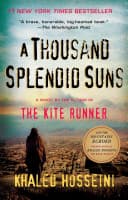
Khaled Hosseini (2008)
Genre
Historical Fiction
Reading Time
700 min
Key Themes
See below
Sign in to track this book
In war-torn Kabul, two Afghan women, trapped in an abusive marriage, form a strong bond of sisterhood over three decades of conflict, sacrificing everything for love and survival.
Mariam, an illegitimate child, lives with her bitter mother, Nana, near Herat. Her father, Jalil, a rich cinema owner, visits weekly but hides her from his family. Nana constantly reminds Mariam of her birth and her mother's sacrifices. Despite Nana's warnings, Mariam loves Jalil and wants to be part of his world. On her fifteenth birthday, Mariam goes to Herat to see Jalil but is turned away. She waits outside his house all night. When she returns home, she finds Nana has died by suicide.
After Nana's death, Jalil's wives, fearing scandal, arrange for Mariam to marry Rasheed. He is a shoemaker from Kabul, over thirty years older than her. Mariam is scared and protests, but Jalil ignores her. She is taken to Kabul, a city she has never seen, and into Rasheed's home. Rasheed at first seems kind, buying her clothes and showing her the city. But his true nature soon appears. He expects her to obey him and demands a son. When she struggles to get pregnant, he becomes verbally abusive. This marks the start of her isolated and oppressive life.
Laila grows up in a more modern, educated family in Kabul. Her father, Babi, a schoolteacher, encourages her to learn. Her mother, Fariba, is depressed after her two sons, Ahmad and Noor, die in the Soviet-Afghan War. Laila feels neglected. Laila's best friend and secret crush is Tariq, who lost a leg to a landmine. As the war worsens, Laila's family sees more violence and destruction in Kabul. Rockets become a daily threat. Despite the dangers, Laila finds comfort in her studies and her friendship with Tariq.
As the war gets worse and Mujahideen groups fight each other, life in Kabul becomes unbearable. Tariq's family decides to move to Pakistan for safety. Laila and Tariq share a sad goodbye, confirming their unspoken love. Laila is heartbroken but stays in Kabul with her parents, as Babi does not want to leave home. Soon after Tariq leaves, a rocket hits Laila's house, killing her parents and badly injuring Laila. Mariam and Rasheed pull her from the rubble and take her into their home to recover. This sets up their connected futures.
Mariam and Rasheed help Laila recover, but Rasheed sees an opportunity. He lies to Laila, telling her Tariq is dead; he paid a man to deliver the false news. Laila realizes she is pregnant with Tariq's child and has no other options. To protect her unborn child and have a place to live, she agrees to marry Rasheed, becoming his second wife. Mariam resents Laila's presence, especially after years of being Rasheed's only victim of abuse. The home quickly becomes tense, with Laila now sharing Mariam's fate under Rasheed's control.
Laila gives birth to a daughter, Aziza. Rasheed is disappointed she is not a boy and shows her little affection, directing his anger at Laila and Mariam. Mariam, however, feels a motherly bond with Aziza, which softens her initial dislike for Laila. The two women slowly begin to work together in their shared suffering. Later, Laila gets pregnant again and gives birth to a son, Zalmai. Rasheed is overjoyed by his son's birth, spoiling him with affection. This highlights his neglect of Aziza and his continued mistreatment of Laila and Mariam. Zalmai quickly becomes Rasheed's favorite, unaware of his father's cruelty.
The shared experience of Rasheed's abuse and their love for Aziza create a strong bond between Mariam and Laila. They become like sisters, supporting each other against their abusive husband. Together, they plan to escape Kabul with Aziza, hoping to reach Pakistan. With a kind bus driver's help, they get tickets and board a bus. However, a suspicious man on the bus reports them. The Taliban catch them, humiliate them publicly, and return them to Rasheed. Their punishment is brutal: Rasheed beats them severely, locking Mariam in a shed and Laila and Aziza in their room for days without food or water.
Years pass under the Taliban, bringing harsher rules and more economic hardship. Aziza is sent to an orphanage because Rasheed cannot provide for the family. One day, Tariq, alive and well, appears at Rasheed's door. He reveals he had been in Pakistan, imprisoned for several years, and returned to Kabul to find Laila. Rasheed had lied about his death. Laila is filled with joy and sorrow, understanding Rasheed's cruelty and the years of happiness he stole. Tariq's return changes Laila's world and forces a confrontation with Rasheed.
When Rasheed finds out about Tariq and Laila's plan to leave with him, he violently attacks Laila, trying to strangle her. Mariam, seeing the violence and fearing for Laila's life and the children's future, steps in. She grabs a shovel and hits Rasheed, killing him. After this, Mariam makes a great sacrifice. To protect Laila and Tariq from legal trouble and let them build a new life, Mariam confesses to the murder. She tells Laila to take Aziza and Zalmai and flee with Tariq to Pakistan, accepting her fate with peace.
The Taliban arrest Mariam for Rasheed's murder. She has a short, unfair trial where she confesses, staying silent about Laila's involvement. Despite the injustice, Mariam faces her execution with quiet dignity. She is taken to a stadium in Kabul and publicly executed by a Taliban soldier before a large crowd. Her death is tragic but ultimately frees Laila and gives her and her children a chance for a better future. Mariam's last thoughts are of her life, her mother, and the deep love she found with Laila and the children.
Laila, Tariq, Aziza, and Zalmai escape to Murree, Pakistan, finding shelter in a small guesthouse. They begin a new life away from Kabul's violence and oppression. Tariq finds work, and Laila raises their children. Zalmai, at first struggling with the loss of his father and his idealized image of him, slowly adapts to his new family and his bond with Tariq. Laila finds happiness and peace, cherishing her relationship with Tariq and the children—a life of love and safety that Mariam made possible through her sacrifice.
After the Taliban's fall, Laila and Tariq decide to return to Afghanistan, feeling drawn to help rebuild their war-torn country. Before settling back in Kabul, Laila visits Herat, seeking out Mariam's childhood home and places connected to her past. She finds a box Jalil left for Mariam, containing money and a letter expressing his regret. Laila uses the money to help rebuild an orphanage in Kabul, where she later becomes a teacher. She becomes pregnant again, and if it is a girl, she plans to name her Mariam, ensuring her memory lives on and symbolizing hope for Afghanistan's future.
The Protagonist
From a timid, resigned victim, Mariam transforms into a woman of immense courage and self-sacrifice, finding her greatest strength and purpose in protecting Laila and her children.
The Protagonist
Laila evolves from an optimistic, educated girl into a hardened but hopeful survivor, ultimately finding love and using her experiences to contribute to the rebuilding of Afghanistan.
The Antagonist
Rasheed remains a static character, consistently embodying cruelty and misogyny until his violent death.
The Supporting
Tariq maintains his core loyalty and love, eventually reuniting with Laila and becoming a stable, loving partner and father.
The Supporting
Aziza endures hardship and separation but ultimately thrives in a loving family, embodying the resilience of children.
The Supporting
Zalmai grapples with the loss of his father and his idealized image, eventually adapting to a new loving family unit.
The Supporting
Nana's arc is largely static, defined by her bitterness and tragedy, culminating in her suicide.
The Supporting
Jalil's character remains largely static in his cowardice, though he expresses posthumous regret for his actions towards Mariam.
The Supporting
Babi remains a consistent source of wisdom and love for Laila until his untimely death.
This theme is central to the novel. It shows how women, despite initial dislike, can form deep bonds of love and support when facing shared oppression. Mariam and Laila's relationship, at first filled with resentment, grows into a deep, sisterly love. This bond becomes their main source of strength and survival in Rasheed's brutal home. Their protection of Aziza and their shared defiance of Rasheed show this theme. Mariam's final sacrifice for Laila is the peak of this solidarity, proving that love and loyalty between women can overcome the worst circumstances and lead to freedom.
““Mariam had never before been wanted like this. Love had never been a gift to her, something to be received. It had always been a reward, earned with painstaking effort.””
The novel clearly shows the terrible effects of decades of war—from the Soviet invasion to the rise of the Mujahideen and the Taliban—on ordinary Afghan citizens, especially women. The destruction of Kabul, the constant threat of rockets, the loss of loved ones, harsh laws, and widespread fear and poverty are all detailed. A rocket directly destroys Laila's family, and the Taliban's oppressive rule takes away women's rights, forcing Mariam and Laila into deeper hardship. The war is not just a background; it actively shapes every character's destiny and limits their choices.
““Like a compass needle that always points north, a man’s accusing finger always finds a woman. Always.””
Sacrifice is a repeated idea, especially through Mariam's actions. Her life is a series of sacrifices: enduring her mother's bitterness, her forced marriage, and finally, her own life to save Laila and her children. This selfless act allows Laila to find a kind of redemption and a chance at a new life. Mariam's sacrifice changes her from a 'harami' into a hero, finding dignity and purpose in her final act. Laila, in turn, honors Mariam's memory by returning to Afghanistan and helping others, continuing the cycle of sacrifice and hope.
““A society has no chance of success if its women are uneducated, Laila. No chance.””
Despite immense hardship, abuse, loss, and oppression, the characters, especially Mariam and Laila, show great resilience. Mariam finds a will to live and love after a lifetime of neglect and abuse. Laila, after losing her family and being forced into a brutal marriage, continues to fight for her children and her own survival, holding onto hope for a reunion with Tariq. Their ability to find moments of joy, connection, and even humor amidst despair shows the human spirit's lasting strength to adapt, resist, and hope for a better tomorrow, even in the darkest times.
““One could not count the moons that shimmer on her roofs, Or the thousand splendid suns that hide behind her walls.””
Hints and clues about future events, often related to character fates or societal shifts.
Foreshadowing is used throughout the novel to hint at the tragic events and character developments. Nana's constant warnings to Mariam about men and the harsh realities of her illegitimate status foreshadow Mariam's eventual suffering with Rasheed. The escalating violence and the departure of Laila's brothers for war foreshadow the eventual destruction of her family and the country. The poem 'A Thousand Splendid Suns' itself, quoted by Babi, foreshadows the hidden strength and beauty that will emerge from the lives of Mariam and Laila despite the surrounding darkness.
Objects, places, or actions that represent deeper meanings.
Various symbols enrich the narrative. The kolba, Mariam's isolated childhood home, symbolizes her marginalization and the limitations placed upon her. The city of Kabul, initially a place of hope and education for Laila, transforms into a symbol of destruction and oppression under different regimes, mirroring the characters' personal journeys. The burqa symbolizes the loss of women's freedom and identity, particularly under the Taliban. Mariam's shovel, used to kill Rasheed, symbolizes her transformation from a passive victim into an active agent of justice and protection.
The narrative structure that juxtaposes the lives of Mariam and Laila before they meet.
The novel employs a narrative structure that initially follows Mariam's life, then Laila's, before bringing them together. This allows for a powerful contrast between their upbringings: Mariam's rural, isolated, and traditional childhood as a 'harami' versus Laila's urban, educated, and relatively modern upbringing. This device highlights the diverse experiences of women in Afghanistan, only for their lives to converge under the shared oppression of Rasheed and the war, emphasizing their common humanity and the unifying power of suffering and solidarity.
Situations where the outcome is contrary to what is expected, or words are used to convey a meaning opposite to their literal meaning.
Irony is used to underscore the harsh realities of the characters' lives. For instance, Mariam's father, Jalil, a man of wealth and supposed standing, ultimately abandons her to a fate worse than poverty, despite his initial show of affection. The idea that Rasheed, who desperately desired a son, would show more love for his son Zalmai than his daughters, yet it is Mariam, the 'harami,' who makes the ultimate sacrifice for his family's future, is deeply ironic. The very institutions meant to provide justice or safety (like the legal system under the Taliban) become tools of oppression and injustice.
“Like a compass needle that always points north, a man’s accusing finger always finds a woman. Always. You remember that, Mariam.”
— Nana's advice to a young Mariam about the unfairness women face.
“Mariam had learned to harden herself against Nana’s stinging words, but Laila had yet to develop a callus.”
— Contrasting the resilience of Mariam and Laila in the face of abuse.
“One could not be a Pashtun and not know what a jinn was. One could not be a Pashtun and not know that some jinns were benevolent and some were malevolent.”
— Describing the cultural beliefs and superstitions prevalent in Afghanistan.
“Marriage can wait, education cannot. A woman's brain is her power.”
— Babi's progressive views on education for Laila.
“For the first time, Mariam could not bring herself to look at Jalil. She had not looked at him either when he’d dropped her off at the orphanage. But that was for a different reason. That day, she’d been afraid to look, afraid that if she did, she would have to confront the fact that he was leaving her. Today, she just didn’t want to.”
— Mariam reflecting on her changing feelings towards her father, Jalil.
“A society has no chance of success if its women are uneducated, and its youth is unemployed.”
— Babi's observation on the state of Afghanistan.
“But mostly, Mariam thought, the city was like a compass with its needle spinning madly, directionless. It was a city of displaced strangers, new arrivals and old residents, people with no history and people with too much history.”
— Mariam's perception of Kabul after the Soviet invasion.
“She was leaving the world as a woman who had loved and been loved back. She was leaving it as a friend, a companion, a hero, a mother. A woman who had been loved and been loved back.”
— Mariam's thoughts as she faces execution, reflecting on her life and love for Laila and her children.
“Laila was like a rock in a riverbed, enduring all that flowed over her, yet remaining unmoved.”
— Describing Laila's resilience and strength in enduring hardships.
“But it was a lie, of course, that she had no one. She had Laila. And Aziza. And Zalmai.”
— Mariam realizing her profound connection to Laila and her children.
“Each snowflake was a tiny mirror, reflecting the world in a thousand different ways.”
— Laila's poetic observation of snowflakes, a moment of beauty amidst hardship.
“Because a woman's face is her husband's property, not her own.”
— Rasheed's cruel justification for forcing Laila to wear a burqa.
“She was a good daughter, a good sister, a good wife. And a good mother. She was a good woman.”
— Laila reflecting on Mariam's life and legacy.
“But the past, she knew, was like a string of beads, to be picked up and admired, or to be discarded and forgotten.”
— Laila's contemplation of the past and its hold on the present.
Ready to see how well you understood this book? Take our interactive quiz with 10 questions.

Khaled Hosseini is an Afghan-American novelist, UNHCR goodwill ambassador, and former physician. His debut novel The Kite Runner (2003) was a critical and commercial success; the book and his subsequent novels have all been at least partially set in Afghanistan and have featured an Afghan as the protagonist.







