“Your house is not a museum. It is a home. And homes are meant to be lived in, not preserved.”
— Young Trevor's grandmother, Eva, imparts wisdom about the family's decaying mansion.

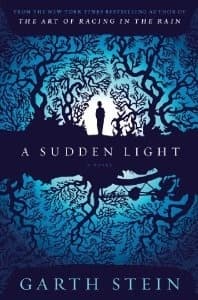
Garth Stein (2014)
Genre
Fantasy / Historical Fiction / Mystery
Reading Time
8-10 hours
Key Themes
See below
Sign in to track this book
A teenage boy in a Puget Sound mansion, built from trees his family cut down, uncovers a century of timber-baron secrets and a vengeful ghost. He must face a legacy of environmental damage to save his family and their ancestral land.
In the summer of 1990, fourteen-year-old Trevor Riddell arrives at Riddell House with his father, Jones Riddell. His parents are separated, and Jones wants to convince his sick father, Samuel, to sell the large Riddell estate overlooking Puget Sound. Jones plans to send Samuel to a care facility, sell the property to developers for 'tract housing for millionaires,' and split the money with his sister, Serena. Trevor immediately notices the house's unique design, built from huge, whole trees, and its wild grounds, which show the family's timber past. His parents' difficult relationship makes his arrival feel both like a safe place and a place with an unsettling purpose.
When he arrives, Trevor meets his Grandpa Samuel, who has dementia and often moves between clear thinking and confusion, sometimes talking as if to unseen people. He also meets his Aunt Serena, Jones's sister, who also wants to sell the property but holds a deep anger toward her brother. The family tension is clear, with Jones and Serena often arguing about how to handle Samuel and the estate. Trevor watches these interactions, feeling like an outsider but increasingly drawn into the family's history and the house's mystery. Samuel's broken memories and unclear comments hint at a deeper, unspoken past connected to the Riddell legacy.
Soon after arriving, Trevor starts to notice strange things in Riddell House. Objects move on their own, doors creak open, and he feels a clear, intelligent presence watching him. Unlike his grandfather's seemingly random talks, these events feel purposeful and directed. He first tries to explain them away, but the ongoing and specific nature of the events, especially the smell of cedar and a distinct coldness, convinces him the house is haunted. This realization both scares and fascinates him, and he starts to suspect the ghost is trying to tell him something important about the Riddell family's past and the estate's future.
Through Samuel's broken memories, old family letters, and his own clearer talks with the ghost, Trevor learns the ghost is Elijah Riddell, the family patriarch and founder of the Riddell Timber company. Elijah, a powerful and driven man, cut down millions of trees, building his fortune and the grand Riddell House from them. However, he later felt deep regret for his actions. Trevor realizes Elijah's spirit is restless because his final wish, that the Riddell estate be allowed to return to wild forest as penance for the environmental damage, has not been fulfilled. This discovery gives Trevor a strong sense of purpose in the house.
Guided by Elijah's ghost and his own curiosity, Trevor explores the hidden parts of Riddell House, finding old journals, letters, and photos. He puts together Elijah's life, learning about his ambition, his love for the land, and his eventual regret. He also uncovers the story of Elijah's relationship with his wife, Lena, and how she shaped his views. Trevor learns about the large scale of the Riddell Timber operation and its harmful effect on the old-growth forests of the Pacific Northwest. This historical research helps him understand Elijah's reasons and the heavy guilt that still hangs over the estate.
Trevor discovers that Elijah's wife, Lena, had a deep, almost spiritual connection to nature and the land. She was a spiritual woman who saw the value and life in the trees, a contrast to Elijah's initial focus on their commercial worth. Lena's influence slowly softened Elijah's heart and gave him a sense of responsibility and regret for the destruction caused by his timber company. Trevor learns about 'Lena's Light,' a spiritual energy Lena fostered and which Elijah wanted to keep alive after her death. This light, Trevor realizes, is linked to the land and the house, and its fading shows the family's separation from their roots and Elijah's unfulfilled wish.
Despite Trevor's growing understanding of Elijah's wishes and the land's spiritual meaning, Jones and Serena remain set on selling the Riddell estate for development. They see Samuel's dementia as a chance to gain control and are increasingly annoyed by his resistance and Trevor's interest in the house's history. Their reasons are purely financial, driven by personal debt and a desire for a new start, which strongly conflicts with the Riddell family's environmental and spiritual legacy. Their actions create growing tension in the house, as Trevor feels increasing pressure from Elijah's ghost to stop the sale.
As tension rises, Trevor's ability to sense and talk with Elijah's ghost grows stronger. He becomes the main person through whom Elijah communicates, interpreting changes in temperature, the smell of cedar, and moving objects as direct messages. Elijah uses Trevor to reveal specific historical details and to show how urgent his plea is. This special bond gives Trevor a sense of purpose beyond his parents' marriage problems. He realizes he is the only one who can truly understand and act on Elijah's final wish, placing a heavy responsibility on him.
With his knowledge of Elijah's will and Lena's spiritual legacy, Trevor confronts his father, aunt, and grandfather, trying to explain the ghost's presence and the importance of saving the land. His family, especially Jones and Serena, dismiss his claims as childish fantasies or signs of stress. They are too focused on their money problems and their own ideas of Samuel's wishes to seriously consider a ghost's intervention. This leads to a heated argument, where Trevor feels alone and misunderstood, but more determined than ever to honor Elijah's request and protect the spirit of Riddell House.
In a key moment, Grandpa Samuel has a period of surprising clarity. He reveals old family secrets, admitting his own part in the past and how he failed to uphold Elijah's wishes. He speaks of Lena's Light and the property's true spiritual meaning, confirming Trevor's understanding of Elijah's regret and the land's importance. This revelation confirms Trevor's experiences and gives him a stronger basis to argue against the sale. Samuel's confession also sheds light on the Riddell legacy's burden and the family's struggle with their past actions.
Through Trevor's persistence, Samuel's clear moments, and the undeniable, increasingly strong appearances of Elijah's ghost, Jones and Serena are finally forced to accept the truth. The ghost's influence becomes too strong to ignore, affecting their decisions and making the idea of selling the house harder. They begin to understand the estate's deeper meaning, moving beyond just money to grasp the land's spiritual and historical importance. This leads to a difficult but ultimately unifying decision to honor Elijah's final wish, preventing development and allowing the land to return to its natural state.
With the decision made to save the land, a sense of peace settles over Riddell House. Trevor's parents start to heal their own relationship, finding common ground in their shared experience and their son's journey. The family begins to heal old wounds, acknowledging the past and looking to a future that honors both their ancestors and the environment. Lena's Light, which had been fading, is renewed, bringing a clear sense of warmth and spiritual energy back into the house. Trevor, having played a key role in this reconciliation, leaves the experience with a deeper understanding of himself, his family, and the connection between life, death, and nature.
The Protagonist
Trevor transforms from a passive observer of his family's dysfunction into an active agent of change, ultimately becoming the family's spiritual and historical anchor.
The Antagonist/Guiding Spirit
Though already deceased, Elijah's 'arc' is externalized through Trevor, as his spirit finds peace only when his final wish is understood and acted upon by his descendants.
The Supporting Character
Jones moves from cynical materialism to a reluctant acceptance of his family's spiritual legacy, leading to personal and marital reconciliation.
The Supporting Character
Samuel, despite his dementia, finds a form of redemption by finally revealing critical truths and validating Elijah's wishes.
The Supporting Character
Serena moves from self-interested materialism to a grudging, then genuine, acceptance of the spiritual value of the estate and family reconciliation.
The Mentioned/Guiding Influence
Lena's influence, though posthumous, guides Elijah's spirit and ultimately helps the living family understand their true purpose.
The Supporting Character
She moves from a state of marital despair to reconciliation and a renewed understanding of family and place.
The novel explores different kinds of legacy: the money from the Riddell timber fortune, the environmental legacy of destruction and the desire to make amends, and the spiritual legacy of Lena's connection to the land. Trevor deals with the weight of these multi-generational legacies, understanding that his family's past actions (Elijah's logging) directly affect their present and future. The house itself, built from the very trees that represent both wealth and destruction, is a strong symbol of this complex inheritance.
““The house itself was a living thing, built from the very trees that had been taken, and it held the stories of all who had lived within its cedar walls.””
A main theme is the difficult and often damaging relationship between people and nature. The Riddell family's wealth came from using old forests, which led to Elijah's deep regret. The ghost's main goal is to fix this historical wrong by letting the land return to its wild state. The story contrasts the initial view of nature as a resource to be used with Lena's spiritual respect for the land, suggesting care and connection instead of conquest. The natural beauty of the Pacific Northwest is always present and acts as a character itself.
““He had taken the trees, yes, but he had also loved them. And in his final years, that love had turned to a profound, aching regret.””
The novel looks at the chance for redemption, both for a person and for a family line. Elijah's ghost shows his unfulfilled wish to make up for his past actions. Trevor's role is to help with this redemption, not just for Elijah, but for the whole Riddell family, who have lived under the shadow of this unresolved past. The story suggests that true forgiveness and healing come from facing past wrongs, taking responsibility, and actively working to make amends, both spiritually and practically, as seen in the family's choice to save the land.
““The house held more than just wood and nails; it held the echoes of their choices, the weight of their mistakes, and the faint, persistent hope of redemption.””
Memory, both personal and shared, is important. Grandpa Samuel's dementia shows how fragile individual memory is, yet his broken recollections are vital clues. The house itself holds family stories, which Trevor finds through old letters, journals, and talking directly with Elijah's ghost. The story's structure, told from Trevor's adult view looking back, highlights how these stories are passed down, understood, and shape identity across generations. Finding these hidden stories is key for the family's healing.
““Memories, Trevor understood, were not always facts. Sometimes they were feelings, impressions, whispers from the past that still had the power to shape the present.””
At its core, the novel is a family drama about a troubled family dealing with communication problems, anger, and money issues. Trevor's parents are close to divorce, and Jones and Serena are in a sibling rivalry. Elijah's ghost acts as a trigger, forcing the living family members to face not only his legacy but also their own conflicts and unresolved problems. Through shared experiences and the clear presence of the past, the family is forced to communicate, understand each other, and work toward reconciliation and healing.
““It wasn't just the house that was falling apart; it was the family within it, splintered and creaking under the weight of unspoken words and inherited burdens.””
Riddell House serves as both setting and a character, imbued with the family's history and a restless spirit.
Riddell House is more than just a setting; it's a sentient entity, built from the very trees that define the family's legacy. Its unique construction from whole trees and its sprawling, untamed grounds make it a powerful symbol of the Riddell family's connection to nature, both destructive and spiritual. The house acts as a repository of memories and emotions, physically manifesting the presence of Elijah's ghost through cold spots, moving objects, and the scent of cedar. It functions as a catalyst for the plot, forcing the family to confront its past and facilitating Trevor's communication with the supernatural.
Grandpa Samuel's dementia provides fragmented, cryptic clues that Trevor must piece together.
Grandpa Samuel's dementia serves as a crucial plot device. His fragmented memories, confused ramblings, and moments of surprising lucidity provide Trevor with vital, albeit incomplete, pieces of the family's history and Elijah's true wishes. This unreliability forces Trevor (and the reader) to actively interpret and connect the dots, adding a layer of mystery and intellectual engagement. It also highlights the theme of memory's fragility and the difficulty of uncovering historical truth, especially when filtered through a damaged mind. Samuel's 'conversations' with Elijah, initially dismissed as senility, are later revealed to be genuine interactions.
The family is burdened by the environmental and spiritual consequences of their ancestors' actions.
The Riddell family is under a generational curse or burden stemming from Elijah's massive deforestation and his unfulfilled final wish. This burden manifests as financial struggles, interpersonal conflict, and a spiritual malaise that affects the house and its inhabitants. The ghost of Elijah is a direct representation of this unresolved past, actively preventing the family from moving forward until they address the historical wrong. Trevor's role is to break this cycle by understanding and honoring the past, thereby releasing the family from the weight of their ancestors' actions and allowing for healing and reconciliation.
A spiritual energy representing the land's life force and Lena Riddell's connection to nature.
'Lena's Light' is a metaphorical and somewhat literal plot device, representing the spiritual essence and life force of the Riddell estate, deeply connected to Elijah's wife, Lena. It symbolizes the intrinsic value of nature and the spiritual health of the family. Its weakening signifies the family's disconnection from their roots and the land, and its restoration indicates their healing and reconciliation with Elijah's wishes. This 'light' guides Trevor's understanding of the deeper meaning behind the estate and provides a tangible (though ethereal) goal for the family to work towards, beyond mere financial gain.
“Your house is not a museum. It is a home. And homes are meant to be lived in, not preserved.”
— Young Trevor's grandmother, Eva, imparts wisdom about the family's decaying mansion.
“The past is not something you escape. It is something you carry.”
— Trevor reflects on the history and secrets embedded within the house and his family.
“Sometimes the greatest love is the one you can't have, the one that remains a ghost.”
— A reflection on the unfulfilled romantic relationships within the family's history.
“Trees remember. They remember everything. And sometimes, they speak.”
— A mystical element of the story, hinting at the sentient nature of the forest surrounding the house.
“A house, like a person, has a soul. And sometimes, that soul is troubled.”
— Trevor's growing awareness of the supernatural occurrences and the house's 'personality'.
“The truth is rarely simple, and often, it's not what you want to hear.”
— As Trevor uncovers more family secrets, he grapples with difficult revelations.
“We are all haunted by something. By the things we did, and the things we didn't do.”
— A general observation about the human condition and the weight of past actions.
“There are no accidents. Only events whose purpose we don't yet understand.”
— A philosophical statement about fate and the interconnectedness of events.
“The living often fear the dead more than the dead fear the living.”
— Exploring the theme of ghosts and the psychological impact they have on the living characters.
“Sometimes, the only way to move forward is to look back, and truly understand what happened.”
— Trevor's journey of discovery is driven by the need to reconcile with the past.
“Love is a kind of madness, a beautiful, terrifying madness.”
— Reflecting on the intense and often destructive romantic relationships within the family's history.
“The greatest stories are not told, they are lived.”
— A meta-commentary on the nature of storytelling and the richness of personal experience.
“Silence can be louder than any scream, especially when it holds a secret.”
— The unspoken truths and hidden secrets within the family are often more potent than direct confessions.
Ready to see how well you understood this book? Take our interactive quiz with 10 questions.







