“Data! Data! Data! I can't make bricks without clay.”
— Sherlock Holmes expressing his need for evidence to Dr. Watson.

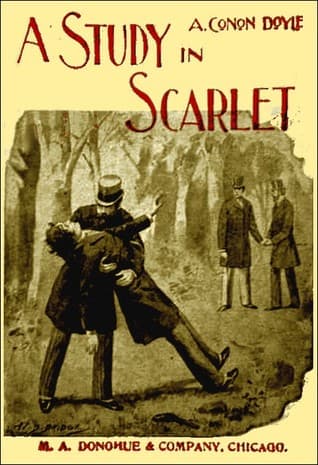
Arthur Conan Doyle (1887)
Genre
Historical Fiction / Mystery
Reading Time
120 min
Key Themes
See below
Sign in to track this book
A war-weary doctor in Victorian London meets an eccentric detective, and together they investigate a cryptic murder with a scarlet message, leading them to a vengeful tale from the American frontier.
Dr. John Watson returns to London after an injury in the Second Anglo-Afghan War, in poor health and with little money. A former hospital orderly suggests he find a flatmate to share costs. This leads to his introduction to Sherlock Holmes, a peculiar man with a strong interest in obscure sciences and many visitors. Watson is at first confused by Holmes's profession, which seems to involve both chemical experiments and an unusual ability to guess personal details from simple observations. They decide to share rooms at 221B Baker Street, starting their famous partnership.
Soon after they settle in, Tobias Gregson of Scotland Yard asks Holmes for help with a puzzling murder at 3, Lauriston Gardens. Enoch Drebber, an American, is found dead in an empty house, with no visible wounds or signs of forced entry. The word 'RACHE' (German for 'revenge') is written in blood on the wall above him. Inspector Lestrade, another Scotland Yard detective, is also there. Holmes immediately begins his careful examination, fascinating Watson, and deduces important details about the victim and the death that the police miss.
Holmes's first observations at Lauriston Gardens lead him to believe Drebber died of poison, not violence, and that a woman was involved, though not directly in the murder. He also deduces the killer's height, the type of cab they used, and even details about their personal habits. As the investigation continues, Drebber's secretary, Joseph Stangerson, is also found murdered in a hotel room, stabbed in the heart. Near Stangerson's body is a small box with two pills – one harmless, one deadly. This second murder deepens the mystery and confirms Holmes's theory of a calculated killer.
Holmes, using his network of informants, learns that Drebber stayed at a specific hotel and had a cab driver named Jefferson Hope. He sets a clever trap: he places an advertisement in the newspaper, pretending to be a cab driver who found a gold wedding ring at Lauriston Gardens, knowing the killer left it there. Jefferson Hope, trying to get the ring, falls into Holmes's trap and is caught by Holmes, Watson, Gregson, and Lestrade. Hope is found to have the poison pills and the knife used to kill Stangerson, confirming him as the murderer of both men.
While in custody, Jefferson Hope, now very ill, confesses to the murders. He starts his story decades earlier in the American West, describing the situation of John Ferrier and his adopted daughter, Lucy, who were rescued from the desert by a Mormon group led by Brigham Young. They are forced to join the Mormon community in Utah, where polygamy is common. John Ferrier, a Gentile, refuses to let Lucy marry a Mormon, angering the 'Avenging Angels' – a secret society within the community. Lucy falls in love with Jefferson Hope, a trapper, but their plans to run away are stopped.
The Mormon elders, especially Enoch Drebber and Joseph Stangerson, demand Lucy choose one of them as a husband within a month, threatening the Ferriers' lives. John Ferrier is murdered by the Avenging Angels for his defiance, and Lucy is forcibly married to Enoch Drebber. Jefferson Hope, who was away hunting, returns to find Lucy dead within a month of her forced marriage, heartbroken and ill from the ordeal. He promises to avenge her death by hunting down Drebber and Stangerson, the men responsible for her suffering and death.
For years, Jefferson Hope carefully tracks Drebber and Stangerson, who fled the Mormon community with stolen money. He follows them across the United States and eventually to Europe, working various jobs and enduring hardship, all while staying committed to his revenge. He becomes a cab driver in London, which lets him watch and follow his targets without suspicion. His relentless pursuit shows his deep love for Lucy and his strong commitment to justice, even if it meant acting outside the law.
Hope finally confronts Enoch Drebber in London. Drebber, drunk, is forced into the abandoned house at Lauriston Gardens. Hope offers him a choice between two pills: one harmless, one deadly, letting Drebber choose his own fate, mirroring a Mormon tradition of 'blood atonement.' Drebber chooses the poisoned pill and dies. Hope, in his hurry, drops Lucy's wedding ring, which becomes an important clue for Holmes. He then writes 'RACHE' on the wall, showing the revenge he has taken for Lucy.
After killing Drebber, Hope finds Joseph Stangerson, also in London. Stangerson resists, and Hope, in a struggle, stabs him with a knife, completing his mission of vengeance. Hope, already suffering from a fatal aortic aneurysm, dies from his illness soon after his confession. He dies peacefully, having fulfilled his life's purpose. Holmes shows some understanding for Hope's motives, acknowledging the deep injustice that drove him, while still condemning his methods.
With Hope's death, the case is officially closed. Despite Holmes solving every detail of the mystery, from the specific type of cab to the killer's identity and motive, Inspectors Gregson and Lestrade receive credit for the arrests and the case's resolution in the newspapers. Dr. Watson, however, is very impressed by Holmes's unique deductive abilities and begins to write down their adventures, making sure Holmes's genius will not go unnoticed. This moment establishes Watson's role as Holmes's chronicler and the start of their future partnership.
The Protagonist
Introduced as an unknown, eccentric genius, he establishes his reputation as a unique consulting detective through his first major case.
The Narrator and Supporting Character
From a bewildered observer, he becomes an indispensable assistant and the chronicler of Holmes's adventures, finding a new purpose in life.
The Antagonist/Vigilante
His life is defined by a singular pursuit of revenge, which he successfully completes before succumbing to illness.
The Victim
His past actions lead directly to his violent death at the hands of Jefferson Hope.
The Victim
His involvement in past injustices leads to his violent death at the hands of Jefferson Hope.
The Supporting/Catalyst
Her life is tragically cut short, but her memory fuels the central conflict of the story.
The Supporting
He serves as a foil to Holmes, demonstrating the limitations of conventional police work.
The Supporting
He serves as a foil to Holmes, demonstrating the limitations of conventional police work.
The novel explores the complex line between legal justice and personal justice. Holmes operates within the law, but Jefferson Hope's story presents a strong argument for vigilante justice born from a failed system. The Mormon community's 'Avenging Angels' show a corrupt justice system, forcing Hope to seek retribution outside the law. His actions, though criminal, are shown with some sympathy, making the reader wonder if the legal system would have properly addressed the wrongs done to Lucy Ferrier and her father. Holmes, while catching Hope, acknowledges the deep injustice that drove him.
“There are some crimes which are not recorded in the calendar, and some criminals who do not figure in the police-court annals.”
This is a main theme of the Sherlock Holmes stories. The novel clearly shows Holmes's ability to deduce complex truths from small details. From the type of soil on a shoe to the brand of tobacco ash, Holmes's observations allow him to reconstruct events and people's profiles. Watson's narration often highlights the difference between Holmes's methods and the mistakes of the Scotland Yard inspectors, showing that true insight comes not just from gathering facts, but from the careful thinking needed to interpret them. This theme makes detection an art form, not just police work.
“You see, but you do not observe. The distinction is clear.”
The story shows characters who are both good and evil, often within the same person or system. Jefferson Hope, the murderer, is also a man driven by deep love and a righteous quest for revenge against truly evil men. The Mormon community, while initially helping the Ferriers, also has a dark, oppressive, and violent side through the 'Avenging Angels.' This duality extends to Holmes himself; his brilliant mind is detached and almost inhuman, yet he is dedicated to solving crimes and, implicitly, to justice. The narrative makes one think about how circumstances can push people to extreme actions, blurring the lines between hero and villain.
“There is a strong family resemblance about misdeeds, and if you have all the details of a thousand at your finger ends, it is odd if you can't unravel the thousand and first.”
The entire second half of the novel, Jefferson Hope's confession, explores how deep love and devastating loss can be the strongest motivations for human action. Hope's strong affection for Lucy Ferrier and the unbearable pain of losing her, along with the injustice of her forced marriage and death, fuel his decades-long, relentless pursuit of vengeance. This theme shows the emotional depth beneath the seemingly cold, logical mystery. It suggests that while reason can solve crimes, strong human emotions often start them, offering a poignant contrast to Holmes's intellectual detachment.
“I will follow them, I will follow them, by day and by night, by land and by sea, until I have my revenge.”
Watson's limited perspective gradually reveals Holmes's genius.
Dr. Watson serves as the narrator, and his initial lack of understanding of Holmes's methods and profession creates an initial sense of mystery around the detective. Watson's conventional perspective and occasional misinterpretations allow the reader to experience Holmes's brilliance through a gradual unveiling, making his deductions more impactful. As Watson learns more, he becomes a more reliable chronicler, but his initial bewilderment is crucial for establishing Holmes's unique character and setting the stage for his extraordinary abilities, mirroring the reader's own journey of discovery.
A lengthy flashback provides the backstory and motive for the murders.
The novel employs a significant flashback, comprising the entire second part of the story, to explain the motive behind the seemingly inexplicable murders in London. This narrative device, told from the perspective of Jefferson Hope, transports the reader to the American West and details the tragic history of Lucy Ferrier and the Mormon community. It serves to provide crucial context, deepen the emotional impact of the crimes, and transform the antagonist, Jefferson Hope, into a sympathetic figure driven by profound injustice. Without this flashback, the London murders would remain a series of random, motiveless acts.
A murder with no apparent means or motive challenges conventional detection.
The initial murder of Enoch Drebber presents itself as an 'impossible crime' – a man found dead in an empty house, with no visible wounds, no signs of forced entry, and a mysterious blood-scrawled message. This setup immediately elevates the case beyond the capabilities of ordinary police work and serves as a perfect vehicle to showcase Sherlock Holmes's extraordinary deductive powers. The impossible nature of the crime forces Holmes to look beyond the obvious, prompting him to deduce poisoning and the subtle clues that conventional detectives overlook, thereby highlighting his unique genius.
Misleading clues or interpretations designed to divert attention.
Several red herrings are employed to mislead both the police and the reader. The most prominent is the word 'RACHE' scrawled in blood, which Inspector Lestrade immediately interprets as a truncated 'RACHEL,' suggesting a woman's involvement in a passionate crime. Holmes quickly dismisses this, deducing it's German for 'revenge.' Another example is the initial focus on the lack of visible wounds, leading the police astray from the true cause of death (poison). These red herrings highlight the difference between superficial observation and Holmes's deeper analytical approach, making his eventual solutions more impressive.
“Data! Data! Data! I can't make bricks without clay.”
— Sherlock Holmes expressing his need for evidence to Dr. Watson.
“What you do in this world is a matter of no consequence. The question is, what can you make people believe that you have done?”
— Jefferson Hope explaining his philosophy on reputation to Lucy.
“There is a science of deduction, and logic. If you have been accustomed to use them, you will find, as a matter of course, that in nine cases out of ten, your conclusions are correct.”
— Sherlock Holmes discussing his method with Dr. Watson.
“I consider that a man's brain originally is like a little empty attic, and you have to stock it with such furniture as you choose.”
— Sherlock Holmes explaining his view on knowledge acquisition to Watson.
“There is nothing more deceptive than an obvious fact.”
— Sherlock Holmes to Watson, highlighting the potential for misinterpretation.
“To a great mind, nothing is little.”
— Sherlock Holmes, emphasizing the importance of details in investigation.
“He has a brain, but it is like a little engine, which has to be set in motion by a push.”
— Watson's initial assessment of Sherlock Holmes's peculiar nature.
“The lowest and vilest alleys of London do not present a more dreadful record of sin than does the smiling and beautiful countryside.”
— Sherlock Holmes musing on the pervasive nature of evil.
“I never make exceptions. An exception disproves the rule.”
— Sherlock Holmes stating his strict adherence to logical principles.
“Detection is, or ought to be, an exact science, and should be treated in the same cold and unemotional manner.”
— Sherlock Holmes outlining his scientific approach to crime-solving.
“I am a brain, Watson. The rest of me is a mere appendix.”
— Sherlock Holmes humorously downplaying his physical self in favor of his intellect.
“No, no, I never guess. It is a shocking habit—destructive to the logical faculty.”
— Sherlock Holmes correcting Watson, stressing the importance of deduction over speculation.
“There are no crimes and no criminals in these days. What is the use of having brains in our profession?”
— Sherlock Holmes lamenting the lack of challenging cases early in the story.
“I never remember feeling so utterly helpless and so keenly alive to the importance of the least detail.”
— Dr. Watson reflecting on a particularly perplexing moment in the investigation.
“You see, but you do not observe.”
— Sherlock Holmes pointing out Watson's lack of keen observation skills.
Ready to see how well you understood this book? Take our interactive quiz with 10 questions.
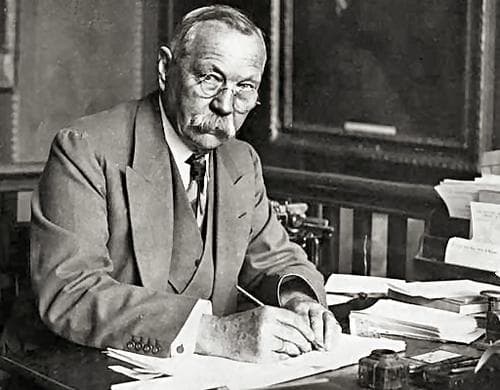
Sir Arthur Ignatius Conan Doyle was a British writer and physician. He created the character Sherlock Holmes in 1887 for A Study in Scarlet, the first of four novels and fifty-six short stories about Holmes and Dr. Watson. The Sherlock Holmes stories are milestones in the field of crime fiction.







