“It is not a question of art. It is a question of truth.”
— Early in the novel, reflecting on the nature of what is being observed and recorded.

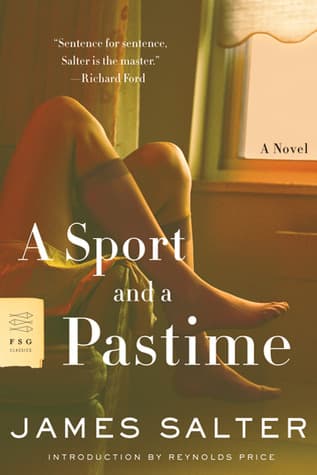
James Salter (1967)
Genre
Literary Fiction / Romance
Reading Time
240 min
Key Themes
See below
Sign in to track this book
In 1960s France, a Yale dropout and a young French girl begin a secret affair, their encounters imagined and observed, blurring reality and dreams.
The story begins with the American narrator telling about the affair between Philip Dean, a wealthy Yale dropout, and Anne-Marie Costallat, a young French shopgirl. The narrator, who seems to observe or imagine their lives in detail, first describes Philip's arrival in France and his distant manner. He then introduces Anne-Marie as a beautiful, somewhat innocent girl working in a shop in Autun. Their first meeting happens almost by chance, a brief talk that starts an immediate, unspoken attraction. The narrator highlights the difference between Philip's American freedom and Anne-Marie's more restricted French life, setting the scene for their passionate, but ultimately short-lived, relationship.
Philip and Anne-Marie's relationship quickly grows. The narrator details their early dates, which often include driving through the French countryside in Philip's sports car, eating simple meals, and spending time in cafés. These moments are full of unspoken desires and hesitant physical contact. The narrator notes Anne-Marie's growing interest in Philip's foreignness and his American casualness, while Philip is drawn to her youth and the newness of their secret affair. Their physical intimacy begins with stolen kisses and touches, slowly increasing as they find more private moments away from the eyes of small-town society. The narrator's descriptions are sensual, focusing on the details of their interactions.
To avoid being seen in Autun, Philip takes Anne-Marie to Dijon for a weekend. This trip marks a big step in their physical and emotional intimacy. The narrator describes their time in Dijon with vivid detail, focusing on their hours spent in a small hotel room. Here, their lovemaking becomes the main point, shown as raw, open, and all-consuming. The narrator explores the power dynamics in their sexual encounters, as well as moments of tenderness. This time in Dijon is shown as a bubble of pure passion, cut off from the outside world, where their only reality is each other's bodies and desires. Their strong connection during this time is clear.
Even with the physical intensity of their affair, the narrator often points out Philip's emotional distance. He shows Philip as a man who enjoys the physical relationship but keeps an inner distance, never fully committing or showing his deeper self. Anne-Marie, in contrast, becomes more devoted to Philip, her world shrinking to include only him. She finds joy in their stolen moments, often waiting anxiously for his calls or visits. The narrator describes her growing vulnerability and dependence, comparing it with Philip's casual view of their future. This imbalance creates an underlying tension, hinting at the affair's end and the chance for heartbreak.
The French landscape is more than just a background; it becomes an important part of the story. The narrator carefully describes their drives through Burgundy, the small towns, the changing seasons, and specific details of their surroundings—from the smell of the air to the quality of light. These descriptions are not just for atmosphere but often reflect the mood and progress of the affair. A private field or a quiet café provides the setting for intimate moments, while the large countryside emphasizes Philip's lack of roots and Anne-Marie's local life. The narrator's deep appreciation for France is clear, weaving the country's sensory experience into Philip and Anne-Marie's relationship.
Throughout the story, the narrator's presence is constant, but changing. He often shares his own thoughts, observations, and even doubts about how accurate his memories are. He admits to not always knowing the full truth, saying he imagines or invents details to fill gaps. This self-awareness blurs the line between objective reporting and personal interpretation. The narrator's descriptions are not just of Philip and Anne-Marie but also of his own process of remembering and building their story. He often questions his memories, asking 'Or was it?' or 'Perhaps it was…', making the reader aware of the story's constructed nature.
As the affair continues, moments of doubt and jealousy appear, especially for Anne-Marie. She becomes more possessive of Philip, fearing his eventual departure or the presence of other women. The narrator describes her worries, her desperate attempts to hold onto him, and her reactions to any perceived threat. Philip, on the other hand, remains largely unreadable, though the narrator sometimes mentions his past relationships, suggesting a history of similar brief encounters. These details highlight the affair's fragility and the emotional cost for Anne-Marie, who is clearly more invested than Philip. The dynamic of power and vulnerability becomes clearer.
Despite the initial intensity, the affair eventually settles into a pattern of secret meetings and passionate encounters. The narrator describes the rhythm of their days and nights, the familiar places they go, and the habits they form. However, beneath this routine lies the unspoken knowledge that their relationship cannot last. Philip's temporary status as an American abroad, combined with Anne-Marie's roots in her French life, creates a barrier. The narrator hints at the coming end, focusing on the short-lived nature of happiness and the bittersweet quality of their present. The future is a constant, unspoken presence, casting a shadow over their intense moments.
Inevitably, Philip plans to leave France. The narrator recounts his decision, which is presented without drama, almost as a natural part of his aimless life. The farewell between Philip and Anne-Marie is quiet but full of the weight of their shared past and the pain of separation. Anne-Marie is left behind, heartbroken but perhaps not surprised, to go back to her life in Autun. The narrator reflects on what happens next, the emptiness Philip leaves, and Anne-Marie's struggle to cope with his absence. The ending is not a grand climax but a quiet, sad fade, emphasizing the temporary nature of their love and Philip's freedom from commitment.
In the final parts, the narrator focuses on memory, loss, and the nature of love. He reflects on how the affair, though brief, leaves a lasting mark on Philip and Anne-Marie, and on himself as the one telling it. He thinks about how some moments shine brightly in memory, even as others fade. The narrator acknowledges that his storytelling is personal and reconstructed, admitting that the 'truth' of their relationship is perhaps less important than how vividly it is imagined. The book ends with a lingering sadness, a reminder of the beauty and sorrow of intense, brief connections, and the lasting power of human desire.
The Central Observer/Storyteller
The narrator's arc is not one of personal change, but rather a journey through the act of creation, grappling with the truth and beauty of his imagined narrative.
The Protagonist
Philip remains largely static, his transient nature and emotional detachment unchanged by the affair, reaffirming his rootless identity.
The Protagonist
Anne-Marie undergoes a profound emotional journey, from innocent fascination to deep love and ultimately, the pain of loss and the resilience of moving on.
The Mentioned
Not applicable; he remains a static background figure.
The Mentioned
Not applicable; she remains a static background figure.
The Supporting
The French countryside remains constant, enduring, and beautiful, providing a timeless stage for the transient human drama.
The novel explores the short-lived nature of passionate love. Philip and Anne-Marie's affair, though intense, is temporary because of Philip's wandering nature and Anne-Marie's settled life. The narrator constantly reminds the reader of its brief quality, showing it as a beautiful moment meant to fade. Scenes of their intimacy in Dijon are quickly followed by hints of Philip's eventual departure, showing that even deep connections can be short. This theme suggests that some loves are meant to be enjoyed for their intensity, not how long they last.
“What is it in love that we love? The other, or the never-to-be-recaptured moment of ourselves?”
A main theme is how memory is personal and often rebuilt, and how it creates a story. The narrator often questions his own memories, admitting to making up details or imagining scenes. This blurs the line between what 'really' happened and what is remembered or wished to have happened. The act of telling the story becomes as important as the story itself. This theme appears in the narrator's frequent comments, such as 'Perhaps it was…' or 'I want it to have been…', making the reader think about how reliable any story is, especially one born from desire and memory.
“There are some things that are true, and some things that are not. I have invented nothing, though I have imagined everything.”
The conflict between complete personal freedom and the limits of commitment is mainly shown through Philip. He represents a life without obligations or deep ties. His attraction to Anne-Marie is purely for the experience and passion, without any plan for a future. Anne-Marie, in contrast, wants commitment and stability, which eventually leads to her heartbreak. The novel looks at the appeal and cost of such freedom, suggesting that while it allows for intense experiences, it also prevents lasting connection and often leaves emotional damage. Philip's constant movement and departure highlight this theme.
“He lived in the present, which was a kind of freedom, but also a kind of blindness.”
Sensuality is a widespread theme, explored through vivid descriptions of physical intimacy. The novel looks at the raw aspects of the affair, focusing on Philip and Anne-Marie's bodies and the pleasure they find together. Beyond sex, the theme includes all sensory experiences: the taste of food, the smell of the air, the feel of the French countryside, and the nuances of touch. The body is shown not just as a vessel for love, but as the main way the characters connect and understand each other, often more than words. This focus makes the affair feel real and immediate.
“They were young, and the world was their skin.”
The dynamic between Philip, the American, and Anne-Marie, the Frenchwoman, shows the appeal of the foreign. Philip is drawn to Anne-Marie's French charm, her innocence, and the newness of a European affair. For Anne-Marie, Philip represents an exciting escape from her ordinary life—his American casualness, wealth, and freedom are captivating. This theme explores how cultural differences can fuel passion and interest, adding adventure and mystery to their relationship. However, it also shows the inherent disconnect, as their different worlds ultimately make a lasting union impossible, with Philip eventually returning to his own 'foreign' land.
“He was from a country of highways and open spaces. She was from a country of ancient towns and closed doors.”
The narrator openly admits to imagining and inventing parts of the story, blurring truth and fiction.
The narrator's self-awareness regarding his own storytelling process is a key device. He frequently questions the veracity of his memories and admits to filling in gaps with imagination, stating, 'I have invented nothing, though I have imagined everything.' This makes the reader constantly question the 'truth' of the narrative and emphasizes that the story is a subjective recreation rather than an objective account. It adds a layer of meta-commentary on the nature of memory and fiction itself, inviting the reader to participate in the act of creation and interpretation.
The narrator describes intimate scenes with a detached yet intensely detailed gaze, akin to a voyeur.
The narrator's descriptions of Philip and Anne-Marie's sexual encounters are often graphic and extremely detailed, but delivered with a certain emotional distance. This creates a voyeuristic effect, as if the reader (and the narrator) is an unseen observer privy to their most private moments. This device heightens the sensuality of the novel and immerses the reader in the characters' physical experience, while simultaneously maintaining the narrator's emotional remove, reinforcing the idea that he is an observer rather than a participant.
The narrative flows through thoughts, memories, and sensory details, often non-linearly.
The story does not always follow a strict chronological order. Instead, it often jumps between scenes, memories, and the narrator's reflections, creating a fragmented, dream-like quality. The narrative is driven more by sensory impressions, emotional states, and philosophical musings than by a linear plot. This mirrors the subjective nature of memory and the way thoughts often flow, making the reading experience immersive and impressionistic, much like recalling a vivid, yet incomplete, dream or memory of an intense affair.
The physical setting of France reflects the characters' emotions and the themes of the story.
The French countryside, towns, and specific locations are not merely backdrops but serve as powerful symbols. The ancient, rooted nature of France contrasts with Philip's transience and Anne-Marie's provincial life. The changing seasons often mirror the progression of the affair, from the blossoming intensity of summer to the fading melancholy of autumn. Secluded spots in the countryside symbolize the private, hidden nature of their love, while the open roads represent Philip's freedom and eventual departure. The landscape is imbued with emotional resonance, becoming an active participant in the story's themes.
“It is not a question of art. It is a question of truth.”
— Early in the novel, reflecting on the nature of what is being observed and recorded.
“The great affair is to move. To feel the heat of the road, the wind in your face, the sun on your neck.”
— Philip's general philosophy on travel and experience.
“We are like the people in the old stories, you and I. We are like the people who lived in the days when things were still possible.”
— Vian's perspective on her relationship with Philip.
“Love is just a word. It's what you do with it that matters.”
— A pragmatic view on the nature of love within the story.
“There are some things you do not forget, even if you want to. And there are some things you remember that never happened.”
— The narrator's reflection on memory and its unreliability.
“The past is a foreign country; they do things differently there.”
— A general observation on the passage of time and the nature of memory, though a famous quote from another author, it resonates strongly with the novel's themes.
“She was like a book that had been read many times, but never understood.”
— The narrator's description of Vian.
“He knew that the true adventure was not in the places he went, but in the way he went to them.”
— Philip's internal reflection on his travels and experiences.
“The only real things were the ones that were happening now.”
— A focus on the present moment, a recurring theme.
“Life was a series of choices, and each choice closed off a thousand others.”
— A philosophical musing on the nature of life and decision-making.
“He loved her with the kind of love that made him want to hurt her, to possess her completely.”
— A darker aspect of Philip's passion for Vian.
“Beauty is a trap. It is a way of holding you captive.”
— A cynical view on the nature of beauty and its effects.
“The true story is never the one that is told.”
— The narrator's self-awareness about the subjective nature of his account.
“They were simply there, existing, like the river, like the trees.”
— A description of the characters' simple, unadorned existence in certain moments.
Ready to see how well you understood this book? Take our interactive quiz with 10 questions.

Biography coming soon.







