“It's a wonder it didn't smash all the trees and turn the mountains to fire and blow the world over.”
— Travis describing the immense power and danger of the T-Rex.

Ray Bradbury (2005)
Genre
Fantasy / Science Fiction
Reading Time
15 min
Key Themes
See below
Sign in to track this book
In a future where prehistoric safaris are a luxury, one misplaced step in the past unravels time and civilization.
In 2055, Travis, the safari leader, explains the strict rules of Time Safari, Inc. to the wealthy hunter Eckels. Eckels, an eager but somewhat proud man, pays a lot for the chance to hunt a Tyrannosaurus Rex. Travis stresses how important it is to stay on the anti-gravity Path, warning that even a small change could alter the future. He explains they only hunt dinosaurs already set to die, to minimize impact on the past. Eckels seems more interested in the thrill than the seriousness of the rules.
Eckels, Travis, and two other hunters, Billings and Kramer, along with Travis's assistant, Lesperance, enter the time machine. Lesperance, a 'time-traveling scout,' had found a Tyrannosaurus Rex that would die within minutes of their arrival, ensuring their hunt would not change history. The group travels sixty million years back to the Tertiary Period. The journey itself is disorienting and impressive. They arrive in a primeval landscape, very different from their future world.
In the prehistoric jungle, Travis again stresses that everyone must stay on the anti-gravity Path, a shimmering metallic track above the ground. He explains that even one changed blade of grass could cause huge changes in the future, comparing it to the 'butterfly effect.' The Path keeps them from touching the past environment, preventing contamination. Eckels hears the warnings, but the vastness and strangeness of the past overwhelm him, and his initial confidence turns to unease and fear.
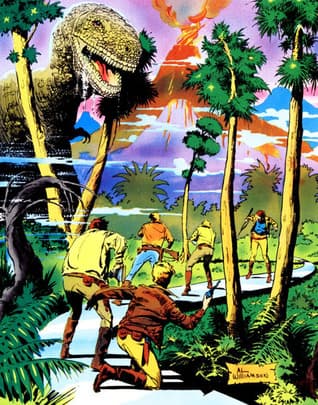
The group soon finds their target: a huge Tyrannosaurus Rex, described as a 'mountain of flesh' and 'death in a forest.' Its immense size and power are overwhelming. Eckels, at first confident, is frozen by fear. He sees the dinosaur's eyes, its huge jaws, and hears its loud roar. The reality of the beast breaks his composure, making him understand the true danger and scale of his undertaking. His courage completely disappears in the face of such raw power.
As the Tyrannosaurus Rex charges, Eckels, terrified, panics. He drops his rifle and, against all warnings, stumbles off the anti-gravity Path. Travis screams at him to return, but Eckels, in shock, runs into the jungle for safety. Billings and Kramer manage to shoot the dinosaur, killing it, but the harm is done. Eckels's careless act of leaving the Path, driven by his fear, has possibly started an irreversible chain of events, breaking the most important rule of Time Safari, Inc.
After the Tyrannosaurus Rex dies, Travis is furious. He scolds Eckels for his fear and for leaving the Path, emphasizing the extreme danger Eckels caused and the possible future consequences. He forces Eckels to retrieve the bullets from the dinosaur's body, a grim task meant as punishment and to ensure no foreign material remains in the past. Eckels, now ashamed and afraid of Travis's anger, must face the scale of his mistake, understanding he broke a crucial rule.
The group, including a shaken Eckels, boards the time machine to return to 2055. The tension inside the machine is thick. Travis remains angry at Eckels, who is now quiet and afraid. As they travel through time, the subtle shifts of temporal displacement are again described, but this time, they feel threatening. Everyone wonders if Eckels's mistake truly had an impact, or if they escaped consequences. Suspense builds as they near their own time.
When they arrive back in the Time Safari office, small changes are immediately clear. The air feels different, there's a strange chemical smell, and the Time Safari, Inc. sign looks slightly off. Travis and Lesperance notice these differences with growing alarm. Eckels also senses something wrong, a feeling of unease that grows with each observation. The familiar environment now feels subtly strange, suggesting the past has indeed changed, even if the full extent is not yet clear. Dread increases for everyone.
Eckels feels a strange need to check the bottom of his mud-caked boots. There, stuck in the sole, is a small, dead, golden butterfly. This small detail explains the big changes. He realizes that when he stumbled off the Path, he accidentally stepped on this butterfly, changing the delicate balance of the prehistoric ecosystem. Travis, seeing the butterfly, is horrified and angry, confirming his worst fears. The Time Safari, Inc. sign now reads 'TYME SAFARI, INC.,' and the English language itself has subtly shifted.
The biggest and most alarming change is the result of the recent presidential election. Before they left, a liberal, democratic candidate had won, but now a fascist leader named Deutscher is in power. This drastic political shift confirms the catastrophic impact of Eckels's actions. Travis, devastated and enraged by the irreversible damage, raises his rifle. Eckels, understanding his fate, begs for his life, but it is too late. The story ends with 'A Sound of Thunder,' implying Travis shoots Eckels, the final, tragic result of a single, carelessly crushed butterfly.
The Protagonist/Foil
Eckels transforms from an overly confident hunter to a terrified, remorseful man who inadvertently causes catastrophic changes to the future, ultimately paying the ultimate price.
The Antagonist/Moral Compass
Travis begins as a strict but professional guide and ends as a devastated and vengeful enforcer of cosmic law, driven to extreme measures by Eckels's transgression.
The Supporting
Lesperance remains a consistent and responsible figure, serving as a foil to Eckels's recklessness.
The Supporting/Mentioned
Billings remains a static character, representing the more responsible hunter.
The Supporting/Mentioned
Kramer remains a static character, acting as another example of a typical, rule-abiding client.
The Mentioned
Deutscher's existence and political victory signify the catastrophic change in the timeline.
Even the smallest change in the past can have huge and unpredictable consequences on the future. Travis explains this, warning that a crushed mouse could 'tip the scales of the future.' This is clearly shown when Eckels steps on a butterfly, leading to a changed language, a different political landscape, and a chilling shift in human civilization. The story emphasizes how all events are connected and the great responsibility that comes with altering the past.
“A mouse could destroy an earthquake. A butterfly could change the world.”
The story criticizes human arrogance and the belief that technology means freedom from consequences. Eckels shows this, paying a lot for a dangerous thrill, but lacking the respect and discipline needed. His initial confidence hides his fear, and his disregard for Travis's warnings about staying on the Path comes from a sense of entitlement and a failure to understand the seriousness of his actions. His carelessness leads to disaster, showing the dangers of human pride when using great power, like time travel.
“He's not a hunter. He's a fool.”
Fear drives much of the story, especially for Eckels. At first confident, he is paralyzed by terror when faced with the raw power of the Tyrannosaurus Rex. His fear causes him to abandon his post and, importantly, to step off the Path. This act of fear is not just a personal failure but has cosmic results. The story explores how fear can override reason and responsibility, leading to choices with devastating, unforeseen consequences. Eckels's final punishment results directly from his inability to control his fear.
“It was a sound like a great volume of thunder. It was the sound of a Tyrannosaurus Rex.”
The story strongly emphasizes that actions have consequences, especially when they affect something as basic as the timeline. Travis's initial warnings are not suggestions but absolute rules, and when Eckels breaks them, the punishment is swift and final. The altered future, with its changed language and fascist leader, is a direct result of Eckels's single careless step. The story ends with Travis's execution, a grim form of justice and the ultimate price for altering existence.
“We don't belong here. We're an anachronism. We don't even belong in our own time anymore.”
An anti-gravity track designed to prevent contact with the past.
The Path is a crucial plot device, serving as a physical manifestation of the rules of time travel. It is a shimmering, metallic track suspended above the prehistoric jungle, explicitly designed to prevent the hunters from touching anything in the past. It symbolizes the delicate balance of the timeline and the absolute necessity of non-interference. Eckels stepping off the Path directly triggers the story's central conflict and its devastating consequences, making it a pivotal element in demonstrating the 'butterfly effect'.
The seemingly insignificant object that causes monumental changes.
The dead butterfly found on Eckels's boot is the ultimate symbol of the 'butterfly effect' and the story's central plot device for revealing the altered future. Its discovery provides concrete proof that Eckels's transgression had a profound impact. The small, seemingly harmless act of crushing a butterfly sixty million years ago leads to drastic changes in language, politics, and potentially the entire course of human civilization, underscoring the story's theme about the fragility of time and the weight of even minor actions.
The advanced technology enabling prehistoric safaris.
The time machine is the primary technological plot device that facilitates the entire premise of the story. It allows the characters to travel to the past, creating the opportunity for the conflict to unfold. While its mechanics aren't detailed, its existence highlights humanity's advanced technological capabilities. More importantly, it serves as a vehicle for exploring the ethical and existential dilemmas that arise when such power is wielded, especially by those who may not fully grasp its implications or dangers.
A recurring motif signifying danger, power, and finality.
The 'sound of thunder' serves as a powerful motif throughout the story. Initially, it refers to the terrifying roar and footsteps of the Tyrannosaurus Rex, signifying primal power and danger. Later, it subtly recurs when the time machine lands, hinting at the immense forces at play. Finally, it serves as the ambiguous but definitive ending, implying the sound of Travis's rifle shot as he executes Eckels. This recurring sound links the prehistoric threat, the act of time travel, and the ultimate, violent consequence, giving the title a profound double meaning.
“It's a wonder it didn't smash all the trees and turn the mountains to fire and blow the world over.”
— Travis describing the immense power and danger of the T-Rex.
“A sound of thunder.”
— Eckels's initial description of the Tyrannosaurus Rex.
“We don't want to change the future. We don't want to kill a thing that has a future.”
— Travis explaining the strict rules of time travel and its potential impact.
“Every time you walk in the past, you're walking on eggs.”
— Travis warning Eckels about the extreme fragility of the past.
“Step on one mouse and you crush a pyramid of mice toward the stars.”
— Travis explaining the butterfly effect and the potential for massive changes.
“A little thing like that can change the world.”
— Travis emphasizing the far-reaching impact of even minor alterations to the past.
“The past is an untouchable thing, a perfect thing, a thing that cannot be changed.”
— Travis's initial, strict view on the immutability of the past.
“Does this safari guarantee I come back alive?”
— Eckels's question before the time travel safari, showing his initial concern.
“The sign on the wall seemed to shimmer under a film of oil, as if the letters were melting.”
— Eckels observing subtle changes to the present after returning from the past.
“It was a tiny thing, a butterfly, of the most exquisite color and symmetry.”
— The discovery of the dead butterfly, the cause of all the changes.
“That was the sound of thunder.”
— The final line of the story, as Travis raises his rifle.
“History has changed!”
— Eckels's horrified realization upon seeing the altered present.
“He felt his heels sink into the wet soil, and he knew he was lost.”
— Eckels's moment of panic and despair when facing the Tyrannosaurus Rex.
“The air was cold, a cold that was not of the weather, but of the time.”
— Describing the unusual sensation of being in the prehistoric past.
Ready to see how well you understood this book? Take our interactive quiz with 10 questions.
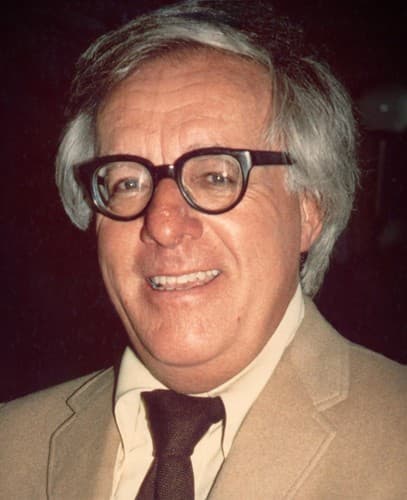
Ray Douglas Bradbury was an American author and screenwriter. One of the most celebrated 20th-century American writers, he worked in a variety of modes, including fantasy, science fiction, horror, mystery, and realistic fiction.







