“A single shard from a celadon vase, if it is of the right quality, is enough to tell the whole story of the vase.”
— Min explains to Tree-ear the value of a single piece of pottery.

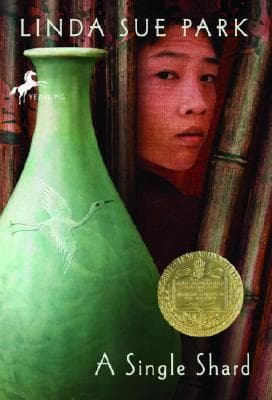
Linda Sue Park (2001)
Genre
Children's / Historical Fiction / Young Adult
Reading Time
180 min
Key Themes
See below
Sign in to track this book
An orphaned boy in 12th-century Korea dreams of making celadon pottery. He works hard and travels far to prove his skill, even when only a single pot fragment remains.
Tree-ear, a young orphan, lives under a bridge with his guardian, Crane-man, outside Ch’ulp’o, a village known for its celadon pottery. Tree-ear spends his days looking for food and watching the potters, especially the skilled but difficult Master Min. He is fascinated by how celadon is made, often watching Min from a distance. One day, Tree-ear follows Min into his workshop and accidentally breaks a finished pot. This act, caused by his strong desire to understand the craft, starts a series of events that will change his life.
Because he broke Min’s pottery, Tree-ear offers to work for Min for nine days to pay him back. Min, known for being strict, agrees. Tree-ear’s first jobs are hard: chopping wood, digging and carrying heavy clay, and preparing it for Min. He handles Min's harshness and the physically demanding work without complaining. He hopes to learn the craft. Crane-man, his wise guardian, encourages him and gives him advice, helping Tree-ear get through the tough conditions and Min's high expectations. Tree-ear's hard work slowly starts to impress Min, though it is not said aloud.
After the first nine days, Min does not send Tree-ear away, and the boy continues his hard work, now without a specific end date. Tree-ear's main jobs remain preparing clay – a physically demanding and repetitive task. During this time, he grows fond of Min's wife, Ajima, who is kind to him, often giving him food and quiet encouragement, which is different from Min's quiet nature. Tree-ear keeps watching Min's pottery work with great focus, learning every detail, though he is never allowed to touch the clay for shaping. He secretly practices making small clay figures in his free time, improving his hand skills.
A royal official, Emissary Kim, comes to Ch’ulp’o to order celadon pieces for the royal court. This event is important for all the potters, as a royal order brings great respect and money. Min works hard to make his best pieces, hoping for recognition. However, during the selection, Emissary Kim chooses the work of other potters, specifically Kang, over Min's. Min is very disappointed and upset, believing his skill is better. He breaks his own unchosen pieces in frustration, a sight that affects Tree-ear and Ajima, showing Min's strong artistic pride and feelings.
After the royal official rejects his work, Min becomes more quiet but also more determined. He starts to try a very complex and new inlay technique for his celadon – a method of carving designs into the unfired clay, filling them with white or black slip, and then carefully scraping away the extra before glazing and firing. This technique is very difficult and takes a lot of time, needing great precision and patience. Tree-ear, still doing his daily chores, watches Min's new work with wonder, seeing the master's constant search for perfection and new ideas, even after past problems.
Min, having perfected his new inlay technique, makes two beautiful celadon vases. He decides to send them to the royal court in the capital city of Songdo, hoping to get an order directly. However, Min is too old and weak for the long, dangerous trip. To Tree-ear's surprise and honor, Min trusts him with the valuable vases. Tree-ear is to travel alone to Songdo, show the pottery to Emissary Kim, and return with news. This mission shows Min's growing trust in Tree-ear and the boy's strong dedication, marking a big change in their relationship.
Tree-ear starts his trip alone to Songdo, carrying the two valuable celadon vases in a strong basket. The journey is long and hard, testing his strength and bravery. He faces many problems: sleeping outside, finding little food, and dealing with bad weather. He constantly worries about the vases, knowing how valuable they are and the trust Min has placed in him. His thoughts often go to Crane-man, whose wisdom and practical advice help him through moments of fear and loneliness, strengthening his decision to complete his mission.
As Tree-ear gets close to Songdo, two bandits attack him. Despite his attempts to protect them, the bandits smash both of Min's beautiful celadon vases, looking for valuables they think are hidden inside. Tree-ear is sad and left with only a basket of broken pieces. In his sadness, he sees one perfect, intricately inlaid piece among the fragments. This single piece, showing the beauty and skill of Min's work, becomes his new goal. He decides, sadly, to continue to Songdo and show this fragment as proof of Min's mastery, instead of going back in defeat.
Tree-ear, hurt and sad but determined, finally reaches Songdo. He finds Emissary Kim and, with shaky hands, presents the single, perfect celadon piece. He tells the story of the bandits and how the vases were destroyed, explaining the great skill and art that went into making the original pieces. Emissary Kim, at first doubtful, is very impressed by the piece's beautiful inlay work and by Tree-ear's honesty, persistence, and loyalty. Seeing the true genius in the fragment, Emissary Kim agrees to order Min to make more pieces for the royal court, completing Tree-ear's difficult mission.
Tree-ear returns to Ch’ulp’o, eager to tell Min and Crane-man the good news. However, he finds that Crane-man has died after falling from the bridge. Heartbroken by the loss of his guardian, Tree-ear is comforted by Min and Ajima. Ajima, showing her deep affection, officially adopts Tree-ear, giving him a new name, Hyung-pil, meaning 'Elder Brother.' Min, recognizing Tree-ear's loyalty and his own changed view, begins to teach him how to make pottery, finally letting him touch the clay. Tree-ear, now Min's son and apprentice, has found a family and a way to achieve his dream.
The Protagonist
Tree-ear transforms from a nameless orphan to Min's adopted son and apprentice, finding a family and a path to his dream.
The Supporting
Min's character softens, moving from a solitary, demanding master to a mentor and adoptive father to Tree-ear.
The Supporting
Crane-man remains a consistent source of wisdom and support, his character arc defined by his role as a mentor and his eventual passing.
The Supporting
Ajima consistently provides emotional support, her arc culminating in her formal adoption of Tree-ear, solidifying his new family.
The Supporting
Emissary Kim's initial judgment is challenged and expanded by Tree-ear's presentation, leading him to recognize Min's genius.
The Mentioned
Kang serves as a catalyst for Min's artistic innovation, his role remaining largely static as a rival.
The theme of perseverance is important to Tree-ear's story. Despite constant hunger, hard work preparing clay, Min's harsh treatment, and the sad loss of Crane-man, Tree-ear never gives up on his dream or his tasks. His hard trip to Songdo, dealing with bandits and the broken vases, shows his strong dedication to Min and the craft. This theme is also clear in Min's constant search for artistic perfection, even after the royal official first rejected him, pushing him to master the inlay technique.
“A man's worth is not in what he has, but in what he does. And what he does, he does for others.”
As an orphan, Tree-ear at first lacks a clear identity and a sense of belonging. His desire to learn pottery is not just about the craft, but about finding a place and purpose. Living under a bridge with Crane-man, he forms a family, but his true belonging is found with Min and Ajima. The adoption and the new name, Hyung-pil, at the end of the story mean he is fully part of a family and community, giving him a defined identity as Min's son and apprentice. His journey is one of self-discovery through service and loyalty.
“He would not be a nameless, faceless boy. He would be Min's son.”
The novel looks at what makes true artistry through Min's character. Min's initial sadness after Emissary Kim ignores his work makes him innovate, not quit. He pushes the limits of celadon by developing the complex inlay technique, showing that true artists are driven by a personal desire for perfection and new ideas, not just outside approval. Tree-ear's deep appreciation for the beauty of the single piece, even after the vases are broken, shows the inherent value of art and the artist's vision.
“The potter's work was not a job, it was a calling.”
The relationship between Tree-ear and Min changes from master-servant to mentor-student and eventually, father-son. Tree-ear's strong loyalty, respect, and dedication to Min reflect the Confucian value of respect for elders, even before he is formally adopted. Crane-man also acts as an important mentor, teaching life lessons and moral rules. These mentorships are key to Tree-ear's growth, while Min's eventual acceptance of Tree-ear as his heir shows the passing down of knowledge and tradition, a deep form of respect and love.
“It was not enough to wish for a thing. One must work for it.”
A central symbol representing beauty, craft, and the characters' aspirations.
The celadon pottery itself is a powerful symbol throughout the novel. It represents not only a beautiful art form but also the aspirations and struggles of the characters. For Min, it is his life's work and his legacy. For Tree-ear, it embodies his deepest desire to create and belong. The creation process—from digging clay to the final firing—mirrors Tree-ear's own arduous journey of growth and transformation. The destruction of the vases and the preservation of the single shard symbolize resilience and the enduring power of art.
A potent symbol of resilience, artistic merit, and the triumph of spirit.
The single celadon shard becomes the ultimate symbol of the story. After the two magnificent vases are destroyed by bandits, this one perfect fragment represents the enduring beauty and skill of Min's work. It embodies the idea that true artistic merit can be recognized even in a small piece, and that value is not solely in completeness or quantity. For Tree-ear, carrying this shard to the emissary requires immense courage and conviction, turning a devastating loss into a testament of perseverance and hope.
Fables and advice that guide Tree-ear and impart life lessons.
Crane-man frequently shares stories, parables, and words of wisdom with Tree-ear. These serve as a narrative device to impart important life lessons and philosophical insights, often foreshadowing or providing commentary on Tree-ear's experiences. For example, his advice on patience and finding beauty in small things helps Tree-ear cope with his difficult circumstances and fuels his perseverance. Crane-man's wisdom acts as Tree-ear's moral compass and inner voice, especially during his solitary journey.
A symbolic dwelling representing Tree-ear's marginalized status and eventual transition.
The bridge under which Tree-ear and Crane-man live is more than just a dwelling; it is a powerful symbol of their marginalized status as orphans and outcasts. It represents a liminal space, neither fully part of the village nor entirely separate. As Tree-ear's circumstances change and he gains a family and a purpose, he leaves the bridge, symbolizing his transition from an isolated existence to one of belonging and integration into society. The bridge also represents the foundation of his early life and his bond with Crane-man.
“A single shard from a celadon vase, if it is of the right quality, is enough to tell the whole story of the vase.”
— Min explains to Tree-ear the value of a single piece of pottery.
“Work gives a man dignity, stealing takes it away.”
— Crane-man advises Tree-ear about honesty and labor.
“A potter is a farmer of the earth. He plants his pots in the kiln and hopes for a good harvest.”
— Min describes the craft of pottery-making.
“The journey of a thousand ri begins with a single step.”
— Tree-ear reflects on his long journey to Songdo.
“Even the most skilled potter cannot make a perfect pot every time.”
— Min acknowledges the imperfections in his work.
“A man's worth is not measured by what he owns, but by what he does.”
— Crane-man teaches Tree-ear about character.
“The clay remembers the touch of the potter's hand.”
— Min explains the intimate connection between artist and material.
“Sometimes the heart must speak when the mouth cannot.”
— Tree-ear struggles to express his gratitude to Min.
“A true artist does not hide his mistakes; he learns from them.”
— Min discusses the importance of flaws in pottery.
“Hope is the last thing to die in a man's heart.”
— Tree-ear perseveres through hardship on his journey.
“The kiln is a potter's greatest teacher.”
— Min explains how firing pottery reveals its true quality.
“A broken pot can be mended, but a broken promise cannot.”
— Crane-man emphasizes the importance of keeping one's word.
“Beauty is not in the eye of the beholder, but in the hand of the maker.”
— Min reflects on the creation of celadon pottery.
“The road is long, but the heart is longer.”
— Tree-ear finds inner strength during his travels.
Ready to see how well you understood this book? Take our interactive quiz with 10 questions.

Biography coming soon.

Dan Gemeinhart
4.5

Kate O'Hearn
4.4

Jeanne Birdsall
4.4

Jen Wang
4.4

Wendelin Van Draanen
4.3

John Marsden
4.3

Chris Van Allsburg
4.3

Jennifer A. Nielsen
4.2