“Hell is repetition. Hell is the same thing over and over again, until you can't stand it anymore, and then you do it again.”
— The protagonist reflects on the nature of his eternal punishment in the Library of Babel.

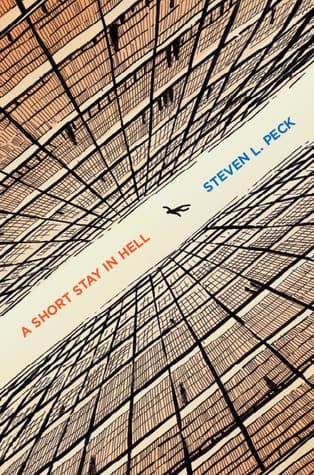
Steven L. Peck (2012)
Genre
Fantasy / Spirituality / Science Fiction / Philosophy
Reading Time
90 min
Key Themes
See below
Sign in to track this book
After a Mormon geologist dies, he awakens in a cosmic library of Hell, where his only escape is to find the book of his life in an eternity where all his earthly beliefs are wrong.
Soren Johansson, a devout Mormon, geologist, and family man, dies peacefully in his sleep. He expects to awaken in the Celestial Kingdom with his beloved wife, Emily, and their children. Instead, he finds himself in a massive, seemingly infinite library filled with books, but no people he recognizes. A voice, later identified as a 'Demon of the Lord,' tells him he is in Hell, a place not of eternal torment, but of endless, futile searching. This God is not the one he worshipped, and His judgment is based on finding the single book that perfectly describes Soren's life among an infinite number of variations. Soren is shocked and disoriented by this alien eternity, a stark contrast to his cherished beliefs.
The 'Demon' explains that Soren's Hell is a library containing every book ever written, every book that could be written, and every book that never will be written, including infinite variations of his own life story. To escape to a 'higher' heaven, Soren must find the one book that is a perfect, word-for-word account of his earthly existence. The Demon emphasizes how nearly impossible this task is, given the library's size and the subtle variations between books. Soren is given a small, Spartan room within the library and begins his search, initially overwhelmed by the sheer scale and the realization that his deeply held faith was entirely wrong.
Initially, Soren approaches the task with the same diligent, organized mind he applied to geology. He tries to devise systems for searching, categorizing, and eliminating books. He reads countless volumes, finding books that are almost his life story, differing by a single word or a minor event. The endless variations, the subtle shifts in narrative, and the sheer volume of books quickly erode his hope. He realizes the task is not merely difficult, but mathematically impossible. The weight of infinite possibilities and the absence of his family begin to take a toll on his mental and emotional state, pushing him towards despair.
Over vast stretches of time, Soren encounters other 'searchers' in the library, individuals from different cultures and belief systems, all tasked with the same impossible quest. He observes their varying coping mechanisms: some meticulously catalog, others wander aimlessly, some descend into madness, tearing pages or creating their own nonsensical 'books.' Soren witnesses the gradual decay of their identities, as memories blur and personalities fragment under the relentless pressure of eternity. He sees the physical deterioration of some, their bodies becoming frail and their minds lost, a grim foreshadowing of his own potential fate.
Time becomes meaningless in the library. Soren experiences epochs that dwarf the entire history of the universe. He reads billions upon billions of books, his memories of his earthly life, his wife Emily, and his children slowly fading into a generalized ache. The details become hazy, the faces less distinct. He struggles to recall specific events, making his search even more impossible as he can no longer definitively identify his own story. The vastness of eternity and the endless repetition of similar but incorrect narratives warp his perception of reality, blurring the lines between what was real and what he has merely read.
As eons pass, the library's structure and inhabitants evolve. The 'scavengers,' beings who feed on the decaying books and knowledge, emerge from the dust and forgotten corners. These creatures are a new threat, embodying the library's indifference and its capacity for decay. Soren learns to navigate these new dangers; his existence is reduced to a primal struggle for survival and the continuation of his futile search. The library is not static; it is a changing entity that mirrors the slow, grinding destruction of the searchers' hopes and sanity.
Despite the unimaginable length of his stay and the erosion of his memories, a deep-seated, almost instinctual desire to reunite with Emily and his children persists. This faint glimmer of hope, however irrational, is the only thing that prevents him from succumbing entirely to the library's madness or simply giving up. He occasionally finds books that evoke strong emotional responses, brief echoes of his past life, which rekindle his resolve, however fleetingly. He understands that finding 'his' book is not just about escape, but about validating the life he lived and the love he shared.
Soren eventually realizes his own memories, now corrupted and incomplete, are hindering his search. To truly identify 'his' book, he needs an objective, perfect record. He considers finding a book that meticulously details the life of someone else, then using that as a template to refine his search for his own. This thought is horrifying, as it implies a further detachment from his own past. He grapples with the idea of intentionally forgetting or discarding what remains of his personal history to become a more efficient, less human, searcher.
After billions of years, Soren makes a final, heartbreaking decision. He acknowledges the impossibility of his task as a single individual. He starts a new project: meticulously copying books that are 'almost' his life, hoping that future searchers might benefit from his work, or perhaps that in the act of copying, he might stumble upon his own story. This act is both a surrender and a defiant assertion of meaning in a meaningless existence. He accepts that his eternity is likely within the library, but he chooses to spend it in a way that creates a legacy, however small, for the infinite future. He becomes a part of the library's fabric, a living archive.
As Soren continues his copying, he occasionally finds books that resonate deeply, not because they are *his* life, but because they capture the essence of love, family, and human experience. He finds a specific book that, while not his own, contains a passage that perfectly articulates the love he felt for Emily. This moment provides a bittersweet sense of connection and validation. It suggests that even in a hell of infinite variations and forgotten identities, fundamental human experiences, like love, can transcend individual stories and persist as universal truths, offering a small measure of comfort in his eternal, solitary quest.
The Protagonist
Soren transforms from a hopeful believer to a despairing searcher, eventually finding a strange form of acceptance and purpose within his eternal punishment.
The Supporting/Mentioned
Emily remains a static memory and an ideal, representing Soren's unchanging longing.
The Supporting
The Demon of the Lord remains a static, expository figure, representing the unchanging rules of the afterlife.
The Supporting
Their individual arcs are largely unseen, but collectively they demonstrate the universal degradation of humanity in the library.
The Mentioned
The Scavengers emerge as the library ages, symbolizing its ongoing, indifferent evolution.
The novel explores the philosophical concept of absurdity, where human yearning for meaning clashes with a silent, indifferent universe. Soren's task in the infinite library—to find a single, perfect book among an endless sea of variations—is meaningless. His deeply held religious beliefs are rendered irrelevant by a new, arbitrary God. The passage of eons, the erosion of memory, and the inevitable descent into madness for most searchers highlight the futility of their struggle, forcing Soren to confront a universe devoid of inherent purpose or justice, where even 'Hell' is a bureaucratic, logical, yet cruel, exercise.
““Welcome to Hell. Not the Hell you imagined, perhaps, but a Hell nevertheless.””
A central theme is the fragility of human identity when stripped of context, relationships, and the passage of meaningful time. Soren's memories of Emily and his children, initially sharp, slowly fade into a generalized longing. The details of his earthly life blur, making his task impossible and his sense of self increasingly tenuous. The library, with its infinite variations of lives, actively works to dismantle individual identity, suggesting that without a fixed narrative and the preservation of personal history, the self dissolves. Soren's struggle to recall specific events shows how memory is crucial for maintaining identity and purpose.
““How could he find his book when he could no longer remember the details of his life?””
Soren's journey is a deconstruction of his lifelong Mormon faith. He expected a specific, loving afterlife with his family, only to find himself in a cold, alien 'Hell' ruled by an unknown God. This stark contrast forces him to confront the complete irrelevance of his earthly beliefs. The novel questions the nature of divine justice and mercy when confronted with an arbitrary, bureaucratic eternity. Soren's initial shock and subsequent despair illustrate the disillusionment that comes from having one's most fundamental assumptions about the universe utterly shattered, leaving him to build a new understanding of existence without the comfort of his old faith.
““His God was not this God. His heaven was not this heaven.””
Peck explores eternity not as a static state, but as an active, destructive force. Time in the library is measured in eons, far beyond human comprehension, leading to the erosion of memory, sanity, and even physical form. The library itself evolves, showing that even infinite systems change and decay. The narrative forces the reader to grapple with the philosophical implications of truly endless time, where all human endeavors, including the search for meaning, eventually become meaningless. Eternity here is a punishment not of active torment, but of relentless, grinding, impossible duration.
““There was no time in Hell. Only a vast, endless now that stretched into an infinite future.””
Despite the overwhelming isolation and the erosion of his memories, Soren's love for Emily and his children remains a persistent, if faded, anchor. This enduring emotional connection, even when the specifics are lost, highlights the human need for connection and the power of love to transcend even the most absurd and dehumanizing circumstances. His final act of copying books, particularly those that evoke universal truths about love, suggests that even in a solitary eternity, the shared experience of human affection can offer solace and meaning, a fragile defiance against cosmic indifference.
““Sometimes, in the quiet between books, he would hear Emily’s voice, a whisper from a life long gone.””
The central setting and primary antagonist, embodying cosmic indifference and existential despair.
The library is not merely a setting but a character and a powerful plot device. It is a manifestation of Jorge Luis Borges's 'Library of Babel,' containing every conceivable book, including infinite variations of Soren's life. This device creates the central conflict: an impossible task in an infinite space. Its vastness, the endless variations, and its indifferent nature serve to strip Soren of hope, memory, and identity, forcing him to confront the absurdity of his existence. It functions as a literal and metaphorical representation of the universe's indifference and the human struggle to find meaning within it.
A psychological device that heightens the protagonist's despair and makes his task impossible.
The gradual fading of Soren's memories of his earthly life, particularly of his wife and children, is a crucial psychological plot device. It directly undermines his ability to complete his task (finding 'his' book) and intensifies his suffering. This erosion highlights the fragility of human identity when confronted with infinite time and the absence of familiar anchors. It transforms his longing from specific memories into a generalized ache, making his quest not just physically impossible, but mentally and emotionally devastating, as the very thing he seeks to preserve (his past) is slowly taken from him.
A narrative voice that establishes the rules of the afterlife with detached, bureaucratic logic.
The 'Demon of the Lord' serves as a crucial expository device. Unlike traditional demons, this entity is not malevolent but merely a detached, logical administrator. Its calm explanation of Soren's impossible task and the nature of this alien Hell immediately establishes the story's tone of cosmic indifference and bureaucratic absurdity. This voice reinforces that Soren's suffering is not a personal vendetta but a consequence of a vastly different, uncaring divine system, making his plight even more isolating and his former faith entirely irrelevant. It sets the stage for the novel's philosophical exploration of meaninglessness.
A narrative technique that emphasizes the crushing weight of eternity and the insignificance of human life.
The novel utilizes the concept of 'deep time' to convey the true horror of Soren's eternity. Instead of days or years, the narrative speaks of billions of years, epochs, and the slow evolution of the library itself. This device stretches human comprehension of time to its breaking point, showing how even the strongest human spirit and memory are utterly overwhelmed. It underscores the ultimate insignificance of an individual life in the face of true eternity and allows the story to depict the profound psychological and physical transformations that occur over such incomprehensible durations, leading to the loss of identity and hope.
“Hell is repetition. Hell is the same thing over and over again, until you can't stand it anymore, and then you do it again.”
— The protagonist reflects on the nature of his eternal punishment in the Library of Babel.
“The Library contains all possible books of a certain length. Every possible combination of letters and spaces. Every truth, every lie, every story ever told or never told.”
— Description of the infinite Library that serves as the setting for the protagonist's hell.
“You search for meaning in a place designed to have none. That's the real torture.”
— A conversation between characters about the futility of their quest in the Library.
“Time doesn't work here like it does back home. A day can feel like a century, and a century can pass in the blink of an eye.”
— The protagonist observes the distorted perception of time in hell.
“We are all just stories in the end. Some are longer, some are shorter, but they all end the same way.”
— A philosophical musing on the nature of existence and narrative.
“The only thing worse than finding nothing is finding something that makes no sense.”
— Reflecting on the frustration of discovering gibberish books in the Library.
“Hope is the cruelest invention of all. It keeps you going when you should have given up long ago.”
— A character expresses bitterness about the persistence of hope in their hopeless situation.
“In an infinite library, the chance of finding your own life's story is zero. But not zero enough to stop looking.”
— Commentary on the statistical impossibility and psychological drive of the search.
“We build our own hells out of the things we love the most.”
— An insight into how personal desires and attachments shape one's suffering.
“There are no new conversations here. Every word has been said before, in every possible order.”
— Noting the exhaustive nature of the Library's contents on communication.
“You don't realize how precious a single coherent sentence is until you've read a million pages of gibberish.”
— The protagonist appreciates clarity after enduring endless nonsense.
“The punishment isn't the search; it's the realization that the search is all there is.”
— A bleak epiphany about the nature of their eternal task.
“Even in hell, we find ways to love. Or maybe especially in hell.”
— Observing the persistence of human connection despite the setting.
“You can't go mad here. Madness would be a relief, but the Library won't allow it.”
— Reflecting on the enforced sanity that amplifies the torment.
Ready to see how well you understood this book? Take our interactive quiz with 10 questions.

Biography coming soon.







