“What does a scanner see? Into the mind, down to the soul, out to the stars. It sees all, and it sees nothing.”
— Opening narration, setting the tone for surveillance and perception.

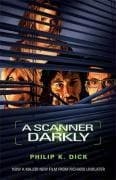
Philip K. Dick (1977)
Genre
Thriller / Mystery / Science Fiction
Reading Time
270 min
Key Themes
See below
Sign in to track this book
In dystopian Los Angeles, an undercover narcotics agent's mind breaks as he succumbs to the drug he is fighting, blurring the lines between hunter and hunted until his identity is lost.
In a near-future Orange County, California, Bob Arctor lives in a run-down house with other drug users: Charles Freck, who is always confused, the paranoid Jerry Fabin, and Donna Hawthorne, who seems more functional. Arctor is secretly Agent Fred, an undercover narcotics officer tasked with infiltrating the Substance D trade. He is addicted to Substance D, a strong hallucinogen that causes brain damage, making his dual life harder. His agency, the Anaheim Police Department, uses 'scramble suits' to protect agents' identities during surveillance, which is necessary due to the drug's effects and the blurring lines between user and agent. His main target is Donna, whom he suspects of being a major distributor.
Jerry Fabin, one of Arctor's housemates, starts having severe delusions, believing his body is full of aphids. He carefully searches his skin and clothes, finding tiny specks he thinks are insects, even as Arctor tries to reason with him. This scene shows the advanced stages of Substance D addiction and its ability to distort perception and reality. Arctor, despite being an agent, feels empathy and frustration, seeing the irreversible damage to his friend, damage he himself is increasingly vulnerable to.
Agent Fred, wearing his scramble suit, attends a briefing where he is assigned to surveil a major Substance D user named Bob Arctor. Fred does not know that Arctor is his own undercover identity. This creates a dangerous paradox: the agency is using him to spy on himself, a situation made possible by the scramble suit's anonymity and the compartmentalization of his brain due to Substance D. The surveillance footage shows Arctor's drug use and increasingly erratic behavior, which Fred observes with detached interest, failing to recognize himself on screen.
Arctor's brain damage from Substance D worsens quickly, causing cognitive impairment, memory loss, and severe disorientation. He can no longer function well as either a civilian or an agent. The agency, seeing his severe addiction and mental decline, decides to remove him from the field. He is forced into a New-Path rehabilitation facility, which is a labor camp for addicts. His identity as Agent Fred is completely removed, and he is now known only as 'Bruce,' a generic patient with no past.
'Bruce' (Arctor) lives a monotonous, dehumanizing existence in the New-Path facility. His days involve manual labor and constant surveillance by the staff. His memory is fragmented, and he struggles to recall details of his former life, including his true identity or mission. He observes other patients, also broken by Substance D, which reinforces the tragic effects of the drug. The facility's main purpose is not rehabilitation but to exploit addicts for their labor and keep them contained, away from the drug trade.
While doing forced labor in the fields around the New-Path facility, 'Bruce' (Arctor) finds a patch of strange, iridescent blue flowers. He vaguely remembers from his fragmented memories that these flowers are the source of Substance D. This discovery sparks a flicker of his former self, a faint memory of his mission as Agent Fred. He realizes the irony: he has been placed in a facility run by the organization that grows the drug's source, unknowingly providing the agency with crucial evidence.
Donna Hawthorne is revealed to be an undercover agent working for the same agency as Fred. She arranged Arctor's placement in New-Path, knowing that his severe brain damage would make him harmless and allow him to infiltrate the facility without suspicion. Her goal was to use him, in his weakened state, to find the true source of Substance D, which she suspected was hidden within New-Path's operations. Arctor's discovery of the blue flowers confirms her suspicions, making him a pawn in a larger, more dangerous game.
Despite his severe cognitive impairment and nearly total loss of identity, 'Bruce' (Arctor) performs one last, crucial act as Agent Fred. He secretly picks one of the blue flowers and hides it, driven by an instinctive loyalty to his mission. He intends to give this flower to the authorities, knowing it is proof of the New-Path facility's involvement in the Substance D trade. This act represents a poignant, tragic victory for the broken agent, fulfilling his duty even in the depths of his mental decline.
The blue flower, given by the now completely incoherent 'Bruce' (Arctor) to his handlers, confirms the horrifying truth: the New-Path rehabilitation facilities, meant to cure addicts, are actually growing the blue flowers from which Substance D is made. This exposes a vast conspiracy where the organization fighting the drug trade is also its main supplier. The agency, in its pursuit of control and profit, has become the monster it swore to destroy, sacrificing its agents and the public.
The novel ends with the chilling realization of systemic corruption at the heart of anti-drug efforts. The title, 'A Scanner Darkly,' takes on its full, ominous meaning, referring to the distorted, morally compromised view through which the agency sees its mission and its agents. Fred's sacrifice and his final, heroic act of bringing the flower to light show the tragic irony of his mission: he exposed the source, but at the cost of his mind and identity, becoming another casualty in a war where the lines between good and evil, victim and perpetrator, have blurred.
The Protagonist
Arctor descends from a functioning, if conflicted, agent into a brain-damaged shell, ultimately sacrificing his identity to expose the drug's source.
The Supporting / Undercover Agent
Donna is revealed to be a calculating and ultimately effective agent, achieving her mission through morally ambiguous means.
The Supporting
Freck's mental state deteriorates steadily throughout the novel, ending in complete delusion and institutionalization.
The Supporting
Fabin's descent into irreversible delusion is rapid and complete, leading to his institutionalization.
The Supporting
Mike remains a static figure, representing the unchanging, anonymous authority of the agency.
The Supporting
Hank, like Mike, remains a static, anonymous figure within the agency's operations.
The Mentioned
Their true, corrupt nature is slowly unveiled as the plot progresses, revealing their role in the drug's cultivation.
The novel explores the fragility of identity, especially under the influence of drugs and the demands of undercover work. Bob Arctor's struggle to maintain distinct identities as Bob, Fred, and later 'Bruce' shows how external roles and internal perception shape who we are. Substance D's brain-damaging effects physically erode Arctor's sense of self, causing memory loss and confusion, making him question which identity is real or if any part of him remains. The scramble suits further anonymize and dehumanize the agents, making them interchangeable parts of a system.
“What does a scanner see? Into the mind, down to the heart. Does it see that I am in the process of becoming a man? No. It sees that I am becoming a thing.”
Dick critiques the effectiveness and morality of the 'war on drugs,' showing it as a corrupt, self-perpetuating system that consumes its own agents and inadvertently makes the problem worse. The revelation that the New-Path facilities, meant for rehabilitation, are the source of Substance D exposes deep hypocrisy and systemic corruption. The agency's use of its agents as expendable assets, and the way it becomes indistinguishable from the criminals it hunts, suggests a grim cycle where the cure is worse than the disease.
“It was a war that had to be fought, but not by the people who were fighting it. Because they had become the thing they fought.”
Substance D constantly blurs the lines between what is real and what is hallucination, for both the characters and the reader. The characters' drug-induced delusions, like Jerry Fabin's aphids or Freck's 'scramble bug,' are presented so vividly that they feel real within the story. Arctor's own perception becomes increasingly unreliable, making it difficult for him, and the reader, to tell truth from illusion. This theme is amplified by surveillance technology, which presents a mediated, often distorted, view of reality, questioning the nature of objective truth.
“Everything is true, everything is false. It’s all a matter of perspective.”
The novel is full of a sense of loss and sacrifice. Arctor sacrifices his mind, his identity, and his sanity for a mission that turns out to be deeply compromised. His friends and housemates also lose their minds and lives to Substance D. The ending, while a form of victory, is tragic, as the truth is uncovered at a huge personal cost. This theme highlights the human toll of addiction and the often-futile sacrifices made for justice within a corrupt system.
“He had won, but what had he won? His mind, his life, his identity: all gone.”
A technological garment that constantly shifts the wearer's appearance, obscuring identity.
The scramble suit is a key piece of technology used by narcotics agents. It features a constantly changing, randomized collage of features, making the wearer utterly anonymous and impossible to identify. This device is crucial for maintaining the secrecy of undercover operations, but it also serves a deeper symbolic purpose. It represents the dehumanization and loss of identity inherent in the drug war, blurring the lines between agents and the anonymous masses they observe. It also enables the central paradox of Arctor surveilling himself, as the suit ensures his identity as Fred is completely separate from his identity as Arctor.
A highly addictive, brain-damaging hallucinogen that drives the plot and characters.
Substance D is the central MacGuffin and antagonist of the story. It is a potent, irreversible neurotoxin that causes progressive brain damage, leading to psychosis, delusions, and eventually complete cognitive impairment. The drug's effects are meticulously detailed, from the initial euphoric 'scramble' to the debilitating 'brain rot.' It drives Arctor's addiction, motivates his mission, and ultimately defines the tragic fate of most characters. The discovery of its natural source, the blue flower, is the ultimate goal of the narrative, revealing the systemic corruption behind its proliferation.
The story is primarily told through the perspective of a character whose perception is compromised by drug use.
The narrative perspective often shifts between Arctor's internal thoughts and objective observations, but Arctor's increasing addiction to Substance D renders him an unreliable narrator. His memory is fragmented, his perceptions are distorted by hallucinations, and his understanding of events is often confused. This device immerses the reader in Arctor's deteriorating mental state, creating a sense of paranoia and uncertainty. It forces the reader to question what is real and what is a drug-induced delusion, mirroring Arctor's own struggle to discern truth from illusion.
The use of situational and dramatic irony to highlight the absurd and tragic aspects of the plot.
Irony is a pervasive plot device in 'A Scanner Darkly.' The most prominent example is the dramatic irony of Agent Fred being assigned to surveil Bob Arctor, unaware that they are the same person. This highlights the dehumanizing and compartmentalized nature of the agency. Situational irony is also evident in the revelation that the New-Path rehabilitation facilities, meant to cure addiction, are actually the source of Substance D. This deepens the critique of the war on drugs, portraying it as a system that paradoxically creates and perpetuates the problem it claims to solve, with tragic consequences for its participants.
“What does a scanner see? Into the mind, down to the soul, out to the stars. It sees all, and it sees nothing.”
— Opening narration, setting the tone for surveillance and perception.
“Everything in our lives, from the cars we drive to the food we eat, is being monitored, recorded, and analyzed. We are all living in a giant fishbowl.”
— A character reflecting on the pervasive surveillance in their society.
“The thing about being a narc is that you become a part of the problem. You're not just observing it, you're living it.”
— Fred/Bob Arctor grappling with his dual identity as an undercover agent and a drug user.
“There are some things you can't come back from. Some places you can't leave.”
— A bleak observation about the irreversible nature of certain choices and situations, particularly drug addiction.
“When you don't know who you are, you can be anyone. But when you don't know who you are, you can also be no one.”
— A profound thought on identity and its fragility, especially under the influence of drugs and surveillance.
“The future is not a place we are going, but a place we are creating. And every choice we make, every action we take, is a part of that creation.”
— A philosophical musing on free will and the impact of individual actions on the future.
“It's not paranoia if they really are after you.”
— A darkly humorous, yet chilling, line reflecting the reality of surveillance and the blurring of sanity.
“Substance D. It's not just a drug, it's a way of life. A slow, agonizing way of death.”
— Description of the devastating effects of the fictional drug Substance D.
“He knew that he was a man divided, a house split against itself. And he knew that sooner or later, one side would have to consume the other.”
— Fred/Bob Arctor's internal struggle with his dual role and disintegrating personality.
“We're all just trying to get by, aren't we? In this fucked-up world, we do what we have to do.”
— A character's cynical justification for their actions in a desperate world.
“The ultimate test of a man's conscience may be his willingness to make a sacrifice for those who cannot do so for themselves.”
— A rare moment of moral reflection amidst the chaos and self-interest.
“There was no 'outside.' There was only 'inside.' And inside was where the world was.”
— A claustrophobic sense of reality, emphasizing the inescapable nature of their existence.
“A scanner darkly. It means that you can see through people, but not clearly. You see the darkness, the flaws, the secrets, but never the full picture.”
— An interpretation of the book's title, highlighting the limitations of surveillance and human perception.
“The past is a foreign country; they do things differently there. But the future... the future is just a black hole.”
— A character's grim outlook on time and the future, particularly under the influence of drugs.
Ready to see how well you understood this book? Take our interactive quiz with 10 questions.

Philip Kindred Dick, often referred to by his initials PKD, was an American science fiction writer. He wrote 44 novels and about 121 short stories, most of which appeared in science fiction magazines during his lifetime. His fiction explored varied philosophical and social questions such as the nature of reality, perception, human nature, and identity, and commonly featured characters struggling against elements such as alternate realities, illusory environments, monopolistic corporations, drug abuse, authoritarian governments, and altered states of consciousness.







