“I, Eleanor, once Queen of England, Duchess of Aquitaine, Countess of Poitou, am in Heaven. I have been here for a long time.”
— Eleanor's opening statement, introducing herself and the setting.

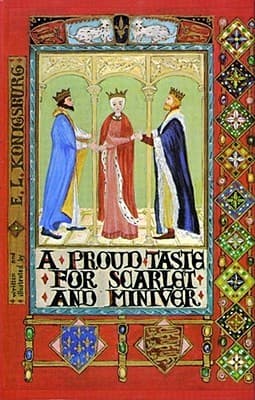
Genre
Fantasy / Children's / Historical Fiction / Young Adult
Reading Time
201 min
Key Themes
See below
Sign in to track this book
From a celestial waiting room, Eleanor of Aquitaine, surrounded by her spirited companions, recounts the true, tumultuous saga of her life as a queen, tastemaker, and political force across twelfth-century Europe, all while hoping her second husband finally makes it past the pearly gates.
Eleanor of Aquitaine, the Queen of England, is in Heaven, residing in a lavish chamber with her former mother-in-law, Matilda-Empress, and the knight, William the Marshal. Eleanor impatiently awaits her second husband, King Henry II, who died before her but has yet to gain admission to Heaven. The celestial bureaucracy is slow, and Eleanor, a pragmatist, is determined to ensure his entry. Their discussions often revolve around Henry's character and his complicated relationship with Eleanor. The setting is one of eternal waiting, where memories of their mortal lives serve as entertainment and a way to understand their past actions.
The monotony of their vigil is broken by the arrival of Abbot Suger, Eleanor's old mentor from her time as Queen of France. Suger, recognizing Eleanor, joins their company. His presence sparks a collective desire to recount Eleanor's life, from her early days as Duchess of Aquitaine to her reign as Queen of England. The group agrees to take turns narrating different periods of her life, aiming to provide a comprehensive, though subjective, account of her experiences. This agreement sets the stage for the book's narrative structure, where multiple perspectives illuminate Eleanor's history.
Eleanor begins by describing her childhood in Aquitaine, a region known for its culture, troubadours, and independence. She details her ascension to Duchess at a young age and her marriage to Louis VII, the pious King of France. Eleanor recalls her initial enthusiasm for court life in Paris, but also her growing disillusionment with Louis's lack of ambition and their incompatibility. She describes the political and personal challenges of being Queen of France, including the pressures to produce a male heir and her increasing desire for a more active role in governance, which often clashed with Louis's devout nature.
Eleanor recounts her decision to accompany Louis VII on the Second Crusade, a venture that further strained their marriage. She describes the hardships and political maneuvering during the crusade, and her growing frustration with Louis's leadership. Upon their return, the differences between Eleanor and Louis became undeniable, leading to the annulment of their marriage. Eleanor then describes her perilous journey back to Aquitaine, fending off attempts by various lords to abduct and marry her for her vast lands, showing her resilience and determination.
William the Marshal takes over the narration, focusing on Eleanor's swift marriage to Henry Plantagenet, Duke of Normandy and Count of Anjou, just eight weeks after her annulment from Louis VII. William emphasizes Henry's ambition, intelligence, and energy, traits that both attracted and challenged Eleanor. Their union created the vast Angevin Empire, stretching from Scotland to the Pyrenees. William highlights the immediate political ramifications of this marriage, particularly for King Louis VII, who felt betrayed and threatened by the powerful new couple. The narrative shows the dynamic and often tempestuous nature of Eleanor and Henry's early years together, marked by both passion and political ambition.
Matilda-Empress, Henry II's mother, provides a perspective on her son, offering a more sympathetic view of his complexities. She describes Henry's drive to consolidate power and establish stable rule, often at the expense of his personal relationships. Matilda acknowledges Henry's faults, including his temper and his infidelities, but also emphasizes his brilliance as a ruler and his affection for Eleanor, despite their frequent clashes. She explains how the demands of kingship and the need for a male heir shaped Henry's decisions, often leading to conflict with his strong-willed wife. Matilda's narration adds depth to Henry's character, portraying him not just as Eleanor's antagonist, but as a product of his time and his formidable upbringing.
Eleanor recalls her time at Poitiers, her ancestral home, where she established a vibrant court. She describes how she encouraged poetry, music, and intellectual discourse, becoming a patron of troubadours and scholars. Most significantly, Eleanor recounts her role in formalizing the 'Rules of Courtly Love,' an idealized code of conduct between knights and noblewomen that emphasized chivalry, devotion, and romantic longing. She explains how this cultural movement, often misunderstood, influenced medieval society, shaping ideals of knighthood and gender roles, and providing an outlet for artistic expression within feudal society.
The narrative shifts to the 'Great Revolt' where Eleanor, along with her sons Young Henry, Richard, and Geoffrey, rebelled against Henry II. Eleanor recounts her active role in supporting the rebellion, driven by a desire for more autonomy for her sons and herself, and a growing resentment of Henry's absolute power and infidelity. She describes the warfare and, ultimately, her capture by Henry's forces. This leads to her long imprisonment, a period of over a decade where she was kept under various forms of house arrest, separated from her children and her lands. This section highlights the consequences of their marital and political conflicts.
Eleanor describes her eventual release from imprisonment upon Henry II's death and her role in securing Richard I's ascension to the throne. She recounts her efforts during Richard's reign, particularly during his absence on the Third Crusade. Eleanor acted as regent, governing England with wisdom and strength, raising his ransom when he was captured, and navigating complex political landscapes. She highlights her unwavering support for Richard, her favorite son, and her determination to protect his kingdom and legacy. This period shows Eleanor's political acumen and resilience, demonstrating her ability to wield power effectively even in her later years.
Eleanor continues her story, detailing her involvement in politics during the reign of her youngest son, John, who was often viewed as the least capable of her children. Despite her advanced age, Eleanor remained a formidable figure, offering counsel and mediating disputes. She recounts her journey to retrieve Blanche of Castile for marriage to her grandson, a sign of her enduring commitment to her dynasty. Eleanor reflects on the challenges of John's reign, including the loss of much of the Angevin Empire, and her efforts to secure the future of her family. Her narrative concludes with a sense of accomplishment and acceptance of her long and eventful life, having outlived most of her contemporaries.
Just as Eleanor concludes her life story, a commotion in the heavenly waiting room signals the arrival of Henry II. He appears disheveled and anxious, having endured a challenging journey to the gates of Heaven. The group, including Eleanor, Matilda-Empress, William the Marshal, and Abbot Suger, immediately turns their attention to him. Henry now faces the task of justifying his life and actions before the celestial judges. His arrival injects a renewed sense of anticipation and tension into the narrative, as the outcome of his judgment will determine if he can join Eleanor in eternal rest, providing the ultimate resolution to the book's framing device.
After a brief but tense period of judgment, the celestial gates open for Henry II. The details of his trial are not explicitly shown, but the implication is that his complex life, filled with both triumphs and transgressions, has been deemed worthy. Eleanor greets him with a mixture of relief and her characteristic sharp wit. While their reunion is not portrayed as purely romantic, it signifies a resolution to their earthly conflicts and a continuation of their complex relationship into the afterlife. The group celebrates his admission, and the narrative concludes with Eleanor and Henry, finally together, ready to embark on their eternal existence, their tumultuous history now a shared memory in the peace of Heaven.
The Protagonist
Eleanor begins as a vibrant, somewhat naive young duchess, matures into a powerful queen who learns the harsh realities of power and patriarchy, and ultimately becomes a wise, influential matriarch who secures her legacy.
The Antagonist/Secondary Protagonist
Henry's arc is largely recounted through the perspectives of others, highlighting his rise to power, his complex reign marked by conflict with family and church, and his eventual death and struggle for heavenly admission.
The Supporting
Matilda's earthly arc is largely concluded before the main narrative, her heavenly role is to provide context and a maternal perspective on Henry II and his actions.
The Supporting
William's arc is less about personal development and more about his consistent loyalty and service, demonstrating the ideal of knighthood throughout a turbulent era.
The Supporting
Abbot Suger's earthly arc is completed before the main events of the book, his heavenly role is to provide a historical and philosophical perspective on Eleanor's early life.
The Mentioned
Louis's story is primarily recounted through Eleanor's and Suger's recollections, illustrating his piety and his limitations as a monarch and husband.
The Mentioned
Richard's story is told through the accounts of Eleanor and William the Marshal, focusing on his military campaigns and his close bond with his mother.
The Mentioned
John's role is largely seen through Eleanor's eyes, highlighting her efforts to guide and support him despite his shortcomings and the eventual decline of the Angevin Empire under his rule.
The book explores the nature of power, how it is gained, wielded, and lost, especially within a feudal and patriarchal society. Eleanor's life is a constant negotiation of power, first as a wealthy duchess, then as Queen of France and England, and finally as a regent and matriarch. The conflict between Eleanor and Henry II is an example of a power struggle between two formidable individuals, each with their own claims to authority. The narrative also examines the limitations placed on female power, as seen in Eleanor's imprisonment by Henry, and her eventual triumph through strategic alliances and political acumen, as when she secured Richard's throne.
“I was a queen in my own right, not merely by marriage. And no man, not even a king, could truly own Aquitaine.”
The theme of love and marriage is central, but it is rarely portrayed as simple romance. The book looks at the complexities of royal marriages, which are often political alliances first and personal unions second. Eleanor's two marriages, to Louis VII and Henry II, show different dynamics. Her first is a mismatch of personalities and ambitions, leading to annulment. Her second is a passionate, intelligent, but tumultuous relationship marked by infidelity, rebellion, and mutual respect. The concept of Courtly Love, which Eleanor championed, is presented as an idealized form of love that offered an alternative to the realities of medieval marriage.
“Love, for a queen, was often a matter of alliances and heirs, not just of the heart.”
The entire narrative is framed by the characters in Heaven reflecting on Eleanor's life, highlighting the importance of legacy and how one is remembered. Each character offers their own perspective, shaping the collective memory of Eleanor and her era. Eleanor herself is aware of her place in history, cultivating her image and influencing culture through her patronage of the arts and the establishment of Courtly Love. The book implicitly questions whose stories get told and how historical figures are judged, especially as the characters anticipate Henry II's own heavenly judgment based on his life's actions.
“A life, no matter how grand, is only as lasting as the stories told about it.”
The novel explores the constraints and opportunities for women in the 12th century. Eleanor, as a woman of wealth and intellect, pushes the boundaries of what is expected of her. She shows remarkable agency, from leading troops on Crusade to governing England as regent. However, the narrative also shows the limitations imposed by a patriarchal society, most notably her prolonged imprisonment by Henry II. Her story is a sign of female resilience and strategic thinking in a world where men held most of the overt power, illustrating how she found ways to exert influence and maintain her identity.
“They thought they could cage a lioness, but a lioness always finds a way to roar.”
The entire narrative is framed by Eleanor and her companions awaiting Henry II in Heaven.
This device allows for a retrospective, multi-perspectival recounting of Eleanor's life. By placing the characters in Heaven, it creates a unique vantage point where historical figures can reflect on their past actions and relationships with a degree of detachment and wisdom. It also builds suspense around Henry II's fate, providing a compelling reason for the storytelling. The frame story allows for the blending of historical fact with fictionalized introspection, giving depth to the characters' motivations and emotions.
Different characters take turns narrating parts of Eleanor's life.
This device offers diverse perspectives on Eleanor's life and the events of the 12th century. Eleanor provides her own spirited and subjective account, while Matilda-Empress offers a maternal view of Henry, William the Marshal gives a knight's practical perspective, and Abbot Suger provides a more diplomatic and historical context. This enriches the narrative by revealing the complexities of historical truth and how different individuals interpret the same events, adding layers of characterization and avoiding a single, potentially biased, viewpoint.
The characters speak in a modern, witty, and often conversational style.
While the historical facts are largely accurate, the dialogue and tone are distinctly modern, infused with wit, sarcasm, and contemporary sensibilities. This device makes the historical figures more accessible and relatable to a young adult audience, breaking down barriers of time and formality. It allows for humorous interactions and sharp, insightful commentary without sacrificing the essence of the characters' historical personalities. This stylistic choice makes the complex history engaging and vibrant.
Eleanor's duchy represents her independence, culture, and true identity.
Aquitaine serves as a powerful symbol throughout the book. It represents Eleanor's birthright, her cultural heritage, and her inherent independence. When she is Queen of France or England, Aquitaine remains her spiritual home and a source of her unique character. Her struggle to maintain control over Aquitaine, and her sons' desire for its inheritance, underscore its importance not just as a territory, but as a representation of freedom and a distinct way of life that contrasts with the more rigid courts of France and England.
“I, Eleanor, once Queen of England, Duchess of Aquitaine, Countess of Poitou, am in Heaven. I have been here for a long time.”
— Eleanor's opening statement, introducing herself and the setting.
“Being a queen is not all roses and rubies. Sometimes it is thorns and mud.”
— Eleanor reflecting on the realities of her royal life.
“Some men are like kites. They need a strong string to keep them from flying away completely.”
— Eleanor's observation about her husband, Henry II.
“I had a proud taste for scarlet and miniver.”
— Eleanor describing her love for luxurious clothing and her personal style.
“It is a terrible thing to be bored, especially when you are a queen.”
— Eleanor discussing her feelings of confinement and lack of purpose at times.
“A good story is like a good meal. It should be savored.”
— Eleanor's general philosophy on storytelling and life experiences.
“Freedom is a very expensive thing. Sometimes it costs you everything you have.”
— Eleanor reflecting on her imprisonment and the sacrifices made for independence.
“Children grow up. Sometimes they grow up to be kings, and sometimes they grow up to be disappointments.”
— Eleanor's thoughts on her many children and their varied fates.
“Love is a complicated business. It can make you do foolish things, and it can make you do brave things.”
— Eleanor's general musings on the nature of love throughout her life.
“History is not just dates and battles. It is people, and their stories, and what they ate for supper.”
— Eleanor's perspective on what truly constitutes history.
“Even in Heaven, one likes to have one's own way now and then.”
— Eleanor asserting her personality and preferences even in the afterlife.
“There are some people who can make a feast out of a single crust of bread, and others who can starve at a banquet.”
— Eleanor reflecting on different attitudes towards life and abundance.
“My life was a tapestry woven with threads of gold and silver, and also with threads of mud and blood.”
— Eleanor's summary of the complex and varied experiences of her long life.
“It is not always the strong who survive, but the clever, and sometimes, the lucky.”
— Eleanor's observation on the factors contributing to success and survival.
Ready to see how well you understood this book? Take our interactive quiz with 10 questions.







