“It is a time for change. The old ways are dying. We must make new ones.”
— Early in the narrative, reflecting the revolutionary fervor brewing in France.

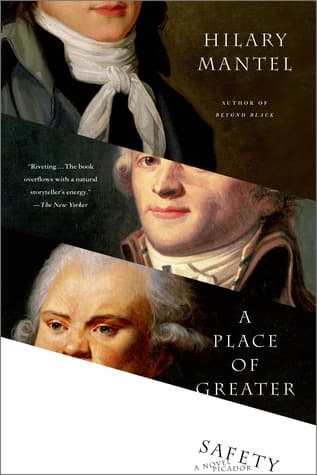
Hilary Mantel (1992)
Genre
Literary Fiction / Historical Fiction
Reading Time
25-30 hours
Key Themes
See below
Sign in to track this book
Under the guillotine's shadow and the revolution's fervor, three men—Danton, Robespierre, and Desmoulins—navigate love, betrayal, and the bloody birth of a new France.
The novel opens by introducing the early lives of its three central figures. Maximilien Robespierre, a serious and somewhat isolated boy from Arras, deals with his family's decline and his mother's death. He shows an early, strict sense of justice and a careful nature. Georges Danton, a boisterous and physically large child from Arcis-sur-Aube, is shown as charismatic and prone to reckless behavior, often fighting and showing natural leadership among his peers. Camille Desmoulins, a stuttering and sensitive boy from Guise, struggles with his physical difficulty but has a sharp mind and a growing love for literature and rhetoric. These early scenes establish their distinct personalities and the social environments that shaped their future revolutionary drive.
As young men, Robespierre, Danton, and Desmoulins all move to Paris, drawn by opportunities in law and public life. Robespierre becomes a successful, though somewhat austere, lawyer in Arras before moving to the capital, known for his firm principles. Danton, despite his provincial background, starts a successful legal practice in Paris, making connections and gaining a reputation for his powerful speeches and friendly nature. Desmoulins, overcoming his stutter through sheer will and a passion for writing, tries to make a living as a journalist and pamphleteer, often struggling financially but finding his voice in the growing revolutionary discussion. Their paths begin to cross through shared intellectual circles and increasing political unrest.
The political climate in France grows more intense with the calling of the Estates-General in 1789. Robespierre, elected as a deputy for Artois, quickly distinguishes himself as a strong supporter of the Third Estate, though his reserved manner makes him initially less popular than more flamboyant speakers. Danton, through his involvement in the Cordeliers district, becomes a prominent voice in the Parisian sections, known for his powerful speeches that energize the working classes. Desmoulins, using his writing skills, publishes inflammatory pamphlets, especially 'La France Libre' and 'Discours de la lanterne aux Parisiens,' which openly call for rebellion and republicanism. The storming of the Bastille, a turning point, further solidifies their roles as emerging leaders of the revolutionary movement.
Amid the political upheaval, the characters' personal lives intertwine and influence their public roles. Danton marries Gabrielle Charpentier, a woman who brings him stability and domestic happiness, and their home becomes a gathering place for revolutionaries. Camille Desmoulins falls in love with Lucile Duplessis, a spirited and intelligent young woman whose family initially disapproves of his lack of prospects. Their marriage is a significant event, celebrated by their friends, including Robespierre, who serves as a witness. Robespierre himself, though seemingly detached from romance, forms close bonds with the Duplay family, who provide him with lodging and a sense of family life, treating him with respect. These relationships offer glimpses into their human vulnerabilities and provide support in increasingly dangerous times.
The revolution takes a more radical turn with King Louis XVI's flight to Varennes and his subsequent return, which destroys public trust in the monarchy. Danton plays a role in the insurrection of August 10, 1792, which leads to the storming of the Tuileries Palace and the overthrow of the monarchy. He is appointed Minister of Justice in the provisional government and, during a crisis as foreign armies threaten Paris, delivers his famous 'audacity' speech, rallying the nation. This period also includes the September Massacres, a brutal series of killings of prisoners, which Danton is accused of tacitly condoning or at least failing to prevent, a mark on his revolutionary record that foreshadows future conflicts. Robespierre and Desmoulins, though not directly involved in the massacres, navigate the moral complexities of the escalating violence.
The fate of the deposed King Louis XVI becomes a central point of disagreement within the National Convention. Robespierre, initially hesitant about a direct trial, eventually becomes a strong advocate for the king's execution, arguing that a king cannot be judged but must die for the revolution to live. His principled, unyielding stance is a defining moment. Danton, while acknowledging the necessity of the king's death, expresses reservations about the political effects and how France would be seen abroad. Desmoulins, ever the publicist, uses his journals to argue passionately for the king's death, framing it as a necessary act of revolutionary justice. The king's execution in January 1793 marks a point of no return for the revolution, solidifying the Republic's establishment and further radicalizing the political situation.
The growing internal and external threats to the new Republic lead to the formation of the Committee of Public Safety, meant to protect the revolution. Robespierre, with his reputation for integrity and clear vision, gradually takes a dominant role within the Committee, advocating for a policy of 'Terror' as a tool of justice and virtue. Danton, initially a powerful figure on the Committee, finds his influence decreasing as he advocates for a less extreme approach and seeks reconciliation rather than further division. Desmoulins, though still supportive of the revolution, grows uneasy with the Committee's harsh measures. The Law of Suspects is passed, granting broad powers to arrest and execute those considered enemies of the revolution, beginning the brutal period known as the Reign of Terror.
As the Reign of Terror intensifies, internal factionalism erupts. Robespierre and the Committee of Public Safety target both the ultra-radical Hébertists, led by Jacques Hébert, who advocate for further de-Christianization and extreme measures, and the 'Indulgents' or Dantonists, who call for a moderation of the Terror. Camille Desmoulins, influenced by Danton and increasingly horrified by the bloodshed, publishes 'Le Vieux Cordelier,' a series of powerful pamphlets that openly criticize the excesses of the Terror, calling for clemency and an end to the endless executions. This act of defiance places him in direct opposition to Robespierre and the Committee, despite their long friendship. The stage is set for a devastating conflict between the former allies.
Despite their long history, Robespierre, driven by his commitment to revolutionary virtue and his fear of corruption, makes the difficult decision to move against Danton and Desmoulins. Danton, increasingly disillusioned and tired, refuses to flee, famously stating that one 'does not carry one's country away on the soles of one's shoes.' He is arrested along with Desmoulins and other Dantonists. During their trial, Danton delivers a powerful and defiant defense, but the Committee, fearing his influence, passes a decree to silence him. Both Danton and Desmoulins, along with Lucile Desmoulins who is also arrested, are condemned and executed by guillotine in April 1794. This purge removes Robespierre's most prominent rivals and former friends, leaving him in a position of unchallenged, yet precarious, power.
Following the execution of Danton and Desmoulins, Robespierre's power reaches its peak, but he becomes increasingly isolated and consumed by his vision of a 'Republic of Virtue.' He introduces the Cult of the Supreme Being, an attempt to establish a civic religion, which is met with skepticism and even ridicule by some, further alienating him from his colleagues. His speeches become more abstract and threatening, filled with veiled threats against unspecified enemies of the revolution. The Law of 22 Prairial, which simplifies trials and removes the right to legal counsel, intensifies the Terror, leading to a rapid increase in executions. Robespierre's paranoia grows, and he begins to suspect plots against him from within the Committee and the Convention, pushing him towards a final, fatal confrontation.
Robespierre's increasing tyranny and his enigmatic pronouncements about new purges create fear among the remaining members of the Convention and the Committee of Public Safety. Fearing they would be next, a coalition of his enemies, including figures like Tallien and Fouché, plans a coup. On the 9th of Thermidor (July 27, 1794), Robespierre tries to address the Convention but is shouted down and prevented from speaking. He and his loyalists, including Saint-Just and Couthon, are declared outlaws and arrested. After a failed attempt to rally support at the Hôtel de Ville, Robespierre is captured. He is injured, possibly by a self-inflicted gunshot, and executed by guillotine the following day, without trial, marking the end of the radical phase of the French Revolution and the Reign of Terror.
The Thermidorian Reaction that follows Robespierre's execution ends the extreme violence of the Terror, but the revolution remains tumultuous. Many of Robespierre's allies are also executed, and there is a general backlash against Jacobinism. The novel concludes by reflecting on the profound and often contradictory legacies of the three central figures and the revolution itself. Their lives, linked by ambition, friendship, and ultimately, betrayal, show the idealism, brutality, and tragic ironies of one of history's most important events. The narrative shows how personal choices and character flaws, alongside grand ideological struggles, shaped France's destiny, leaving a complex mix of heroism and horror.
The Protagonist
From a provincial lawyer advocating for the oppressed, he transforms into the supreme leader of the Committee of Public Safety, ultimately falling victim to the very terror he championed.
The Protagonist
Rising from a popular street orator to a powerful revolutionary minister, he attempts to moderate the Terror, leading to his tragic downfall.
The Protagonist
From an obscure, stuttering lawyer, he becomes a celebrated revolutionary writer, only to be silenced by the very revolution he helped to create.
The Supporting
From a hopeful young wife, she experiences the joy of love and the horror of the Terror, ultimately sacrificing her life for her husband and their ideals.
The Supporting
She provides a stable, loving home for Danton, but her early death contributes to his disillusionment.
The Supporting
He rises as Robespierre's 'angel of death,' becoming a powerful figure in the Committee of Public Safety, and shares Robespierre's fate on Thermidor.
The Supporting
He navigates the revolution with a mix of wit and opportunism, but his involvement in corruption ultimately leads to his arrest and execution.
The Antagonist
He rises as a voice of the extreme sans-culottes, only to be purged by Robespierre's Committee for being too radical.
The novel explores how revolutionary ideals, initially driven by a desire for liberty and equality, descend into extreme violence. It questions whether violence is a necessary part of radical change or a tragic distortion of noble goals. The escalating executions, from the king to Danton and Desmoulins, show a revolution consuming its own. Mantel illustrates how the abstract pursuit of 'virtue' can justify horrific acts, as seen in Robespierre's belief that terror is a swift, severe, and unwavering justice. The September Massacres and the Reign of Terror are depicted as the logical, though horrific, outcome of ideological purity and the struggle for power.
“Revolution is not a dinner party; it is an insurrection, an act of violence by which one class overthrows another.”
A central part of the narrative is the complex interplay of friendship and betrayal among the protagonists. Robespierre, Danton, and Desmoulins begin as allies and friends, sharing revolutionary aspirations. However, as ideological differences harden and the stakes rise, these bonds weaken and ultimately break. The personal cost of the revolution is explored through their relationships – the anguish of Desmoulins writing against Robespierre, the sadness of Danton facing his former comrade's judgment, and Robespierre's own internal struggle in condemning those he once held dear. The novel highlights how political ambition and ideological purity can override personal loyalty, leading to tragic betrayals that devastate not only the men themselves but also their families, particularly Lucile Desmoulins.
“When you have to choose between your country and your friends, you choose your country.”
The concept of justice is a constant, changing battleground throughout the novel. Each character, especially Robespierre, believes they are acting for true justice and virtue, yet their interpretations lead to wildly different, and often brutal, outcomes. Robespierre's 'Republic of Virtue' becomes a system where dissent is treason, and terror enforces moral purity. Danton’s more practical view of justice, valuing mercy and reconciliation, clashes with this absolute vision. The novel questions whether an objective, universal justice can exist in a revolutionary climate, suggesting instead that it becomes a tool used by those in power, constantly redefined to suit immediate political needs. The executions of both the 'corrupt' and the 'indulgent' show the arbitrary and often contradictory nature of revolutionary justice.
“The government in a revolution is the despotism of liberty against tyranny.”
Language is a potent weapon and a driving force of the revolution. Desmoulins' inflammatory pamphlets, Danton's booming, energizing speeches, and Robespierre's carefully crafted, often chilling, pronouncements all show the power of words to incite, persuade, and condemn. The novel illustrates how rhetoric can shape public opinion, rally support, and justify extreme actions. The ability to articulate ideals, to frame enemies, and to inspire fear or hope is crucial to gaining and maintaining power. Conversely, the inability to communicate effectively, such as Desmoulins' stutter or Robespierre's increasingly abstract speeches, can also have profound consequences, highlighting the double-edged sword of public discourse in a time of radical change.
“Words are not just sounds, they are deeds.”
Mantel shows how the individual personalities, ambitions, flaws, and psychological states of the protagonists greatly influence the French Revolution, rather than only being driven by grand historical forces. Robespierre's rigidity, paranoia, and strict dedication; Danton's charisma, practicality, and occasional laziness; and Desmoulins' idealism, sensitivity, and impulsiveness are all explored. Their personal relationships, jealousies, and vulnerabilities shape their political decisions and ultimately their fates. The novel argues that history is not just made by abstract ideas but by the very human, often flawed, individuals who embody and enact those ideas, showing that personal character is inseparable from political action and consequence.
“A man's character is his fate.”
The story is told through an omniscient narrator, frequently shifting focus between the three protagonists.
The novel employs an omniscient third-person narrator who delves deeply into the thoughts, motivations, and personal histories of Robespierre, Danton, and Desmoulins. This allows Mantel to present a multi-faceted view of the revolution, showcasing the different ideological stances, personal struggles, and moral compromises of each man. The frequent shifts in perspective create a comprehensive, albeit complex, understanding of the events, enabling the reader to empathize with each character's journey even as their actions lead to conflict and tragedy. This device highlights the subjective nature of truth and justice in revolutionary times.
Extensive historical research is blended with a modern, anachronistic narrative voice.
Mantel saturates the narrative with meticulously researched historical details, from the specific political decrees and speeches to the minutiae of daily life in 18th-century France. This creates a vivid and immersive historical backdrop. However, she also employs a distinctly modern, often ironic, and darkly witty narrative voice that occasionally uses contemporary idioms or observations. This anachronistic style bridges the gap between the historical period and the contemporary reader, making the past feel immediate and relevant, while also subtly commenting on the timeless nature of political power, human ambition, and violence.
Hints of future events and the characters' ultimate fates are woven throughout the narrative.
The novel frequently uses foreshadowing, often subtly, to hint at the tragic fates awaiting the protagonists and the escalating violence of the revolution. Early observations about Robespierre's rigid principles, Danton's love of life, or Desmoulins' vulnerability all prefigure their later struggles. Dramatic irony is also heavily employed, as the reader, possessing historical knowledge, is aware of the characters' ultimate destinies even as they make choices based on their limited understanding of the future. This creates a sense of impending doom and heightens the tragedy of their personal and political struggles, making their triumphs bittersweet and their downfalls inevitable.
Specific names and locations carry symbolic weight that enhances the narrative.
Mantel subtly uses the symbolism of names and places to deepen the novel's themes. For example, the very title, 'A Place of Greater Safety,' ironically refers to the idea that the revolution, intended to create safety, instead leads to widespread danger and death. The shift from the provincial towns of Arras and Arcis-sur-Aube to the chaotic heart of Paris symbolizes the characters' transition from innocence to political engagement and ultimately, their demise. The specific districts, like the Cordeliers or the Jacobin Club, become more than just locations; they represent ideological factions and centers of power, each with its own symbolic resonance in the revolutionary landscape.
“It is a time for change. The old ways are dying. We must make new ones.”
— Early in the narrative, reflecting the revolutionary fervor brewing in France.
“The poor have no country. They have no bread. They have only their rage.”
— A character observing the growing desperation and anger of the Parisian underclass.
“We are all born with a certain amount of the beast in us. The trick is to keep it chained.”
— A philosophical reflection on human nature amidst the escalating violence.
“Power is like a knife. You can use it to cut bread or to cut throats.”
— Discussing the dual nature of power and its potential for good or evil.
“To govern is to choose. And to choose is to exclude.”
— A political figure contemplating the difficult decisions and inevitable exclusions of governance.
“History is not a line, but a labyrinth.”
— A character's musing on the complex and often unpredictable course of historical events.
“The greatest cruelty is not to kill, but to prolong suffering.”
— A grim observation on the nature of revolutionary justice and its methods.
“Fear is a poor counsellor, but a powerful motivator.”
— Reflecting on how fear drives many of the actions during the Reign of Terror.
“Every revolution devours its own children.”
— A classic quote, applied as the revolutionary leaders begin to turn on each other.
“There is no such thing as a clean revolution. Only the illusion of one.”
— Disillusionment setting in as the ideals of the revolution are stained by bloodshed.
“We are all actors on a stage, and the stage is France.”
— A character's dramatic perspective on their role in the unfolding historical drama.
“The past is a foreign country; they do things differently there.”
— A subtle nod to L.P. Hartley, used implicitly to highlight the vast differences between eras.
“Hope is a dangerous thing in a time like this. It makes you vulnerable.”
— A pragmatic view of hope during a period of extreme political instability and danger.
“To be forgotten is a second death.”
— A character's fear of oblivion, particularly relevant for those who shaped history.
Ready to see how well you understood this book? Take our interactive quiz with 10 questions.

Dame Hilary Mary Mantel was a British writer whose work includes historical fiction, personal memoirs and short stories. Her first published novel, Every Day Is Mother's Day, was released in 1985. She went on to write 12 novels, two collections of short stories, a personal memoir, and numerous articles and opinion pieces.







