“I was seven years old when I first learned what it was to be a scientist.”
— Isabella's childhood realization about her passion for science and discovery.

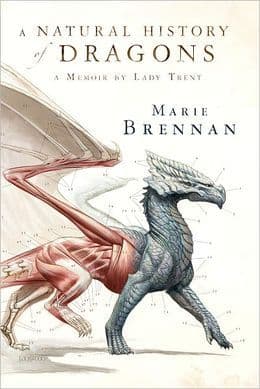
Marie Brennan (2013)
Genre
Fantasy / Historical Fiction
Reading Time
7 hr
Key Themes
See below
Sign in to track this book
Lady Trent, a pioneering naturalist, defies expectations in a world of dragons, studying these beasts and changing scientific understanding.
From a young age, Isabella Camherst shows an unusual interest in natural history, especially dragons. Her governess disapproves, and her family is confused. She secretly collects specimens and reads any book on the subject she can find, even though young ladies are expected to focus on skills like needlework and household management. Her interest is seen as odd and unfeminine. Her father is her only ally, allowing her some freedom and access to his library. This early conflict sets up Isabella's lifelong struggle against her society's strict gender norms.
As Isabella nears marriageable age, her parents arrange a match with Thomas Trent, a scholar interested in natural history, though not specifically dragons. Isabella is surprised and relieved to find Thomas kind and genuinely interested in her intellectual pursuits. He is impressed by her knowledge and encourages her studies, even getting books and specimens for her. Their shared love for learning forms a happy and unconventional marriage, where Isabella's scientific passion is supported, a rare thing for women of her time.
An opportunity comes when a letter arrives from Lord Relton, another naturalist. He invites Thomas to join an expedition to Vystrana, a remote, mountainous country known for its dragons. The goal is to study the local Rock-wyrms, which have recently become more aggressive. Thomas hesitates to bring Isabella because of the dangers, but she argues strongly, pointing out her expertise and her dream of seeing dragons in their natural habitat. Thomas reluctantly agrees, and Isabella prepares for her first real scientific expedition, again going against social norms.
When they arrive in the remote Vystranan village of Drustane, Isabella and Thomas experience a sharp contrast to their comfortable Scirland life. The accommodations are basic, and the local people are wary, holding traditional, often superstitious, views of the Rock-wyrms. Lord Relton, a more experienced but less open-minded naturalist, is already there. Isabella immediately starts observing the local animals and plants, quickly noticing details about the Rock-wyrms' behavior and ecology that others miss. She begins sketching and taking notes, showing her keen observation skills and scientific approach.
Thomas is fatally wounded during an attempt to observe Rock-wyrms more closely; a dragon attacks him. Isabella is devastated by the loss of her husband and intellectual partner. The expedition is in chaos, and Lord Relton suggests they go home. In her grief, Isabella finds new resolve. She decides the only way to honor Thomas's memory and their shared passion is to continue the research, to finish what they started, despite the danger and her sorrow. This event strengthens her commitment to dragonology.
Despite Lord Relton's skepticism and local superstitions, Isabella dedicates herself to studying the Rock-wyrms. With her loyal Vystranan assistant, Jacob, a former hunter, she carefully observes their nesting habits, diet, and social structures. She discovers that the dragons are complex creatures with distinct behaviors, including a camouflage method and a reproductive cycle involving a 'nursery' rock. Her detailed sketches and notes begin to challenge common misconceptions about dragons.
As Isabella studies more, she finds evidence of another, larger, and more dangerous dragon species in the Vystranan forests: the Forest-wyrm. These creatures are more elusive and aggressive, posing a greater threat than the Rock-wyrms. She learns that the recent increase in Rock-wyrm activity, which started the expedition, might relate to these larger predators. Her discovery expands her research and puts her in greater danger, as she enters uncharted territory.
During her explorations, Isabella finds a group of poachers, led by Kosta, who are illegally collecting Rock-wyrm eggs. She realizes that the disturbance to the local dragon population, and possibly the increased aggression, is not just natural but also a result of human interference. The poachers are disrupting nesting sites and depleting the dragon population for money. This discovery adds a moral layer to her scientific work; she now feels responsible for protecting these creatures from human exploitation.
Isabella, with Jacob's help and against Lord Relton's advice, decides to confront the poachers. She plans to disrupt their operation and rescue the stolen eggs. This leads to a tense and dangerous confrontation in the mountains, where Isabella shows courage and quick thinking. The poachers are stopped, and the eggs are returned to their natural habitat. This victory protects the dragons and establishes Isabella's reputation as a dedicated naturalist, willing to take risks for her science and the creatures she studies.
After the expedition, Isabella returns to Scirland, no longer just Thomas Trent's wife, but a widow and a respected, if unconventional, scientist. She publishes her findings on the Vystranan dragons, including her observations of Rock-wyrms and her discovery of the Forest-wyrm. Her work, initially met with skepticism because of her gender, eventually gains recognition for its scientific rigor and originality. Isabella, Lady Trent, starts a lifelong career as a dragon naturalist, opening the way for future scientific exploration and challenging social norms.
The Protagonist
From a stifled, curious girl, she transforms into a renowned and respected scientist, overcoming personal tragedy and societal barriers.
The Supporting
He provides the initial catalyst for Isabella's public scientific career, and his death solidifies her resolve.
The Supporting
He serves as a foil to Isabella's pioneering spirit, gradually acknowledging her competence.
The Supporting
He transitions from a local guide to Isabella's indispensable and trusted scientific assistant and friend.
The Antagonist
He is a static antagonist, representing a corrupt force that Isabella must overcome.
The Supporting
He remains a consistent, albeit minor, figure offering practical assistance and a grounding presence.
The Supporting
He provides initial, gentle encouragement for Isabella's intellectual development.
The Mentioned
Their true nature is gradually revealed through Isabella's scientific investigation.
The Mentioned
Their discovery represents a deeper layer of scientific understanding and danger in Isabella's expedition.
Isabella's journey is about self-discovery, as she deals with societal expectations versus her scientific calling. Her identity changes from 'Miss Camherst,' a stifled young lady, to 'Mrs. Trent,' a supportive wife, and then to 'Lady Trent,' an independent scientist. Thomas's death, while sad, forces her to define herself outside of her relationship, embracing her intellectual strengths and making her own way in a male-dominated world. Her interest in dragons becomes central to who she is.
“You, dear reader, continue at your own risk. It is not for the faint of heart—no more so than the study of dragons itself.”
The novel is set in a society like Victorian England, where women are expected to follow strict gender roles, mainly focusing on home and 'accomplishments.' Isabella constantly pushes against these limits, from her childhood interest in natural history to her insistence on joining a dangerous expedition. Her scientific work is often called 'unladylike' or 'eccentric.' Her presence in the field, and her eventual success, directly challenges the assumptions about women's intellectual abilities and their place in the world.
“I was always an odd child, my governess used to say, with a sigh that suggested the vast amount of trouble I had given her.”
The book shows the process of scientific inquiry: observation, data collection, sketching, forming hypotheses, and revising them. Isabella shows what an ideal scientist is, approaching her subjects with an open mind, care, and a willingness to challenge old ideas and superstitions. She differs from characters like Lord Relton, who are more tied to existing theories. The story emphasizes the importance of direct observation in the field over speculation, and the ethical responsibility of scientists to protect what they study.
“One must always remember that the common wisdom is not always the truth. Indeed, it very rarely is.”
The novel explores how humans interact with the natural world, especially with creatures like dragons. It contrasts Isabella's respectful, scientific approach with the superstitious fear of the local Vystranan villagers and the greed of the poachers. It shows how misunderstanding and fear can lead to cruelty, while careful observation can lead to appreciation and protection. The story advocates for a harmonious relationship built on understanding and respect for the natural world and its inhabitants.
“To stand in a dragon's presence, even for the briefest of moments—even at the risk of one's life—is a delight that, once experienced, can never be forgotten.”
The story is told by an older, renowned Isabella, looking back on her youth.
The entire novel is framed as the personal memoirs of the elderly Lady Trent, recounting her first major expedition. This allows for a reflective, authoritative, and often witty narrative voice. The 'present-day' Isabella frequently interjects with commentary, foreshadowing, and philosophical insights, adding depth and a sense of gravitas to the story. This device also creates dramatic irony, as the reader knows Isabella's ultimate success, even as the younger Isabella faces struggles and tragedies.
Incorporation of letters and journal entries to provide context and immediacy.
While primarily a memoir, the narrative occasionally incorporates excerpts from letters (like the invitation to Vystrana) and Isabella's own journal entries from her youth. These elements serve to ground the retrospective account in specific, contemporaneous details, providing a sense of immediacy and authenticity. They also allow for different perspectives or direct evidence of Isabella's early thought processes and observations, enriching the overall narrative.
Characters who highlight Isabella's unique qualities through contrast.
Lord Relton serves as a significant foil to Isabella. He represents the established, somewhat rigid scientific community, contrasting with Isabella's open-minded, unconventional, and ultimately more successful approach. His skepticism and traditional views on women in science highlight Isabella's pioneering spirit and determination. Similarly, the superstitious Vystranan villagers and the greedy poachers serve as foils to Isabella's scientific and respectful engagement with dragons, emphasizing her unique perspective and ethical stance.
Symbolizes the exclusive, male-dominated world of science.
Though not a physical object, the 'gentleman's club' atmosphere of the scientific community is a recurring metaphorical device. Isabella is constantly aware of being an outsider, a woman attempting to enter a world traditionally reserved for men. The subtle and overt dismissals she faces, the need for Thomas's initial patronage, and the skepticism of figures like Lord Relton all represent the invisible barriers of this 'club.' Her eventual acceptance, and indeed preeminence, signifies her breaking down these metaphorical walls.
“I was seven years old when I first learned what it was to be a scientist.”
— Isabella's childhood realization about her passion for science and discovery.
“Dragons are not merely beasts to be slain; they are a mystery to be understood.”
— Isabella's perspective on dragons as subjects of scientific study rather than monsters.
“A lady must always be proper, but a scientist must sometimes be improper.”
— Isabella navigating the conflict between societal expectations and scientific curiosity.
“The world is full of wonders, if only one has the eyes to see them.”
— Reflecting on the beauty and mystery of the natural world.
“To study dragons is to study the world itself, in all its savage glory.”
— Isabella explaining how dragon research reveals broader truths about nature.
“Curiosity is a dangerous thing, but it is also the engine of progress.”
— Acknowledging the risks and rewards of pursuing knowledge.
“In the field, there is no room for delicacy; one must be as tough as the terrain.”
— Isabella describing the harsh realities of fieldwork and exploration.
“Every dragon has a story, written in the scars upon its hide and the fire in its eyes.”
— Emphasizing the individuality and history of each dragon.
“The greatest discoveries often come from the smallest observations.”
— Highlighting the importance of attention to detail in scientific work.
“To be a natural historian is to be a detective of the natural world.”
— Comparing the work of a scientist to solving mysteries in nature.
“Fear is a useful tool, but it must never be the master.”
— Isabella's advice on managing fear during dangerous encounters.
“The sky belongs to the dragons, and we are merely guests in their domain.”
— Reflecting on the majesty and power of dragons in their natural habitat.
“A notebook and a keen eye are worth more than any sword.”
— Isabella valuing scientific tools over traditional weapons.
“In the silence of the mountains, one can hear the heartbeat of the earth.”
— Describing the profound connection to nature during expeditions.
Ready to see how well you understood this book? Take our interactive quiz with 10 questions.

Biography coming soon.







