“For good or ill, the world would never be quite the same again. It had begun to change, and the change would not be stopped.”
— Reflecting on the changing times and the impact of events.

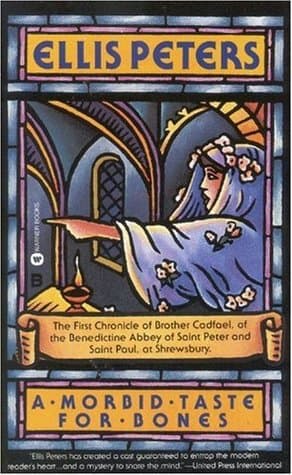
Ellis Peters (2021)
Genre
Historical Fiction / Mystery
Reading Time
197 min
Key Themes
See below
Sign in to track this book
In 12th-century Wales, Brother Cadfael looks for a saint's relics but finds a murder instead, leading him to uncover a killer amidst faith, love, and old loyalties.
In 1137, Abbot Heribert of Shrewsbury Abbey wants to raise the abbey's standing and wealth. He decides to get Saint Winifred's relics from her burial place in Gwytherin, a remote Welsh village. He sends a small group, led by Prior Robert, with Brother Cadfael, a former crusader and herbalist, as their Welsh translator. The group also includes Brother Columbanus, a young monk, and a few lay brothers. Their journey to the isolated village is hard, setting the scene for a cultural clash between the monks and the traditional Welsh villagers.
When they arrive in Gwytherin, the Shrewsbury group gets a mixed welcome. Some villagers, like Father Huw and Sioned, are open to moving the saint. Others strongly protect their saint. Rhisiart, a respected elder, is the most vocal opponent. He sees the monks' plan as sacrilege and theft. He argues passionately against disturbing Winifred's peace, rallying the community against the monks. Cadfael observes the situation and understands the deep spiritual and cultural meaning Winifred has for the Welsh people.
Prior Robert wants to complete Abbot Heribert's mission. He uses persuasion and veiled threats, talking about spiritual benefits and possible wealth for the village. But his unyielding approach only strengthens Rhisiart's resolve and alienates many villagers. Cadfael, as translator, tries to mediate, understanding Welsh language and culture, but Prior Robert mostly ignores him. The talks become more bitter. Rhisiart refuses to let the relics be moved, setting up a conflict.
One morning, the community finds Rhisiart dead in the woods, an arrow in his chest. The murder throws the village into chaos and casts suspicion on the Shrewsbury monks, especially Prior Robert, due to his animosity with Rhisiart. Villagers also whisper about divine punishment, suggesting Saint Winifred herself killed her opponent. Brother Cadfael, with his sharp observation and practical experience, immediately sees this as a human crime, not a divine one, and begins his own quiet investigation.
Cadfael examines the crime scene and the arrow, noting its unusual feathers. He starts questioning villagers, discreetly gathering information. He learns about local disputes and relationships, including a rivalry between Rhisiart and his nephew, Meriet, over land. He also finds that Sioned, who had been open to the translation, had a complex relationship with Rhisiart, her guardian. The arrow becomes a key clue, leading Cadfael to consider who in the village had such a weapon and the skill to use it, slowly narrowing down suspects.
Through careful questioning and observation, Cadfael learns the arrow's distinct fletching is typical of a local style, known only to a few skilled archers in Gwytherin. He focuses on Meriet, Rhisiart's nephew, and Engelard, a traveling Norman bowman who had been in the area. Cadfael also thinks about a local hunter, but the precise shot suggests a more personal motive. His investigation shows the murder weapon was likely made locally, increasing suspicion within the community and ruling out outside possibilities.
As Cadfael looks deeper, he uncovers a web of romantic relationships. He learns Sioned and Meriet were secretly in love, but Rhisiart, Sioned's guardian, strongly disapproved. He wanted her to marry someone else for political and social reasons. Engelard, the Norman archer, also liked Sioned, creating a tense love triangle. This discovery provides a strong motive for murder, as Rhisiart's death would remove the main obstacle to Sioned and Meriet's union. Cadfael realizes the murder is about human emotions, not the relics.
Cadfael, with careful questioning and by showing his evidence, eventually confronts Meriet. Overwhelmed by Cadfael's deductions and his own guilt, Meriet confesses to killing Rhisiart. He explains that Rhisiart's firm opposition to his marriage with Sioned, along with his plans to force Sioned into another marriage, drove him to desperation. Meriet saw Rhisiart's death as the only way to secure his future with Sioned, believing it was an act of justice for their forbidden love. His confession brings a tragic end to the immediate mystery.
With the killer identified and the authorities satisfied, the issue of Saint Winifred's relics comes up again. Despite the initial resistance and the tragedy, the villagers, perhaps tired from the events or seeing it as unavoidable, agree to the translation. The relics are carefully dug up and prepared for their trip to Shrewsbury Abbey. The process is serious, mixed with sadness for Rhisiart's death and a reluctant acceptance of the saint's departure. The Shrewsbury monks, having finished their mission, prepare to return.
The Shrewsbury group, now carrying Saint Winifred's relics, makes the long journey back to the abbey. Abbot Heribert is happy with their success, seeing it as a victory for the abbey. Cadfael, however, remains thoughtful. He thinks about human nature, the blurred lines between justice and revenge, and the power of faith, both true and manipulative. He carries the weight of the murder and the knowledge of the human cost involved in getting the saint's bones, a stark contrast to the triumphant mood of his fellow monks.
The Protagonist
Cadfael solidifies his role as an unconventional detective, using his worldly wisdom to solve a crime that challenges the abbey's spiritual mission.
The Antagonist (in the relic dispute)
Prior Robert remains largely unchanged, achieving his objective of acquiring the relics but failing to gain any deeper understanding of the human cost involved.
The Victim
Rhisiart's death serves as the catalyst for the mystery, his strong will leading directly to his demise.
The Supporting
Sioned endures the trauma of her guardian's murder and the revelation of her lover's guilt, emerging as a figure of quiet resilience.
The Murderer
Meriet transforms from a frustrated lover into a desperate murderer, revealing the dark side of his passion.
The Supporting
Abbot Heribert successfully acquires the relics, reinforcing his ambition and the abbey's status, largely unaffected by the human tragedy.
The Supporting
Columbanus witnesses the harsh realities of the world, which challenges his naive understanding of faith and justice.
The Supporting
Father Huw navigates the conflict and tragedy, ultimately accepting the inevitable translation of the relics with a sense of resignation.
The Mentioned
Engelard serves as a red herring, diverting suspicion before the true murderer is revealed.
The novel explores the tension between true religious faith, common superstitions, and the practical, often self-serving motives of institutions. Prior Robert shows a rigid, institutional faith focused on relics and power. The villagers' faith in Saint Winifred is personal and linked to their land. Cadfael bridges these views, understanding both spiritual longing and human flaws. The murder itself questions divine intervention versus human action, with some villagers believing Winifred killed Rhisiart, while Cadfael looks for a human culprit. The search for relics, seemingly an act of faith, is driven by the abbey's ambition.
““There are two ways of knowing God, Brother Cadfael. One is by the spirit, and the other is by the bones.””
Justice is a main theme in the story. Cadfael's personal sense of justice, from his worldly experience and moral compass, drives his investigation. This often clashes with the formal, sometimes unfair, legal systems of the time, and the abbey's own idea of 'justice' as getting relics. Rhisiart's murder forces Cadfael to seek justice for a human crime, regardless of its effect on the abbey's mission. The ending, where the killer is found but the relics are still taken, raises questions about different forms of justice and their priorities.
““There is no justice save what we make for ourselves.””
The novel clearly shows the clash between the Norman-influenced Benedictine monks from Shrewsbury and the Welsh villagers of Gwytherin. The monks, representing a more central and powerful religious authority, try to impose their will and culture on the remote Welsh community. The language barrier, different customs, and contrasting views on the sanctity of land and saints highlight this cultural conflict. Getting Saint Winifred's relics can be seen as cultural appropriation or spiritual colonialism, where the dominant power tries to take over the symbols of the less powerful. Cadfael, as a Welshman, handles this divide with empathy.
““They are taking our saint, our solace, our very heart, and they call it an act of God.””
Underneath the religious and cultural conflict, powerful human emotions drive the story: love, ambition, jealousy, and desperation. Rhisiart's murder is not about the relic dispute. It results from Meriet's desperate love for Sioned and Rhisiart's strong control over their future. Prior Robert's ambition for the abbey also causes much of the initial conflict. The novel shows how intense emotions can lead to tragic and unexpected outcomes, even overshadowing grand spiritual goals.
““It is not God who moves men to such deeds, but the devil in their own hearts.””
A murder occurs within a closed, isolated community, limiting suspects and forcing internal investigation.
While not a literal 'locked room,' the remote Welsh village of Gwytherin functions as a psychological locked room. Its isolation from the outside world means that the murderer must be one of its inhabitants or one of the few visitors. This device concentrates the tension and suspicion within the small community, allowing Cadfael to delve deeply into the personal histories, relationships, and hidden motives of a limited cast of characters. It emphasizes that the solution lies not in external factors, but in the intricate web of human connections within the village.
Misleading clues or suspects designed to divert the reader and investigator from the true culprit.
The novel employs several red herrings. Initially, suspicion falls heavily on Prior Robert due to his contentious relationship with Rhisiart, and on the idea of divine retribution. The presence of Engelard, a skilled Norman bowman who also had an interest in Sioned, further complicates the investigation, suggesting an outsider might be responsible. These diversions force Cadfael, and the reader, to consider multiple possibilities before the true, more personal motive and perpetrator are revealed. This device builds suspense and allows for a more satisfying unraveling of the mystery.
A detective figure who is not originally part of the community where the crime occurs, offering a fresh perspective.
Brother Cadfael serves as the outsider-investigator. Although Welsh by birth, he is a monk from Shrewsbury, a 'foreigner' in Gwytherin. This position allows him a degree of impartiality and detachment, enabling him to observe the villagers' customs and relationships without being fully entangled in their local politics or prejudices. His unique blend of monastic vows and worldly experience provides him with the necessary empathy to understand the local culture, while his outsider status grants him the critical distance required to piece together the truth without succumbing to local biases or superstitions.
An object or goal that drives the plot forward but is ultimately of secondary importance to the main conflict.
The relics of Saint Winifred act as the primary MacGuffin in the story. Their acquisition is the initial goal that sets the Shrewsbury monks on their journey to Gwytherin, leading to the conflict with Rhisiart and, indirectly, to his murder. While the relics are the ostensible reason for the expedition, the true heart of the story and the mystery lies in the human passions, jealousies, and moral dilemmas that arise around their presence. The relics themselves become less important than the human drama they provoke, effectively serving as a catalyst for the real plot.
“For good or ill, the world would never be quite the same again. It had begun to change, and the change would not be stopped.”
— Reflecting on the changing times and the impact of events.
“There are some things that even the most pious of men cannot resist, and a good mystery is one of them.”
— Brother Cadfael's internal thought on his interest in the unfolding mystery.
“It is a strange thing, this human heart. It can hold so much love, and so much hate, sometimes for the same person.”
— Cadfael musing on the complexities of human emotion.
“Justice is not always a matter of law, but sometimes of what is right in the sight of God.”
— Cadfael's view on a situation where legal justice might not align with moral justice.
“The past is never truly dead. It merely sleeps, waiting for a moment to stir.”
— A reflection on how past events and secrets can resurface.
“God's will can be a fearsome thing, especially when men presume to know it.”
— Commentary on characters who claim to act solely on divine will, often for their own ends.
“Sometimes, the smallest of clues can unravel the largest of deceptions.”
— Cadfael's observation during his investigation.
“There is a great deal of difference between what is true and what men choose to believe.”
— A point about the subjective nature of truth and belief.
“Even in the holiest of places, the shadows of worldly desires can linger.”
— Noting the presence of human failings within the monastery setting.
“Life has a way of twisting the straightest paths into tangled mazes.”
— A general observation on the unpredictable nature of life's journey.
“It takes a certain kind of courage to admit one's own folly.”
— Reflecting on a character's struggle with pride and error.
“The dead, alas, tell no tales, but they leave behind those who do.”
— Cadfael's understanding that while victims are silent, their lives and circumstances speak through others.
“Patience is a virtue, but sometimes a swift hand is more effective.”
— Cadfael balancing his contemplative nature with the need for decisive action.
“What is hidden in the earth will eventually come to light, one way or another.”
— A thematic reflection on the uncovering of secrets, particularly the bones of Saint Winifred.
Ready to see how well you understood this book? Take our interactive quiz with 10 questions.
Biography coming soon.







