“Stories are wild creatures, the monster said. When you let them loose, who knows what havoc they might wreak?”
— The monster explains the unpredictable nature of stories to Conor.

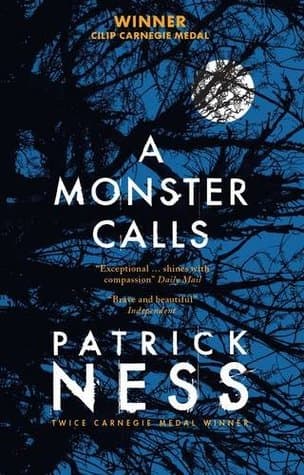
Patrick Ness (2011)
Genre
Fantasy / Children's / Young Adult
Reading Time
240 min
Key Themes
See below
Sign in to track this book
A grieving boy's nightmares manifest into a tree monster that demands the terrifying truth about his mother's terminal illness, forcing him to confront the complex, messy emotions of loss and acceptance.
Thirteen-year-old Conor O'Malley has a recurring nightmare involving a cliff, a chasm, and a falling hand. One night, exactly seven minutes past midnight, a monster made of yew tree branches bursts from the old yew in his backyard, breaking through his bedroom window. The Monster, a tall, old being, tells Conor it has come for him, but not to harm him. Instead, it says it will tell Conor three stories, and in return, Conor must tell the Monster a fourth story — his own truth, the one he is most afraid to admit. Conor, at first defiant and sure it's another dream, ignores the Monster. His mind is busy with his mother's cancer treatments and his grandmother's upcoming visit.
The Monster's first story is about a handsome prince whose father, the King, marries a beautiful but cold woman. The prince fears his stepmother and plans to run away with his true love, a farmer's daughter. However, the stepmother poisons the farmer's daughter, or so the prince thinks. In anger, the prince drags his stepmother to a cliff, intending to push her. The Monster reveals the truth: the prince killed the farmer's daughter himself to frame his stepmother and turn the kingdom against her, gaining power. The Monster concludes that humans are complicated, and good and evil are not always clear, leaving Conor confused and frustrated, as he expected a simpler moral.
At school, Conor is bullied by Harry, Sully, and Anton. Harry, the leader, often beats Conor, but Conor never fights back, accepting the punishment. He also feels more alone, as teachers and classmates treat him with pity because of his mother's illness. His strict grandmother, Mrs. O'Malley, arrives to stay while his mother gets more intense treatment. She immediately starts to enforce her rigid rules on Conor and his mother, causing tension and making Conor feel more restricted and watched. His mother tries to calm things, but her worsening health limits her ability to help.
The Monster appears again, telling its second story about an apothecary who uses old remedies and a parson who preaches about hellfire. When the parson's daughters get a mysterious illness, he refuses the apothecary's help, believing in divine punishment. After his daughters die, the parson's church members leave him, and he begs the apothecary to save him from the Monster (the yew tree, here). The Monster explains that it saved the parson, not from itself, but from his own lack of belief, which caused him to lose everything. The Monster says belief helps healing, but Conor struggles to understand the details, still wanting a clear villain.
Conor's anger and frustration grow as his mother's condition gets worse and his grandmother's presence feels overwhelming. During a particularly bad attack by Harry at school, Conor snaps. The Monster appears, destroying Harry and his friends, though only Conor sees how much damage happened. Later, his grandmother finds her antique clock and living room completely destroyed. Conor, still influenced by the Monster, is blamed. He feels a strange satisfaction, a release of his stored-up rage, even as he faces his grandmother's anger and the confusion of the adults around him, who think the damage was from a nightmare or sleepwalking.
The Monster returns for its third story, this time about an invisible man. This man is not truly invisible, but people simply do not see him, looking through him as if he is not there. He longs to be noticed, to be acknowledged. One day, he decides he has had enough of being ignored. He goes on a rampage, breaking things, destroying property, and causing chaos, forcing people to finally look at him and recognize he exists. The Monster explains that the invisible man's actions, though destructive, made him visible, and sometimes, to be seen, one must break things. Conor understands this story, relating to the feeling of being overlooked and wanting recognition.
Conor's mother's condition quickly gets worse, and she starts receiving comfort care. His father, who lives in America with his new family, flies over for a short visit. Conor hopes his father will offer comfort or a solution, maybe even take him to live with him. However, his father is distant and awkward, making it clear that Conor will have to stay with his grandmother after his mother dies. This conversation breaks Conor's last bit of hope, leaving him feeling abandoned and alone, further solidifying his resentment towards his father and the unavoidable future he faces with his grandmother.
Conor's nightmare becomes more real and terrifying. He is on a cliff, holding his mother's hand, but he cannot hold on, and she falls into the chasm. The Monster appears again, asking for Conor's fourth story. Conor is scared, resisting, knowing the truth he must tell is too painful and shameful. The Monster insists that it came not to save him, but to help him understand. It explains that the truth is what Conor has been avoiding, the secret he holds in his heart. The Monster promises that once he tells his truth, it will help him face the nightmare.
At his mother's bedside, as she lies unconscious, the Monster appears again. Conor has to face his truth. He breaks down, confessing that in the recurring nightmare, he is not trying to save his mother; he is letting her go. He admits that he wished for her to die, not because he did not love her, but because he could not bear to watch her suffer anymore. He felt guilty for this wish, believing it made him a monster. The Monster embraces Conor, validating his feelings, explaining that it is natural to want an end to pain, even if it means losing a loved one. It tells him that he is not a monster, but a boy who simply wanted the suffering to stop.
As Conor finally speaks his truth, the Monster becomes a comforting presence, wrapping its branches around him. His mother, briefly conscious, whispers her love to him. Conor clings to her, finally able to accept what will happen. He realizes that the Monster's stories were not about good or evil, but about the complicated truths of human emotions: wanting revenge, the power of belief, needing to be seen, and the guilt of wishing for suffering to end. As his mother dies in his arms, Conor can face her death with a new understanding and a fragile sense of peace, helped by the Monster's lessons.
The Protagonist
Conor transforms from a boy consumed by denial and guilt into one who can face and accept the painful truth of his mother's illness and his own complex emotions.
The Mentor/Allegorical Figure
The Monster remains consistent in its role, its 'arc' is in how Conor's perception and understanding of it evolve.
The Supporting
Her physical health declines throughout the story, leading to her inevitable death, which brings Conor's emotional journey to a head.
The Supporting
She remains largely consistent, her stoicism only slightly softening at the very end as she shares grief with Conor.
The Supporting/Mentioned
His character doesn't undergo significant development; he primarily serves to highlight Conor's feelings of abandonment.
The Supporting
Harry remains a static antagonist, serving as a catalyst for Conor's internal struggles and the Monster's manifestations.
The Mentioned
No significant arc.
The Mentioned
No significant arc.
The main idea is Conor's struggle to deal with his mother's terminal illness and upcoming death. He experiences denial, anger, guilt, and eventually, a difficult acceptance. The Monster's stories, especially the third one about the invisible man, show how isolating grief can be and the strong need to be seen and understood. Conor's journey shows how children cope with the pain of losing a parent, and how grieving is a messy process where emotions are rarely simple.
“''Your mind will believe comforting lies while your heart knows the painful truths,' the monster said.”
Conor's deepest struggle is his inability to face the truth of his mother's illness and his own conflicting emotions, especially his wish for her suffering to end. The Monster's visits aim to make Conor acknowledge this 'fourth story,' his painful truth. The Monster's parables consistently challenge simple ideas of good and evil, pushing Conor to accept the complexity of human nature and the difficult, often contradictory, truths within himself. The book suggests that real healing starts when one stops denying uncomfortable realities.
“'Stories are wild creatures,' the monster said. 'When you let them loose, who knows what havoc they might wreak?'”
The Monster's first two stories, about the prince and the apothecary, intentionally turn traditional fairy tale morals upside down. They show that good people can do bad things, and seemingly bad people can be justified. This idea challenges Conor's black-and-white view of the world, making him understand that life and human actions have many shades of gray. This reflects Conor's own inner conflict: his love for his mother and his simultaneous, guilty wish for her death, which defies simple moral rules.
“'There is not always a good guy. Nor is there always a bad one. Most people are somewhere in between.'”
Stories are not just entertainment here; they are a tool for processing trauma and understanding the world. The Monster uses its tales to guide Conor through his emotional maze, providing allegorical ways to understand his own experiences. Conor's 'fourth story' is his ultimate truth, the narrative he must create and tell to find relief. The book itself, as a story, shows how narrative can help confront difficult realities and find meaning in suffering.
“'And by the time the story was over, Conor knew it wasn't a story at all. It was the truth.'”
Conor hides a lot of anger and frustration about his mother's illness, the bullying he faces, and his grandmother's coldness. This hidden rage appears physically through the Monster's destructive actions, such as the attack on Harry and the destruction of the living room. The Monster's third story, about the invisible man, directly addresses the need to be seen, even if through destructive means. The story shows that anger, while damaging, can also be a necessary step in dealing with grief and asserting one's presence, leading to a release.
“'You only think you know this story,' the monster said. 'But you do not.'”
A magical realist manifestation of nature and Conor's subconscious.
The Monster, a colossal creature made of yew branches, serves as a magical realist device. It is both literally present in Conor's world and allegorically representative of his subconscious, grief, and the raw, untamed forces of nature. It acts as a guide and a confessor, forcing Conor to confront uncomfortable truths through its parables. Its physicality allows for externalization of Conor's internal struggles, such as his rage, making the abstract emotions tangible and allowing for a fantastical exploration of very real human pain.
A symbolic dream representing Conor's guilt and fear of loss.
Conor's nightmare, involving a cliff, a chasm, and his mother's slipping hand, is a powerful symbol. It initially represents his fear of losing his mother, but as the story progresses, it's revealed to symbolize his hidden guilt – his wish for her to die and end her suffering. The nightmare's increasingly vivid nature mirrors Conor's growing inability to deny his truth. It is the 'fourth story' that the Monster demands, acting as the ultimate hurdle Conor must overcome to achieve acceptance.
Fairy tale-like stories that subvert traditional morals.
The three stories told by the Monster are not simple children's tales. They are complex parables that deliberately defy conventional good-versus-evil narratives, presenting morally ambiguous characters and situations. These stories serve as direct challenges to Conor's simplistic worldview, preparing him to accept the messy, complicated truth of his own emotions and the reality of his mother's illness. They are a pedagogical tool, slowly chipping away at Conor's denial and forcing him to think critically about morality and human nature.
The blending of the fantastical Monster into a realistic contemporary setting.
The novel employs magical realism by seamlessly integrating the fantastical element of the yew tree Monster into Conor's otherwise mundane and realistic contemporary life. The Monster's appearance and actions are treated as real within Conor's perception, even as other characters remain oblivious or attribute events to normal causes. This device allows the story to explore profound psychological and emotional themes in an imaginative way, externalizing Conor's internal world and making his grief and guilt tangible without resorting to a purely allegorical or dream-like framework.
“Stories are wild creatures, the monster said. When you let them loose, who knows what havoc they might wreak?”
— The monster explains the unpredictable nature of stories to Conor.
“There is not always a good guy. Nor is there always a bad one. Most people are somewhere in between.”
— The monster tells Conor a story that challenges simplistic moral views.
“You do not write your life with words... You write it with actions. What you think is not important. It is only important what you do.”
— The monster emphasizes the importance of actions over thoughts.
“I did not come to heal her. I came to heal you.”
— The monster reveals its true purpose to Conor near the end.
“You were merely wishing for the end of pain, the monster said. Your own pain. An end to how it isolated you. It is the most human wish of all.”
— The monster helps Conor understand his hidden feelings about his mother's illness.
“Belief is half of all healing.”
— The monster speaks about the power of belief in difficult times.
“You thought it might be easier if you were to be punished, the monster continued, if you did not have to feel so guilty.”
— The monster confronts Conor about his desire for punishment over guilt.
“Stories are the wildest things of all, the monster rumbled. Stories chase and bite and hunt.”
— The monster describes the untamed power of stories.
“You must tell the truth or you will never leave this nightmare.”
— The monster urges Conor to confront his deepest truth.
“There is no prince, the monster said. There is no princess. And there is no spell.”
— The monster dismisses fairy-tale expectations in one of its stories.
“You were afraid to be alone, the monster said. And you were afraid she would go.”
— The monster articulates Conor's fears about his mother's impending death.
“You do not have to be a hero to be brave.”
— The monster reassures Conor about the nature of courage.
“The answer is that it does not matter what you think, the monster said, because your mind will contradict itself a hundred times each day.”
— The monster points out the inconsistency of human thoughts.
“You have been thinking it, but that does not mean you have to be ashamed of it.”
— The monster helps Conor accept his difficult emotions without shame.
Ready to see how well you understood this book? Take our interactive quiz with 10 questions.

Biography coming soon.







