“The trouble with our country is that nobody is angry enough to make the government sit up.”
— Nanga expresses frustration about public apathy toward government corruption.


Chinua Achebe (1966)
Genre
Literary Fiction / Politics / Historical Fiction
Reading Time
160 min
Key Themes
See below
Sign in to track this book
In a post-colonial African nation, a young teacher's campaign against his corrupt former mentor ignites a personal and political conflict, pushing their country toward revolution.
Odili Samalu, a young, educated teacher in the fictional West African country of Anata, gets an invitation from his former teacher, Chief M. A. Nanga. Nanga is now the powerful Minister of Culture. Odili travels to the capital, Bori, and is at first impressed by Nanga's generosity and lavish life. He stays in Nanga's luxurious official residence and sees the constant flow of people who flatter the Minister. Nanga, despite his humble beginnings as a village schoolteacher, has fully embraced the rich and corrupt world of post-colonial politics. This world involves bribery, favoritism, and ignoring public service. Odili, still holding onto his youthful ideals, starts to feel uneasy with Nanga's behavior and the fawning around him.
While staying with Nanga, Odili introduces his girlfriend, Elsie, a nurse, to the Minister. Nanga, known for being promiscuous, quickly shows interest in Elsie. Despite Odili's trust and Elsie being his guest, Nanga seduces Elsie and brings her into his bedroom, making her his mistress. Odili is deeply humiliated and angry about this betrayal. He feels not just personally wronged but also very disappointed in Nanga's character. He confronts Nanga, but the Minister dismisses his anger, offering him money and downplaying the incident. Odili, feeling disrespected, leaves Nanga's house, vowing revenge for this personal offense, which now mixes with his growing political dislike for Nanga.
After leaving Nanga's house, Odili returns to Anata. His personal anger against Nanga fuels his interest in politics. Max, a former university friend and a lawyer, approaches him. Max is forming a new political party, the Common People's Alliance (C.P.A.), to challenge the corrupt ruling party, the People's Organization Party (P.O.P.), led by Nanga. Odili, wanting a way to oppose Nanga, joins the C.P.A. He then meets Edna, a young woman from Anata whose father was Nanga's former teacher. Nanga has promised to pay for Edna's education and marry her as his second wife, treating her like property. Odili, still seeking revenge and now attracted to Edna, begins to court her, seeing her as another way to spite Nanga.
As the general election gets closer, Odili decides to run as the C.P.A. candidate for the Anata area, directly challenging Chief Nanga. This decision makes the personal and political conflict between the two men more intense. Nanga sees Odili's candidacy as a direct insult and betrayal. Odili sees it as a chance to expose Nanga's corruption and get his revenge. The election campaign quickly becomes dirty and violent. Nanga, using his power, wealth, and influence, uses intimidation, bribery, and propaganda to hurt Odili's campaign. Odili, despite his ideals, finds himself in the practical and often morally unclear world of politics, trying to keep his principles as the conflict grows.
The election campaign in Anata becomes more brutal. Nanga's supporters, with plenty of money and organization, use violence to break up C.P.A. rallies and scare voters. Odili and his campaigners are physically attacked, their vehicles are damaged, and they face constant threats. During one violent event, Odili is assaulted, and his Land Rover is destroyed. Despite these dangers, Odili and Max remain committed to their goal, believing they can bring change. The C.P.A. struggles to gain ground against the established power and resources of the P.O.P. This shows the deep corruption and the difficulty of challenging the current situation in the country's politics. The violence shows how fragile democracy is and how desperate those in power are to keep it.
On the day before the election, a tragic event happens: Max, the leader of the C.P.A., is killed. Nanga's thugs, sent to disrupt a C.P.A. meeting, kill him. This extreme political violence shocks the country and further shows the ruling party's brutality. Soon after Max's death, a military coup d'état happens, led by young army officers. The coup quickly overthrows the corrupt government, including Chief Nanga and his ministers. The country enters a time of uncertainty, but there is an initial hope that the military will get rid of the widespread corruption and bring about true public service and accountability. The coup is shown as a necessary, though violent, response to the civilian government's complete failure.
After the military coup, Chief Nanga and other corrupt ministers are arrested and lose their power and wealth. The time of 'chop-chop' politics, where politicians got rich at the people's expense, ends suddenly. Odili, though sad about Max's death, feels some vindication. The coup, while violent, achieves what his political campaign could not: the removal of the corrupt government. With Nanga gone, Odili is free to pursue his relationship with Edna without the Minister's claim. He proposes to Edna, and they plan to marry. The novel ends with cautious hope, suggesting that while good governance is hard to achieve, there is hope for a better future, shown by Odili and Edna's marriage and the chance for a new political order.
The Protagonist
From an idealistic observer, Odili transforms into an active, albeit flawed, political participant, ultimately finding personal resolution and a new direction after the coup.
The Antagonist
Nanga consolidates and enjoys his corrupt power throughout the narrative, only to be abruptly overthrown and stripped of everything by the military coup.
The Supporting
Max remains steadfast in his political ideals, ultimately sacrificing his life for the cause he believes in.
The Supporting
Elsie's character arc is brief, serving mainly as a catalyst for Odili's transformation and an example of the corrupting influence of power.
The Supporting
Edna transitions from being a pawn in Nanga's plans to choosing her own path with Odili, symbolizing hope for a less corrupt future.
The Mentioned
Chief Koko's 'arc' is merely his initial act of corruption and subsequent acquittal, serving as an example of the systemic problems.
The Supporting
Mrs. Nanga remains largely static, a symbol of the traditional wife in a corrupt modern setting.
The Supporting
Jossy's arc is limited to his role as a loyal follower of Nanga, reflecting the broader societal issue of patronage.
This is the main theme, shown through Chief Nanga and the ruling People's Organization Party (P.O.P.). Nanga, a former teacher, becomes a minister who openly uses his position for personal wealth, bribery, and threats. The 'eat-and-let-eat' idea runs through all parts of the government, where public money is seen as personal gain. Chief Koko gets away with vehicular manslaughter, and Nanga seduces Odili's girlfriend, Elsie. This shows a complete lack of moral and legal accountability. The political system is shown as flawed, putting self-interest before public good, which leads to widespread disappointment and, in the end, a violent military coup.
“A man who has just come from the toilet can't blame his trousers for smelling. And if the people choose to soil their bed, who is Odili to wash it for them?”
The novel explores the conflict between the youthful ideals of Odili and Max, and the cynicism of Chief Nanga and older politicians. Odili at first believes in principles and justice, but his experiences gradually make him face the realities of power politics, where violence and manipulation are common. He struggles to keep his moral standards, at times giving in to his own desires for revenge and personal gain. Nanga, on the other hand, shows no idealism, openly accepting corruption as normal. Max, the most idealistic character, is killed, which shows the high cost of challenging the current system. The military coup suggests the limits of democratic ideals in such a corrupt environment.
“The owner of the house had fallen in love with his guest's wife. No. Let me put it more accurately: the owner of the house had fallen in love with his guest's intended wife.”
Achebe criticizes newly independent African nations for failing to create good and ethical governance. The novel is set in a fictional post-colonial country where the promise of independence has turned into widespread corruption, tribalism, and a self-serving elite. Leaders like Nanga often use traditional values while getting rich and ignoring public service. The military coup at the end, though violent, is shown as a necessary response to a government that completely failed its people. The novel reflects the disappointment felt in many African nations after independence, as new leaders often copied or worsened the exploitative practices of their colonial rulers.
“The people themselves, as we say, had become wise to the ways of their leaders and accepted the 'eat-and-let-eat' philosophy.”
The novel looks at the responsibilities and difficulties faced by the educated in a corrupt society. Odili and Max represent this group, with their education and desire for change. However, their efforts are constantly undercut by the power, wealth, and manipulation of leaders like Nanga, who are not educated but are politically smart. Odili's initial hesitation to fully join politics, and his later struggle to keep his principles, show how hard it is for intellectuals to make real change without compromising their ideals. The story questions whether intellect alone is enough to fight deep corruption, suggesting that it often gives in to or is overwhelmed by the practical, often brutal, realities of power.
“I had to confess that if I were in the shoes of the villagers I would have probably done the same. For what did a young, inexperienced man like me have to offer them compared with Chief Nanga's thirty-two-inch television set and his long car?”
Women in 'A Man of the People' are mostly shown as objects of male desire, status symbols, or passive victims in a male-dominated society. Elsie is easily seduced by Nanga's wealth, showing how women can be exploited or choose to use the system for personal gain. Edna is treated as an item; her education and future are decided by Nanga's plans to make her his second wife. This shows women's lack of control over their lives. Mrs. Nanga quietly endures her husband's affairs. These portrayals show how political corruption extends to personal relationships, where women's bodies and futures are often used to serve powerful men, further revealing the society's moral decay.
“She was going to be my second wife, of course. Everybody knew that. I had already paid for her school fees and things like that.”
Provides an intimate, yet subjective, perspective on the events.
The story is told from the perspective of Odili Samalu, allowing the reader to experience his initial idealism, his growing disillusionment, and his internal conflicts directly. This narrative choice immerses the reader in Odili's subjective experience, highlighting his struggle with moral compromises and his evolving understanding of power. However, it also means the reader's perception of events and characters, particularly Chief Nanga, is filtered through Odili's often biased and emotionally charged viewpoint, making him an unreliable narrator at times, especially when his personal vendetta clouds his judgment.
Uses humor and exaggeration to critique political corruption.
Achebe employs satire to expose and ridicule the widespread corruption, hypocrisy, and self-serving nature of post-colonial African politics. Chief Nanga, despite his villainous actions, is often portrayed with a degree of exaggerated charm and absurdity, such as his boastful illiteracy and his 'man of the people' persona, which makes his corruption all the more farcical and tragic. The humorous descriptions of political rallies, the sycophancy of his followers, and the blatant disregard for justice serve to highlight the absurdity and moral decay of the system, making the critique both sharp and memorable.
Subtly hints at the impending military takeover.
The novel contains subtle hints and allusions to the instability and eventual collapse of the civilian government. The escalating violence during the election, the arbitrary exercise of power by ministers, and the general sense of lawlessness create an atmosphere of impending doom. The narration occasionally alludes to the fragility of the political system, leading the reader to anticipate a drastic change. The military coup, when it finally occurs, feels both shocking and inevitable, a culmination of the rampant corruption and the people's growing frustration, fulfilling the sense of crisis that has built throughout the narrative.
A literary device used to expose political hypocrisy.
The title itself refers to Chief Nanga's public persona: a politician who claims to represent the common people while simultaneously exploiting them. This trope highlights the hypocrisy of leaders who use populist rhetoric and traditional symbols to mask their self-serving agendas. Nanga's ability to connect with the masses, despite his blatant corruption, is a key aspect of his power. This device allows Achebe to critique how demagoguery and a superficial appeal to the common man can be used to manipulate the electorate and maintain a corrupt hold on power, contrasting the public image with the private reality of the politician.
“The trouble with our country is that nobody is angry enough to make the government sit up.”
— Nanga expresses frustration about public apathy toward government corruption.
“A man who has just come in from the rain and dried his body and put on dry clothes is more reluctant to go out again than another who has been indoors all the time.”
— Odili reflects on how those who have experienced hardship become cautious about change.
“In our country, the only way to be safe is to be on the side of the government.”
— A cynical observation about political survival in a corrupt system.
“The people are the government and the government is the people.”
— Nanga uses populist rhetoric to justify his actions.
“We ignore man's basic nature if we say, as some critics do, that because a man like Nanga had risen overnight from poverty and insignificance to his present opulence he could be persuaded without much trouble to give it up for the good of the people.”
— Odili analyzes the difficulty of convincing corrupt politicians to reform.
“In our country, the only thing that matters is money. If you have money, you are a man of the people.”
— A critique of how wealth defines political legitimacy.
“The trouble with our new nation was that none of us had been indoors long enough to be able to say 'To hell with it'.”
— Reflection on the challenges facing a newly independent nation.
“Power is sweet; it is even sweeter than honey.”
— Nanga expresses his addiction to political power.
“In our country, the only way to get justice is to buy it.”
— A cynical view of the legal system under corruption.
“The people are like children; they must be led.”
— Nanga's paternalistic attitude toward the electorate.
“We were too busy fighting our personal battles to see the national disaster looming ahead.”
— Odili reflects on how individual ambitions overshadow national concerns.
“In politics, you do not fight a man because he has wronged you, but because he is in your way.”
— A pragmatic observation about political rivalry.
“The true test of a man's character is what he does when no one is watching.”
— Odili reflects on integrity in a corrupt environment.
“Our people have a short memory; that is why politicians can get away with anything.”
— Commentary on public forgetfulness enabling corruption.
Ready to see how well you understood this book? Take our interactive quiz with 10 questions.
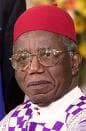
Chinua Achebe was a Nigerian novelist, poet, and critic who is regarded as a central figure of modern African literature. His first novel and magnum opus, Things Fall Apart (1958), occupies a pivotal place in African literature and remains the most widely studied, translated, and read African novel. Along with Things Fall Apart, his No Longer at Ease (1960) and Arrow of God (1964) complete the "African Trilogy". Later novels include A Man of the People (1966) and Anthills of the Savannah (1987). In the West, Achebe is often referred to as the "father of African literature", although he vigorously rejected the characterization.







