“I think that when statesmen forsake their own private conscience for the sake of their public duties... they lead their country by a short route to chaos.”
— Spoken by Sir Thomas More, reflecting on his refusal to sign the Act of Supremacy.

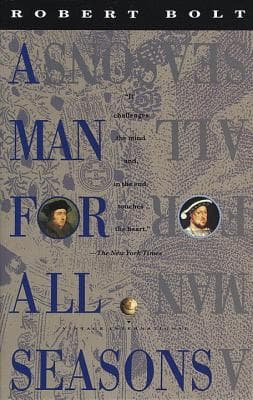
Robert Bolt (1960)
Genre
Historical Fiction / Spirituality
Reading Time
192 min
Key Themes
See below
Sign in to track this book
In a treacherous court, Sir Thomas More, a man of conscience, chooses death over betraying his soul and God for King Henry VIII's desires.
The play begins with the Common Man, who narrates and plays various minor characters, introducing the audience to 16th-century England's political and social climate. He immediately sets up the central conflict: the King's desire for a divorce and the clash with the established order. We meet Sir Thomas More at home in Chelsea with his family: his daughter, Margaret More; her suitor, William Roper; and Alice More, Thomas's wife. More's piety and integrity are clear, contrasting with Roper's zealous Protestantism, which More gently challenges. Richard Rich, an ambitious but morally weak young man seeking patronage, arrives, further highlighting More's character as a man of principle who offers advice rather than easy advancement.
Cardinal Wolsey, the Lord Chancellor, sends for Sir Thomas More, interrupting his family time. More, a loyal servant, expresses unease about the King's intentions, especially regarding his divorce from Queen Catherine of Aragon. Wolsey, frustrated by More's moral stance and lack of political expediency, tries to explain the urgency of the King's desire for a male heir and the political consequences of his marriage. More, however, believes only the Pope has authority in such matters and that the King's marriage is valid. Their conversation previews the conflict between More's conscience and the King's will, with Wolsey representing the court's pragmatic, power-driven side.
After Cardinal Wolsey's death, Sir Thomas More reluctantly becomes Lord Chancellor, a role he performs with integrity. However, King Henry VIII's determination to divorce Catherine and marry Anne Boleyn grows stronger. The King begins pressuring the clergy to acknowledge his supremacy over the Pope in England. When Parliament passes acts undermining papal authority and declaring Henry the Supreme Head of the Church of England, More finds himself in an impossible position. Rather than directly oppose the King, which he knows would be dangerous, More resigns his Chancellorship, hoping silence will protect his conscience and family. This act isolates him from power and puts him against the King's agenda.
The King's break with Rome leads to the Act of Succession, requiring all subjects to swear an oath acknowledging Anne Boleyn's children as legitimate heirs and, implicitly, the King's supremacy over the Church. Sir Thomas More is summoned to Lambeth Palace to take this oath. Despite pressure from figures like Thomas Cromwell and Archbishop Thomas Cranmer, More refuses. He states that while he accepts the succession, he cannot swear to the oath's preamble, which asserts the King's ecclesiastical supremacy, as it violates his conscience and understanding of divine law. His refusal, carefully worded to avoid explicit treason, is seen as defiance, and he is arrested and imprisoned in the Tower of London.
While imprisoned, Sir Thomas More receives visits from his family: his wife Alice, his daughter Margaret, and his son-in-law William Roper. They are distressed by his suffering and the hardship his refusal has brought them, as their property has been confiscated. Alice, practical and concerned for their survival, pleads with him to take the oath and return home. Margaret, though sharing his intellectual depth, also struggles with his stance, urging him to find a loophole or compromise. More, however, remains resolute. He explains his soul is his own and he cannot sacrifice his conscience, even for his family. He tries to comfort them, but his commitment to his principles highlights the immense personal cost of his integrity.
Thomas Cromwell, now the King's chief minister, repeatedly interrogates Sir Thomas More in the Tower, seeking a confession or an explicit denial of the King's supremacy that would condemn him. Cromwell uses various tactics, from cajoling to thinly veiled threats, but More remains silent on the specific issue of the King's headship of the Church. He argues that the law cannot condemn him for silence, only for words spoken against the King. This legal defense frustrates Cromwell, who needs a clear statement of treason. Despite prison hardships and More's deteriorating health, his intellectual rigor and moral fortitude remain unbroken, much to Cromwell's irritation and the King's impatience.
The Duke of Norfolk, an old friend of Sir Thomas More, visits him in the Tower, sent by Cromwell to persuade him to change his mind. Norfolk, a man of power who values his position and life, finds More's uncompromising stance baffling and dangerous. He appeals to their friendship, to More's family, and to common sense, arguing that More's stand is futile and will lead to his death. More, however, explains that his conscience is not a matter for compromise or popular opinion. He regrets the loss of their friendship but firmly states he cannot betray his soul for worldly gain or even for life itself. This exchange highlights the contrast between More's spiritual convictions and his peers' worldly pragmatism.
As other attempts to condemn Sir Thomas More fail, Thomas Cromwell fabricates evidence. Richard Rich, who More had earlier advised to become a teacher rather than pursue a corrupt court career, now appears as a key witness for the prosecution. Rich, having accepted the position of Attorney-General for Wales (a reward for his loyalty to Cromwell), perjures himself. He claims that More, in a private conversation in the Tower, explicitly denied the King's supremacy, saying, 'No King can be head of the Church.' More refutes this, pointing out Rich's moral decay and the unlikelihood of him making such a statement to a known schemer. However, with Rich's testimony, the court has the 'evidence' it needs to convict More of high treason.
Sir Thomas More's trial takes place, presided over by his former friend, the Duke of Norfolk. Despite More's eloquent defense, where he exposes the flimsy legal basis of the charges and Richard Rich's clear perjury, the outcome is predetermined. The jury, intimidated by Cromwell and the King's power, quickly finds him guilty of treason. Once the verdict is delivered, More, no longer bound by his careful silence, openly declares his belief that the Act of Supremacy is unlawful and against God's laws and the Church. He asserts that no temporal ruler can usurp the Pope's spiritual authority. This final, defiant statement seals his fate, and he is condemned to be hanged, drawn, and quartered, though the sentence is later commuted to beheading.
On the scaffold, Sir Thomas More maintains his composure, dignity, and wit. He addresses the crowd, stating that he dies 'the King's good servant, but God's first.' He forgives his executioner and asks for prayers. His final moments show peace and commitment to his faith and conscience. The Common Man, observing, reflects on the futility of More's death in worldly terms but acknowledges the lasting power of his integrity. More's execution is a solemn conclusion, showing the sacrifice he makes for his principles, becoming a martyr for his beliefs against absolute temporal power.
The Protagonist
More begins as a respected, influential figure at court and ends as a condemned martyr, his journey defined by an increasing isolation as he refuses to compromise his conscience.
The Narrator/Supporting
The Common Man remains largely unchanged, serving as a consistent foil to More's idealism, representing the enduring human instinct for self-preservation.
The Antagonist
Henry's character remains consistent as a powerful, self-serving monarch, his actions driving the central conflict with More.
The Antagonist
Cromwell rises in power by executing the King's will, becoming More's primary persecutor, and remains a consistent antagonist.
The Supporting
Rich begins as a hopeful but unprincipled young man and devolves into a perjuring betrayer, gaining worldly success at the cost of his soul.
The Supporting
Alice struggles to understand and accept More's principled stand, her love for him clashing with her pragmatic desire for their safety.
The Supporting
Margaret grapples with her father's choices, torn between her love for him and her desire for his survival, ultimately accepting his profound integrity.
The Supporting
Roper evolves from a zealous, somewhat naive young man to a more mature and steadfast supporter of More, finding common ground in shared principles.
The Supporting
Norfolk's friendship with More is tragically severed by More's unwavering principles, as Norfolk prioritizes his own survival.
The main theme explores the conflict between an individual's moral and religious conscience and the absolute power of the state. Sir Thomas More's refusal to swear the Oath of Supremacy, which he believes violates God's law, pits his personal conviction against King Henry VIII's claim of absolute temporal and spiritual authority. This conflict appears in scenes like More's interrogation by Cromwell, where More insists that 'my conscience is my own,' even facing imprisonment and death. The play questions the limits of state power and the sanctity of individual belief.
“I will not wound my conscience for a Kingdom!”
The play contrasts the path of integrity, shown by Sir Thomas More, with the path of self-preservation, taken by characters like Richard Rich and even the Common Man. More chooses to die rather than compromise his principles, showing that true integrity means holding to one's beliefs regardless of the cost. Richard Rich, however, abandons his morals for ambition, perjuring himself for power. The Common Man, in his various roles, consistently chooses the safest, most expedient option, highlighting the difficulty and rarity of More's heroic stand. This theme explores what it means to live as 'a man for all seasons,' a person whose values remain constant through changing times.
“A man's soul is his own.”
Bolt examines the complexities of law, questioning whether it serves justice or merely the will of the powerful. More, a lawyer, initially believes in the law's protective power, arguing that 'the law is a causeway upon which, so long as he keeps to it, a citizen may walk safely.' However, as the King manipulates Parliament to create laws serving his agenda, and as Cromwell orchestrates More's conviction through fabricated evidence and perjury, the play shows how law can become an instrument of oppression. More's trial, where he is condemned despite a lack of legal evidence, illustrates justice subverted by political power.
“The law is not a 'light' for you or any man to see by; the law is not a 'light' but a torrent!”
The play explores martyrdom as a religious act and a profound statement of personal conviction that goes beyond worldly concerns. More's decision to die for his beliefs makes him a martyr whose legacy outlasts the temporal power that condemned him. His death is a testament to the power of an individual's moral stand against tyranny. The play suggests that while his death might seem a defeat in the short term, it secures an eternal victory for his soul and leaves a lasting mark on history, inspiring future generations with his example of principled resistance.
“I die the King's good servant, but God's first.”
The play shows how absolute power corrupts, both those who hold it and those who seek it. King Henry VIII's desire for a male heir and unchallenged authority leads him to dismantle established religious and legal structures, showing how unchecked power can lead to tyranny. Thomas Cromwell's rise is fueled by his willingness to abandon moral principles for political expediency, leading him to orchestrate More's downfall. Richard Rich's journey from a hopeful scholar to a perjuring official exemplifies how the pursuit of power can erode one's integrity. The play suggests that power, without a strong moral foundation, leads to injustice and moral decay.
“When statesmen forsake their own private conscience for the sake of their public duties... they lead their country by a short route to chaos.”
A choric figure who breaks the fourth wall and represents the audience's pragmatism.
The Common Man serves multiple roles: narrator, stagehand, and various minor characters (steward, boatman, jailer, executioner, etc.). His primary function is to provide commentary on the action, often with cynical humor, and to bridge the gap between the audience and the historical events. He embodies the pragmatic, self-preserving instinct of ordinary people, contrasting sharply with More's idealism. By breaking the fourth wall, he invites the audience to consider their own choices in similar situations, making the historical drama feel immediate and relatable. He highlights the universal human tendency to prioritize survival over principle.
Characters who highlight More's virtues through contrast.
Bolt uses several characters as foils to emphasize Sir Thomas More's unwavering integrity. Richard Rich is the most prominent, as his moral decay and betrayal directly contrast More's steadfastness. While More refuses to compromise his conscience, Rich sacrifices his for ambition. Thomas Cromwell's ruthless pragmatism and manipulation highlight More's adherence to law and justice. Even the Duke of Norfolk's worldly concerns and desire for self-preservation serve to underscore More's spiritual priorities. These foils make More's heroic stand more pronounced and allow the audience to grasp the full extent of his sacrifice.
Metaphorical representation of safety/law and danger/unprincipled action.
The imagery of water and dry land is used throughout the play to symbolize safety and danger, or adherence to the law versus stepping into moral ambiguity. More often refers to the law as a 'causeway' or 'dry land' that protects citizens, while 'the currents and eddies' of politics or unprincipled actions are dangerous waters. His advice to Rich to become a teacher rather than enter the 'treacherous' court is another instance. By remaining silent and within the letter of the law, More tries to stay on 'dry land,' but the King's actions eventually force him into the perilous 'waters' of open defiance and martyrdom. This metaphor visually and thematically reinforces More's struggle to maintain his legal and moral footing.
The audience's awareness of More's fate before the characters.
Dramatic irony is employed from the outset, particularly through the Common Man's narration, who often alludes to More's eventual execution. The audience knows More's historical fate, which creates a sense of impending tragedy and heightens the tension of his every decision. This device makes More's steadfastness even more poignant, as his principled choices are understood to be leading him directly to his death. It also allows the audience to appreciate the profound courage of his actions, knowing the ultimate cost, and to reflect on the historical inevitability of the conflict between his conscience and the King's will.
“I think that when statesmen forsake their own private conscience for the sake of their public duties... they lead their country by a short route to chaos.”
— Spoken by Sir Thomas More, reflecting on his refusal to sign the Act of Supremacy.
“The law is not a ‘light’ for you or any man to see by; the law is a causeway upon which so long as he keeps to it a citizen may walk safely.”
— More explains to Roper the importance of upholding the law, even for the devil.
“What matters to me is not whether it's true, but that I believe it; or no, not that I believe it, but that *I* believe it.”
— More distinguishing his personal conviction from general acceptance.
“When a man takes an oath, Meg, he's holding his own self in his own hands. Like water. And if he opens his fingers then—he needn't hope to find himself again.”
— More explaining the sanctity of an oath to his daughter, Margaret.
“I'm not a man for physics. I am a man for morals.”
— More contrasting his interests and priorities.
“God made the angels to show him splendor, as he made animals for innocence and plants for their simplicity. But Man he made to serve him wittily, in the tangle of his mind.”
— More reflecting on the unique nature and purpose of humanity.
“You wouldn't need to know my reasons, the King's a lawyer himself; he'd know my reasons.”
— More explaining why he doesn't need to explicitly state his reasons for refusing the oath to the King.
“I have not taken any money. I will not take any money. I will not be associated with it.”
— More's firm refusal to accept bribes or engage in corruption.
“It is not the business of the law to make you good. It is the business of the law to make you safe.”
— More's pragmatic view on the function of law.
“I'm a plain, simple man. I'm no hero. I'm just trying to get to heaven.”
— More humbly describing himself and his ultimate goal.
“Yes! I'd give the Devil benefit of law, for my own safety's sake!”
— More passionately defending the principle of law, even for one's enemies, to Roper.
“Death comes for us all, my lord; yes, even for Kings he comes.”
— More's stoic acceptance of mortality, spoken to King Henry VIII.
“If we are to go to heaven, we must walk the road of suffering.”
— More reflecting on the path to spiritual salvation.
Ready to see how well you understood this book? Take our interactive quiz with 10 questions.

Biography coming soon.







