“She wasn't just my grandma; she was a force of nature, like a tornado in a flowered hat.”
— Joey describes his Grandma Dowdel's powerful personality.

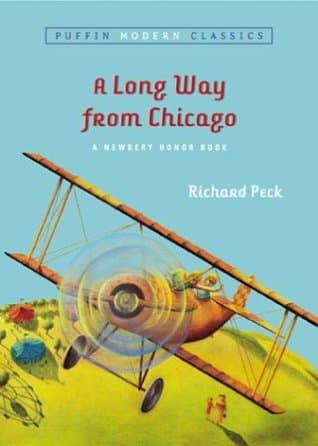
Richard Peck (1998)
Genre
Children's / Historical Fiction / Young Adult
Reading Time
160 min
Key Themes
See below
Sign in to track this book
Joey and Mary Alice spend nine eventful summers with their Grandma Dowdel, whose unusual actions in rural Illinois during the Great Depression lead them into memorable small-town mischief and heartwarming chaos.
In 1929, ten-year-old Joey Dowdel and his younger sister, Mary Alice, go from Chicago to spend a week of their summer with their Grandma Dowdel in a small Illinois town. Their visit begins with the death of Shotgun Cheatham, the town drunk. Grandma Dowdel, always resourceful, arranges for Shotgun's wake to be held in her parlor to get a free coffin from the Ladies' Aid Society, which she plans to reuse. During the wake, Grandma finds Shotgun's false teeth and, to everyone's horror and Joey's fascination, puts them in the deceased's mouth. This causes a stir, but Grandma believes Shotgun would appreciate it, setting the tone for the children's unusual summers.
The next summer, 1930, Joey and Mary Alice return. Grandma Dowdel is determined to get free pie for her grandchildren. She creates a dramatic scene by having Joey lie across the train tracks, pretending an accident, just as the Wabash Cannonball approaches. The train's brakeman, at first terrified, stops the train, believing he has hit a child. Grandma then appears, pretending distress and demanding payment for her 'traumatized' grandchildren. The sympathetic brakeman, relieved Joey is unharmed, gives them a generous stack of pies from the train's dining car. Joey is embarrassed by the deception, but Mary Alice is quietly impressed by Grandma's cleverness.
In 1931, Joey and Mary Alice become involved in Grandma Dowdel's plan to deal with Ernie Cowgill, a local bully who has been bothering Mary Alice. Grandma takes the children fishing, but her real purpose becomes clear when she places a dead catfish in Ernie's fishing hole, then 'discovers' it and accuses Ernie of poaching. This public humiliation, along with Grandma's stern words, effectively ends Ernie's bullying. Joey is embarrassed but relieved, while Mary Alice, though initially upset, learns to appreciate Grandma's unusual methods of justice.
The summer of 1932 sees Grandma Dowdel in a quiet conflict with Mrs. Effie Wilcox, a town gossip. When Mrs. Wilcox implies that Grandma's family is too poor to afford proper milk, Grandma responds. She places a dead mouse in a bottle of milk, then 'accidentally' delivers it to Mrs. Wilcox's doorstep. The resulting scandal, with Mrs. Wilcox loudly complaining about the 'contaminated' milk, forces Grandma to pretend outrage and demand an apology, effectively silencing Mrs. Wilcox's gossip about the Dowdel family's money for a time. Joey watches Grandma's cunning with a mix of awe and worry.
In 1933, Grandma Dowdel helps her hired hand, Royce McNabb, and his sweetheart, Audrey Brubaker, elope. Audrey's wealthy and strict father disapproves of Royce. Grandma plans to distract Mr. Brubaker while the young couple escapes. She inflates a hot air balloon, attaches a cow to it, and releases it into the sky. The sight of a 'flying cow' draws everyone's attention, including Mr. Brubaker, creating a perfect diversion for Royce and Audrey to slip away and get married. Joey and Mary Alice are amazed by Grandma's elaborate and successful scheme, which shows her willingness to bend rules for love.
During Halloween in 1934, Grandma Dowdel creates a memorable prank involving the town's snobbish banker, Mr. Weidenbach. She dresses as a ghost and, with Joey and Mary Alice's help, places a 'haunted' coffin in Mr. Weidenbach's yard, complete with spooky noises and a 'ghostly' presence. The banker is terrified, believing his house is truly haunted. The prank works, scaring Mr. Weidenbach into treating the townspeople with more respect and generosity. Joey and Mary Alice are active participants, experiencing the fun of Grandma's mischievous justice firsthand.
In 1935, the town prepares for its centennial celebration. Grandma Dowdel wants to ensure that her old friend, the reclusive but kind World War I veteran, Old Man Nyquist, receives proper recognition. The town initially overlooks him. Grandma, with her usual flair, ensures Nyquist is prominently featured in the parade, even giving him a suitable uniform and a place of honor. She also arranges for him to receive a medal. Through her efforts, Old Man Nyquist, who had long lived in obscurity, is finally acknowledged as a hero by the community. Joey and Mary Alice see Grandma's fierce loyalty and community spirit.
The summer of 1942 brings big changes. World War II is happening, and Joey, now a young man, is preparing to enlist in the Air Force. Mary Alice, now seventeen, announces her decision to stay with Grandma Dowdel permanently, seeing the old woman not just as a relative but as a source of strength and wisdom. This is a turning point, as Joey realizes Mary Alice has found her own path and purpose with their grandmother. The coming war casts a shadow, but the bond between the three remains strong, showing the power of their summers.
After serving in World War II, Joey returns home. He visits Grandma Dowdel and Mary Alice, who is now married to Royce McNabb. Joey thinks about the big impact their summers with Grandma had on him and Mary Alice. He realizes that Grandma's unusual, often scandalous, methods taught them important lessons about resilience, justice, and what community truly means. The book ends with Joey acknowledging that while Grandma Dowdel may have been 'the worst influence imaginable,' she was also the best, shaping them into the people they became. The stories are presented as his nostalgic memories.
The Protagonist/Narrator
Joey transforms from a naive, easily embarrassed boy into a more understanding and appreciative young man, learning to see the wisdom in Grandma's unconventional ways.
The Protagonist
Mary Alice evolves from a quiet, observant child into a resilient and independent young woman who embraces Grandma's world.
The Protagonist/Mentor
Her character remains largely consistent, serving as a powerful, unchanging force that shapes the lives of her grandchildren.
The Supporting/Antagonist (minor)
Her character remains static, consistently fulfilling the role of the town gossip and foil to Grandma Dowdel.
The Supporting
Royce transitions from a hardworking hired hand to a loving husband, cementing his place in the Dowdel family.
The Mentioned
N/A (deceased)
The Supporting/Antagonist (minor)
His bullying behavior is effectively curtailed by Grandma Dowdel's intervention.
The book explores the idea that justice isn't always found within the law or conventional morality. Grandma Dowdel often bends rules, uses deception, and even commits small acts of trickery to achieve what she believes is a greater good. From getting a free coffin for Shotgun Cheatham to humiliating Ernie Cowgill, her actions challenge Joey's simple understanding of right and wrong. The story suggests that true justice sometimes requires unusual, even 'immoral,' means, especially when conventional systems fail. Joey's gradual acceptance of Grandma's methods reflects this complex view.
“Grandma knew what was right, and if the law got in the way, then so much the worse for the law.”
The nine summers Joey and Mary Alice spend with Grandma Dowdel are important for their growth. Each summer brings new challenges and lessons that shape their characters. Joey, as the narrator, reflects on how these experiences changed him from an easily embarrassed boy into a more understanding and appreciative young man. Mary Alice, initially shy, grows into a strong, independent woman who ultimately chooses to stay with Grandma. Their encounters with Grandma's unique personality, the townspeople, and the realities of small-town life during the Depression era build resilience, independence, and a deeper understanding of human nature.
“I was ten that first summer, and I went back every summer until I was eighteen, and then the war came. But I never went back to being a kid.”
Despite Grandma Dowdel's often solitary and independent nature, she is deeply connected to and fiercely protective of her community. Her actions, though sometimes scandalous, often strengthen community bonds, challenge snobbery, or correct wrongs within the town. She helps a young couple elope, ensures a war veteran is honored, and generally acts as a guardian of the town's less fortunate. Through her, Joey and Mary Alice learn about the web of relationships in a small town, the importance of looking out for neighbors, and what it means to truly belong somewhere, even if that belonging comes with its own set of peculiar rules.
“She didn't have much use for outsiders, but once you were in, you were family.”
The entire novel is Joey Dowdel's adult memory of his childhood summers. This narrative structure highlights the lasting power of memory and storytelling. Joey's recounting is full of nostalgia, humor, and a deep appreciation for his grandmother's impact on his life. The stories themselves, often exaggerated or embellished by Grandma's actions, become legends within the family and the town. Telling these stories allows Joey to process his past, understand the lessons learned, and keep Grandma Dowdel's spirit alive, showing how personal narratives shape identity and preserve history.
“Those summers were the best education I ever had.”
Each chapter functions as a self-contained short story, detailing a specific summer incident.
The novel is structured as a series of distinct, self-contained episodes, each representing a summer visit from Joey and Mary Alice to Grandma Dowdel. While a chronological progression is maintained (from 1929 to 1942), each chapter can largely be read as its own short story, focusing on a particular event or Grandma's scheme. This episodic nature allows for a variety of humorous and poignant situations, showcases different facets of Grandma's character, and effectively captures the essence of childhood summers as a collection of memorable, distinct adventures rather than a continuous, linear plot.
The story is told by an adult Joey looking back on his childhood experiences.
The entire narrative is presented through the eyes of an adult Joey Dowdel, recounting his summers with Grandma Dowdel. This allows for a blend of innocent childhood perspective and mature reflection. The adult Joey can comment on the significance of events, understand the deeper motivations behind Grandma's actions, and express the lasting impact these experiences had on him and Mary Alice. This retrospective lens adds depth, humor, and a sense of nostalgic warmth, allowing the narrator to deliver insights that a child character could not.
Humor is derived from the contrast between expectations and reality, and through subtle, dry observations.
Richard Peck frequently uses situational irony, where the outcome of events is contrary to what is expected, often for humorous effect (e.g., a wake held for a free coffin, a flying cow for a diversion). Grandma Dowdel's actions are often outrageous, creating ironic situations that highlight the absurdity of conventional behavior. Additionally, the narrator's (Joey's) dry, understated observations and reactions to Grandma's antics contribute significantly to the book's comedic tone. This contrast between the wild events and Joey's often bewildered or resigned internal commentary creates much of the novel's charm and wit.
Characters like Mrs. Effie Wilcox and Ernie Cowgill highlight Grandma Dowdel's unique qualities.
Foil characters, such as the gossipy Mrs. Effie Wilcox and the bullying Ernie Cowgill, serve to highlight Grandma Dowdel's distinct personality and moral code. Mrs. Wilcox's conventional, often judgmental, nature provides a stark contrast to Grandma's unconventional and direct methods of problem-solving. Ernie Cowgill's meanness allows Grandma to demonstrate her protective instincts and her unique approach to justice. These characters, by opposing or provoking Grandma, allow her resourcefulness, wit, and fierce loyalty to shine through, emphasizing her role as the story's central, transformative figure.
“She wasn't just my grandma; she was a force of nature, like a tornado in a flowered hat.”
— Joey describes his Grandma Dowdel's powerful personality.
“Grandma Dowdel believed in the power of a good story, especially if she was telling it.”
— Joey reflects on his grandmother's love for storytelling.
“In a small town, everybody knew your business, and if they didn't, they made it up.”
— Joey observes the nature of gossip and community in a small town.
“Some people are born to be famous, and some are born to be interesting. Grandma was the second kind.”
— Joey contrasts his grandmother's unique character with traditional fame.
“You can always tell a lot about a man by the way he treats his dog. Or, in Grandma's case, by the way she treats her shotgun.”
— Joey humorously reflects on how to judge character, especially Grandma's.
“Grandma Dowdel had a way of cutting corners and making them seem like the straightest path.”
— Joey observes his grandmother's practical and sometimes unconventional problem-solving.
“It was a time when summer lasted forever, and the only thing that mattered was what Grandma would do next.”
— Joey reminisces about the carefree summers spent with his grandmother.
“She didn't believe in wasting anything, especially a good opportunity to stir things up.”
— Joey comments on his grandmother's knack for creating excitement.
“Sometimes the best way to get people to do what you want is to let them think it was their idea all along.”
— Joey reflects on Grandma's manipulative but effective tactics.
“Life with Grandma wasn't a picnic, it was a three-ring circus, and we were always in the front row.”
— Joey describes the exciting and unpredictable nature of living with Grandma Dowdel.
“She had a face that could curdle milk and a heart that was pure gold, though she'd never admit to the second part.”
— Joey describes his grandmother's gruff exterior and underlying kindness.
“The past is never really gone. It's always waiting for you, like an old friend or a bad habit.”
— Joey reflects on the enduring presence of the past.
“Grandma didn't just live in the present; she lived in the past, the future, and sometimes, in a world entirely of her own making.”
— Joey observes his grandmother's unique perspective on time and reality.
“There's a lot to be said for a good bluff, especially when you've got nothing else up your sleeve.”
— Joey comments on Grandma's reliance on bravado and quick thinking.
Ready to see how well you understood this book? Take our interactive quiz with 10 questions.

Biography coming soon.

Dan Gemeinhart
4.5

Kate O'Hearn
4.4

Jeanne Birdsall
4.4

Jen Wang
4.4

Wendelin Van Draanen
4.3

John Marsden
4.3

Chris Van Allsburg
4.3
Jennifer A. Nielsen
4.2