“She felt like she was a character in a movie, and this was the part where she was about to do something brave.”
— Lea before her first creative writing class.

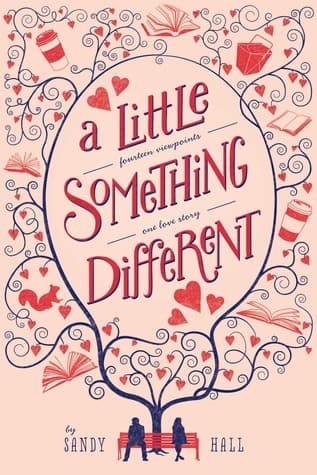
Sandy Hall (2014)
Genre
Young Adult / Romance
Reading Time
270 min
Key Themes
See below
Sign in to track this book
An entire town, from a meddling creative writing teacher to a squirrel, conspires to bring together two shy college students oblivious to their own connection.
Gabe and Lea meet in Professor Miller's creative writing class. From the start, their shared quietness and quick glances are noticed by Professor Miller, who feels a connection between them. Other characters, like Chelsea, a barista, and Ben, a delivery guy, also see the two students in the same places, showing a shy, unspoken attraction. Lea, a talented writer, often watches Gabe, an artist, from a distance. Gabe finds himself drawn to Lea's quiet focus and unique perspective.
Their lives continue to cross in small ways. They often find themselves at the same Starbucks, where the baristas, Chelsea and Dylan, comment on their potential romance. They also order Chinese food from the same place, delivered by Ben, who becomes interested in their story. Lea's roommate, Maribel, and Gabe's best friend, Andrew, both see the growing attraction. Despite their shyness, shared pop culture interests, and similar habits, neither Gabe nor Lea makes a move, creating anticipation among those around them.
Professor Miller, seeing the spark between Gabe and Lea, starts to make writing assignments that encourage them to interact. She gives prompts that require partners or themes that she knows will speak to their personalities and might lead them to write about each other. For example, she pairs them for a peer review, making them work together on their writing. These assignments, while seeming normal to the class, are Professor Miller's way of pushing them out of their comfort zones to acknowledge their mutual interest, which she believes helps their creative and personal growth.
Even their daily routines become part of the story. The bus driver, Charles, often sees them on his route, sometimes together, sometimes just missing each other, and tells his wife about their 'progress.' At the local diner, Maya, the waitress, seats them at the same booth whenever they come in separately, expecting them to meet. These daily observations from community members show how invested everyone is in their romance, turning their slow-burn relationship into a local event that brings shared community and gentle amusement.
Lea's reserved nature comes from past heartbreaks, making her afraid to open up. She fears rejection and prefers to watch from a safe distance. Gabe, however, carries the weight of his parents' difficult relationship and his father's leaving, which makes him hesitant to commit. These personal struggles create invisible walls between them, even as their attraction grows. Their friends, Maribel and Andrew, separately try to encourage them, often wishing their friends would take the step and acknowledge the clear connection everyone else sees.
Professor Miller assigns a major creative writing project that needs partners, and she pairs Gabe and Lea. This means they spend a lot of time together outside of class, working on their story. During these sessions, they start to talk more openly, sharing details about their lives, dreams, and fears. Lea learns about Gabe's difficult family background, and Gabe begins to understand Lea's quiet insecurities. This time together helps them move past surface observations to truly connect emotionally and intellectually, deepening their bond.
During one of their late-night study sessions, the air between Gabe and Lea becomes charged. They are close to confessing their feelings. They share a long look, and the tension is high. But at the last moment, one or both pull back, perhaps from fear of rejection or a habit of holding back emotions. This 'almost moment' is strongly felt by the other characters following their story, leading to collective sighs of frustration and renewed hope that they will eventually overcome their hesitations.
As the semester goes on and their relationship remains unclear, their friends and the various observers become more direct in their encouragement. Maribel tries to arrange 'casual' meetings between Lea and Gabe, while Andrew often talks Lea up to Gabe. Chelsea and Dylan at Starbucks make pointed comments, and Ben, the delivery guy, often delivers their food at the same time, hoping they will interact. Even the squirrel in the park, a quiet observer, seems to root for them, showing a general wish for their happiness. These actions, though sometimes clumsy, show the community's investment in their love story.
One rainy afternoon, Gabe and Lea are alone together at their usual cafe. The quiet, private setting, along with the shared history of their 'observers' (Chelsea and Dylan are working), creates an environment where their defenses finally fall. They have an open conversation about their past, their worries, and their unspoken feelings. This talk is a turning point, as it is the first time they truly acknowledge the depth of their connection and why they hesitated, opening the way for a more honest relationship.
For their final creative writing project, Gabe and Lea must present a deeply personal piece. Inspired by their shared experiences and new understanding, they each write stories that, unknown to the other, reflect their feelings and observations about the other. During their presentations, the entire class, including Professor Miller, sees the clear references to their growing relationship. This public, artistic declaration is a powerful confession of their mutual affection, finally breaking the unspoken barrier between them and making their bond firm in front of their community of observers.
After the emotional peak of their final presentations, Gabe finds the courage to ask Lea on a proper date. Their first official date is full of nervous excitement and comfortable familiarity, showing the friendship and shared experiences they had already built. The date is a success, confirming their connection and the potential for a deeper relationship. Their friends and the community members who rooted for them celebrate this moment, marking the start of their official romance, to the delight of their 'audience.'
Even after Gabe and Lea become a couple, the community of observers continues to watch over them, now with satisfaction and affection. Professor Miller beams with pride, Chelsea and Dylan at Starbucks offer knowing smiles, and Ben, the delivery guy, gives them extra fortune cookies. Their relationship, once a source of hopeful anticipation, now shows the power of connection and the beauty of a love story unfolding. The novel ends with the understanding that while their journey has just begun, they have a supportive network that truly cares for their happiness.
The Protagonist
Lea learns to overcome her fear of vulnerability and expresses her feelings, allowing herself to embrace love and connection.
The Protagonist
Gabe confronts his past fears and learns to trust and commit to a relationship, finding emotional stability with Lea.
The Supporting
Professor Miller successfully guides Gabe and Lea towards their romantic connection, fulfilling her role as a catalyst.
The Supporting
Chelsea observes the culmination of Gabe and Lea's romance, validating her initial belief in their connection.
The Supporting
Ben's observations evolve from hopeful anticipation to satisfied confirmation of Gabe and Lea's relationship.
The Supporting
Maribel witnesses Lea's growth in confidence and romantic happiness.
The Supporting
Andrew sees Gabe overcome his commitment fears and find happiness with Lea.
The Mentioned
The squirrel, as a symbolic entity, 'witnesses' the eventual union of Gabe and Lea.
A main theme is how a community's shared observation and belief can affect individual actions and results. The story is told through the eyes of various side characters—baristas, a professor, friends, a delivery guy, even a squirrel—who all notice the unspoken connection between Gabe and Lea. Their shared interest and subtle pushes create an atmosphere where the protagonists' shy romance is almost willed into being. This shows how human connection is often helped and celebrated by the wider community, turning a private love story into a shared experience, as seen when Professor Miller intentionally pairs them for projects or when the Starbucks baristas track their every move.
“It was like watching a movie, only better, because you knew it was real and you were actually there.”
Both Lea and Gabe struggle with inner problems that stop them from acting on their clear attraction. Lea's past heartbreaks make her hesitant and afraid to be vulnerable, while Gabe's difficult family history, especially his father's leaving, has given him a fear of commitment. The story shows how they slowly learn to face these personal issues, often with indirect help from their observers and through being close to each other. Their journey is about breaking down these self-made walls to let real connection and love grow, seen in their eventual honest talk where they share their fears.
“Sometimes the hardest stories to tell are the ones about yourself.”
Before any words are spoken, the connection between Gabe and Lea is shown through subtle glances, shared silences, and similar habits. The novel skillfully shows the details of unspoken attraction—how they choose the same Chinese food, make eye contact across a room, or go to the same places. This theme highlights that true connection often starts on a subconscious, non-verbal level, understood by the individuals and by those around them. The observers often comment on the 'something' happening between them, even when 'nothing' explicitly is.
“You could feel it, couldn't you? That hum in the air, like two magnets about to click.”
Since the characters are in a creative writing class and the story is told from many viewpoints, the novel quietly explores what storytelling is. The observers are essentially creating and telling Gabe and Lea's love story, showing how real-life events can be shaped and understood as compelling stories. Professor Miller's assignments often reflect or influence their reality, blurring the lines between fiction and life. The final creative writing project, where Gabe and Lea write about each other, becomes the ultimate blend of their personal story and their artistic expression.
“Every story needs a narrator, even if the characters don't know they're in one.”
The story is told through the eyes of various supporting characters.
Instead of a traditional dual-POV or omniscient narrator focusing solely on Gabe and Lea, the novel employs multiple third-person perspectives from various 'observers' in their lives. This includes their creative writing professor, baristas, friends, a delivery guy, and even a bus driver. This device allows the reader to experience the unfolding romance from a collective, communal viewpoint, emphasizing how deeply invested everyone is in their story and creating a unique, almost voyeuristic, narrative style.
Supporting characters collectively comment on and subtly influence the protagonists' actions.
The various observers—Chelsea and Dylan the baristas, Ben the delivery guy, Maribel and Andrew, Professor Miller, and others—function as a modern-day Greek Chorus. They provide commentary, express frustration, and offer encouragement regarding Gabe and Lea's slow-burn romance. Their collective observations and subtle interventions (like Professor Miller's assigned pairings or Chelsea's knowing smiles) not only advance the plot but also highlight the universal human desire for connection and the communal joy found in witnessing a love story unfold.
Class assignments are used by the professor to subtly push Gabe and Lea together.
Professor Miller's creative writing assignments are not merely academic tasks; they are carefully crafted plot devices designed to foster interaction and self-reflection between Gabe and Lea. By pairing them for projects, assigning themes that resonate with their unspoken feelings, or encouraging them to write personally, these assignments force the protagonists into proximity and facilitate deeper emotional connection, subtly driving their relationship forward under the guise of academic work.
Recurring locations and routines underscore the characters' shared lives.
The repeated use of specific settings—the same Starbucks, the same Chinese food delivery, the same bus route, the same diner booth—serves as a symbolic plot device. These routines and shared spaces constantly bring Gabe and Lea into each other's orbit, even when they're not actively seeking it. They reinforce the idea of their destinies being intertwined and provide consistent opportunities for the observers to witness and comment on their interactions, making their eventual coming together feel inevitable and natural.
“She felt like she was a character in a movie, and this was the part where she was about to do something brave.”
— Lea before her first creative writing class.
“He just wanted to be a part of something, to feel like he belonged somewhere.”
— Gabe's internal thoughts about fitting in.
“The universe, it seemed, had a funny way of bringing people together.”
— A general observation from an unnamed character.
“Sometimes the best stories are the ones that are still being written.”
— Professor Harper's advice to his creative writing class.
“He liked the way she talked about books, like they were old friends she hadn't seen in a while.”
— Gabe observing Lea in the campus coffee shop.
“It wasn't a grand gesture, but it was real, and sometimes real was better.”
— A character reflecting on a small act of kindness.
“She had a way of making him feel like he was the only person in the room, even when there were a hundred others.”
— Gabe's feelings for Lea.
“Every person is a story waiting to be told.”
— A thought from the barista, Maribel.
“He wondered if she knew how much she glowed when she was happy.”
— Gabe observing Lea.
“Sometimes you just have to take a chance, even if you don't know where it will lead.”
— A character contemplating a risky decision.
“The world was full of little moments, tiny sparks that could ignite something wonderful.”
— An observation from the bus driver.
“He felt a pull, like gravity, drawing him closer to her, even when he tried to resist.”
— Gabe's undeniable feelings for Lea.
“It was the kind of smile that could make you forget all your worries, if only for a moment.”
— A description of Lea's smile.
“Maybe love wasn't about grand gestures, but about all the tiny, almost imperceptible ways you showed someone you cared.”
— A character's internal reflection on the nature of love.
“The best stories are often told by those who are just observing.”
— A general thought from a peripheral character.
Ready to see how well you understood this book? Take our interactive quiz with 10 questions.