“She was not so much afraid of being caught as of the sheer physical effort of carrying out her intentions.”
— Eunice struggles with her murderous plan.

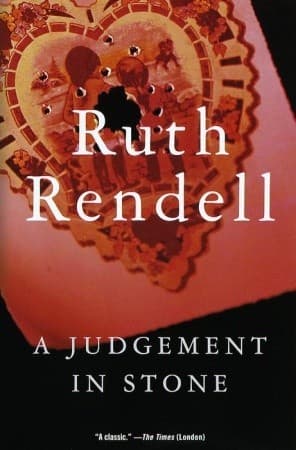
Ruth Rendell (1977)
Genre
Thriller / Mystery
Reading Time
240 min
Key Themes
See below
Sign in to track this book
A housekeeper's secret illiteracy leads to a Valentine's Day massacre, showing how shame and desperation can drive extreme violence.
On Valentine's Day, the wealthy Coverdale family – George, Jacqueline, their daughter Melinda, and son Giles – are murdered in their Suffolk home. The killer is their housekeeper, Eunice Parchman. The murders happen during a televised opera, *Don Giovanni*, which plays in the background. Eunice shoots each family member, moving through the house calmly. The initial police investigation, led by Detective Chief Superintendent William Vetch, struggles to find a clear motive, as Eunice seems an unlikely suspect, living a quiet life.
Months before the murders, Eunice Parchman starts working for the Coverdales as a live-in housekeeper. She is quiet, efficient, and seems unremarkable, but she hides a secret: she cannot read. This shame has affected her since childhood and made her very private and defensive. The Coverdales, a cultured family, do not know about her illiteracy, and Eunice goes to great lengths to hide it, often pretending to understand or making excuses when faced with written materials.
Eunice meets Joan Smith, a strange and very religious woman who moves into a nearby cottage. Joan, a former prostitute who found religion, is immediately drawn to Eunice, seeing a similar loneliness and perceived weakness. Joan's intense religious beliefs and strong opinions on morality and social class start to influence Eunice. This friendship gives Eunice her first real confidante, but also exposes her to Joan's increasingly extreme views, which begin to mix with Eunice's own hidden insecurities and resentments.
The Coverdale family, especially Melinda and Giles, often leave notes for Eunice. Each note causes Eunice intense anxiety, forcing her to invent excuses or guess the meaning from context. The threat of her illiteracy being discovered constantly hangs over her, increasing her paranoia and resentment toward the family. Her secret becomes a heavy burden, fueling a growing sense of unfairness and isolation. She sees the Coverdales' intellectual pursuits and casual use of written communication as a constant, subtle insult to her own failing.
Joan Smith visits more often, and her influence over Eunice grows. Joan, holding deep resentment for the wealthy and educated, often talks about divine judgment and the moral failures of upper classes. She sees everyday events as religious punishment and social inequality. Eunice, already feeling inferior and defensive because she cannot read, takes in Joan's words, which confirm her own unspoken bitterness and unfair feelings toward the Coverdales, whom she increasingly sees as undeserving and morally corrupt.
A key event happens when the television breaks, and a repairman leaves a note for Eunice explaining the problem and instructions. Unable to read it, Eunice panics. She tries to get Joan to read it, but Joan, in her own way, misunderstands and accidentally causes more confusion. This close call with exposure further increases Eunice's fear and paranoia. The repairman's note becomes a symbol of her weakness and the constant danger of her secret being revealed, reinforcing her belief that the world of those who can read is hostile.
On Valentine's Day, with the Coverdales planning a quiet evening watching the opera, Eunice and Joan finalize their plan. Joan, convinced that the Coverdales represent moral corruption and that their wealth is ill-gotten, persuades Eunice that their deaths would be divine justice, a 'judgement in stone.' Eunice, driven by her shame from illiteracy, resentment, and Joan's twisted religious justifications, agrees. The opera's themes of sin and punishment provide a dark backdrop to their chilling conversation and the finalization of their murderous scheme.
After the murders, Detective Chief Superintendent William Vetch begins his investigation. The lack of forced entry, stolen items, or any clear motive puzzles him and his team. Eunice Parchman, outwardly calm, is dismissed as a suspect early on due to her meek appearance and lack of connection to the victims beyond her job. Vetch carefully examines the family's lives, interviewing neighbors, but the pieces do not fit. The brutality and randomness of the crime defy normal explanation, making it a frustrating case.
Vetch eventually finds a subtle oddity regarding written communication in the house. He notices Eunice avoids notes and gives strange answers to questions involving text. A crucial moment comes when he realizes Eunice cannot read a simple note. This discovery provides the missing link, the 'private humiliation' that explains Eunice's extreme actions. Faced with this knowledge, Eunice breaks down and confesses to the murders, revealing her deep shame and Joan Smith's role in manipulating her. Her confession is raw and driven by the lifelong burden of her secret.
With Eunice's confession, Joan Smith is quickly arrested. During questioning, Joan, initially defiant, admits her role in starting and planning the murders. She reveals her deep-seated class resentment and her twisted religious ideas, which she used to convince Eunice that the Coverdales deserved their fate. The full, tragic motive is clear: Eunice's profound, lifelong shame over her illiteracy combined with Joan's fanatical hatred for the wealthy, resulting in a horrific act of violence presented as divine retribution. The 'judgement in stone' refers to the unshakeable reason for the crime.
The Protagonist/Antagonist
Eunice's arc is a tragic descent from quiet, internal suffering to explosive violence, driven by her lifelong secret and the malevolent influence of Joan Smith.
The Antagonist
Joan's arc remains consistent as a malevolent force, using her warped ideology to instigate violence, never truly evolving beyond her self-righteous convictions.
The Supporting
Vetch's arc is one of persistent investigation, culminating in his breakthrough understanding of the psychological motive behind the seemingly senseless murders.
The Supporting
George's arc is static, serving as a symbol of the 'judged' class, his life abruptly ended by forces he never understood.
The Supporting
Jacqueline, like her family, is a static character, a victim whose death underscores the novel's themes of class and hidden shame.
The Supporting
Melinda's static character serves to highlight the chasm between the literate and illiterate worlds, making her an unwitting trigger for Eunice's rage.
The Supporting
Giles's static character emphasizes the innocence destroyed by Eunice's deep-seated shame and Joan's malevolent influence.
The novel shows how Eunice Parchman's lifelong shame over her illiteracy grows into a destructive force. Her inability to read, a secret she guards with extreme paranoia, isolates her and creates deep resentment toward the literate world. Every note, book, and casual mention of text by the Coverdales becomes a threat, increasing her feeling of inadequacy and unfairness. This internal pain, combined with outside manipulation, leads to the murders, showing how deep, unaddressed shame can twist a mind to extreme acts.
“It was the secret, the terrible, humiliating secret, that had poisoned her life, made her solitary, suspicious, and finally, murderous.”
Rendell shows the simmering tensions between social classes, mainly through Joan Smith. Joan, from a disadvantaged background, strongly dislikes the wealthy and educated, seeing them as morally corrupt and deserving punishment. She projects her class resentments onto the Coverdales, manipulating Eunice by framing their comfortable lifestyle as a sin. Eunice, already feeling inferior due to her illiteracy, takes in this class-based animosity, seeing the Coverdales' intellectual pursuits as a constant, mocking reminder of her own perceived failures. The murders become a brutal expression of this deep social resentment.
“They were the proud, the rich, the educated, and they would be judged.”
The novel explores the dangerous dynamic of manipulation, particularly through Joan Smith's influence over Eunice. Joan, with her intense, twisted religious beliefs and strong personality, preys on Eunice's weakness, insecurity, and deep resentment. She gives Eunice a warped moral framework, convincing her that killing the Coverdales would be a righteous act, a 'judgement in stone.' This theme highlights how easily a vulnerable person can be drawn into extreme actions when their existing worries and hatreds are skillfully used by a charismatic, fanatical figure, blurring the lines between personal grievance and manufactured justice.
“God's hand was on her shoulder, guiding her to do His work.”
Rendell explores the ordinary and complex nature of evil, showing it not as a monstrous force, but as something that can come from seemingly normal lives and deep psychological pain. Eunice, an outwardly unremarkable housekeeper, commits an unspeakable act driven by a lifetime of hidden shame and another's corrosive influence. The evil comes from human weakness, fear, and the twisted justifications of fanaticism. The novel suggests that evil can grow in the quietest parts of society, often stemming from personal humiliation and the inability to cope with perceived flaws, leading to chillingly detached violence.
“Evil had a face, but it was a quiet, unassuming face, and it had been there all along.”
The audience knows Eunice's secret while the Coverdales remain oblivious.
Dramatic irony is a central device, creating sustained tension and a sense of dread. The reader is aware of Eunice's illiteracy and her simmering resentment from early in the narrative, while the Coverdale family remains completely oblivious. This allows the reader to understand the true significance of seemingly innocuous events—like a note left on the kitchen table or a casual conversation about books—which are perceived as profound threats by Eunice. This disparity in knowledge heightens the tragedy of the inevitable murders, as the audience watches the victims unknowingly contribute to their own demise.
Initial police investigation focuses on conventional motives.
Rendell employs red herrings in the initial stages of the police investigation. Detective Vetch and his team explore conventional motives such as robbery, revenge from a business associate, or a lover's quarrel. These avenues of inquiry are meticulously detailed, leading the police (and initially, the reader) away from the true, psychological motive. This device effectively misdirects attention, emphasizing the unusual nature of the crime and making Vetch's eventual discovery of Eunice's illiteracy all the more impactful as it defies typical criminal profiling.
Subtle hints of Eunice's illiteracy and growing resentment.
The novel uses subtle foreshadowing to hint at Eunice's secret and the impending tragedy. Her discomfort with notes, her vague responses when asked to read something, and her general social awkwardness all serve as early indicators of her illiteracy. Furthermore, Joan Smith's increasingly fervent and violent rhetoric, coupled with Eunice's quiet absorption of it, foreshadows the murderous plot. These details build a mounting sense of unease and inevitability, preparing the reader for the shocking climax while simultaneously making the revelation of the motive feel earned and psychologically coherent.
The narrative often delves into Eunice's subjective and distorted perception.
While not strictly an unreliable narrator in the traditional sense, the narrative frequently provides deep insight into Eunice's subjective and often distorted perception of events. The reader experiences the world through her lens of shame, paranoia, and resentment. The Coverdales' innocent actions are interpreted by Eunice as deliberate slights or threats. This limited, biased perspective helps the reader understand the psychological landscape that leads to the murders, even if Eunice's interpretations are far from objective reality, making her actions more comprehensible, if not justifiable.
“She was not so much afraid of being caught as of the sheer physical effort of carrying out her intentions.”
— Eunice struggles with her murderous plan.
“For the illiterate, the world of print is a closed garden, tantalizing and frustrating.”
— Describing Eunice's isolation due to her illiteracy.
“She had always known that her secret was her own, and that it must remain so, at any cost.”
— Eunice's determination to keep her illiteracy hidden.
“The truth was not something to be revealed, but something to be defended against.”
— Eunice's perspective on her hidden truth.
“Ignorance is not bliss when it isolates you from the very fabric of society.”
— Reflecting on the social impact of Eunice's inability to read.
“It was not a question of good or evil, but of necessity. Her necessity.”
— Eunice rationalizing her actions.
“People always want to believe what they want to believe, and no amount of evidence will sway them.”
— Reflecting on human nature and perception.
“The house was a stage, and they were all actors, playing out parts they scarcely understood.”
— Describing the dynamics within the Coverdale household.
“A secret shared is no longer a secret, but a burden divided.”
— Contemplating the nature of secrets.
“She had a strong sense of injustice, not for herself, but for the world as she saw it.”
— Describing Eunice's skewed moral compass.
“The trivialities of everyday life can sometimes conceal the most profound and terrifying depths.”
— Hinting at the hidden darkness beneath a seemingly ordinary existence.
“Fear was a cold knot in her stomach, but it was also a spur, driving her forward.”
— Eunice's internal struggle with fear and resolve.
“The past, she had discovered, was never truly past. It was always there, waiting to be unearthed.”
— Reflecting on the inescapable nature of one's history.
“It was impossible to guess what lay behind such a placid, almost bovine, exterior.”
— Describing the deceptive appearance of Eunice Parchman.
Ready to see how well you understood this book? Take our interactive quiz with 10 questions.

Biography coming soon.







