“It's time for me to move. My shell is too small.”
— Hermit Crab realizing he has outgrown his shell.

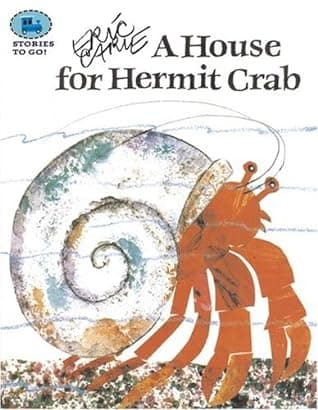
Eric Carle (1987)
Genre
Children's
Reading Time
5 min
Key Themes
See below
Sign in to track this book
A charming hermit crab navigates the cycle of growth and change, making and leaving behind friends with each new shell he inhabits, reflecting life's transitions.
In January, a small Hermit Crab realizes his shell is too small and uncomfortable. He says, "I've grown too big for this little shell! I have to find a new house." He leaves his old shell and starts a journey across the ocean floor to find a replacement. After some searching, he finds a large, empty shell on the sand. He inspects it, moves inside, and finds that it fits perfectly. Happy, Hermit Crab decides this will be his new home, but soon realizes it feels plain and empty.
In February, as Hermit Crab explores his new, plain shell, he meets a Sea Anemone with "beautiful waving tentacles." Hermit Crab, feeling vulnerable in his undecorated home, asks the Sea Anemone, "Sea Anemone, you are so beautiful. Would you like to come and live on my house? It will make my house beautiful and protect me, too." The Sea Anemone agrees and attaches itself to the top of Hermit Crab's new shell, adding color and defense. Hermit Crab feels safer and happier.
By March, Hermit Crab is still looking for ways to improve his home. He meets a bright orange Starfish. Admiring its shape and color, Hermit Crab asks, "Starfish, you are so pretty. Would you like to come and live on my house?" The Starfish joins and climbs onto the side of Hermit Crab's shell, adding another decoration. Hermit Crab's shell is changing from a plain dwelling into a lively, decorated home, making him feel more proud and secure with each new friend.
In April, Hermit Crab meets a Snail, busy cleaning a rock. Hermit Crab, noticing the Snail's helpful nature, asks, "Snail, you are so good at cleaning. Would you like to come and live on my house and keep it clean?" The Snail agrees and begins to crawl around the shell, eating algae or debris. This addition brings a companion and helps keep Hermit Crab's new home tidy, improving his comfort and satisfaction.
May brings another friend for Hermit Crab: a Sea Urchin with many sharp spines. Recognizing the protective qualities of the Sea Urchin, Hermit Crab asks, "Sea Urchin, you have so many sharp spines. Would you like to come and live on my house and protect me?" The Sea Urchin agrees and settles onto the shell. Its spines act as a deterrent to predators. Hermit Crab feels more secure with the Sea Urchin's presence, making his home beautiful and very safe.
By June, Hermit Crab's shell is crowded and colorful. He sees a piece of Coral, admiring its structure and colors. He asks, "Coral, you are so colorful. Would you like to come and live on my house and make it even prettier?" The Coral, a stationary but beautiful addition, attaches itself to the shell, making it more decorative. Hermit Crab is happy with his growing collection of friends and the transformation of his house into a lively, living ecosystem.
In July, Hermit Crab finds a Sea Cucumber, known for cleaning the ocean floor. Hermit Crab, always thinking of ways to improve his home, asks, "Sea Cucumber, you are so good at cleaning. Would you like to come and live on my house and help the Snail keep it clean?" The Sea Cucumber agrees and joins the Snail in tidying the shell, keeping it clean. With two cleaners, Hermit Crab's house is beautiful and well-maintained, adding to his comfort and pride.
August brings a unique addition: another Hermit Crab. This time, Hermit Crab wants companionship. He asks, "Hermit Crab, would you like to come and live on my house and be my friend?" The other Hermit Crab agrees, and they become companions on the shell, adding camaraderie to the bustling home. Hermit Crab's house is now a lively community, full of friends who provide various benefits, from protection to cleaning and companionship.
From September to November, Hermit Crab continues to grow. By December, he notices a familiar feeling: his shell is starting to feel tight and uncomfortable again. He tries to stretch, but it is no use. He has grown too big for this shell, just as he did for his previous one. A wave of sadness comes over him as he realizes he will soon have to leave his beautiful, decorated home and all his friends, facing another search for a new dwelling.
The time has come for Hermit Crab to move on. He tells his friends, "I've grown too big for this shell! I have to find a new house." His friends, though sad, understand. He encourages them to find a new home, perhaps with a smaller hermit crab who needs a decorated shell. He then wiggles out of his shell, leaving his friends behind. As he swims away, he looks back at his old home, now a moving reef, and wishes his friends well, ready for his next adventure.
In January, Hermit Crab, now in a plain, new shell, sees a smaller hermit crab looking for a home. He points to his old, beautifully decorated shell and says, "Look! A new house for you!" The smaller hermit crab happily moves into the old shell. Hermit Crab then continues his search for new friends to decorate his brand new, plain shell. He approaches a Sea Anemone, just as he did a year ago, ready to begin building and decorating a new home, embracing the continuous change in his life.
The Protagonist
Hermit Crab learns to embrace change, initially finding comfort in companionship and decoration, and eventually accepting the necessity of moving on and starting anew.
The Supporting
Remains a steadfast protector and decorator on Hermit Crab's shell.
The Supporting
Remains a decorative element on Hermit Crab's shell.
The Supporting
Continuously cleans Hermit Crab's shell.
The Supporting
Provides continuous protection for Hermit Crab's shell.
The Supporting
Remains a decorative and structural element on Hermit Crab's shell.
The Supporting
Assists in cleaning Hermit Crab's shell.
The Supporting
Joins Hermit Crab as a friend and later inherits his decorated shell.
The main theme is Hermit Crab's need to adapt to change. From outgrowing his shell to finding a new one and then having to leave it again, the story shows the natural cycle of growth and transition. Hermit Crab's ability to find new homes and new friends shows resilience and a positive outlook towards new beginnings. This is clear when he says, "I've grown too big for this little shell! I have to find a new house," and then, at the end, passes on his old shell to a smaller crab, accepting the ongoing nature of change.
“I've grown too big for this little shell! I have to find a new house.”
Hermit Crab actively seeks out and gathers friends to share his home. Each friend (Sea Anemone, Starfish, Snail, Sea Urchin, Coral, Sea Cucumber, other Hermit Crab) adds something unique, whether it is protection, cleaning, or beauty, changing a plain shell into a vibrant, living ecosystem. This shows the importance of companionship and how shared living makes life better, providing practical help and emotional comfort. The friends' sadness when Hermit Crab leaves, and their understanding, show the strength of their bond.
“Would you like to come and live on my house?”
The shell is more than a physical dwelling; it becomes Hermit Crab's 'home' through decoration and the presence of his friends. The story explores the idea that home is not just a place but a feeling of security, beauty, and belonging created by the inhabitants. Hermit Crab's efforts to beautify and protect his shell show his desire for a true home. The emotional attachment he develops to his decorated shell and its inhabitants shows the importance of creating a personal space filled with loved ones.
“It will make my house beautiful and protect me, too.”
The story is structured around the annual cycle, with each month bringing a new friend or development, ending with Hermit Crab outgrowing his shell again by December and starting anew in January. This monthly progression and the repeated need for a new shell emphasize the natural process of growth in living creatures. It teaches that growth is continuous and often requires letting go of the old to embrace the new, showing life's cyclical nature. The story ends with Hermit Crab starting the process again, showing the endless cycle.
“One day in January, Hermit Crab felt that he had grown too big for his little shell.”
Hermit Crab takes responsibility for his home and the well-being of its inhabitants. He chooses friends who can help with the shell's safety and cleanliness, such as the Sea Anemone for protection and the Snail and Sea Cucumber for cleaning. He also makes sure his friends are comfortable and happy. When he leaves, he guides them to find a new, smaller hermit crab, showing care for their future. This theme teaches about the duties that come with creating and maintaining a community.
“Snail, you are so good at cleaning. Would you like to come and live on my house and keep it clean?”
Giving human-like qualities and emotions to animal characters.
Hermit Crab and his marine friends are endowed with human-like thoughts, feelings, and the ability to communicate and make decisions. Hermit Crab 'feels' his shell is too small, 'asks' other creatures to live on his house, and 'feels sad' when he has to leave his friends. This device allows young readers to connect with the characters on an emotional level and understand complex themes like friendship, change, and belonging through relatable experiences, despite the characters being sea creatures. It makes the story accessible and engaging for children.
A recurring pattern of Hermit Crab inviting new friends to his shell.
The story employs a repetitive pattern where Hermit Crab encounters a new sea creature, compliments its specific quality (e.g., 'so beautiful,' 'so pretty,' 'so good at cleaning,' 'many sharp spines'), and then asks, 'Would you like to come and live on my house?' The creature invariably agrees. This predictable structure is comforting for young readers, reinforces learning about different marine animals and their attributes, and emphasizes Hermit Crab's proactive nature in building his home. It also creates a rhythm that is enjoyable for read-alouds.
Adding new elements (friends) sequentially to build the narrative.
Each month, Hermit Crab adds a new friend to his shell, building upon the previous additions. The narrative accumulates characters and their contributions, making the shell progressively more decorated, protected, and lively. This device allows the story to grow in complexity and visual richness, demonstrating the gradual process of building a home and a community. The reader sees the shell transform from plain to bustling, mirroring Hermit Crab's growing sense of belonging and the richness of his life.
Using months of the year to mark the progression of the story.
The story is explicitly structured by months, starting in January and progressing through December, before looping back to January. Each month is dedicated to a new encounter or a significant development, primarily the addition of a new friend to Hermit Crab's shell. This device provides a clear and understandable timeline for young readers, illustrates the passage of a full year, and subtly introduces the concept of seasonal or cyclical change, emphasizing the natural rhythm of life and growth that Hermit Crab experiences.
“It's time for me to move. My shell is too small.”
— Hermit Crab realizing he has outgrown his shell.
“I need a new house.”
— Hermit Crab's simple declaration of his need.
“It was a big shell, but it was empty.”
— Hermit Crab finds a new, larger shell.
“It looked so bare.”
— Hermit Crab observing his new, undecorated shell.
“How dull it is, he thought.”
— Hermit Crab's initial impression of his plain new home.
“I wish it were more beautiful.”
— Hermit Crab desiring to beautify his new shell.
“One day in January, Hermit Crab saw some sea anemones.”
— Hermit Crab beginning his journey of decorating.
“You are beautiful! Will you live on my house?”
— Hermit Crab inviting a sea anemone to join him.
“In February, Hermit Crab met some starfish.”
— Hermit Crab continuing to find new companions.
“My house is growing more and more beautiful!”
— Hermit Crab's joy as his shell becomes decorated.
“Now it is August. Look how big I have grown!”
— Hermit Crab realizing he has outgrown his shell once more.
“It's time for me to move again.”
— Hermit Crab accepting the need for another move.
“I have outgrown this house.”
— Hermit Crab's simple statement about his growth.
“You are big enough to find your own home.”
— Hermit Crab telling his sea creatures goodbye.
“And he swam off in search of a new, even bigger house.”
— Hermit Crab confidently moving on to his next adventure.
Ready to see how well you understood this book? Take our interactive quiz with 10 questions.

Eric Carle was an American author, designer and illustrator of children's books. His picture book The Very Hungry Caterpillar, first published in 1969, has been translated into more than 66 languages and sold more than 50 million copies. His career as an illustrator and children's book author took off after he collaborated on Brown Bear, Brown Bear, What Do You See?. He illustrated more than 70 books, most of which he also wrote, and more than 145 million copies of his books have been sold around the world.

Dan Gemeinhart
4.5

Kate O'Hearn
4.4

Jeanne Birdsall
4.4

Jen Wang
4.4

Wendelin Van Draanen
4.3

John Marsden
4.3

Chris Van Allsburg
4.3

Jennifer A. Nielsen
4.2