“Sometimes you have to give up the ghost, so to speak, and just let yourself be.”
— Marjorie's struggle with her perceived possession and the family's attempts to understand it.

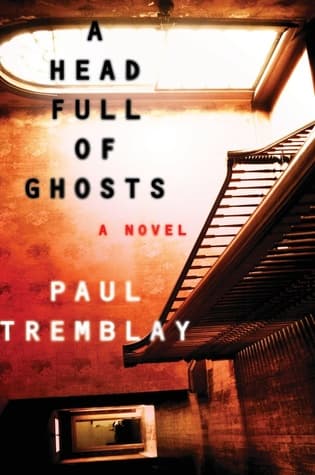
Paul Tremblay (2015)
Genre
Thriller / Mystery
Reading Time
6-8 hours
Key Themes
See below
Sign in to track this book
Fifteen years after her family's televised exorcism ended in tragedy, a woman recounts her sister's 'demonic possession,' uncovering a complex story of memory, media, and the nature of truth.
Fifteen years after her family became infamous, Merry Barrett, now called Karen, is interviewed by Rachel, a writer researching the Barrett family. Karen is reluctant but agrees to share her memories of her older sister, Marjorie, and the reality TV show, 'The Possession,' which claimed to document a demonic possession. Karen's story creates a dual perspective: her childhood memories against the public's view from the show and Rachel's research. Karen lives a quiet life, still affected by the past, and her account promises to reveal the 'true' story behind the sensational events.
Karen describes Marjorie's symptoms starting when Marjorie was fourteen. What began as typical teenage mood swings escalated into disturbing behaviors: a deep voice, violent outbursts, claims of seeing things, and terrifying nightmares. Her parents, John and Sarah Barrett, first sought medical help. Doctors diagnosed schizophrenia, but no treatment worked. The family's stable suburban life began to fall apart under Marjorie's unpredictable episodes. Doctors offered no solutions, leaving the Barretts isolated.
With medical options exhausted and Marjorie worse, the Barretts, especially Sarah, reluctantly turn to Father Wanderly, a local Catholic priest. Father Wanderly believes Marjorie has a demonic possession, not a mental illness, and suggests an exorcism. He also arranges for a production company to film the ordeal, promising financial help. This agreement turns their private tragedy into 'The Possession,' a reality TV show that brings them unexpected fame. Cameras become a constant presence, blurring their private pain and public spectacle.
Karen remembers the constant film crew and how their lives were documented. The house became a set. Marjorie's 'episodes' were often filmed, sometimes seeming staged for drama. Eight-year-old Karen struggled to tell the difference between Marjorie's real illness and the persona she adopted for cameras. The show presented a clear good versus evil story, with Father Wanderly as the spiritual hero. This period changed family dynamics; John became detached, and Sarah clung to the church's hope, even as Karen began to doubt the show's authenticity.
Karen reveals that Marjorie's behavior seemed to change depending on whether cameras were rolling. Off-camera, Marjorie sometimes acted like her old self, interacting normally with Karen, or expressing fear about her actions. But when the crew was present, she often transformed, showing classic possession signs: speaking in tongues, contorting her body, and uttering blasphemous remarks. This duality confused Karen and raised doubts about Marjorie's condition — was it illness, performance, or something else? This difference is a main point of conflict for Karen's memory and Rachel's interpretation.
As filming continues, Karen and her father, John, grow skeptical of the 'possession' story. John, initially desperate, becomes disillusioned with Father Wanderly and the production company, sensing exploitation. Karen, observing Marjorie, notes inconsistencies that do not fit the demonic narrative. Meanwhile, the 'possessed' incidents escalate for the cameras, including levitation attempts, moving objects, and violent outbursts toward Father Wanderly and the family. These events, while terrifying onscreen, often had explanations or felt contrived to Karen, further blurring reality and performance. Family tension rises, worsened by their financial reliance on the show.
The climax of 'The Possession' is a long, violent exorcism by Father Wanderly. Karen describes the event as chaotic and terrifying. Marjorie thrashed, screamed, and seemed to resist the priest with supernatural strength. The film crew captured every detail, creating a spectacle for viewers. This intense sequence was presented as the ultimate battle between good and evil. For Karen, the memory is mixed with confusion and fear, as she tries to reconcile the dramatic onscreen events with her own fragmented, eight-year-old view of what happened.
The 'exorcism' ends in tragedy, though the exact details are unclear. The show abruptly ends, implying a devastating outcome. Karen recalls the aftermath as a blur of chaos, police, and Marjorie's permanent disappearance. The Barretts' home becomes a site of morbid curiosity, and the family is forever marked. The show, despite its abrupt ending, becomes a cultural phenomenon, solidifying the public's belief in Marjorie's possession and the family's downfall. Karen is left to deal with her sister's loss and her family's infamy.
As Karen continues her interview with Rachel, Rachel's research often challenges Karen's childhood memories. This research includes transcripts from 'The Possession,' interviews with cast and crew, and other public records. Rachel points out inconsistencies, missing details, and different interpretations that conflict with Karen's recollections. This creates tension, forcing Karen to confront how unreliable memory can be, especially a child's, and the strong influence of media. Karen struggles to tell the difference between what she truly remembers and what she absorbed from the show or later retellings, leading to growing uncertainty about her family's story.
Rachel tells Karen about a popular blog that analyzes 'The Possession.' The blog offers cynical critiques of the show's authenticity. Maintained by a former film student, it analyzes camera angles, editing choices, and character motivations, suggesting that much of what was presented as demonic possession was staged, exaggerated, or Marjorie's mental illness exploited for entertainment. This blog offers a counter-narrative, suggesting the Barretts were victims of media manipulation, not demonic forces. Karen must consider these theories, which further complicate her understanding of her past and her family's role.
As the interview continues, Rachel's persistent questions and conflicting evidence lead Karen to a terrifying realization about Marjorie's fate. The book builds suspense, not explicitly stating the tragedy's details. This allows the reader to experience Karen's journey of discovery and doubt. The climax of Karen's story involves piecing together fragmented memories, suppressed truths, and subtle clues from the show itself. She confronts the horrifying possibility that the 'possession' was a complex mix of mental illness, family problems, and manipulation, ending in a devastating act more human than supernatural. The final revelation challenges everything Karen, and the reader, thought they knew.
The Protagonist/Narrator
Karen evolves from a child observer to an adult grappling with trauma and the unreliability of memory, ultimately seeking and confronting the truth of her past.
The Central Figure/Victim
Marjorie's arc is a tragic descent into madness or a calculated performance, ultimately leading to her unexplained disappearance and the family's ruin.
The Supporting
Sarah transforms from a traditional suburban mother into a woman consumed by grief and desperation, ultimately losing her agency to the show's narrative.
The Supporting
John descends from a hopeful father into a cynical and detached observer, losing his family and sense of purpose to the show's exploitation.
The Antagonist/Supporting
Father Wanderly maintains his conviction of demonic possession, serving as the antagonist to scientific and psychological explanations, and the architect of the family's public tragedy.
The Supporting
Rachel remains largely static as the interviewer, her role is to facilitate Karen's narrative and provide external context and challenges.
The Mentioned/Supporting
The blog's influence is constant, providing an evolving critical lens through which Karen and the reader re-evaluate the past.
The novel questions the accuracy of memory, especially a child's, when faced with trauma and media. Karen's adult memories are fragmented and often conflict with Rachel's research, which includes show transcripts. This theme appears in Karen's struggle to tell what she truly remembers from what she saw on TV or reconstructed. For example, Karen first recalls certain dramatic events vividly, only for Rachel to suggest how the show's editing might have shaped those memories, making Karen re-evaluate her 'truth.'
“Maybe that's the thing. Maybe there are no memories, only stories. Maybe I'm just making it all up, trying to find meaning where there isn't any.”
The book critiques how reality television exploits and distorts personal tragedy for entertainment. 'The Possession' shows a family's suffering, pushing them to perform for cameras and creating a narrative of demonic possession. The production company's influence, the staging of 'episodes,' and financial incentives highlight how media turns real pain into a spectacle. John Barrett's growing disillusionment and the blog's analysis of the show's manipulation are key examples.
“They weren't filming a family in crisis. They were filming a show about a family in crisis. Big difference.”
A main conflict is the clash between scientific explanations for Marjorie's condition (schizophrenia) and the religious idea of demonic possession. Doctors diagnose mental illness, offering no cure, while Father Wanderly insists on a spiritual battle. The story blurs the lines, presenting evidence for both theories. Marjorie's symptoms could be psychotic breaks or classic signs of possession, leaving the reader to question which is 'real.' This theme explores the human need for explanation in the face of the inexplicable and the dangers of favoring one narrative.
“Is it madness, or is it evil? Sometimes, the two look exactly alike.”
The novel explores the many forms of evil, asking if it is supernatural, psychological, or from human actions. If Marjorie is not possessed, then the evil comes from her mental illness, family problems, or media exploitation. The book suggests that true horror might be in psychological torment, the breakdown of family, and manipulative forces. The ambiguity around Marjorie's condition makes the reader consider different forms of 'evil' and how they appear, especially in human cruelty.
“Sometimes, the devil isn't a demon at all. Sometimes, it's just a person.”
Karen's perspective is filtered through childhood trauma and adult uncertainty.
Karen (Merry) Barrett serves as the primary unreliable narrator. Her memories of the events are those of an eight-year-old child, colored by trauma, fear, and the influence of the reality television show. As an adult, she struggles to reconcile these fragmented, subjective recollections with objective facts and Rachel's research. This device constantly forces the reader to question what is 'true' and creates a pervasive sense of ambiguity, making the psychological horror more potent. Her unreliability is not deceitful but a genuine struggle to process and remember a traumatic past.
The story is told through an adult interview, with interspersed blog commentary.
The entire novel is framed as an interview between an adult Karen and a writer, Rachel. This allows for a layered narrative, where Karen's first-person account is constantly interrogated, analyzed, and contrasted with external research, including transcripts from 'The Possession' and commentary from a critical blog. This meta-narrative structure enables the exploration of memory, media, and truth from multiple angles, preventing a single, definitive interpretation of events and enhancing the mystery and psychological depth of the story. It effectively creates a story within a story, commenting on its own construction.
The true nature of Marjorie's condition and the events remains unclear.
A Head Full of Ghosts thrives on ambiguity, never definitively confirming whether Marjorie was genuinely possessed, suffering from mental illness, or deliberately manipulating those around her. The narrative presents compelling evidence for all possibilities, leaving the reader to draw their own conclusions. This device is crucial to the novel's horror, as the uncertainty itself is terrifying. It forces the reader to confront the terrifying 'what ifs' and the idea that some horrors defy simple explanation, blurring the lines between the supernatural, the psychological, and the performative.
The story uses the format of a reality TV show and its 'footage' to tell the story.
The 'found footage' or reality TV trope is central, as much of the narrative revolves around 'The Possession,' the reality show that documented the Barrett family. The novel references specific scenes, dialogue, and dramatic events from the show, often contrasting them with Karen's private memories. This device allows Tremblay to critique the genre, explore media manipulation, and create a sense of voyeurism. It also provides a public, often sensationalized, version of events that Karen and Rachel must deconstruct, highlighting the gap between mediated reality and lived experience.
“Sometimes you have to give up the ghost, so to speak, and just let yourself be.”
— Marjorie's struggle with her perceived possession and the family's attempts to understand it.
“The truth is rarely pure and never simple.”
— Merry reflecting on the ambiguity of memory and the events of her childhood.
“What if the monster isn't under the bed, but in the bed?”
— A recurring thought about the source of Marjorie's troubles, questioning if it's internal or external.
“Belief is a powerful thing. It can save you, or it can destroy you.”
— The family's varying degrees of belief in Marjorie's possession and its consequences.
“We all have our demons. Some of us just have them televised.”
— Merry's cynical view of her family's reality show experience and public scrutiny.
“Memory is a tricky thing. It's not a video recorder. It's more like a story we tell ourselves over and over again.”
— Merry discussing the unreliable nature of her childhood memories with Dr. Arnholdt.
“The scariest monsters are the ones that look just like us.”
— The idea that the true horror might not be a supernatural entity but human cruelty or psychological illness.
“Maybe the real possession was the friends we made along the way.”
— A darkly humorous and ironic commentary on the events, hinting at the manipulative nature of some characters.
“Sometimes, the only way out is through.”
— The family's desperate attempts to navigate Marjorie's illness, whether spiritual or psychological.
“You can't exorcise what isn't there.”
— A skeptical viewpoint on Marjorie's condition, suggesting it might be psychological rather than demonic.
“The past isn't dead. It's not even past.”
— Merry's lingering trauma from her childhood experiences and how they continue to affect her.
“Every family has its secrets. Ours just happened to be broadcast.”
— Merry reflecting on the family's privacy being invaded by the reality show and the public's perception.
“Sanity is a fragile thing, easily shattered by the right amount of pressure.”
— The psychological toll the events take on each family member, particularly Marjorie and her parents.
“We prefer our monsters to be clearly defined, easy to point at. But life isn't like that.”
— The difficulty in identifying the true source of horror or evil in the story, blurring lines between good and bad.
Ready to see how well you understood this book? Take our interactive quiz with 10 questions.

Biography coming soon.







