“Only those who are brave enough to risk losing everything can truly win.”
— Saleem's early life and his father's advice.

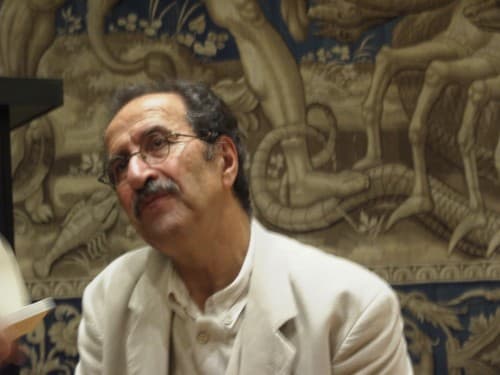
Rafik Schami (2023)
Genre
Historical Fiction / Young Adult
Reading Time
240 min
Key Themes
See below
Sign in to track this book
In 1950s Damascus, a teenager secretly writes in his diary, dreaming of becoming a journalist and speaking out against the city's oppressive silence.
Mahmoud, a restless and observant teenager in Damascus, Syria, receives a diary from his father for his twelfth birthday. At first, he doesn't care for it, but he soon finds comfort and purpose in writing down his daily life. He introduces his family: his strict father, his kind mother, his younger sister, and his younger brother. Mahmoud describes his neighborhood, his friends, and the constant fear of the secret police, the 'Mukhabarat.' He dreams of becoming a journalist, even though he knows free speech is severely limited in his country. His first entries show his youthful innocence mixed with a growing awareness of the political repression around him, setting the scene for his journey of self-discovery and rebellion.
Mahmoud describes school, where teachers often repeat government messages and creative thinking is discouraged. He becomes close with his friends, including the adventurous Uncle Salim, who influences him greatly. Through their talks and observations, Mahmoud starts to question official stories and the widespread fear. He sees the arbitrary power of the authorities when a teacher is punished for an innocent comment, showing the dangers of speaking out. These early experiences with censorship and threats fuel Mahmoud's desire for truth and his growing understanding of the need for an independent voice, solidifying his wish to be a journalist.
Mahmoud often visits the busy souk, where he meets an old, blind storyteller named Uncle Salim (not related to his friend). Uncle Salim, a respected community member, captivates audiences with tales of ancient heroes, clever tricksters, and ordinary people who resist oppression with wit and bravery. Mahmoud is fascinated by his ability to tell stories that subtly criticize the current government without naming it, using metaphors. Uncle Salim teaches Mahmoud that stories can be a powerful way to resist, preserving truth and inspiring hope even in the darkest times. This mentorship deepens Mahmoud's appreciation for written words and their potential for social change, strengthening his desire to speak for those without a voice.
Mahmoud has his first direct, though small, encounters with the feared Mukhabarat. He sees their intimidating presence in the streets, their sudden arrests, and the clear fear they cause among people. He tells of a time when a neighbor is taken away without explanation, leaving his family distressed and the community in silent terror. These experiences make the government's threat very real and personal for Mahmoud. He becomes keenly aware of the constant surveillance and the results of disagreement, which only makes him more determined to use his diary as a place for truth, even if it stays private. The Mukhabarat's actions show the daily oppression faced by people in Damascus.
Mahmoud and his friends secretly attend a university student protest, a rare and risky act of defiance against the government. He is inspired by the students' courage and their demands for freedom and justice. However, the peaceful demonstration is brutally stopped by the Mukhabarat, who use violence to break up the crowd and arrest many. Mahmoud is deeply shaken by the scene, seeing the raw power of the state and the vulnerability of those who dare to speak. This event is a turning point for him, changing his abstract understanding of oppression into a concrete, horrifying reality. It reinforces the urgent need for a voice that can challenge the government and expose its cruel acts.
After the violent suppression of the student protest, Mahmoud and his close friends, including Uncle Salim, decide they cannot stay silent. They are driven by a shared sense of injustice and a wish to tell the public the truth, which is twisted by state-controlled media. They plan to create an underground newspaper, a dangerous task that could lead to severe punishment if discovered. Mahmoud, with his developing writing skills and his diary for practice, becomes the main writer. They gather their few resources, find a hidden printing press, and begin the difficult and risky job of collecting information and secretly distributing their defiant publication, 'The Voice of the People.'
Mahmoud and his friends successfully publish their first few issues of 'The Voice of the People.' They report on local corruption, human rights abuses, and the real events of the student protests, offering a different story from the government's propaganda. The newspaper, though distributed secretly and sparingly, begins to circulate among a few people, bringing a bit of hope and truth to the community. However, making and distributing the paper becomes more dangerous. They constantly fear discovery by the Mukhabarat, leading to tense moments and narrow escapes. Mahmoud's writing becomes more urgent and passionate as he deals with the big responsibility and personal risk involved in their mission.
During one of their distribution runs, Mahmoud and his friends have a terrifyingly close call with the Mukhabarat. They are almost caught, forcing them to leave their materials and run. This incident deeply shakes them, making them realize how serious the consequences would be if they were caught. The experience creates a stronger sense of paranoia and caution, and some group members think about giving up. However, Mahmoud, driven by his belief and the memory of the injustices he has seen, convinces them to continue. He argues that their work is more important than ever, strengthening their commitment to their dangerous journalistic effort despite the growing risks.
In a devastating blow to Mahmoud and his friends, Uncle Salim, the old storyteller and their inspiration, is arrested by the Mukhabarat. The reasons for his arrest are unclear, but most believe it is because of his subversive storytelling and his influence on the community. This event deeply affects Mahmoud, who sees his mentor, a symbol of resistance through words, silenced. The arrest is a harsh reminder of the government's ruthlessness and its determination to crush any form of disagreement. It leaves Mahmoud dealing with fear and despair, but ultimately strengthens his resolve to continue their underground newspaper, honoring Uncle Salim's legacy.
After Uncle Salim's arrest, Mahmoud and his remaining friends decide to publish one last, powerful issue of 'The Voice of the People,' dedicating it to their mentor and exposing more of the government's cruel acts. This issue is their most daring yet, leaving them very vulnerable. Seeing the extreme danger Mahmoud is in, especially as the main writer, his family and friends make a difficult decision. They realize that for Mahmoud to continue his fight for truth and freedom, he must leave Damascus. They arrange for him to flee the country, a heartbreaking but necessary choice to ensure his survival and the continuation of his voice.
With a heavy heart, Mahmoud gets ready to leave Damascus. He says goodbye to his family and friends, promising to continue his work and never forget his homeland. He takes his precious diary with him, a record of his experiences and his strong commitment to truth. As he leaves, he thinks about his journey, from a naive boy to a brave young journalist. He carries the stories of his people, the lessons from Uncle Salim, and the hope that one day his 'hand full of stars'—his writings and his voice—will shine brightly, lighting up the darkness and inspiring change. The book ends with Mahmoud starting a new chapter, carrying on the fight for freedom.
The Protagonist
Mahmoud transforms from an innocent boy documenting his life into a courageous young journalist who risks everything to publish an underground newspaper.
The Supporting
From a cautious and seemingly conventional father, he evolves to make a profound sacrifice to ensure his son's freedom and future.
The Supporting
Her character remains a consistent source of comfort and worry, embodying the emotional toll of living under oppression.
The Supporting
Introduced as a wise mentor, his arrest serves as a catalyst for Mahmoud's heightened commitment to resistance.
The Supporting
He remains a steadfast and courageous friend, evolving in his understanding of the risks involved in their activism.
The Antagonist
The Mukhabarat remains a constant, menacing force, symbolizing the unchanging nature of the oppressive regime.
The novel shows how writing, through Mahmoud's diary and the underground newspaper, is a tool for truth, resistance, and self-expression in an oppressive society. Mahmoud's diary starts as a private place for his thoughts, a safe space for honesty. It grows into the basis for his journalism, letting him record reality when official sources spread propaganda. The stories told by Uncle Salim also show how narrative can preserve culture and subtly challenge authority, proving that words can be a strong weapon against tyranny. The act of writing becomes an act of defiance, giving a voice to those who have none.
“A hand full of stars is better than an empty sky.”
Mahmoud's story is a classic coming-of-age tale set against political repression. He starts as a curious but innocent boy, slowly losing his naivete as he sees the harsh realities of his society. Encounters with the Mukhabarat, the brutal stopping of student protests, and the arrest of his mentor force him to face the dark side of his world. This loss of innocence is not just a personal sadness but helps him become a brave activist. He changes from a passive observer to an active participant, taking on the dangerous responsibility of speaking truth to power.
“I understood then that fear was a disease, and it was contagious.”
The novel explores different ways people resist an authoritarian government, from subtle acts of defiance to open rebellion. Uncle Salim's allegorical storytelling, Mahmoud's secret diary, and the creation of the underground newspaper all show courage against overwhelming power. The characters demonstrate that resistance is not always about grand actions but often about preserving truth, keeping hope, and refusing to be silenced. Their courage comes not from a lack of fear, but from a deeper commitment to justice and freedom, showing the human spirit's resilience against tyranny.
“To stay silent is to be complicit. We must speak, even if our voices tremble.”
A main idea is how important truth and free speech are, especially when they are systematically suppressed. The state's control over information through propaganda and censorship is shown to distort reality and paralyze people with fear. Mahmoud's goal to become a journalist is driven by his belief that people deserve to know the truth. The underground newspaper directly challenges the government's lies, offering a different story and creating a sense of shared reality among its readers. The novel argues that without truth and the freedom to express it, a society cannot truly flourish or be free.
“The truth is a dangerous thing in a land of lies.”
A personal journal that serves as the narrative voice and a symbol of truth.
Mahmoud's diary is the primary narrative device, providing a first-person perspective on events in Damascus. It functions as a safe space for Mahmoud to express his true thoughts and observations, unfiltered by state censorship. Symbolically, the diary represents the pursuit of truth and the preservation of individual voice in an oppressive society. It is both a personal confidante and a training ground for his journalistic aspirations, allowing him to hone his writing skills and document realities that are otherwise suppressed. Its existence is an act of quiet defiance, ultimately leading to the more public act of the underground newspaper.
Stories used to subtly critique the regime and convey messages of resistance.
The allegorical stories told by Uncle Salim are a crucial plot device. They allow for the expression of dissent and criticism of the government in a way that is seemingly innocuous but deeply subversive. By embedding messages of courage, justice, and resistance within traditional tales, Uncle Salim teaches Mahmoud and the community to interpret hidden meanings and to find hope in challenging times. This device highlights the cultural importance of oral tradition and demonstrates how art can be a powerful, indirect form of political commentary, inspiring action without directly inviting retribution.
A secret publication used to disseminate truth and challenge government propaganda.
The underground newspaper is a central plot device that embodies active resistance and the collective pursuit of truth. It represents the direct challenge to the regime's control over information and its attempts to spread propaganda. The process of creating and distributing the newspaper drives much of the later plot, introducing elements of danger, suspense, and teamwork. It symbolizes the power of collective action and the vital role of a free press, even a clandestine one, in informing the public and fostering a spirit of defiance against an authoritarian state.
An omnipresent, faceless force representing state oppression and fear.
The Mukhabarat function as an invisible yet constantly felt plot device, representing the omnipresent threat of state power. They are rarely personified but their actions—surveillance, arrests, and the pervasive fear they instill—drive much of the characters' caution and the narrative's tension. Their unseen presence creates an atmosphere of paranoia and danger, forcing Mahmoud and his friends to operate in secrecy and highlighting the severe consequences of dissent. This device effectively conveys the suffocating nature of life under an authoritarian regime and the constant risk faced by those who dare to challenge it.
“Only those who are brave enough to risk losing everything can truly win.”
— Saleem's early life and his father's advice.
“A story is like a magic carpet; it can take you anywhere, even to places you've never imagined.”
— Saleem's love for storytelling and its power.
“The greatest prison is a mind that is afraid to think.”
— Reflecting on intellectual freedom and oppression.
“Hope is a small, stubborn seed that can grow even in the harshest desert.”
— Amidst difficult times in Damascus.
“Laughter is the shortest distance between two people.”
— Saleem's observations on human connection.
“To truly see, you must close your eyes and open your heart.”
— A philosophical reflection on understanding others.
“The past is a story we tell ourselves, but the future is a story we write every day.”
— Considering the impact of history and personal agency.
“Fear can build walls, but love can build bridges.”
— Discussing the divisions within society.
“Sometimes the most important battles are fought not with swords, but with words.”
— Highlighting the power of communication and debate.
“The true wealth of a city is not in its gold, but in the dreams of its people.”
— Describing the spirit of Damascus.
“Even the smallest act of kindness can cast a long shadow of good.”
— Observing the impact of compassion.
“Silence can be louder than any shout, especially when it carries a hidden truth.”
— Exploring unspoken truths and their power.
“Every person carries a universe within them, full of stars and shadows.”
— A reflection on human complexity and individuality.
“The greatest journey is the one you take into yourself.”
— Saleem's personal growth and self-discovery.
Ready to see how well you understood this book? Take our interactive quiz with 10 questions.
Biography coming soon.







