BookBrief
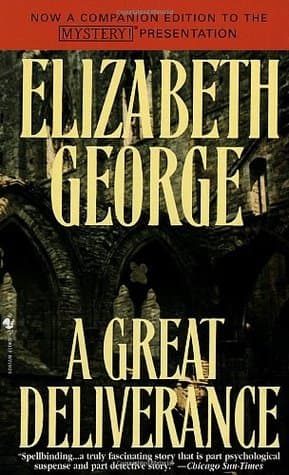
A Great Deliverance cover
Archivist's Choice

A Great Deliverance

Elizabeth George (1988)

Genre

Thriller / Mystery

Reading Time

540 min

Key Themes

See below

Track Your Reading

Sign in to track this book

A brutal beheading in a tranquil Yorkshire valley plunges aristocratic Inspector Lynley and his working-class partner into a labyrinth of ancient legends, dark family secrets, and a confession that only deepens the mystery.

Synopsis

In the quiet, isolated Yorkshire village of Keldale, Inspector Thomas Lynley and Detective Sergeant Barbara Havers investigate the murder of William Teys, whose headless body is found in a barn. His daughter, Roberta Teys, is discovered beside him, an axe in her lap, confessing with her last words: "I did it. And I'm not sorry." Despite Roberta's confession, Lynley and Havers suspect there is more to the story. They investigate the village's deep secrets, uncovering William Teys's abusive past, his control over his family, and the tragic circumstances around the disappearance of his eldest daughter, Judith. As they interview villagers, including Reverend Ardery and the local doctor, they piece together a history of neglect, manipulation, and hidden relationships. The investigation finds William Teys's missing head, buried in a local cave, and the shocking revelation that Judith Teys, long presumed dead, is alive and has returned to Keldale. Roberta, suffering from a lifetime of abuse and mental fragility, did kill her father, but Reverend Ardery orchestrated and manipulated events, including the attempt to frame Judith. Ardery had a complex, incestuous relationship with Judith and sought to protect his secrets and control the Teys family's inheritance. Lynley and Havers bring Ardery to justice, but the tragedy leaves marks on the lives of all involved and on their partnership.
Reading time
540 min
Difficulty
Medium
Pacing
Moderate
Mood
Atmospheric, Dark, Suspenseful, Brooding
✓ Read this if...
You enjoy classic British police procedurals with intricate plots, psychological depth, and a strong sense of place, featuring complex characters and dark village secrets.
✗ Skip this if...
You prefer fast-paced action thrillers or lighthearted mysteries, or are sensitive to themes of abuse and incest.

Plot Summary

A Gruesome Discovery in Keldale

The peaceful Yorkshire village of Keldale is shattered by the discovery of William Teys's headless body in his barn. His daughter, Roberta Teys, a large, mentally slow woman, is found beside him, an axe in her lap, muttering, "I did it. And I'm not sorry." The local police, led by Inspector Hillier, quickly arrest Roberta, believing the case is open-and-shut. However, the brutality of the crime and Roberta's unusual demeanor cause Scotland Yard to send two of its finest: Inspector Thomas Lynley, the aristocratic eighth Earl of Asherton, and his working-class partner, Detective Sergeant Barbara Havers, whose career is already teetering.

Lynley and Havers Arrive in Keldale

Upon their arrival in Keldale, Lynley and Havers find themselves in a close-knit community wary of outsiders. Lynley, with his polished manners, is more readily accepted, while Havers, with her bluntness and social awkwardness, struggles to gain trust. They interview the Teys family's neighbors and acquaintances, including the local vicar, Reverend Jonathan Ardery, and his wife, Sarah, as well as the Teys's housekeeper, Eileen Riscoe. The initial interviews reveal little beyond the villagers' general dislike and fear of William Teys, who was a cruel and manipulative man, but offer no clear motive for Roberta's actions, or any alternative suspect.

Unraveling William Teys's Past

As Lynley and Havers investigate, they uncover a disturbing history of abuse and control by William Teys. He was a tyrannical patriarch, known for his cruelty towards his wife, Kathleen, and his daughters, Roberta and Judith. Kathleen Teys, now frail and suffering from a stroke, cannot communicate effectively. Judith Teys, Roberta's younger sister, left Keldale years ago and is now a journalist in London. The detectives learn that William Teys had a particularly cruel way of tormenting Roberta, often reminding her of her perceived intellectual deficiencies and controlling every aspect of her life. This background suggests a strong motive for Roberta, but Lynley questions if she is truly capable of such a premeditated act.

Judith Teys Returns and Reveals More

Judith Teys, a journalist, returns to Keldale, initially presenting a composed and detached facade. Her presence stirs up old resentments and fears. She reveals more about her father's abusive nature, including his sexual abuse of her during her childhood. This revelation adds another layer of horror to the Teys family history and provides a powerful, albeit indirect, motive for anyone connected to the family. Judith also recounts how her father controlled their lives, particularly Roberta's, and how he had manipulated their mother, Kathleen. Her testimony paints a picture of a man who deserved to die, but still does not definitively point to Roberta as the sole killer.

The Role of the Reverend Ardery

Reverend Jonathan Ardery, the local vicar, becomes a person of interest due to his long connection to the Teys family. Ardery had a close relationship with Judith and Roberta when they were younger, often acting as a confidante and a source of comfort against their father's cruelty. This closeness raises questions about his knowledge of the family's secrets and his potential involvement. Havers, in particular, suspects Ardery, finding his piety a convenient mask for something darker. His wife, Sarah, appears increasingly anxious and secretive, further fueling Havers's suspicions about the vicar's true nature and any hidden role he might have played.

The Discovery of the Head

The investigation takes a turn with the discovery of William Teys's severed head, buried in a shallow grave near the barn. This discovery provides forensic evidence, including the specific type of axe used and the manner of the decapitation. The finding also complicates Roberta's simple confession, as it suggests a more elaborate crime scene and potentially more than one person involved in the disposal of evidence. Lynley begins to suspect a cover-up, believing that while Roberta might have been involved, she may not be the sole perpetrator or the mastermind behind the murder. The head's location also points to a deliberate attempt to conceal it.

The Truth About the Past and Present

Through interviews and piecing together fragmented testimonies, Lynley and Havers uncover the full, horrifying truth of William Teys's reign of terror. He abused Judith and subjected Roberta to psychological torment, constantly undermining her intelligence and independence. Kathleen, their mother, knew of the abuse but was too afraid and emotionally broken to intervene. William was also blackmailing Reverend Ardery over a past indiscretion involving a young woman, further entangling the vicar in the Teys family's web of secrets. This revelation explains Ardery's anxiety and his seemingly protective stance towards the Teys sisters.

The Confession and the Real Perpetrator

The investigation culminates in a shocking revelation. Roberta Teys, despite her initial confession, was not the sole or primary murderer. The true killer is Kathleen Teys, William's long-suffering wife. Driven to a breaking point by decades of physical and psychological abuse, and the knowledge of her husband's ongoing torment of their daughters, Kathleen finally snapped. She killed William with the axe, and Roberta, out of a misguided sense of loyalty and a desire to protect her mother, took the blame. Roberta, though intellectually challenged, understood the gravity of her mother's actions and sacrificed herself to shield her.

The Aftermath and Justice

With Kathleen Teys's confession, the full extent of the family's tragedy is clear. The community of Keldale, which had long suspected William Teys's cruelty but remained silent, must confront its complicity. Lynley and Havers, though bound by the law, feel sympathy for Kathleen. The legal process begins, but the circumstances of the murder, driven by decades of severe domestic abuse, are taken into consideration. The novel concludes with the understanding that while justice will be served, it is a complex and tragic outcome for all involved, particularly for Kathleen, Roberta, and Judith, who must now rebuild their lives after their father's tyranny and their mother's desperate act.

Principal Figures

Inspector Thomas Lynley

The Protagonist

Lynley learns to appreciate Havers's unique investigative strengths and develops a deeper understanding of the hidden darkness beneath seemingly tranquil surfaces.

Detective Sergeant Barbara Havers

The Protagonist

Havers confronts her professional insecurities and learns to trust her own instincts, ultimately proving her value as a detective.

Roberta Teys

The Central Figure/Victim

Roberta's initial confession is revealed to be a protective act, highlighting her capacity for self-sacrifice despite her intellectual limitations.

William Teys

The Victim/Antagonist (posthumous)

His death exposes the full extent of his past atrocities, bringing a form of justice to his victims.

Kathleen Teys

The Hidden Perpetrator/Victim

After decades of silent suffering, Kathleen finds the strength to end her husband's tyranny, a desperate act of self-preservation and protection for her daughters.

Judith Teys

The Supporting

Judith confronts the trauma of her past abuse and begins a path towards healing by speaking her truth.

Reverend Jonathan Ardery

The Supporting

Ardery's carefully constructed facade of piety crumbles under the weight of the investigation, forcing him to confront his past and complicity.

Sarah Ardery

The Supporting

Sarah's fear of exposure intensifies as the truth about her husband's past emerges, challenging her perceptions of their life.

Eileen Riscoe

The Mentioned

Eileen struggles with her conscience and loyalty as the truth about the Teys family unfolds.

Themes & Insights

Abuse and its Intergenerational Impact

The novel explores the devastating effects of domestic abuse, particularly William Teys's physical, psychological, and sexual violence. His tyranny over Kathleen, Roberta, and Judith shapes their lives, leading to trauma, fear, and ultimately, murder. The theme shows how abuse can cripple individuals, destroy family bonds, and leave lasting scars across generations, compelling characters like Judith to flee and Kathleen to commit a desperate act. It shows how silenced abuse can fester within a family and a community.

“They say the past is a foreign country. Maybe so. But sometimes, Inspector, the past is your own living room, and you can’t get out.”

Narrator (reflecting on Keldale's secrets)

Justice vs. Vengeance

The narrative grapples with the line between seeking justice and understanding the motivations behind acts of vengeance. While William Teys's murder is a crime, the circumstances reveal it as a desperate act by Kathleen, born from decades of abuse and a desire to protect her daughters. Lynley and Havers must navigate the legal definition of murder against the moral weight of William's atrocities. The book questions whether a legal conviction can truly provide justice for victims of long-term abuse and whether retribution, in some extreme cases, can be understood, if not wholly condoned.

“There’s justice, Sergeant, and then there’s the law. Sometimes they don’t meet.”

Inspector Thomas Lynley

Class and Social Divide

The contrast between Inspector Lynley's aristocratic background and Detective Sergeant Havers's working-class origins is a theme. Their differing perspectives and social skills influence their interactions with the Keldale community and each other. Lynley's ease among the gentry and Havers's struggles with social niceties highlight the enduring class system in England. This divide creates tension between the partners and shapes their individual approaches to the investigation, demonstrating how social standing can open or close doors, and influence perceptions of truth and authority.

“He had breeding. She had… life.”

Narrator (describing Lynley and Havers)

Secrets and Silence in a Rural Community

Keldale, a seemingly idyllic Yorkshire village, is a hotbed of long-held secrets and complicit silence. The villagers' reluctance to speak ill of the dead, or to acknowledge William Teys's known cruelty, shows how communities can collectively turn a blind eye to abuse. The 'low, thin wail of an infant' legend foreshadows the buried truths. This theme explores the psychological impact of living with unspoken truths and how the desire to maintain a facade of peace can enable horrific acts to continue unchecked, requiring outsiders like Lynley and Havers to expose the rot beneath the surface.

“People here, Inspector, they don’t like to talk. Not about things that matter.”

A Keldale local

The Nature of Guilt and Responsibility

The novel explores various forms of guilt: Kathleen's for not protecting her daughters sooner, Roberta's misguided guilt leading to her confession, Judith's survivor's guilt, and Reverend Ardery's guilt over his past indiscretion and his inability to truly intervene. Beyond individual guilt, the story also examines the collective responsibility of the Keldale community for allowing William Teys's abuse to continue unchecked for decades. This theme questions who bears responsibility when a community chooses silence over intervention, and how different forms of guilt can motivate actions, from self-sacrifice to desperate violence.

“Silence, Inspector, is often the loudest confession.”

Detective Sergeant Barbara Havers

Plot Devices & Literary Techniques

The 'Open-and-Shut' Case Illusion

Roberta's immediate confession creates a false sense of an easy resolution.

The novel begins with Roberta Teys's immediate confession to her father's murder, seemingly presenting an open-and-shut case. This device serves to hook the reader and establish the central mystery: if she confessed, why are Lynley and Havers investigating? It allows George to immediately delve into the complexities of the Teys family's past, forcing the detectives to look beyond the obvious. This illusion of simplicity ultimately highlights the deeper, more convoluted truths hidden beneath the surface, making the eventual reveal of Kathleen's true culpability more impactful.

Dual Protagonist Perspective

Alternating viewpoints of Lynley and Havers provide contrasting insights.

The narrative frequently shifts between the perspectives of Inspector Thomas Lynley and Detective Sergeant Barbara Havers. This dual protagonist device allows for a multi-faceted exploration of the Keldale community and the Teys family. Lynley's aristocratic background often grants him access to certain social circles, while Havers's working-class roots and bluntness enable her to uncover different types of information and connect with other villagers. Their contrasting investigative styles and personal biases provide a richer, more nuanced understanding of the case and the underlying social dynamics, as well as developing their individual character arcs.

The Keldale Legend (Infant's Wail)

A local legend foreshadows the village's hidden cruelties and secrets.

The recurring legend of the infant's wail in Keldale Abbey, stemming from a 300-year-old tale of villagers smothering a crying baby to escape Cromwell's raiders, serves as a powerful symbolic plot device. It immediately establishes a dark undercurrent to the seemingly idyllic village, foreshadowing the hidden cruelties and secrets that Lynley and Havers will uncover within the Teys family. The legend suggests a historical precedent for desperate acts and silenced suffering within the community, mirroring the Teys family's own history of abuse and the village's complicit silence.

Posthumous Antagonist (William Teys)

The murdered victim's past actions drive the entire plot and character motivations.

Although William Teys is dead from the opening pages, his character functions as the primary antagonist. His decades of abuse, manipulation, and cruelty are gradually revealed through interviews and flashbacks, directly motivating the actions of almost every other character – Roberta's confession, Kathleen's murder, Judith's escape and trauma, and Reverend Ardery's complicity. This device allows the author to explore the lasting impact of a tyrannical figure even after their demise, demonstrating how a person's past actions can continue to exert a powerful influence on the present and shape the trajectory of an entire story.

Critical analysis

Notable Quotes

There are some things in this world that are best left undisturbed, Inspector. Some evils that are better not brought to light.

Lynley is warned by a local not to dig too deep into thery. The quote foreshadows the dark secrets that Lynley will uncover as he investigates the murder.

The truth, like a good wine, needs time to breathe.

Lynley is reflecting on the slow pace of the investigation and the gradual unfolding of information. The quote suggests that discovering the truth is not always a quick process.

Grief is a strange and isolating country, Inspector. It makes its own rules.

Lynley observes the unusual behavior of one of the suspects, who is grieving. The quote highlights the complex and often unpredictable nature of grief.

Everyone has a past, Inspector. Some are just more tangled than others.

Havers comments on the complicated family histories and relationships of the people involved in the case. The quote emphasizes the hidden complexities of human lives.

Sometimes the most monstrous acts are committed by the most ordinary people.

Lynley considers the nature of the killer and the ordinariness of their outward appearance. The quote explores the unsettling idea that evil can reside in anyone.

Prejudice is a poison, Inspector. It blinds you to the truth.

Havers faces prejudice due to her gender and social class, and the quote reflects on how such biases can hinder an investigation. It highlights the dangers of preconceived notions.

Justice is not always about what is deserved, but what can be proven.

Lynley grapples with the legal limitations and the difficulty of securing a conviction, even when he believes he knows the truth. The quote reflects on the practicalities of the justice system.

The quietest lives often hold the loudest secrets.

Lynley investigates a seemingly unremarkable village and uncovers a web of hidden truths and past wrongdoings. The quote suggests that appearances can be deceiving.

There's a fine line between loyalty and complicity, wouldn't you agree?

Lynley questions a character who has been protecting another, blurring the lines of their involvement in the crime. The quote explores moral dilemmas and difficult choices.

The past has a way of catching up with you, no matter how fast you run.

The characters discover that old events and unresolved issues are directly impacting the present-day murder. The quote emphasizes the enduring power of history.

We all carry our scars, Inspector. Some are just more visible than others.

Lynley observes the emotional wounds of the characters, both physical and psychological. The quote speaks to the universal experience of suffering and hidden pain.

Sometimes the greatest acts of love are born from the deepest despair.

The motive behind the murder is revealed to be a complex mix of love, desperation, and protection. The quote highlights the extreme actions people can take out of love.

It's the things left unsaid that often do the most damage.

The lack of communication and hidden truths within the family contribute to the tragic events. The quote emphasizes the destructive power of silence and secrets.

Quiz

Test Your Knowledge

Ready to see how well you understood this book? Take our interactive quiz with 10 questions.

10
Questions
~5
Minutes
?
Best Score

Key Questions (FAQ)

A Great Deliverance follows Scotland Yard Inspector Thomas Lynley and Detective Sergeant Barbara Havers as they investigate the brutal murder of Dennis Teys in the seemingly tranquil Yorkshire valley of Keldale. His daughter, Roberta Teys, is found beside his headless corpse, confessing to the crime, but Lynley and Havers soon uncover a complex web of family secrets, past traumas, and hidden motivations that suggest a far more intricate truth.

About the author