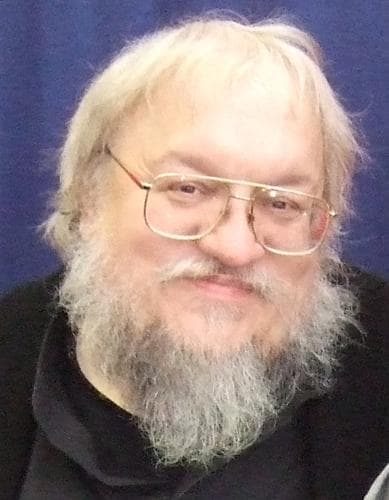
Biography coming soon.

George R.R. Martin (2003)
Genre
Fantasy
Reading Time
1670 min
Key Themes
See below
Sign in to track this book
Winter approaches, and Eddard Stark is drawn into political plots, incest, and murder in King's Landing, while a deposed princess is married off to reclaim her family's throne across the sea.
The novel starts with three Night's Watch rangers finding Others beyond the Wall. They are killed, except for one deserter whom Eddard 'Ned' Stark later executes. After the execution, Ned's children—Robb, Jon Snow, Sansa, Arya, Bran, and Rickon—find direwolf pups, which is a sign in the North, and each child adopts one. Soon, King Robert Baratheon arrives at Winterfell with his court, including Queen Cersei Lannister, her brothers Jaime and Tyrion, and her children Joffrey, Myrcella, and Tommen. Robert asks his old friend Ned to be Hand of the King, replacing Jon Arryn, who recently died. Ned is unsure but accepts after his wife, Catelyn, gets a letter from her sister Lysa Arryn, accusing the Lannisters of Jon Arryn's murder.
While exploring Winterfell, young Bran Stark climbs a tower and sees Queen Cersei and her twin brother, Jaime Lannister, together. To silence him, Jaime pushes Bran from the tower, leaving him unconscious. The Lannisters quickly leave Winterfell, and Ned prepares to go to King's Landing with his daughters, Sansa and Arya. Catelyn stays in Winterfell to care for Bran. Before Ned leaves, Jon Snow, his illegitimate son, decides to join the Night's Watch and travels north to the Wall. Tyrion Lannister also travels north to see the Wall before going south to King's Landing, stopping at Winterfell where he gives Bran a special saddle design.
After an assassin tries to kill Bran with a Valyrian steel dagger, Catelyn goes to King's Landing to warn Ned and investigate the attempt. Lord Petyr 'Littlefinger' Baelish, a former suitor, tells her the dagger belonged to Tyrion Lannister. On her way back, Catelyn finds Tyrion at an inn. Believing he caused Bran's fall and the assassination attempt, Catelyn gathers loyal men and captures Tyrion, planning to take him to her sister Lysa at the Eyrie for justice. This act worsens relations between House Stark and House Lannister.
In King's Landing, Ned starts his duties as Hand of the King and investigates Jon Arryn's death. He learns that Jon Arryn was looking into whether King Robert's children were legitimate, especially their Baratheon ancestry. Ned finds that Robert has many illegitimate children in the city, and all of them have black hair, unlike Joffrey, Myrcella, and Tommen, who have fair hair like the Lannisters. This detail makes Ned suspect that Joffrey, Myrcella, and Tommen are not Robert's children but are from Cersei and Jaime's relationship. Meanwhile, Sansa becomes engaged to Prince Joffrey, and Arya begins secret sword-fighting lessons with Syrio Forel.
At the Eyrie, Tyrion Lannister demands a trial by combat to prove he is innocent against Catelyn's claims. Bronn, a mercenary, fights for Tyrion and wins, freeing Tyrion. Before Tyrion leaves, Lysa Arryn, Catelyn's sister, tells him that she poisoned her husband, Jon Arryn, because Littlefinger told her to, and that Littlefinger also convinced her to send Catelyn the letter falsely accusing the Lannisters. This shows Littlefinger's plans and adds to the political plotting, making it clear that the Lannisters were framed for Jon Arryn's murder, though their other crimes remain.
Across the Narrow Sea, Viserys Targaryen, the exiled 'beggar king,' makes his younger sister, Daenerys, marry Khal Drogo, a Dothraki warlord, for an army to take back the Iron Throne. Daenerys initially fears Drogo but slowly gets used to Dothraki customs and gains confidence, forming a bond with her new husband. She receives three petrified dragon eggs as a wedding gift. As her influence grows, Viserys becomes more impatient and cruel, demanding his crown. Daenerys, once quiet, begins to stand up to her brother and embrace her Targaryen heritage.
King Robert Baratheon goes hunting and is badly wounded, likely by poisoned wine given by Cersei. On his deathbed, Robert names Ned regent and protector of the realm. Ned, knowing Joffrey is not Robert's true son, tries to secure the throne for Robert's rightful heir, Stannis Baratheon. He tells Littlefinger, who promises help but betrays him. When Ned tries to reveal Joffrey's illegitimacy, Cersei has him arrested for treason, and his household guards are killed. Sansa is captured, while Arya escapes King's Landing with Syrio Forel's help.
Hearing of his father's arrest, Robb Stark, now Lord of Winterfell, calls his northern men and marches south to rescue Ned and get revenge. He makes an alliance with Walder Frey by agreeing to marry one of Frey's daughters. Robb leads his army into battle against the Lannisters in the Whispering Wood, where he plans an ambush. He defeats Jaime Lannister's forces and captures Jaime, a big blow to the Lannister war effort. His men call him 'The Young Wolf.' This victory starts the War of the Five Kings.
Viserys Targaryen, frustrated by not having an army and Daenerys's growing independence, publicly threatens Daenerys and her unborn child, demanding his 'golden crown.' Khal Drogo, angered by Viserys's disrespect, 'crowns' him by pouring molten gold over his head, killing him. Daenerys watches, calm, showing her new strength. Later, Drogo gets sick from a small wound after a fight. Daenerys, desperate to save him, consults a maegi named Mirri Maz Duur, who performs blood magic that leaves Drogo in a coma and causes Daenerys to lose her unborn child, Rhaego. Daenerys burns Mirri Maz Duur on Drogo's funeral pyre.
Despite promises from Cersei and Varys that Ned could join the Night's Watch if he confessed to treason, King Joffrey Baratheon, using his authority, orders Ned Stark's public execution in King's Landing. Ned is beheaded in front of Sansa, Arya (who sees it from the crowd), and the people. This brutal act ends any hope of peace and starts a civil war. Hearing of Ned's death, Robb Stark's northern lords declare him King in the North. Renly Baratheon, Robert's younger brother, also declares himself king, challenging Joffrey's claim and further dividing the realm.
After Khal Drogo's death and the loss of her child, Daenerys puts her three petrified dragon eggs on Drogo's funeral pyre, along with Mirri Maz Duur. She walks into the fire herself. As the flames die, Daenerys emerges unharmed, holding three newborn dragons: Drogon, Rhaegal, and Viserion. This event shows magic returning to the world and strengthens Daenerys's claim as the rightful heir to the Iron Throne, now with a powerful, mythical weapon. Her loyal followers, including Ser Jorah Mormont, are amazed, and she becomes known as the 'Mother of Dragons,' ready to begin her journey to reclaim Westeros.
The Protagonist
Ned begins as a respected, honorable lord and ends as a tragic martyr, his idealism crushed by the cynical reality of power.
The Supporting
Catelyn transforms from a worried wife and mother into a key figure in the Northern war effort, driven by grief and vengeance.
The Supporting
Robert's arc is one of decline, from a powerful warrior king to a complacent, easily manipulated ruler whose death sparks civil war.
The Antagonist
Cersei maintains her power through manipulation and ruthlessness, setting herself up as a major player in the unfolding conflict.
The Supporting
Jaime begins as a villainous figure, but his capture by Robb Stark and subsequent interactions hint at a more nuanced character.
The Supporting
Tyrion navigates false accusations and dangerous political landscapes, proving his intelligence and resilience.
The Supporting
Jon transitions from an outcast in Winterfell to a dedicated member of the Night's Watch, beginning to forge his own identity.
The Protagonist
Daenerys transforms from a timid, abused girl into a powerful, confident leader and the 'Mother of Dragons'.
The Antagonist
Joffrey quickly ascends to the throne, using his power to commit acts of extreme cruelty, solidifying his role as a primary antagonist.
The Supporting
Robb transforms from a young lord into a wartime leader, earning the loyalty of his men and the title 'King in the North'.
The novel shows how power changes people and what they will do to get and keep it. From Cersei's plans to secure her children's claim to the throne, to Littlefinger's schemes that turn houses against each other, the pursuit of power is a main force. Ned Stark's failure shows how honor can be a weakness in a world where power is used without mercy. It suggests that true power often comes from cleverness and force, not justice. The fight for the Iron Throne becomes a harsh game with bad results for the realm.
“When you play the game of thrones, you win or you die. There is no middle ground.”
A main theme is the clash between strict honor and the practical, often harsh, needs for survival and success in Westeros. Ned Stark represents honor, always making choices based on his moral code, even when it puts him at a disadvantage. Characters like Littlefinger and Varys, however, act purely on practical terms, valuing self-preservation and strategic manipulation above all else. Ned's fate shows the sad results of holding onto honor in a world that values cleverness and betrayal, suggesting that pure honor can be a deadly flaw.
“The man who passes the sentence should swing the sword.”
Family bonds and loyalty are very important in Westeros, shaping alliances, feuds, and individual goals. The Starks are known for their strong family ties and loyalty, which leads Robb to war after his father's arrest. In contrast, the Lannisters, despite their internal disagreements, act as a single unit when their family's power is threatened. Daenerys's journey also comes from her family's history, the Targaryen claim to the throne. However, the theme also explores the darker side of family, like Viserys's abuse of Daenerys and Cersei's devotion to Jaime.
“The lone wolf dies, but the pack survives.”
Several characters go on journeys to understand themselves, forced to face who they are and who they want to be. Jon Snow struggles with being an illegitimate son and finds purpose in the Night's Watch. Arya rejects traditional female roles, embracing her fighting spirit. Daenerys changes from a timid, abused girl into a confident leader, leaving her brother's shadow and accepting her Targaryen heritage. These characters are shaped by their situations, often finding strength and purpose in unexpected places, challenging what society expects of them.
“A mind needs books as a sword needs a whetstone, if it is to keep its edge.”
While much of the story focuses on political plots, supernatural elements appear subtly, hinting at a larger, magical world. The discovery of the direwolf pups, an unusual event, hints at the return of old forces. The White Walkers beyond the Wall are a clear, frightening supernatural threat. Most importantly, Daenerys's survival in the flames and the hatching of her dragon eggs mark a clear return of magic to the world. This signals a change from a purely political struggle to one with mythical elements, setting the stage for future conflicts.
“Dragons. They are the children of fire. And fire is power.”
Narrative told through rotating character perspectives.
The novel is structured using multiple limited third-person perspectives, with each chapter focusing on a single character's experiences and thoughts. This device allows readers to gain intimate insight into the motivations, political leanings, and personal struggles of various key players, from Ned Stark's honorable but naive perspective to Tyrion Lannister's cynical wit and Daenerys Targaryen's journey across the Narrow Sea. This fragmented narrative builds suspense, reveals political intrigue from different angles, and creates a complex, morally ambiguous world where no single character holds all the truth.
Subtle hints and ancient predictions guiding the narrative.
Martin employs extensive foreshadowing and occasional prophecy to hint at future events and thematic developments. The discovery of the direwolf pups, symbolic of House Stark, immediately precedes the arrival of the Lannisters and the unraveling of peace. Old Nan's tales of the Others and long winters serve as grim warnings of the supernatural threats beyond the Wall. While direct prophecies are rare, the sense of impending doom and the unfolding of seemingly fated events through subtle hints keeps the reader engaged and constantly searching for clues about what is to come in the complex tapestry of Westeros.
The central object of desire driving the overarching conflict.
The Iron Throne serves as the ultimate MacGuffin in 'A Game of Thrones.' While it is a tangible object, its true significance lies in being the symbol of ultimate power and the central object of desire for virtually every major faction. The struggle to sit on the Iron Throne drives the entire plot, motivating betrayals, alliances, and wars. Although characters like Ned Stark are more concerned with justice and duty, their actions inevitably become entangled in the larger 'game' for the throne, illustrating how this singular object dictates the fates of countless individuals and the entire realm.
Animals representing the fates and identities of their respective houses.
The direwolves and dragons are powerful symbols representing the Starks and Targaryens, respectively. The direwolves, found by the Stark children, mirror their individual personalities and fates: for instance, Sansa's elegant Lady is killed, reflecting Sansa's loss of innocence, while Arya's wild Nymeria survives in the wilderness. The hatching of Daenerys's dragons signifies the rebirth of House Targaryen's power and the return of magic, transforming her from a vulnerable exile into a formidable claimant to the Iron Throne. These creatures are not just pets but extensions of their masters' identities and destinies.
Ready to see how well you understood this book? Take our interactive quiz with 10 questions.
Biography coming soon.







