“Justice? You get justice in the next world, in this world you have the law.”
— Oscar's cynical view on the legal system.

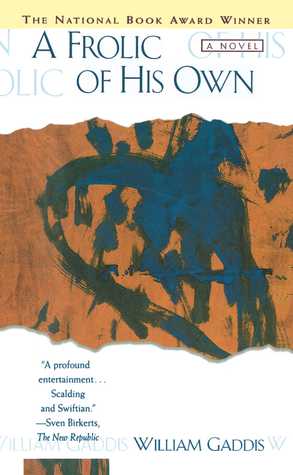
William Gaddis (1994)
Genre
Literary Fiction
Reading Time
1500 min
Key Themes
See below
Sign in to track this book
A man's fight against legal absurdity shows how justice can be both farcical and tragic.
The novel begins with Oscar Crease, a playwright and artist, facing the destruction of his large kinetic sculpture, 'The Frolic', in his barn. The sculpture, a complex machine meant to show the human condition, was destroyed when his great-nephew, Wyatt, used it for a film and accidentally set it on fire. Oscar, always short on money and feeling unappreciated, decides to sue the film company, 'InterGlobal Pictures,' for damages, claiming copyright infringement and property destruction. This event starts Oscar's long and complicated involvement with the American legal system, which becomes the main focus of the story. His common-law wife, Christina, tries to support him, but she struggles to understand his artistic goals and legal fights.
At the same time as the sculpture lawsuit, Oscar Crease faces another legal problem about his unproduced play, 'The Last Act.' A former student, Harry Lutz, accuses Oscar of copying parts from a play Harry had given Oscar years ago. This accusation makes Oscar's already difficult legal situation even worse, as he must now defend his own creative work while seeking money for his destroyed art. The plagiarism case shows Oscar's view of himself as an unrecognized genius always fighting a system that fails to understand or reward him. His conversations, often long and philosophical, with Christina and his lawyer, Norman, frequently discuss originality, ownership, and the unfair judgments of the art and legal worlds. The play's content, about death and legacy, ironically reflects Oscar's own worries about his life's work.
Adding to the growing legal troubles, Christina's dog, Rex, is killed by a car. This leads to Christina filing an insurance claim, which quickly becomes another bureaucratic problem. The insurance company disputes the dog's value and how it died, causing more delays and frustrating interactions with legal and administrative people. This seemingly small event expands the novel's criticism of the legal system beyond art and intellectual property, showing how even everyday misfortunes can get caught in endless legal details. Christina's sadness over Rex's death is set against the cold, procedural language of the insurance adjusters, highlighting how the legal process can be dehumanizing. The dog's death also shows Christina's vulnerabilities and her attempts to find comfort amid Oscar's all-consuming legal battles.
Oscar Crease's main lawyer is Norman, a somewhat tired but persistent attorney who tries to keep Oscar focused and realistic about his cases. Norman is often overwhelmed by Oscar's digressions, artistic theories, and often unrealistic expectations. The novel includes other legal professionals, such as judges, opposing lawyers, and expert witnesses, each adding to the complex and often conflicting legal arguments. The dialogue in these sections is full of legal terms, procedural details, and philosophical discussions about justice, truth, and interpretation. Oscar's cases are marked by endless motions, depositions, and postponements, showing the slow, difficult nature of the American legal system. The lawyers themselves are shown as both participants and victims of this system, often more concerned with process and rules than with actual justice or solutions.
We meet Oscar's uncle, Judge Crease, a federal judge who also has his own legal and personal problems. The Judge is dealing with a lawsuit about a faulty septic system at his vacation home, which he believes is a frivolous claim meant to extort him. His personal life is further complicated by his difficult relationship with his wife, Lily, and his thoughts on his own mortality and legacy. The Judge's experiences offer a parallel story to Oscar's, giving an insider's view of the frustrations and hypocrisies of the legal system, even for those at its highest levels. His internal thoughts and conversations reveal a man tired of the law's endless complexities and its often arbitrary outcomes, contrasting with Oscar's more idealistic, though often misguided, pursuit of justice.
Wyatt, Oscar's great-nephew, the aspiring filmmaker who destroyed 'The Frolic,' represents a younger generation's view of art and media. His film, 'The Last Taboo,' which was being shot when the sculpture was destroyed, explores themes of violence, sexuality, and societal rules, often in a sensational way. Wyatt's creative process and his understanding of art differ greatly from Oscar's, showing a generational gap in artistic philosophy. While Oscar carefully creates his complex and symbolic sculpture, Wyatt's approach is more immediate, commercial, and perhaps less concerned with deep meaning. His legal involvement in Oscar's case, as a witness and a defendant, further links their artistic and personal lives. Wyatt's perspective offers a cynical view of art's commercialization and its potential for exploitation, contrasting with Oscar's more earnest, if often self-important, artistic goals.
Much of the story focuses on long discussions and legal arguments about copyright, intellectual property, and what defines artistic ownership. Oscar Crease's cases force an examination of what makes an original work, how intent is determined, and how value is given to creative efforts. The legal system, with its strict categories and precedents, struggles to handle the changing and subjective nature of art. Characters like Oscar, Norman, and the various legal experts engage in detailed, often circular, debates about the originality of Oscar's play and the uniqueness of his sculpture. These discussions highlight the tension between artistic freedom and legal limits, questioning whether a legal framework can truly capture or protect the essence of creative expression. The novel implies that the law, in trying to define and categorize, often misunderstands and undervalues art.
As Oscar Crease's various cases continue, the legal proceedings themselves become more absurd and prolonged. Depositions offer little clarity, expert witnesses disagree, and procedural delays push resolutions further into the future. The story's structure, with long, unbroken sections of dialogue and legal documents, immerses the reader in the frustrating and often illogical reality of the legal system. Oscar's initial confidence gives way to tiredness, though he never fully gives up his pursuit of justice. The constant interruptions, shifts in focus, and sheer amount of legal jargon emphasize the idea that the process itself has become the punishment, regardless of the original claims. The novel satirizes the legal system's inefficiency and its ability to hide the truth rather than reveal it.
Christina, Oscar's long-suffering common-law wife, provides a down-to-earth contrast to Oscar's artistic and legal grandiosity. She often listens to his long speeches and philosophical thoughts, offering a more practical and emotional view of their shared problems. Her frustration grows as Oscar becomes more absorbed by his lawsuits, neglecting their financial stability and their personal relationship. She tries to understand his artistic vision and his desire for recognition, but she also wants a simpler, more stable life. Christina's own legal battle over her dog's death shows the common experience of dealing with bureaucracy, contrasting with Oscar's more intellectual approach. Her internal struggles and her attempts to keep some normalcy give an emotional center to the otherwise intellectual story, showing the personal cost of Oscar's endless legal fights.
Judge Crease, Oscar's uncle, offers a more cynical and experienced view of justice. Through his internal thoughts and his talks with legal colleagues, he reflects on the legal system's limits, its reliance on precedent over truth, and the often arbitrary nature of its outcomes. He grapples with the ethical problems of his job, the pressure to conform, and the personal toll of constantly deciding disputes. His own legal troubles with the septic system lawsuit further emphasize that even those within the system are not safe from its absurdities and injustices. The Judge's character provides a complex perspective, acknowledging the system's flaws while also recognizing its necessity. His reflections often suggest that justice, in practice, is far from its ideal form, being more a result of procedure and persuasion than of objective truth.
Throughout the novel, Oscar Crease, Christina, Judge Crease, and other characters constantly search for meaning, in both art and law. Oscar believes his art holds deep truths, yet the legal system reduces it to property and monetary value. The Judge questions whether the law can ever truly deliver justice or simply manage disagreements. The sprawling, often contradictory discussions about aesthetics, intent, originality, and legal precedent highlight how subjective value and truth are. The characters' struggles reflect a wider societal search for meaning in a world increasingly dominated by bureaucracy, commercialism, and a relative understanding of truth. The novel suggests that while art and law both try to create order and meaning, they often fail, becoming caught in their own complexities and limits, leaving individuals feeling separated and unfulfilled.
As the novel nears its end, Oscar Crease's various legal battles remain mostly unresolved. The sculpture lawsuit, the plagiarism claim, and Christina's dog insurance case are all stuck in ongoing litigation, appeals, and procedural delays. There is no clear victory or final solution for Oscar, reflecting the novel's main theme that the legal system is a continuous process rather than a source of final truths. The unclear outcomes emphasize that justice is often hard to find and that life's complexities rarely fit neatly into legal categories. Oscar remains an unfulfilled artist and litigant, always seeking validation and payment. The lack of a clear ending highlights the repeating nature of legal disputes and the ongoing struggle of individuals against impersonal systems, leaving the characters, and the reader, with a feeling of ongoing, unresolved tension.
The Protagonist
Oscar begins as an idealist seeking justice and recognition through the legal system but gradually becomes worn down by its complexities and absurdities, though he never fully abandons his quixotic pursuits.
The Supporting
Christina's initial support for Oscar wanes as she becomes increasingly frustrated by his all-consuming legal battles, leading her to question their future together.
The Supporting
The Judge starts as a jaded but functional part of the legal system and ultimately finds himself increasingly disillusioned by its inability to deliver true justice, even for himself.
The Supporting
Norman's initial professional engagement with Oscar gradually evolves into a more exasperated but enduring commitment, highlighting the toll of the legal process on its practitioners.
The Supporting
Wyatt's involvement in Oscar's legal battles forces him to confront the implications of his own artistic choices and the unintended consequences of his actions.
The Supporting
Lily remains a steadfast, if sometimes weary, presence, providing a stable emotional anchor for Judge Crease amidst his professional and personal turmoil.
The Mentioned
Harry's actions, though largely off-stage, are the inciting incident for Oscar's plagiarism lawsuit, driving a significant portion of the narrative's legal and philosophical inquiries.
Gaddis shows the American legal system as a complex, often illogical bureaucracy more concerned with rules than with actual justice. Oscar Crease's many lawsuits get stuck in endless delays, conflicting testimonies, and legal terms, as seen in the long depositions for 'The Frolic' case and the confusing arguments about his play's originality. The Judge's own frustrations with his septic system lawsuit, despite his position, show that the system's flaws are widespread, affecting everyone. The constant focus on technical details over truth, and the sheer amount of paperwork and talk, make the pursuit of justice a pointless task, where the process itself becomes the punishment.
“Justice, according to the law, is not justice according to truth.”
The novel explores what art is, who owns it, and how hard it is to define originality. Oscar's sculpture, 'The Frolic,' and his play, 'The Last Act,' become subjects of intense legal and philosophical debate about their value, their uniqueness, and whether they can be 'owned' legally. The plagiarism accusation against Oscar forces a detailed look at influence versus theft, and the arbitrary lines drawn by copyright law. Gaddis questions whether the legal system can truly understand or protect creative expression, often reducing it to mere property or a product. The contrast between Oscar's artistic goals and the lawyers' literal interpretations highlights the tension between artistic freedom and legal limits.
“It's all in the intent, isn't it? The intent of the artist, the intent of the plagiarist, the intent of the law.”
Oscar Crease represents the struggle of the idealist artist against a practical, often cynical world. He approaches his art and legal battles with a deep belief in truth and justice, yet he constantly faces everyday, greedy, and bureaucratic realities. His grand plans for 'The Frolic' are contrasted with its accidental destruction and the commercialization of its loss. Similarly, his pursuit of intellectual justice in the plagiarism case clashes with the legal system's focus on technical details. This theme also appears in Judge Crease's disappointment, as his high ideals for the law are worn down by its daily practice. The novel suggests that noble goals often break down under the weight of human flaws and institutional slowness.
“The law, like art, is a search for order in chaos, but it too often finds only chaos in order.”
Gaddis uses dialogue, or rather, monologues and overlapping talk, to show the common problem of communication breakdown. Characters, especially Oscar, give long, rambling speeches full of obscure references and complex ideas, often speaking past each other. The legal proceedings are a prime example, where lawyers, judges, and witnesses use specialized language that hides meaning rather than clarifies it, leading to endless misunderstandings and frustrations. Christina's attempts to connect with Oscar are often blocked by his intellectual distance, and even the Judge struggles to communicate well with his wife. This theme highlights how hard it is to convey truth and intent, in both personal relationships and formal systems like the law.
“We talk and talk, and what do we say? Nothing that matters, nothing that gets heard.”
Oscar Crease's constant pursuit of money and justification is linked to his desire for legacy and recognition as an artist. He sees his art as his lasting contribution, and its destruction, along with the plagiarism accusation, threatens his sense of self-worth and his place in history. Similarly, Judge Crease reflects on his own legacy within the legal system, questioning whether his career has truly made a difference. The characters grapple with what lasts, whether it's a physical work of art, a collection of legal decisions, or simply a memory. The novel suggests that the desire to leave a mark is a basic human drive, often complicated by outside forces and the subjective nature of judgment.
“All we want is to be remembered, isn't it? To have left something behind that matters.”
Long, winding passages of thought and conversation without clear speakers.
Gaddis employs extensive use of unattributed dialogue and stream-of-consciousness narration, often making it challenging for the reader to identify who is speaking. This device mirrors the chaotic, overlapping, and often self-absorbed nature of human communication, particularly within legal and artistic circles. It forces the reader to actively interpret the text, immersing them in the confusion and ambiguity that the characters themselves experience. This technique also blurs the lines between individual thoughts and collective discourse, emphasizing the pervasive influence of legal and artistic rhetoric on the characters' minds, and reflecting the difficulty of pinning down definitive 'truth' or 'intent' in a world of endless interpretation.
Dense, specialized language of the legal system used to create a sense of overwhelming complexity.
The novel is saturated with authentic legal terminology, court procedures, and bureaucratic language, often presented in long, unbroken paragraphs. This device serves multiple purposes: it satirizes the inherent opacity and inefficiency of the legal system, making it inaccessible to the layperson (and often the reader); it emphasizes the dehumanizing aspect of legal processes, where individuals and their emotional experiences are reduced to case numbers and precedents; and it creates a sense of overwhelming complexity that mirrors Oscar's own struggles to navigate the system. The sheer volume of this language highlights how form and procedure can overshadow the substance of justice, becoming a barrier to understanding rather than a tool for clarity.
Multiple, distinct legal cases running concurrently for different characters.
Gaddis weaves together several parallel legal plotlines: Oscar's lawsuit for his destroyed sculpture, his defense against plagiarism accusations, Christina's insurance claim for her dog, and Judge Crease's own septic system dispute. This device serves to broaden the novel's critique of the legal system, demonstrating its pervasive influence across different social strata and types of cases. It highlights the universality of bureaucratic frustration and the often-interconnected nature of personal and professional struggles. By showing multiple characters entangled in similar, though distinct, legal quagmires, Gaddis reinforces the idea that the system itself is the antagonist, rather than any single individual or event, and underscores the novel's overarching theme of systemic inefficiency and absurdity.
Frequent references to literature, art, philosophy, and legal history.
The novel is rich with intertextual references and allusions to classical and modern literature, art history, philosophy, and legal precedents. Oscar, in particular, constantly draws upon a vast reservoir of cultural knowledge in his monologues and arguments. This device enriches the intellectual depth of the narrative, providing context for Oscar's artistic theories and his understanding of justice. It also highlights the intellectual pretensions of the characters and the often-academic nature of legal and artistic discourse. By embedding these references, Gaddis creates a dense, layered text that reflects the complexity of human thought and cultural heritage, while also subtly critiquing the way such knowledge can be misused or misinterpreted within the confines of a legal battle.
“Justice? You get justice in the next world, in this world you have the law.”
— Oscar's cynical view on the legal system.
“The only difference between a lawyer and a prostitute is that a prostitute only screws one person at a time.”
— Another of Oscar's jaded observations about the legal profession.
“Art is not a mirror held up to reality, but a hammer with which to shape it.”
— A discussion about the purpose and impact of art, particularly relevant to Oscar's play.
“The trouble with the world is that the stupid are cocksure and the intelligent are full of doubt.”
— A general philosophical lament about human nature.
“Everything is complicated, if you look at it long enough.”
— Reflecting on the overwhelming complexity of legal and personal matters.
“The past is never dead. It's not even past.”
— While discussing how past events and grievances continually influence the present.
“Bureaucracy, the triumph of the means over the end.”
— A critique of the legal and governmental systems Oscar navigates.
“Every man is a king until he's sued.”
— Highlighting the vulnerability even the powerful face when entangled in legal action.
“Language is not merely a tool for communication; it is a weapon.”
— Observing how words are used strategically and often aggressively in legal and social discourse.
“The greater the artist, the greater the doubt. Perfect confidence is granted to the less talented as a consolation prize.”
— A thought on artistic insecurity and the nature of creativity.
“Life is a trial, and we are all defendants.”
— A broader metaphorical statement about the human condition and constant judgment.
“Truth is a variable, not a constant, especially in a courtroom.”
— Oscar's realistic, if cynical, view of how truth is manipulated in legal proceedings.
“The world is full of people who have never been told they're wrong.”
— A comment on arrogance and the lack of self-awareness in many characters.
“Ignorance is not bliss, it's just expensive.”
— Referring to the costly consequences of not understanding the law or one's situation.
Ready to see how well you understood this book? Take our interactive quiz with 10 questions.

William Thomas Gaddis, Jr. was an American novelist. The first and longest of his five novels, The Recognitions, was named one of TIME magazine's 100 best novels from 1923 to 2005 and two others, J R and A Frolic of His Own, won the annual U.S. National Book Award for Fiction. A collection of his essays was published posthumously as The Rush for Second Place (2002). The Letters of William Gaddis was published by Dalkey Archive Press in February 2013.







