“There was a time when the world was new and all the creatures in it lived together in peace.”
— Emmaline's grandmother often shared stories of the past.

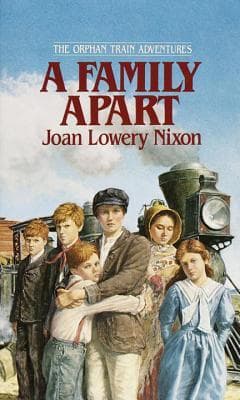
Joan Lowery Nixon (1987)
Genre
Children's / Historical Fiction / Young Adult
Reading Time
160 min
Key Themes
See below
Sign in to track this book
Thirteen-year-old Frances disguises herself as a boy and journeys across the 1850s American West to reunite her siblings after their widowed mother places them on an orphan train.
In 1856 New York City, Mrs. Kelly faces poverty after her husband's death. She cannot provide for her six children – Frances, Pete, Peggy, Danny, Mike, and little Mary – so she decides to send them on an 'orphan train' to find new homes in the West. Thirteen-year-old Frances, the eldest, is upset and struggles to understand her mother's choice, feeling abandoned despite her mother's words of love. The children are put on a train with many other children, heading towards an unknown future, leaving behind everything they know and their only remaining parent.
The journey west is long. Frances, always protective, tries to keep her younger siblings together and their spirits up, though her own fear and anger are present. She promises her mother she will look after them. In St. Joseph, Missouri, the children go to a hall where families come to choose children. Seeing other children picked and separated from their siblings fills Frances with dread. She hears whispers and sees the desperation in other orphans' eyes, making her more determined to keep her family together.
Frances's worst fears start to happen. First, Peggy and Danny are chosen by the Johnsons, a kind-looking couple who already have children. Frances tries to object, explaining they are a family, but the adults say it is for the best. Next, little Mary, the baby, is taken by another family. Frances is heartbroken and feels like a failure, unable to keep her promise to her mother. She tries to make herself seem unattractive to avoid being chosen, hoping to stay with Pete and Mike, but the process feels unstoppable.
Frances realizes her chances of staying with any of her siblings are small if she remains a girl. She plans to disguise herself. She cuts her hair short, puts on a boy's cap and clothes she finds, and uses the name 'Frankie.' Her younger brother, Pete, is confused but agrees. When the Stevens family, a stern but decent couple from a farm, looks for a boy to help with chores, Frances, disguised as Frankie, steps forward with Pete. The Stevens agree to take both 'Frankie' and Pete, believing Frances is a boy and Pete her younger brother. This gives Frances hope that she can protect Pete.
Life on the Stevens farm is hard. Frances, as 'Frankie,' does heavy farm work, which is physically tiring. Pete, though younger, also has chores. Mrs. Stevens is strict but fair, and Mr. Stevens speaks little. Frances constantly worries about her disguise being discovered, especially when bathing or sick. She learns to milk cows, slop hogs, and work in the fields, showing her ability as a 'boy' while secretly wishing for her true identity and her separated family. Pete likes the farm animals.
Frances's main concern, after keeping her identity secret, is finding Mike. She learns Mike was taken by the Brubakers, who live on a remote farm. Frances uses every chance to get information, asking questions and listening to conversations in town. She finds out the Brubakers are reclusive and strange, which increases her worry for Mike. She knows she must find a way to check on him, even if it risks her place with the Stevens family and her disguise.
During a trip to town with the Stevens, Frances (as Frankie) convinces Mrs. Stevens to let her and Pete deliver goods to the Brubaker farm. There, they find Mike looking thin, sad, and messy. The Brubakers are stern and seem to neglect Mike, using him for hard labor without much care. Frances's fears are confirmed. She sees Mike is unhappy and possibly mistreated. She tries to speak with Mike, telling him she has not forgotten him and will help, strengthening her resolve to reunite her family.
One day, while helping Mrs. Stevens, Frances's binding comes loose, and her true identity as a girl is accidentally revealed. Mrs. Stevens is shocked and angry, feeling betrayed. Frances tearfully explains her reasons – her promise to her mother and her wish to protect Pete and find Mike. Mrs. Stevens, though stern, is moved by Frances's devotion. They plan together. Mrs. Stevens agrees to help Frances get Mike from the Brubakers, understanding his bad placement. They decide to approach the Brubakers by offering Mike a better home.
Mrs. Stevens, with Frances (now openly a girl again), confronts the Brubakers. She argues that Mike would be better off with her family, saying the Brubakers cannot provide proper care. The Brubakers, not wanting trouble, reluctantly let Mike go. Mike is happy to be reunited with Frances and Pete. The three siblings are now together on the Stevens farm, a temporary safe place. They are safe for now, but Frances knows their goal is to find all their siblings and, someday, their mother. The Stevens agree to keep all three Kelly children, giving them a stable, though still challenging, home.
With Frances, Pete, and Mike living together on the Stevens farm, a family life starts to return. Frances continues to work hard, now as herself, and Pete and Mike settle into their roles. Mrs. Stevens, though strict, is a caring guardian, and Mr. Stevens shows quiet approval. The children still miss their other siblings, Peggy, Danny, and Mary, and their mother, but they find strength in being together again. Frances knows finding their other siblings will be a long journey, but she is determined, holding onto the promise she made to her mother. Their new life on the farm, while not perfect, provides a basis for their future.
The Protagonist
From a scared, angry girl burdened by responsibility, Frances transforms into a courageous and resourceful young woman who learns to trust and accept help, while never losing sight of her family.
The Supporting
Pete adapts from a confused child to a capable farmhand, finding a sense of belonging in his new environment while maintaining his bond with Frances.
The Supporting
Mike goes from a neglected and unhappy child to being reunited with his siblings and finding a more stable home, beginning to heal from his trauma.
The Supporting
Her arc is largely off-page, but her initial decision sets the entire plot in motion, and Frances's understanding of her deepens throughout the story.
The Supporting
Initially a strict and somewhat detached guardian, Mrs. Stevens evolves into a compassionate figure who understands Frances's plight and actively helps her.
The Supporting
He remains a consistent, quiet, and fair presence, providing stability and a home for the children.
The Mentioned
Her arc is largely off-page, as she is separated early in the story, but her memory motivates Frances.
The Mentioned
His arc is largely off-page, as he is separated early in the story, but his memory motivates Frances.
The Mentioned
Her arc is off-page, as she is separated very early in the story, symbolizing the family's initial dispersal.
The main theme is the strong bond among the Kelly siblings and Frances's loyalty to her family. Even when separated and facing hardship, Frances wants to keep her siblings together and protect them. Her disguise as 'Frankie' and her search for Mike show this theme. The children's shared past and their mother's promise to Frances strengthen their connection, even across distances and new homes.
“'I promised Mama I’d keep us all together,' Frances whispered to herself, her voice thick with unshed tears. 'I have to find a way.'”
Frances's decision to disguise herself as a boy, 'Frankie,' explores identity and the sacrifices made for survival and protection. Her assumed identity helps her navigate a society run by men and secure a place for herself and Pete, but it costs her personally, forcing her to hide her true self. The eventual revelation of her identity to Mrs. Stevens shows the tension between her true self and the persona she created, and the acceptance she finds.
“'I was Frankie, the boy who could do anything. But inside, I was still Frances, the girl who missed her mama and her sisters and brothers.'”
The Kelly children, especially Frances, show resilience when facing extreme hardship. From the trauma of being separated from their mother to enduring the harsh conditions of the orphan train and new homes, they learn to adapt and survive. Frances's ability to do demanding farm labor as 'Frankie' and her thinking in rescuing Mike show her strength and determination to overcome challenges and create a better life for her family.
“'No matter how tired she was, no matter how much her muscles ached, Frances reminded herself that giving up was not an option.'”
The book looks at love and sacrifice. Mrs. Kelly's decision to send her children away, though first seen as abandonment, is an act of maternal love, a desperate sacrifice for their survival and a better future. Similarly, Frances sacrifices her comfort, identity, and safety to protect and reunite her younger siblings. Her actions come from a deep, selfless love, reflecting her mother's desperate choice and showing the complex nature of love under pressure.
“'Mama didn't send us away because she didn't love us. She sent us away because she loved us too much to let us starve.'”
The historical context and primary vehicle for the plot's central conflict.
The orphan train system serves as the foundational plot device, driving the entire narrative. It is the mechanism by which the Kelly children are separated from their mother and subsequently from each other. This historical reality provides the setting, the initial conflict, and the continuous challenges faced by the protagonists. It highlights the social issues of poverty and child welfare in 19th-century America, creating a high-stakes environment where children are literally 'chosen' for new lives, often with uncertain outcomes.
A crucial plot device allowing Frances to exert agency and protect her brother.
Frances's disguise as a boy, 'Frankie,' is a central plot device that enables her to manipulate her circumstances and stay with Pete. This deception creates dramatic tension, as Frances constantly fears exposure, and allows her to access roles and responsibilities typically denied to girls at the time. It highlights themes of identity, gender roles, and the resourcefulness required for survival. The eventual revelation of her true identity to Mrs. Stevens is a pivotal moment, leading to a shift in their relationship and a new phase of the plot.
Frances's vow to her mother, serving as her primary motivation throughout the story.
The promise Frances makes to her mother – to keep her siblings together and look after them – acts as a powerful motivational plot device. This internal commitment drives all of Frances's major decisions, from her disguise to her relentless search for Mike. It provides her with a clear objective and a source of strength when faced with despair. The promise also reinforces the theme of family loyalty and the enduring bond between parent and child, even in separation.
The physical separation of the Kelly children, creating multiple narrative threads and goals.
The scattering of the Kelly siblings across different homes and locations is a key plot device that creates ongoing narrative tension and provides Frances with clear objectives. Each separated sibling represents a challenge for Frances to overcome and a piece of her family to reclaim. This device allows the story to explore various types of placements (some good, some bad) and the diverse experiences of orphan train children, while consistently bringing Frances back to her central mission of reunification.
“There was a time when the world was new and all the creatures in it lived together in peace.”
— Emmaline's grandmother often shared stories of the past.
“Sometimes a person has to make a choice, even if it’s a hard one.”
— Emmaline reflects on the difficult decision to send children away.
“The wind howled like a hungry wolf, and the snow fell thick and fast.”
— Describing the harsh weather during the journey.
“It wasn’t fair. Nothing was fair anymore.”
— Emmaline's internal thoughts about their family's separation.
“A new family. A new life. It was almost too much to think about.”
— Emmaline contemplates the future after being placed with a new family.
“You can’t always get what you want, but you can always try to make the best of what you get.”
— A pragmatic piece of advice Emmaline receives.
“Home wasn’t a place; it was the people you loved.”
— Emmaline's realization about the true meaning of home.
“The city was a bewildering maze of noise and people.”
— Emmaline's initial impression of St. Louis.
“Every day was a step further away from the past, and a step closer to something new.”
— Emmaline reflects on the passage of time and their journey.
“We have to hold onto each other, no matter what.”
— A vow of familial loyalty amidst separation.
“Being brave didn’t mean you weren’t scared; it meant you did what you had to do anyway.”
— Emmaline's understanding of true bravery.
“The silence of the prairie was a comfort after the clamor of the city.”
— Emmaline finds solace in her new rural surroundings.
“Sometimes, the hardest goodbyes lead to the most unexpected hellos.”
— Emmaline's reflection on the bittersweet nature of their journey.
“A promise was a promise, and it had to be kept.”
— Emmaline's strong sense of integrity regarding her family's reunion.
Ready to see how well you understood this book? Take our interactive quiz with 10 questions.

Dan Gemeinhart
4.5

Kate O'Hearn
4.4

Jeanne Birdsall
4.4

Jen Wang
4.4

Wendelin Van Draanen
4.3

John Marsden
4.3

Chris Van Allsburg
4.3

Jennifer A. Nielsen
4.2