“A face is not a mask. It is a map of the soul.”
— Reflection on the nature of faces in Caverna, where expressions are learned rather than innate.

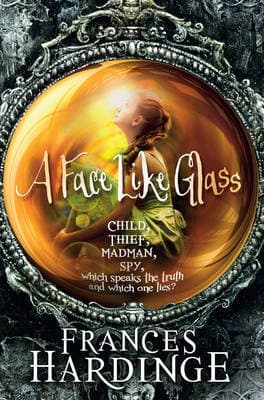
Frances Hardinge (2012)
Genre
Fantasy / Children's / Mystery / Science Fiction / Young Adult
Reading Time
500 min
Key Themes
See below
Sign in to track this book
In a city where faces are blank and emotions are learned, a girl with an expressive face becomes a danger to a society built on lies.
Neverfell lives a hidden life in the Fallowfield cheese mines of Caverna, an underground city, under the care of a man she calls 'Grandfather.' Unlike others in Caverna, whose faces are blank and need learned expressions from Facesmiths, Neverfell's face shows her emotions naturally. This makes her unusual and dangerous in a society where real expression is forbidden and faked emotions are valued. Grandfather, a master cheesemaker, keeps her hidden, teaching her only about cheese and warning her not to show her face. Despite her isolation, Neverfell is curious about the world outside her tunnels, especially the 'Grand Below' and the effects of crafted goods.
Neverfell's hidden life ends when she accidentally lets her mask slip while talking to a customer, showing her expressive face. The customer, a nobleman, is both shocked and interested. Knowing her secret is out, Grandfather, worried for her safety, gives her a warning about 'the Grand Below' and tells her to hide. Neverfell escapes into Caverna's tunnels, a city of specialized craftsmen and hidden plans. She quickly learns that her genuine expressions are scary to the people of Caverna, who are used to carefully made emotions, and she must try to hide her face to survive.
Lost and alone, Neverfell is found by Facesmiths, led by Madame Appeline. Appeline is interested in Neverfell's unique ability to show real emotion and takes her in. Neverfell learns about the Grand Below, the rich, political upper parts of Caverna where the most powerful crafts are traded and social standing is everything. She sees the complex dance of learned expressions and constant manipulation. She also meets other figures, including the Facesmith, Erstwhile, and the powerful Madame Upmost.
As Neverfell moves through the challenging social world of the Grand Below, she starts to remember parts of her forgotten past. She learns that Grandfather is not her relative but a craftsman who took her in. Hints suggest that her existence is connected to a big, possibly dangerous, secret. Her unique face, she realizes, is a way to understand her origins. She finds that Grandfather was once respected among the craftsmen, and his move to the cheese mines was linked to her arrival.
Neverfell learns about Caverna's powerful crafts, especially those related to memory. She discovers wines that can remove specific memories, perfumes that change perceptions, and cheeses that cause hallucinations. More concerning, she finds hints of a widespread 'forgetting'—a deliberate act that erased the collective memory of Caverna's people about their true history and the world above ground. This explains why Grandfather was so protective and why her own memories are broken, suggesting she might be connected to this forgotten past or survived it. The Grand Below's power relies on controlling information and memory.
Neverfell sees the power held by the Facesmiths. They do not just teach expression but control social interaction, able to create personalities through learned facial movements. She learns that the blankness of Caverna's faces is not natural but from a specific, long-forgotten event or craft. This 'blankness' lets the Facesmiths dictate emotional responses, making them essential. Erstwhile, a Facesmith who seems to understand more, subtly guides Neverfell, hinting at the true nature of their craft and the weakness it creates in the people.
Neverfell, because of her unique face, becomes important to different groups within the Grand Below. Madame Upmost, a powerful and manipulative figure, sees Neverfell as both a threat and a tool. Neverfell realizes she is a pawn in a larger game, caught between the Facesmiths' power, the Craftsmen's secret goals, and Caverna's forgotten history. She uncovers a plot to use her or her abilities for political gain, possibly to upset or control the entire city. Her genuine expressions are both a strength and a weakness.
Grandfather, having followed Neverfell, later appears in the Grand Below, risking his safety. He tells her the full truth: Neverfell is the daughter of Caverna's original Creator, a master craftsman who rebelled against the Grand Below's rule. The 'Forgetting' was done by the Grand Below to hide knowledge of the Creator's rebellion and Caverna's true nature. Neverfell's naturally expressive face is a genetic trait from her mother, who was from the surface world, before the 'blankness' was put on Caverna's population.
Grandfather explains that Neverfell's father, the Creator, tried to make a craft that would let people remember the truth and break free from the Grand Below's control. He gave Neverfell to Grandfather to protect her from those who wanted to keep the 'Forgetting.' Neverfell understands that her unique face, a symbol of real emotion, threatens the established order. She realizes she must follow her father's path and use her very existence to challenge the Grand Below's control and awaken Caverna's people to their forgotten history.
In a confrontation, Neverfell, with Grandfather and Erstwhile's help, exposes the truth about the 'Forgetting' and the Grand Below's manipulation. She confronts Madame Upmost, revealing the Creator's history and the true nature of Caverna's blank faces. Her naturally expressive face, once scary, becomes a symbol of truth. While Caverna does not change immediately, Neverfell's actions start doubt and self-discovery. The ending suggests a new time for Caverna, where people might start to reclaim their memories and real emotions, challenging the Facesmiths' and Grand Below's power.
The Protagonist
From a sheltered, fearful child, Neverfell transforms into a brave truth-teller who challenges the established order of Caverna.
The Supporting
Initially a reclusive protector, Grandfather eventually risks his safety to reveal the truth and support Neverfell's mission.
The Supporting
Appeline's initial curiosity about Neverfell eventually leads her to a reluctant understanding of the deeper implications of genuine emotion.
The Supporting
Erstwhile moves from a detached observer to a more active, albeit subtle, participant in Neverfell's quest for truth.
The Antagonist
Upmost remains a staunch defender of the status quo, actively working to suppress Neverfell and the truth she represents.
The Mentioned
His past rebellion and sacrifice serve as a catalyst for Neverfell's journey.
The Supporting
Vex remains largely a victim of the Grand Below's power structures, her character highlighting the societal pressures.
The Mentioned
The blank-faced people represent the potential for change and awakening, as Neverfell's actions challenge their long-held societal norms.
Neverfell's journey is about finding out who she is, where she comes from, and what her unique face means. Her lack of memory and unusual ability make her question everything she has been taught. This theme is shown through her struggle to balance her real emotions with Caverna's culture of made-up expressions, leading her to accept her true self as a way to create change. Her identity is not just personal but also linked to Caverna's forgotten history.
“'Your face is your fortune, child. But not in the way you think.'”
Caverna is a city built on lies and manipulation, where expressions are made, memories are erased, and perceptions are changed by powerful crafts. The Grand Below hides the truth about Caverna's origins and the 'Forgetting.' Neverfell's naturally expressive face becomes a symbol of truth in a world that fears it. The novel explores how truth can be hidden, twisted, and used as a weapon, and how real honesty can break down systems of control. The Facesmiths' job is based on faking emotion.
“'A lie can be a beautiful thing, child. More beautiful, sometimes, than truth.'”
The Grand Below controls its citizens through various ways: the 'forgetting' of history, the Facesmiths' control over expression, and mind-altering crafts. People are not free to show real emotion or even remember their past. Neverfell's struggle is a fight for personal freedom of expression and, in turn, the freedom of all Caverna to remember and feel genuinely. Her journey shows how oppressive absolute control is and the human desire for independence and real experience.
“'They don't want you to remember. They want you to stay exactly as you are, a blank page for them to write upon.'”
The novel explores what it means to feel and show emotion. In Caverna, emotions are learned performances, without real feeling, leading to a society that lacks true empathy. Neverfell, with her natural expressions, brings genuine emotion and therefore, empathy, into this artificial world. Her face makes others confront the reality of feeling, challenging their made-up emotional displays and showing the importance of real connection and understanding.
“'You don't just feel. You show. And that, in Caverna, is a crime.'”
A societal condition where natural facial expressions are absent, requiring learned performances.
This is the central conceit of the world. The blank faces are not just a quirk but a critical plot device. They represent the collective 'forgetting' and the Grand Below's control over its populace. They enable the Facesmiths' power and make Neverfell's genuine expressions a terrifying anomaly, driving much of the initial conflict and her need for secrecy. The mystery of their origin is a key element of the plot, revealing the deeper history of Caverna.
Magical, memory-altering, and perception-manipulating creations central to Caverna's economy and control.
These enchanted crafts are more than just luxuries; they are instruments of power and manipulation. Wines erase memories, cheeses induce hallucinations, and perfumes alter trust or perception. They are integral to how the Grand Below maintains its dominance and suppresses dissent. Neverfell's initial interactions with these goods, particularly Grandfather's cheeses, introduce her to the world's unique magic and the dangers of its manipulation. They are both a source of wonder and a tool of oppression.
The protagonist's unique ability to naturally display emotions, a stark contrast to Caverna's blank faces.
Neverfell's face is not just a character trait but a powerful plot device. It immediately sets her apart and makes her a target, forcing her into hiding and then into the Grand Below. Her genuine expressions are a 'weapon' of truth in a world of lies, making her a living challenge to the established order. It is the physical manifestation of the forgotten past and the potential for a different future, ultimately becoming the catalyst for revealing the truth about Caverna's history and the 'forgetting.'
A historical event or craft that wiped the collective memory of Caverna's true history and the world above.
The 'forgetting' is a crucial backstory element that drives the mystery and explains the current state of Caverna. It's the reason for the blank faces, the suppression of genuine emotion, and the Grand Below's unchallenged power. Neverfell's quest to uncover her past is inextricably linked to uncovering the truth of this collective amnesia. It serves as the ultimate secret that, once revealed, has the potential to dismantle the entire societal structure of Caverna.
“A face is not a mask. It is a map of the soul.”
— Reflection on the nature of faces in Caverna, where expressions are learned rather than innate.
“In Caverna, faces were like glass, and expressions were like cracks.”
— Description of the city's inhabitants, who must learn facial expressions as skills.
“Neverfell was a girl with a face that could not lie.”
— Introduction of the protagonist, whose natural expressions disrupt Caverna's norms.
“The Grand Steward's smile was a thing of sharp edges and cold calculation.”
— Observation of the ruler of Caverna, whose expressions are meticulously crafted.
“Truth is a dangerous commodity in a city built on secrets.”
— Commentary on Caverna's society, where honesty is rare and perilous.
“A smile can be a weapon, a shield, or a trap.”
— Discussion of how facial expressions are used strategically in Caverna.
“The Cheesemaster's creations were not just food; they were memories and dreams given form.”
— Description of the magical cheeses that can alter perceptions and emotions.
“In a world of masks, the one without a mask is the most terrifying.”
— Reflection on Neverfell's impact as someone who cannot hide her emotions.
“Every face in Caverna tells a story, but most of them are lies.”
— Critique of the artificiality and deception pervasive in the city.
“The heart of Caverna beats with the rhythm of forgotten clocks.”
— Poetic description of the ancient, mysterious city and its hidden mechanisms.
“To be free is to be dangerous, and to be dangerous is to be alive.”
— A rebellious sentiment expressed by characters challenging Caverna's control.
“The vats of the Vintners held not just wine, but the distilled essence of time itself.”
— Description of the magical wines that can manipulate age and memory.
“A single honest tear can unravel a thousand carefully woven lies.”
— Highlighting the power of genuine emotion in a society built on falsehoods.
“In Caverna, even the air is a lie, scented with perfumes that hide the truth.”
— Metaphor for the pervasive deception in every aspect of the city's life.
Ready to see how well you understood this book? Take our interactive quiz with 10 questions.







