“They were only a boy and a dog; but they were all that was left to each other.”
— Describing Nello and Patrasche's relationship early in the story.

Sign in to track this book
In 19th-century Flanders, an orphaned boy artist and his loyal dog face hardship and cruelty, finding comfort only in their bond and dreams of art, leading to a sad, peaceful end.
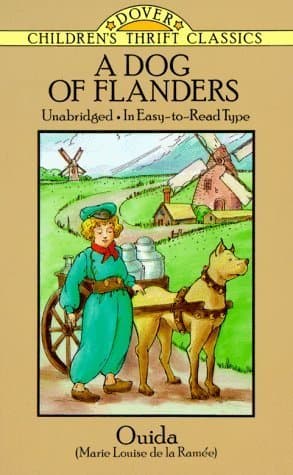
The story begins with Nello, an orphaned boy living with his poor grandfather, Jehan Daas, in a small Flemish village near Antwerp. They earn little money selling milk, which Jehan delivers in a small cart. One day, Nello finds a large, thin dog, Patrasche, by the road. The dog had been beaten and left by his cruel owner. Nello and his grandfather, despite their own poverty, take the dog in. They nurse him back to health, and Patrasche soon becomes a key part of their lives, helping pull the milk cart. Nello, a talented but unknown artist, dreams of becoming a great painter like Rubens, whose works he wants to see in Antwerp Cathedral.
Nello spends his days helping his grandfather with the milk rounds and sketching in the dirt. He often draws inspiration from the beautiful scenery and people around him. His greatest wish is to see the Rubens paintings in Antwerp Cathedral, which are kept covered and cost money to view, money he does not have. He becomes good friends with Alois Cogez, the daughter of the village's rich miller. Alois is kind and supports Nello's art dreams, often bringing him food and comforting him. Their bond gives Nello joy, even though Alois's father, Baas Cogez, does not approve of their friendship because Nello is poor.
Nello hears about an important art competition in Antwerp, offering a large prize and a chance for artistic recognition. He works hard on a drawing, putting his heart into the piece, hoping to win and help his grandfather with money troubles. Meanwhile, the harsh Flemish winter arrives, making their milk rounds harder and their poverty worse. Jehan Daas, already weak, gets weaker, and they lose customers. Despite these problems, Nello stays hopeful, driven by his art dreams and Patrasche's constant loyalty.
A fire breaks out at Baas Cogez's mill. Without any proof, Nello is wrongly accused of starting it. This accusation, fueled by Baas Cogez's existing dislike for Nello, further separates the boy from the community. People start to avoid him and his grandfather, and their already uncertain living is put at risk. This false accusation deeply hurts Nello, not just because of the unfairness but also because it strains his friendship with Alois, as her father forbids her from seeing him. Despite being alone, Nello keeps drawing, finding peace in his art.
The stress of poverty, the accusations, and the harsh winter greatly affect Jehan Daas's health. He becomes very ill and bedridden, unable to work. Nello, with Patrasche's help, tries to manage the milk rounds alone, but their income is not enough for their needs and medical costs. Nello takes care of his grandfather carefully, but the old man's condition worsens. Jehan Daas eventually dies, leaving Nello completely alone, with only Patrasche for company and support. This loss is a crushing blow to the young boy.
After his grandfather's death, Nello cannot pay the rent for their small cottage. The landlord, uncaring about his situation, evicts him. With nowhere to go and no way to support himself, Nello feels more despair. He has no family, no friends left in the village (except Alois, who is forbidden to see him), and his art dreams seem further away than ever. He and Patrasche are forced to wander the roads, homeless and hungry, facing a bleak future on the streets. Nello holds onto the small hope of the art competition results.
Driven by a desperate hope, Nello travels to Antwerp on the day the art competition results are announced. He stands in the crowd, waiting for news that could change his life. When the winners are read, Nello's name is not among them. His drawing, despite his great effort and talent, has been rejected, seen as too rough or simple by the judges. This rejection is the final, crushing blow, putting out the last spark of hope in Nello's heart. He feels completely defeated, his dreams of becoming an artist seeming impossible.
With his last hope gone and nowhere else to go, Nello decides to fulfill his lifelong dream: to see the Rubens paintings in Antwerp Cathedral. He knows he has no money for the viewing fee, but he is drawn to the church. He and Patrasche make their way through the snowy streets of Antwerp. The weather is very cold, and Nello is weak from hunger and tiredness. He feels a deep sense of peace and acceptance as he nears the cathedral, a place he has always linked with beauty and inspiration.
As Nello and Patrasche arrive at the cathedral, they find that, by rare chance, the Rubens paintings – "The Elevation of the Cross" and "The Descent from the Cross" – have been left uncovered after a late-night service. Nello, weak but filled with deep wonder, looks at the masterpieces he has dreamed of seeing his whole life. The beauty and grandeur of the art overwhelm him, giving him a moment of pure joy and fulfillment in the midst of his suffering. Patrasche stays faithfully by his side, sharing in this quiet, sacred experience.
After seeing the Rubens paintings, Nello and Patrasche, tired and freezing, curl up together on the cold stone floor of the cathedral, beneath the very paintings Nello loved. The extreme cold and Nello's weak state, along with the emotional and physical toll of his hardships, prove too much. In the morning, they are found dead, intertwined in a final embrace. Their tragic end is peaceful, as they passed away together, having found comfort and beauty in their last moments. The villagers, including Baas Cogez and Alois, eventually learn the truth of Nello's innocence regarding the fire, but it is too late.
The Protagonist
Nello's arc is one of sustained suffering and unfulfilled dreams, culminating in a tragically peaceful death, finding beauty in his final moments.
The Supporting
Patrasche's arc is one of liberation from abuse to profound loyalty and companionship, ultimately sharing Nello's fate.
The Supporting
Jehan's arc is one of decline, from a struggling provider to a dependent, ultimately dying from poverty and old age.
The Supporting
Alois's arc shows her struggle between personal kindness and external pressures, leading to her inability to help Nello when he needs it most.
The Antagonist
Baas Cogez remains largely unchanged in his prejudice, although he later realizes his error, it is too late to atone.
The Mentioned
Her arc is static, representing the general indifference of the community.
Poverty is the main enemy in Nello's life, shaping his every struggle and leading to his sad end. From his meager life with his grandfather, struggling to sell milk, to not being able to afford basic needs like food, warmth, and even the fee to see the Rubens paintings, poverty starves Nello physically and emotionally. It isolates him, as shown by Baas Cogez's dislike and the villagers' abandonment. His eviction after his grandfather's death is a direct result of not being able to pay rent, showing how poverty takes away dignity and basic safety, leaving Nello and Patrasche completely vulnerable.
“"He was poor, and he was friendless, and the world was very cold to him."”
Nello's strong desire to become a painter like Rubens is a central theme, representing the human need for beauty, purpose, and self-expression. Despite his talent, Nello's dreams are always blocked by his circumstances. He lacks the money for proper training, his art is dismissed by judges, and seeing his idol's work is a luxury he cannot afford for most of his life. This theme highlights the tragedy of unused potential and the societal barriers that stop talented people from following their passions, especially when they come from poor backgrounds. His final moments seeing the Rubens paintings offer a touching, though brief, fulfillment.
“"To see the Rubens, that was his life's desire."”
Patrasche's constant loyalty to Nello stands out against the cruelty and indifference Nello faces from people. Rescued from abuse, Patrasche devotes his life to Nello, helping him with the milk cart, comforting him, and staying by his side through every hardship, including hunger, homelessness, and Nello's eventual death. This theme stresses the pure and deep bond between humans and animals, showing Patrasche as Nello's most loyal friend and family member. His loyalty highlights the often-missing compassion in human society and gives Nello his only steady source of comfort.
“"Patrasche loved Nello more than all the world, more than his own life."”
The story is full of examples of social unfairness and human cruelty towards Nello. Baas Cogez's prejudice against Nello because of his poverty, his false accusation of arson, and the community's subsequent shunning show the harshness of societal judgment. Nello's eviction and the villagers' general indifference to his suffering show how easily the vulnerable are used and left behind. This theme criticizes a society that values wealth and status over kindness and fairness, showing how widespread biases and individual malice can lead to deep suffering and tragedy for those at the bottom of the social ladder.
“"It was always the poor who were suspected, and the poor who were condemned."”
Hints at future tragic events.
The narrative frequently employs foreshadowing, subtly hinting at the tragic fate awaiting Nello and Patrasche. For instance, descriptions of Nello's extreme poverty, his grandfather's failing health, and the harshness of the Flemish winter all build a sense of impending doom. The recurring motif of the covered Rubens paintings, unattainable to Nello, foreshadows his unfulfilled dreams and the difficulty of achieving his aspirations. These elements create a melancholic atmosphere and prepare the reader for the story's poignant conclusion, emphasizing the inevitability of their struggle against overwhelming odds.
Representing unattainable beauty, hope, and artistic aspiration.
The Rubens paintings in Antwerp Cathedral symbolize Nello's deepest desires, his artistic soul, and the beauty he longs to experience but cannot afford. They represent a world of art, culture, and recognition that is perpetually out of his reach due to his poverty. The fact that he can only see them in his final moments, when they are accidentally uncovered, underscores the tragedy of his life – that his greatest dream is fulfilled only at the very end, and through sheer chance, not merit or opportunity. They become a symbol of both the beauty of art and the cruelty of a world that denies access to it based on class.
Nature mirroring the characters' emotional states.
The story frequently uses pathetic fallacy, where the natural environment reflects the emotional state and plight of Nello and Patrasche. The harsh, bitter Flemish winter, with its snow and freezing temperatures, directly mirrors Nello's growing despair, isolation, and physical suffering. The coldness of the weather parallels the 'coldness' of human indifference and cruelty he experiences. Conversely, brief moments of warmth or sunshine might coincide with a fleeting hope, though these are rare. This device heightens the emotional impact of their struggles and emphasizes the overwhelming forces of nature and society against them.
Contradictions between expectation and reality.
Irony is a prominent device, particularly situational irony. Nello, a talented artist, is rejected by the art competition, while his greatest artistic desire (seeing the Rubens paintings) is only fulfilled by accident in his last moments of life. He is falsely accused of arson by Baas Cogez, who later realizes Nello's innocence, but too late to make amends. The greatest kindness Nello receives is from an animal, Patrasche, while humans often treat him with cruelty or indifference. This irony underscores the injustice and tragedy inherent in Nello's life, highlighting the unfairness of his fate.
“They were only a boy and a dog; but they were all that was left to each other.”
— Describing Nello and Patrasche's relationship early in the story.
“Love is eternal, and the love of a dog is the most eternal of all.”
— A reflection on the enduring bond between humans and dogs.
“For the love of a dog, like the love of a child, is a thing of heaven.”
— Emphasizing the pure and divine nature of a dog's affection.
“He lay there, at the foot of the great picture, and the last smile on his face was for Patrasche.”
— Nello's final moments, looking at Patrasche and Rubens' 'Descent from the Cross'.
“No one knew how long they had been there, or how they had come, but they lay side by side, dead.”
— The discovery of Nello and Patrasche's bodies in the cathedral.
“To be able to paint like Rubens! To be able to give to the world such beauty!”
— Nello's fervent wish and admiration for the art of Rubens.
“It was Christmas Eve; and the snow was falling fast.”
— Setting the scene for the tragic climax of the story.
“The wind howled round the little hut, and shook its frail walls.”
— Describing the harsh conditions Nello and his grandfather faced.
“He would never be a painter; he would never even see the pictures again.”
— Nello's despair as he faces eviction and the loss of his dreams.
“The boy was too little to work, and the old man too old.”
— Highlighting the vulnerability and helplessness of Nello and his grandfather.
“For Patrasche loved Nello better than his life.”
— Emphasizing Patrasche's absolute devotion to Nello.
“He had only wanted to see the Rubens.”
— Nello's simple, ultimate desire that led him to the cathedral.
“No one had ever been so kind to him as Patrasche.”
— Nello's perspective on the unwavering companionship of his dog.
“The great picture was before him, and he was alone with it.”
— Nello's triumphant, albeit final, moment of viewing the Rubens masterpiece.
Ready to see how well you understood this book? Take our interactive quiz with 10 questions.

Biography coming soon.
Dan Gemeinhart
4.5
Kate O'Hearn
4.4

Jeanne Birdsall
4.4

Jen Wang
4.4
Wendelin Van Draanen
4.3

John Marsden
4.3

Chris Van Allsburg
4.3
Jennifer A. Nielsen
4.2