“A man ain't whole 'til he has a son.”
— Pa's traditional view on family and legacy.

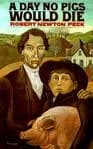
Robert Newton Peck (1972)
Genre
Children's / Historical Fiction / Young Adult
Reading Time
160 min
Key Themes
See below
Sign in to track this book
A thirteen-year-old boy in rural Vermont forms a deep bond with a pig, navigating farm life and Shaker traditions, which leads to a heartbreaking act of sacrifice and his passage into adulthood.
Thirteen-year-old Robert Peck walks home from school and finds Apron, a neighbor's cow, struggling to give birth. Despite his fear, Robert helps, pulling the calf free. He hurts his hand during the delivery. The cow's owner, Mr. Tanner, a kind Baptist farmer, is very thankful for Robert's help. To show thanks, Mr. Tanner offers Robert a small, weak piglet. Robert's Shaker father, Haven Peck, first refuses the gift, believing it is not the Shaker way to accept payment for helping a neighbor. But after some convincing and seeing Robert's fondness for the piglet, he agrees, letting Robert keep the animal, which he names Pinky.
Robert quickly grows close to Pinky, the small pig. He cares for her, feeding her milk from a bottle and making sure she thrives. Pinky becomes more than a farm animal; she is Robert's friend and a source of happiness. He spends many hours with her, watching her grow and developing deep affection. This responsibility teaches Robert about nurturing and the farm's life cycle. His father, Haven, sees Robert's dedication with quiet approval, but he also understands the farm's harsh realities about livestock, which Robert has yet to fully grasp.
Robert's father, Haven Peck, is a key person in his upbringing, teaching him about farm life and the Shaker Way. Haven, though unable to read, has great knowledge about the land, animals, and hard work. He teaches Robert how to make maple syrup, butcher a hog, and do other farm tasks. These lessons are about more than physical labor; they teach discipline, self-reliance, and respect for nature's cycles. Haven teaches Robert Shaker values of simplicity, honesty, and hard work, often saying that 'frills' are not needed and a man's worth is in his actions, not his possessions or words.
Robert goes to the local school, where he struggles with grammar but does well in other subjects. He experiences different social situations, including teasing from other boys and the strict guidance of his teacher, Miss Kelly. His Shaker upbringing often sets him apart from his peers, especially in their understanding of 'sin' and 'frills.' He learns about different religious practices, like the Baptists, through his interactions with Mr. Tanner and others. These experiences broaden his view beyond the strict Shaker doctrine he grew up with, helping him understand the diversity of beliefs and customs in the wider world.
One memorable event for Robert is his trip to the Rutland Fair with his father. It is a burst of sensory experiences, a strong contrast to his quiet farm life. Robert is fascinated by the fair's sights, sounds, and smells—the rides, games, food, and crowds. He sees things he never imagined, like a woman with a tattoo. This experience opens Robert's eyes, showing him a world beyond his Shaker community and expanding his understanding of human nature and entertainment. His father, though seemingly quiet, allows Robert to experience this 'frill' of life.
As Pinky grows, she becomes a large sow. Her heritage and Robert's care make her an exceptional animal. Haven Peck sees Pinky's potential and decides she will be bred to produce more pigs, ensuring the farm's future. Robert, proud of Pinky, starts to understand the reality of raising farm animals. He knows that Pinky, despite being his pet, has a practical purpose on the farm. This realization hints at the difficult decisions to come, as the line between pet and livestock blurs for Robert.
The time comes for Pinky to be bred. Haven Peck explains to Robert that Pinky is now a grown sow and must fulfill her purpose by having piglets. This talk is hard for Robert, as it makes him face Pinky's dual nature—his loved pet and a valuable farm asset. He struggles with the idea of Pinky being used for breeding, understanding it is a necessary part of farm life but conflicting with his emotional bond. Haven gently but firmly guides Robert to accept this reality, teaching him about the responsibilities and harsh truths of farming.
As seasons pass, Haven Peck, a strong and resilient man, starts to show signs of illness. His health declines, and he can no longer do all the strenuous farm work. Robert, now more mature, takes on a greater share of the work. He diligently cares for the farm, tending to animals and doing tasks his father can no longer manage. This period tests Robert's new maturity and his ability to carry the farm's burdens, showing his growing competence and dedication to his family and their way of life.
One day, Haven Peck, weakened by illness, calls Robert to his side. He shares a painful secret and makes a request. He tells Robert that Pinky, his beloved sow, must be slaughtered. Haven explains that Pinky is now 'barren' and can no longer produce piglets, making her an economic burden on the struggling farm. He gives Robert the difficult duty of doing the slaughter himself, stressing that it is a man's job and a necessary sacrifice for the family's survival. This moment is the ultimate test of Robert's transition to manhood and his understanding of farm life's harsh realities.
With a heavy heart and great inner struggle, Robert prepares to fulfill his father's request. He takes Pinky, his cherished pet, to the slaughterhouse. The act is agonizing, a deep personal sacrifice that marks the end of his innocence and his full acceptance of adult responsibilities. He performs the task with the quiet strength and resolve he learned from his father, understanding the act's necessity for his family's survival. This moment is the peak of Robert's journey, forcing him to confront the brutal cycle of life and death on the farm.
Shortly after Pinky's sacrifice, Haven Peck dies from his illness. His death leaves a deep emptiness in Robert's life and in the family. Robert, now truly the man of the house, must take on the farm's responsibilities and care for his mother. He thinks about his father's life, his quiet strength, his wisdom, and the values he taught. Robert knows his father's legacy is not just the land but the lessons of hard work, honesty, and self-reliance he passed on. Robert is now ready to continue the Shaker Way and the family farm, having fully embraced his role as an adult.
The Protagonist
Robert transforms from a boy into a man, learning to accept the difficult truths of life and death, and taking on the responsibilities of his family and farm.
The Supporting/Mentor
Haven guides Robert through the transition from boyhood to manhood, culminating in his final, painful lesson.
The Supporting
Lucy remains a consistent source of comfort and stability for Robert, supporting his growth.
The Supporting/Symbolic
Pinky grows from a helpless piglet into a magnificent sow, ultimately fulfilling her purpose in the farm's economy, leading to her sacrifice.
The Supporting
Mr. Tanner serves as a catalyst for Robert's journey, introducing Pinky into his life.
The Mentioned/Supporting
Miss Kelly provides academic guidance that complements Robert's farm education.
This theme is central to Robert's journey. His thirteenth year includes experiences that make him leave innocence behind and take on adult responsibilities. From helping Apron's calf be born to Pinky's sacrifice, each event pushes Robert to face life's harsh realities. His father, Haven, guides him, teaching him skills and wisdom about the Shaker Way and farm demands. The story ends with Robert accepting his adult role, especially after his father's death, as he takes on responsibility for his family and the farm.
“A day no pigs would die. That was how I knew. And it was a day I would never forget.”
The novel clearly shows the farm's life and death cycle, which is always present in Robert's development. He sees birth (Apron's calf, Pinky's own birth) and is involved in death (the hog's slaughter, and later, Pinky's). These events are not presented as tragedies but as necessary parts of farm life. Robert learns that death is often needed for life and survival, especially when livestock provides food. This theme challenges Robert's emotional attachments and makes him understand the practical, often brutal, balance of the natural world.
“A good farmer knows when to be cruel, for cruelty is sometimes kindness.”
The Shaker Way, with its focus on simplicity, honesty, hard work, and rejection of 'frills,' shapes the Peck family's life. Haven Peck constantly reinforces these values, teaching Robert to value what is essential over what is extra. The Shaker belief system provides a strong base for Robert's character, giving him a sense of duty and integrity. However, Robert also encounters other ways of life, like the Baptists and the Rutland Fair, which challenge his idea of 'frills' and broaden his perspective while keeping him grounded in his Shaker identity.
“We thank you, Brother Tanner, but it's not the Shaker Way to take frills for being neighborly. All that Robert done was what any farmer would do for another.”
The strong connection between Robert and Pinky shows love in the novel. Robert's devotion to his pet is pure. But this love is tied to loss and sacrifice. The story builds to the heartbreaking need to slaughter Pinky, a decision driven by economic survival and farm life's harsh realities. Robert's act of sacrificing Pinky is the ultimate example of this theme, showing that true love can sometimes mean deep personal pain and loss, especially when combined with duty and family survival. It is a sacrifice that confirms his passage into manhood.
“I had to do it. I had to do it for Papa. I had to do it for Ma. I had to do it for myself.”
The story follows Robert's psychological and moral growth from boyhood to manhood.
This device is the overarching structure of the novel. The entire plot is framed around Robert Peck's thirteenth year, a pivotal period of transition. Each event, from helping Apron calve to the ultimate sacrifice of Pinky, serves as a milestone in Robert's development. The narrative focuses on his internal struggles, his learning experiences, and his gradual acceptance of adult responsibilities and the harsh realities of life. His interactions with his father, the farm's demands, and his personal bond with Pinky are all vehicles for his transformation.
Pinky represents Robert's innocence, the interconnectedness of life and death, and the necessities of farm life.
Pinky is more than just a pig; she is a powerful symbol. Initially, she symbolizes Robert's youthful innocence, his capacity for nurturing love, and the simple joys of childhood. As she grows, she comes to represent the blurring line between pet and livestock, forcing Robert to confront the practical, often brutal, realities of farm economics. Her eventual sacrifice symbolizes the death of Robert's childhood innocence and his full acceptance of the adult world's responsibilities, particularly the difficult decisions inherent in sustaining life on a farm.
Subtle hints and discussions prepare the reader for future difficult events.
Foreshadowing is used throughout the novel, particularly in Haven Peck's pragmatic discussions about farm animals. From the moment Pinky is introduced, Haven's comments about her purpose and the cycle of life on the farm subtly hint at her eventual fate. For example, when Haven insists Pinky be bred, it signals that her value is tied to her utility. These early remarks, though seemingly casual, prepare both Robert and the reader for the inevitable, difficult decisions that must be made, making the climactic sacrifice both painful and understandable within the context of farm life.
The Vermont farm setting grounds the story in nature's cycles and rural life.
The rural Vermont farm serves as more than just a backdrop; it is an active character in Robert's development. The seasonal changes, the demands of tending to animals and crops, and the isolation of the setting all contribute to Robert's education and understanding of life. The pastoral setting emphasizes the themes of simplicity, hard work, and the interconnectedness of human life with nature's rhythms. It highlights the contrast between the natural world's unvarnished truths and the 'frills' of modern society, reinforcing the Shaker values of the Peck family.
“A man ain't whole 'til he has a son.”
— Pa's traditional view on family and legacy.
“There's a time for everything, and a season for every activity under heaven.”
— Pa reflecting on the cyclical nature of life and farming.
“I learned that day that a man can cry inside, even if he don't show it.”
— Haven's internal reflection on his father's stoicism.
“A day no pigs would die.”
— The title phrase, representing a day free from the harsh realities of farm life.
“Some things a boy just has to do, whether he wants to or not.”
— Pa explaining the necessity of difficult tasks on the farm.
“It was the first time I ever saw my father cry, and it was a terrible thing to see.”
— Haven witnessing Pa's emotional breakdown.
“You got to make your own way in this world, boy.”
— Pa's advice to Haven about independence.
“There's good in everything, even a pig's blood.”
— Pa finding value and purpose in all aspects of farm life, even the grim ones.
“The hardest part of living is saying good-bye.”
— Haven's realization about loss and farewells.
“A man's word is his bond.”
— Pa's strong belief in integrity and honesty.
“Death is just a part of life, son. We all got to face it.”
— Pa's stoic acceptance of mortality.
“You can't eat a hog unless you kill it.”
— A blunt statement about the practicalities of farm life and survival.
“Sometimes a boy has to be a man, even when he don't feel like it.”
— Haven's internal struggle with the responsibilities thrust upon him.
“There's a lot of things in this world that ain't fair, Haven.”
— Pa's realistic view on life's injustices.
Ready to see how well you understood this book? Take our interactive quiz with 10 questions.
Dan Gemeinhart
4.5
Kate O'Hearn
4.4

Jeanne Birdsall
4.4

Jen Wang
4.4
Wendelin Van Draanen
4.3

John Marsden
4.3

Chris Van Allsburg
4.3
Jennifer A. Nielsen
4.2