“In a room where people unanimously maintain a conspiracy of silence, one word of truth sounds like a pistol shot.”
— Reflecting on the power of truth in a corrupt society.

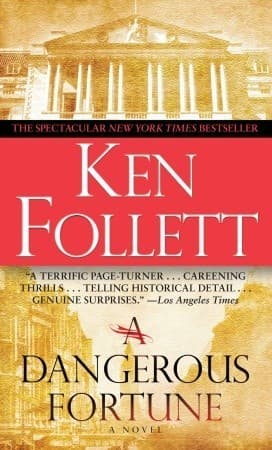
Ken Follett (1993)
Genre
Thriller / Historical Fiction / Mystery / Romance
Reading Time
12-15 hours
Key Themes
See below
Sign in to track this book
In the lavish but dangerous world of 1860s England, a schoolboy's drowning starts a thirty-year story of forbidden loves, ambition, and a family's secrets that threaten to destroy a nation.
In 1866, at the Windfield School, a student named Hugh Pilaster drowns. The incident happens during a forbidden late-night swim with Micky Miranda, Edward Pilaster (Hugh's cousin), Peter Middleton, and Hugh's younger brother, Billy Pilaster. Though called an accident, Billy and Peter suspect Micky Miranda pushed Hugh. Micky's powerful father, Samuel Miranda, covers it up with the headmaster and Edward's father, Joseph Pilaster, to protect his son and the school's name. Billy is sent to a boarding school in Scotland, Peter is silenced, and Edward prepares for a future in the Pilaster family bank.
Twenty years later, in 1886, Billy Pilaster returns to London, having made his fortune in America. He wants to prove he can run the Pilaster bank, despite being an outsider, and find the truth about his brother Hugh's death. Edward Pilaster, now a senior partner in the bank, is married to Augusta, a manipulative woman who is Samuel Miranda's daughter. Peter Middleton, a bank clerk, is still affected by the Windfield incident and remains loyal to Billy. Micky Miranda, a financier, has great power and wealth, often clashing with Billy and the Pilaster bank.
Billy quickly becomes a shrewd financier, earning the respect of senior partners at Pilaster bank, which annoys Edward. Edward, relying more on his father-in-law Samuel Miranda and his wife Augusta, starts making bad financial decisions, often driven by greed and a desire to beat Billy. The rivalry between Billy and Edward grows, reflecting the unspoken tensions from Windfield. Billy finds an ally in Maisie Robinson, a spirited and intelligent woman from a less privileged background, who becomes his secretary and love interest. Their relationship is complicated by class differences and the power struggle within the bank.
The Baring Crisis, caused by Argentina's inability to pay debts, shakes the global financial market. Pilaster bank, with heavy investments in Argentine bonds due to Edward's aggressive strategies, is in trouble. Samuel Miranda, seeing a chance, subtly pushes Edward into more risky ventures, aiming to destabilize the bank and possibly take control. Billy, seeing the crisis, tries to warn the other partners, but Edward, blinded by arrogance and his wife's influence, ignores him. The bank faces ruin, and partners question Edward's leadership and his involvement with Samuel Miranda.
Maisie, working for Billy, finds old letters and documents about the Windfield School. Her intelligence leads her to question the official story of Hugh Pilaster's death. She finds evidence of a cover-up, a letter from the headmaster to Joseph Pilaster hinting at Micky Miranda's direct involvement. Realizing what she found, Maisie tells Billy, renewing his desire to find the full truth. Their investigation starts to threaten the powerful people who covered up the original incident, especially Samuel Miranda and Micky.
As the Pilaster bank nears collapse, Samuel Miranda shows his true intentions. He blackmails Edward with evidence of his financial mismanagement and possibly illegal dealings related to the Argentine investments. Samuel offers to 'save' the bank, but only if Edward agrees to his terms, which include giving Samuel a controlling interest and removing Billy. Edward, desperate to avoid public disgrace and financial ruin, has to agree, solidifying Samuel's power. Augusta, aware of her father's plans, quietly encourages Edward's downfall to benefit her family's wealth and status.
Billy, with Maisie and Peter Middleton, investigates Hugh's death more deeply, believing it holds the key to Samuel Miranda's long-term plans. They discover that Samuel Miranda had a financial reason for Hugh Pilaster's death, as Hugh was to inherit a large part of the bank, and his death allowed Edward (Samuel's son-in-law) to gain power. Billy also works to get support from other bankers and the Bank of England to stop Samuel Miranda from taking over Pilaster bank. He believes that only by exposing the historical crime can he stop Samuel's current power grab.
Billy, with Maisie's findings and Peter's memories, confronts Micky Miranda. Under pressure and the threat of public exposure, Micky confesses the truth about Hugh's death: he pushed Hugh into the water, knowing Hugh couldn't swim well, and held him under. This was not an accident but a malicious act. Micky's confession involves Samuel Miranda in the cover-up, showing their depravity. This confession gives Billy the leverage he needs to get justice for Hugh and challenge Samuel Miranda's control over the bank.
With Micky's confession, Billy presents the evidence to the other Pilaster partners and the authorities. The scandal shocks London's financial and social elite. Samuel Miranda's reputation is ruined, and his attempts to take over Pilaster bank are stopped. Edward Pilaster, involved in the cover-up and his own financial misdeeds, faces ruin. Augusta, her schemes exposed, loses her standing. The Miranda family's empire starts to crumble. Justice for Hugh Pilaster, though long delayed, is finally served, and the Pilaster bank's integrity is restored after great turmoil.
Afterward, Billy Pilaster becomes the leader of Pilaster bank. His integrity, courage, and financial skill are recognized, and he rebuilds the bank's reputation and stability. Edward is forced out, and the Mirandas are disgraced. Billy, having achieved justice for his brother and control of the bank, is free to pursue his happiness. He marries Maisie Robinson, who proved to be an invaluable partner in his professional and personal life. Together, they look to a future where the Pilaster bank is run with honesty and foresight, free from the past's shadows.
The Protagonist
From a grieving, marginalized boy, Billy transforms into a powerful and respected financier who exposes corruption and reclaims his family's legacy, finding love and justice along the way.
The Antagonist/Major Supporting
Edward's arc is one of gradual downfall, as his ambition and poor judgment lead him from a position of power to disgrace and ruin, his family legacy destroyed by his own actions and the manipulations of others.
The Antagonist
Samuel's arc sees him rise to immense power through manipulation and deceit, only to be ultimately exposed and defeated by Billy Pilaster, losing his fortune and reputation.
The Supporting/Love Interest
Maisie evolves from a capable secretary into an indispensable partner, both professionally and personally, to Billy, finding love and a significant role in exposing the truth.
The Antagonist
Micky's arc is one of unpunished villainy, until his past finally catches up to him, leading to his exposure and the downfall of his family.
The Supporting Antagonist
Augusta's arc sees her successfully manipulating her husband and benefiting from her father's schemes, only to face public disgrace when their plots are exposed.
The Supporting
Peter overcomes years of fear and silence to finally reveal the truth, finding a measure of peace and redemption by aiding Billy's quest for justice.
The Mentioned/Catalyst
Hugh's arc is tragically cut short, but his memory and the injustice of his death serve as a powerful catalyst for the entire story, leading to the eventual exposure of deep-seated corruption.
The Supporting
Joseph Pilaster's arc is one of complicity and the slow unraveling of the consequences of his initial moral compromise, as the truth he helped bury eventually resurfaces.
The main theme is Billy Pilaster's search for justice for his brother Hugh's murder, which powerful people covered up. This theme shows in Billy's drive to expose the truth, even decades later, and hold those responsible accountable. It shows that truth, no matter how hidden, will come out, and that the consequences of one's actions, especially a grave injustice, cannot be avoided. The downfall of the Mirandas and Edward shows justice winning.
““The truth was a slippery thing, but it had a way of surfacing when you least expected it.””
The novel shows how greed harms the high-stakes world of London finance and upper society. Samuel Miranda and his children, Micky and Augusta, want wealth and power, leading them to murder, financial manipulation, and blackmail. Edward Pilaster's own greed and ambition make him vulnerable to their plans, putting the Pilaster bank at risk. The story shows how unchecked greed can corrupt individuals and institutions, leading to moral decay and ruin.
““Money was power, and power was the ultimate aphrodisiac for men like Samuel Miranda.””
The story looks at Victorian England's strict class structures and the difficulties of social mobility. Billy Pilaster, despite his family name, starts as an outsider after being sent away. He has to build his own fortune to gain respect among the financial elite. Maisie Robinson, from a working-class background, shows intelligence and skill beyond her social standing, proving her worth in a world run by privileged men. Their relationship shows the societal barriers they face, but also how individuals can rise above their birthright through merit.
““In London, birth and breeding were everything, but a sharp mind and a determined spirit could carve out a path, however difficult.””
The Pilaster family shows loyalty and betrayal. Billy's devotion to his deceased brother Hugh drives his quest. In contrast, Edward's betrayal of his family's values, his part in the cover-up, and his susceptibility to his in-laws' manipulations show a lack of loyalty. The Miranda family, united in their schemes, has a darker, more opportunistic loyalty based on self-preservation and shared secrets. The theme examines family dynamics, where love and duty can clash with ambition and deceit.
““A family could be a fortress or a prison, depending on the secrets it kept.””
The past, specifically the Windfield tragedy, affects the lives of all characters, shaping their decisions and destinies for decades. Billy is troubled by his brother's death, driving his search for truth. Peter Middleton carries the weight of his silenced testimony. Edward and the Mirandas constantly fear exposure. The novel shows how unresolved historical events and unaddressed injustices can influence the present, creating a sense of inescapable destiny until the truth is confronted.
““The past was never truly buried; it merely waited for the right moment to claw its way back to the surface.””
The central enigma that drives the entire narrative.
The mysterious drowning of Hugh Pilaster at Windfield School serves as the inciting incident and the core mystery that propels the plot. Initially dismissed as an accident, the lingering suspicion of foul play and the subsequent cover-up create a long-term quest for truth. This device establishes the central conflict and motivates Billy Pilaster's actions throughout the novel, providing a constant undercurrent of tension and intrigue as the reader, along with Billy, seeks to uncover the decades-old secret.
The contrasting paths of Billy and Edward Pilaster highlight themes of integrity versus corruption.
The narrative frequently juxtaposes the parallel yet fundamentally opposing journeys of Billy and Edward Pilaster. Both are members of the same family and aspirants to leadership in the Pilaster bank, but their methods, motivations, and moral compasses diverge sharply. Billy's path is one of hard work, integrity, and a quest for justice, while Edward's is marked by arrogance, greed, and susceptibility to manipulation. This device allows for a clear exploration of good versus evil within a single family and institution, culminating in a dramatic clash for control and moral authority.
A real-world financial crisis that mirrors and amplifies the fictional plot's stakes.
Ken Follett expertly weaves in the real-life Baring Crisis of 1890, a significant financial panic triggered by Argentina's debt default. This historical event serves as more than just background; it becomes an integral plot device. It provides a credible external pressure that exacerbates the internal conflicts within the Pilaster bank, exposing Edward's poor judgment and creating opportunities for Samuel Miranda's manipulative schemes. By rooting the fictional plot in a real historical crisis, Follett adds realism, gravitas, and higher stakes to the narrative, demonstrating how individual greed can have national and international repercussions.
A character who holds crucial, suppressed information from the past.
Peter Middleton functions as the reluctant witness and eventual informant. Present at the Windfield drowning, he carries the burden of suppressed truth and fear. His character embodies the long-term psychological impact of a cover-up. As the narrative progresses, his gradual recollection and willingness to share his testimony become a critical turning point for Billy's investigation. This device is essential for slowly unraveling the central mystery, providing the missing pieces of the puzzle that ultimately expose Micky Miranda's crime and Samuel Miranda's conspiracy.
A seemingly innocent setting where innocence is lost and corruption begins.
Windfield School, an exclusive institution for the sons of the elite, is a symbolic setting. It represents a place where innocence should be nurtured but instead becomes the site of a brutal murder and a subsequent cover-up orchestrated by the very pillars of society. The 'dangerous fortune' itself begins here, not just in terms of money, but in the moral compromises made. The school's initial portrayal as a place of privilege contrasts sharply with the dark events that unfold, highlighting the corruption that can exist even within the most esteemed institutions.
“In a room where people unanimously maintain a conspiracy of silence, one word of truth sounds like a pistol shot.”
— Reflecting on the power of truth in a corrupt society.
“The only thing more dangerous than a secret is the person who knows it.”
— A character musing on the risks of hidden knowledge.
“Wealth is not about having money, but about having power over those who do not.”
— A banker discussing the true nature of wealth.
“In the world of finance, there are no friends, only allies of convenience.”
— A lesson learned in the cutthroat banking industry.
“Love is the most dangerous gamble of all, for it stakes not just money, but the heart.”
— A romantic subplot highlighting emotional risks.
“The past is a ghost that haunts the present, and only the brave can lay it to rest.”
— Reflecting on how historical events shape current conflicts.
“A man's character is not judged by his successes, but by how he handles his failures.”
— A moral insight during a personal downfall.
“In the pursuit of fortune, many lose their souls and call it business.”
— Critiquing the moral compromises in banking.
“Fear is a weapon sharper than any sword, and it requires no steel to wield.”
— Describing how intimidation is used in power struggles.
“The river of time flows only forward, but its currents are shaped by the stones of our choices.”
— Philosophizing on fate and free will.
“A family's legacy is built not on gold, but on the integrity of its name.”
— A debate about values in a wealthy dynasty.
“In the shadows of great houses, the whispers of scandal are louder than the shouts of triumph.”
— Highlighting the hidden scandals in high society.
“To trust is to give another the power to destroy you, and that is the essence of love.”
— A romantic reflection on vulnerability.
“The world is a chessboard, and those who do not play are merely pawns.”
— A strategic view of social and financial maneuvering.
Ready to see how well you understood this book? Take our interactive quiz with 10 questions.

Kenneth Martin Follett, is a British author of thrillers and historical novels who has sold more than 160 million copies of his works.







