“There are no good or evil people. Only people who make good or evil choices.”
— Agatha's realization about the nature of humanity, echoing a core theme of the series.

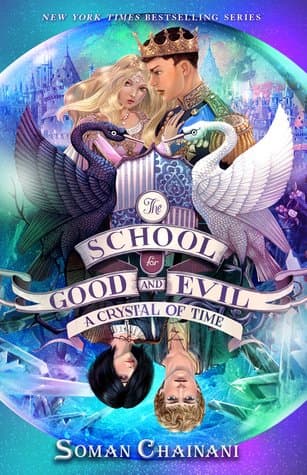
Soman Chainani (2019)
Genre
Fantasy / Children's / Young Adult / Romance
Reading Time
1200 min
Key Themes
See below
Sign in to track this book
With Camelot corrupted by a false king and Tedros facing execution, Agatha must rally her friends to rewrite their twisted fairy tale before their happily ever afters are violently erased.
The story opens with the forced coronation of Rhian as the new King of Camelot, orchestrated by the School Master. Tedros, the rightful heir, is framed for the murder of his father, King Arthur, and is captured and imprisoned, awaiting execution. Sophie, under the School Master's influence and bound by a magical curse, is forced into marriage with Rhian and crowned his Queen. Agatha, witnessing the entire spectacle, manages to escape the castle with the help of Hort and Professor Dovey, realizing their dire situation. The School for Good and Evil, once a beacon of balance, is now under the School Master's complete control, with many students and faculty manipulated or imprisoned. Agatha knows she must find a way to save Tedros and Camelot from this tyrannical new regime.
After witnessing Tedros's capture and Sophie's forced marriage, Agatha, Hort, and Professor Dovey flee Camelot. They are pursued by the School Master's forces, including the 'Lieutenants' – corrupted former students and faculty. Their escape is harrowing, but they eventually find refuge with the Coven of Witches in the Whispering Woods, led by Lady Lesso. Though initially wary of Agatha and her companions due to their past association with the School for Good, Lady Lesso agrees to help, recognizing the greater threat posed by the School Master's twisted vision. This alliance marks a turning point, as Agatha begins to gather allies against the School Master's seemingly insurmountable power.
Believing that the wizard Merlin is the only one powerful enough to counter the School Master's magic and expose Rhian's deception, Agatha, Hort, and a group of witches embark on a perilous journey. They navigate treacherous landscapes and evade the School Master's relentless pursuers, facing various magical traps and moral dilemmas. Their quest leads them through ancient ruins and forgotten pathways, gathering clues about Merlin's whereabouts. Along the way, Agatha grapples with her responsibilities, her fear for Tedros, and her complex feelings for Sophie, who appears to be an unwilling participant in the School Master's scheme. The search for Merlin becomes a race against time as Tedros's execution draws nearer.
Meanwhile, in Camelot, Sophie is forced to play the role of Rhian's queen, her every move monitored by the School Master and his loyalists. She is tormented by her forced loyalty and the knowledge that Tedros is imprisoned, but a powerful curse prevents her from directly defying the School Master. She subtly tries to find ways to communicate with the outside world and gather information, using her position to observe Rhian and the School Master's plans. Despite her outward compliance, Sophie secretly plots to undermine them, driven by her affection for Tedros and a lingering sense of duty to her friends. Her internal struggle is intense, torn between self-preservation and the desire to do what is right, even if it means risking her own life.
Tedros is put on a public trial, a thinly veiled farce designed to solidify Rhian's claim to the throne. The School Master manipulates evidence and witnesses, painting Tedros as a villain and a traitor. News of the impending execution reaches Agatha and her allies, forcing them to accelerate their plans. Knowing they cannot wait for Merlin, Agatha, Hort, and the witches launch a desperate infiltration of Camelot. Their goal is not just to free Tedros, but also to expose Rhian's lies to the public. The rescue mission is fraught with danger, leading to intense confrontations with the School Master's Lieutenants and revealing the true extent of his power and influence over Camelot.
Amidst the chaos of the rescue attempt, Agatha finally locates Merlin, who has been hidden away, weakened but still powerful. Merlin reveals the shocking truth: the School Master is not just a villain, but a being who has manipulated time and destiny across countless fairy tales. He explains that the School Master is attempting to rewrite the very fabric of their world, turning Good into Evil and Evil into Good, and that Rhian is merely a pawn. Merlin reveals the 'Crystal of Time,' a powerful artifact that allows the School Master to alter past events, which is the source of his immense power. He emphasizes that to defeat him, they must not just fight him in the present, but also correct the past.
With Merlin's guidance, Agatha, Sophie (who manages to break free from the School Master's direct control with a surge of her own magic), and a newly freed Tedros embark on a perilous journey through time using the Crystal of Time. They must revisit moments in their own past and the history of the School for Good and Evil, identifying and undoing the School Master's alterations. This involves facing past versions of themselves and their friends, reliving painful memories, and understanding how subtle changes in key events led to the current distorted reality. They learn that the School Master has been tampering with their destinies for generations, subtly shifting the balance between Good and Evil to his own advantage.
As they go deeper into the past, Agatha, Sophie, and Tedros uncover the School Master's true origin. They learn that he was once a student himself, deeply wronged and abandoned, leading to his desire to control and rewrite stories. They discover that the School Master's power stems from a single, original lie he told himself and others, a lie that grew and corrupted over time, enabling him to manipulate the fabric of reality. This revelation is crucial, as it provides them with the understanding needed to truly dismantle his power. They realize that simply defeating him in a physical battle won't suffice; they must undo the foundational lie that sustains his existence.
The climax of the story has Agatha, Sophie, and Tedros confront the School Master in a multi-layered battle that spans across different timelines and realities. The School Master unleashes his full power, manifesting as distorted versions of their deepest fears and past failures. The fight is not just physical, but also a battle of wills and truths. The trio must use their combined strengths, their understanding of the School Master's vulnerabilities, and their unwavering belief in their own stories to counter his manipulations. Each character faces their personal demons, and their bonds of friendship and love are tested as they fight to restore their true destinies and prevent the complete unraveling of their world.
Through their combined efforts, Agatha, Sophie, and Tedros finally expose the School Master's original lie and break his hold over the Crystal of Time, weakening him significantly. Rhian's deception is revealed to all of Camelot, and he is stripped of his false power. With the School Master defeated and the timeline largely corrected, balance is restored to the School for Good and Evil and the wider fairytale world. Tedros is reinstated as the rightful King of Camelot, and the students and faculty return to their proper places. The experience leaves all three protagonists changed, with a deeper understanding of their own identities, the nature of good and evil, and the power of choice in shaping one's own destiny.
The Protagonist
Agatha evolves from a hesitant hero to a confident leader, fully embracing her power and her role in shaping destiny, understanding that true Good requires active participation.
The Protagonist
Sophie learns to embrace her unique duality, using her power for good while accepting her flaws, ultimately finding strength in her authentic self rather than a prescribed fairytale role.
The Protagonist
Tedros matures from a sometimes arrogant prince into a wise and selfless king, understanding that true leadership requires vulnerability, trust, and a willingness to fight for justice beyond personal glory.
The Antagonist
The School Master is revealed to be a tragic figure, a victim of his own past who became a villain, his arc focused on the exposure and undoing of his pervasive manipulation rather than personal growth.
The Supporting
Rhian's arc is one of tragic downfall, rising to false power only to be exposed as a puppet and lose everything, serving as a cautionary tale.
The Supporting
Hort grows in courage and self-worth, moving beyond his unrequited crush to become a genuinely dependable and heroic ally.
The Supporting
Professor Dovey demonstrates unwavering commitment to Good, providing steadfast guidance and support to the heroes throughout the conflict.
The Supporting
Lady Lesso, despite her alignment with Evil, proves to be a key force for balance, demonstrating that even 'Evil' can fight for a greater good when faced with existential threats.
The Supporting
Merlin's arc is one of revelation, guiding the protagonists to understand the true nature of their enemy and empowering them to correct the timeline.
This theme is central to the entire series, but in 'A Crystal of Time,' it reaches its peak. The School Master's manipulation of time and destiny blurs the lines between Good and Evil, forcing characters to question what truly defines them. Sophie's struggle with her inner darkness and her desire to do good, Agatha's 'evil' appearance masking her good heart, and even Lady Lesso's alliance with Good, all highlight that Good and Evil are not absolute, but rather choices and actions. The story argues that true Good involves active resistance to injustice, not passive acceptance of a label. The School Master's attempt to rewrite history to create 'perfect' Good and Evil ultimately shows the dangers of rigid definitions.
“Good and Evil aren't born. They're made. By choices. By stories. By the lies we tell ourselves and the truths we choose to believe.”
The novel explores how stories shape reality and destiny. The School Master's ability to manipulate the 'Crystal of Time' allows him to rewrite past events, thereby altering the present and future of all fairy tales. This highlights the idea that narratives are not just passive accounts, but active forces that define identities and outcomes. Agatha, Sophie, and Tedros must fight to reclaim their true stories, asserting their agency against the School Master's attempts to impose a twisted narrative. The theme emphasizes that while destiny might offer a path, individual choices and the truth of one's own story ultimately determine who a character becomes.
“Every story has a heart. If you can change the heart, you can change the story.”
The bonds of friendship and loyalty are tested throughout the book. Agatha's commitment to saving Tedros and Sophie, even when Sophie appears to be allied with the enemy, shows the strength of their connection. The betrayal by Rhian, once a friend to Tedros, highlights the devastating impact of deceit. The novel demonstrates that true loyalty requires sacrifice and belief in one another, even when circumstances seem to suggest otherwise. The ultimate victory against the School Master is achieved through the combined strength and trust of the protagonists, proving that these relationships are the most powerful weapon against manipulation and division.
“Some bonds are stronger than any curse, stronger than any lie. They're carved into your very soul.”
Each protagonist grapples with their identity. Tedros struggles to live up to the legacy of King Arthur while finding his own voice as a leader. Sophie battles her dual nature, constantly caught between her desire for beauty and her capacity for darkness, ultimately learning to accept all parts of herself. Agatha, who has always felt like an outsider, must fully embrace her role as a hero, regardless of external perceptions. The School Master's manipulations often target these insecurities, forcing the characters to confront who they truly are, independent of the stories assigned to them. The journey through time forces them to understand how past choices shaped their present identities.
“You are not just the story you were given. You are the story you choose to live.”
A powerful artifact that allows manipulation of past events and destinies.
The Crystal of Time is the central magical artifact that drives the plot. It is the source of the School Master's immense power, enabling him to travel through time and subtly alter pivotal moments in the history of the School for Good and Evil and the wider fairytale world. This device creates the urgency for Agatha, Sophie, and Tedros to journey into the past, as merely defeating the School Master in the present would not undo the damage already done. The Crystal represents the ultimate power over destiny, and its control is central to restoring balance and truth to their world.
The narrative technique of revisiting and altering past events to change the present.
Time travel is a crucial plot device, allowing the story to delve into the origins of the School Master's manipulations and the true history of the fairytale world. By revisiting past events, the protagonists gain critical information and the opportunity to undo the School Master's changes. This creates a complex narrative structure where the characters must understand the ripple effects of their actions in the past on their present reality. The concept of alternate timelines highlights the fragility of their world's history and the power of choice in shaping destiny.
Corrupted former students and faculty who enforce the School Master's twisted regime.
The Lieutenants are a plot device used to show the pervasive influence and corruption of the School Master's power. These are characters who were once familiar, often students or teachers from the School for Good and Evil, but have been twisted and empowered by the School Master to serve his will. They act as formidable antagonists for Agatha and her allies, forcing them to confront distorted versions of their peers and mentors. This device adds a layer of personal conflict and tragedy, demonstrating how easily individuals can be swayed by power and false promises.
A political and magical setup designed to legitimize Rhian's claim and control Sophie.
This plot device immediately establishes the stakes and the antagonist's power at the beginning of the novel. The forced coronation of Rhian as king and Sophie's coerced marriage to him serve multiple purposes: it frames Tedros, entrenches Rhian's false authority, and places Sophie under the School Master's direct magical control. This event ignites Agatha's quest for justice and freedom, creating a clear objective for the protagonists. It also highlights the theme of manipulation and the perversion of traditional fairytale tropes (a wedding becoming a symbol of oppression rather than love).
“There are no good or evil people. Only people who make good or evil choices.”
— Agatha's realization about the nature of humanity, echoing a core theme of the series.
“The greatest love isn't about finding the right person. It's about being the right person.”
— Agatha's evolving understanding of love, moving beyond fairy tale tropes.
“Sometimes the only way to save someone is to let them save themselves.”
— Agatha's struggle with protecting her friends versus empowering them.
“True strength isn't about never falling. It's about getting up every time you do.”
— A recurring lesson learned by the protagonists through their many trials.
“The past isn't a burden to carry, but a path to learn from.”
— The characters dealing with the consequences and lessons of previous books.
“Fairytales don't end with 'happily ever after.' They begin with it.”
— A meta-commentary on the nature of fairy tales and the ongoing challenges of life.
“To truly know someone, you must see them not just for who they are, but for who they could be.”
— Hester's observation about understanding and accepting others.
“Hope is a dangerous thing, but despair is a deadlier one.”
— The characters grappling with difficult situations and the choice between hope and giving up.
“Magic isn't about what you can do. It's about who you are.”
— A deeper understanding of the source and nature of magic in the world.
“Sometimes the greatest betrayals come from those who love you most.”
— The complex dynamics and conflicts within the main trio's relationships.
“The future isn't written in stone. It's written in every choice we make.”
— The characters realizing their agency and responsibility in shaping their destiny.
“Even the darkest night will end, and the sun will rise.”
— A message of perseverance and optimism during a particularly challenging time.
“Love isn't a spell you cast. It's a story you live.”
— Tedros's evolving perspective on love, moving past superficial ideas.
“The greatest battles are not fought with swords, but with hearts.”
— Highlighting the emotional and internal struggles faced by the characters.
Ready to see how well you understood this book? Take our interactive quiz with 10 questions.

Biography coming soon.







