“Don't feel bad for one moment about doing what brings you joy.”
— Rhysand to Feyre, encouraging her to embrace her own happiness and desires.

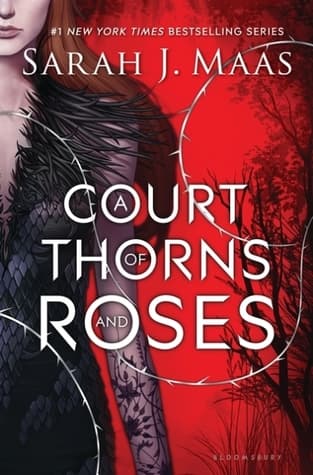
Sarah J. Maas (2015)
Genre
Fantasy / Young Adult / Romance
Reading Time
800 min
Key Themes
See below
Sign in to track this book
Hunted for killing a faerie, a human huntress is dragged into an enchanted, treacherous fae land where she must unravel ancient curses and forbidden desires to save her captor and herself.
Nineteen-year-old Feyre Archeron lives in a run-down cottage with her poor father and two selfish older sisters, Elaine and Nesta. As the family's only provider, Feyre hunts in the dangerous woods near the faerie lands. During a harsh winter, she finds a large wolf, which she knows is a faerie in animal form due to its unusual size and intelligence. Desperate for food, she ambushes and kills the wolf with an ash arrow. Weeks later, a monstrous, beast-like faerie named Tamlin, High Lord of the Spring Court, arrives at her cottage. He says the wolf Feyre killed was his friend, Andras, and demands her life as payment. He offers her a choice: die or come live with him in the faerie lands of Prythian.
Feyre chooses to go with Tamlin to the Spring Court, a beautiful, enchanted land that is very different from her previous hard life. She lives in a luxurious manor and can explore, but she cannot leave the grounds. She meets Tamlin's seneschal, Lucien, a sarcastic faerie with a metal eye, who is initially hostile to her. Despite the opulent surroundings, Feyre feels like a prisoner, always watched and reminded of her human mortality among the immortal Fae. She also notices a general tension and sadness in the court, especially from Tamlin, who often wears a jeweled mask and seems burdened by a secret.
Feyre starts to find clues about a mysterious problem affecting the faerie lands, a darkness that drains the Fae's magic and stops them from changing forms or leaving their courts. She learns that the High Lords are also affected, their powers lessened. As she spends more time with Tamlin, painting and reading, their initial dislike slowly turns into a friendship and then a strong attraction. Tamlin, initially distant, shows glimpses of his protective and gentle nature. Feyre also develops a complex relationship with Lucien, moving from antagonism to respect and even camaraderie as they face the growing threat together.
The truth about the problem is finally revealed: a wicked High Fae queen named Amarantha, from the Autumn Court, has cursed Prythian. She placed a geis (a magical oath/curse) on Tamlin and the other High Lords fifty years ago, demanding that if Tamlin did not find a human girl to declare her love for him, she would take over Prythian. The curse specifically requires a human, as humans are mortal and their love is considered more potent. Amarantha has imprisoned many Fae, including Tamlin's entire court, and has been slowly taking their power. The masks worn by the Spring Court Fae are part of this curse, binding them to her will and stopping them from revealing the truth.
As Amarantha's deadline nears, the curse tightens its hold. Tamlin, desperate to protect Feyre, reveals the full curse and confesses his love for her, urging her to leave the court to save herself. However, Feyre, who has fallen in love with him, refuses to abandon him. She realizes that her love for him could break the curse. Before she can act, Amarantha appears at the Spring Court and takes Tamlin and the other Fae captive, dragging them Under the Mountain, her stronghold. Feyre, heartbroken and determined, vows to follow them and save Tamlin and Prythian.
Feyre, guided by a cryptic message, goes to Amarantha's fortress Under the Mountain. She finds Tamlin and the other Fae imprisoned, their powers much less. Amarantha, enjoying her power, offers Feyre a deal: if she can complete three impossible tasks set by Amarantha within a month, Tamlin and the Spring Court will be freed. If she fails, both she and Tamlin will die. Feyre agrees, knowing the odds are against her. She encounters Rhysand, the High Lord of the Night Court, who is also Under the Mountain, seemingly allied with Amarantha. Rhysand, mysterious and cruel, offers Feyre a deal: he will help her with the trials if she spends one week a month with him.
For her first trial, Amarantha orders Feyre to kill a monstrous, worm-like creature called a 'wyrm' that guards a magical ring. Feyre, though scared, uses her human cleverness. Instead of fighting it directly, she realizes the wyrm is blind and hears well. She lures it into a trap, causing it to stab itself on a sharpened stalagmite. This act of calculated violence, though needed, deeply bothers her. Rhysand watches her during this trial, offering hints and making his presence known. Feyre starts to think his motives are more complex.
The second trial requires Feyre to solve a riddle: 'What is it that can be broken, yet held; given, yet taken; and is worthless, yet priceless?' She struggles with the answer, feeling the pressure of Tamlin's life. Rhysand, keeping his word, helps her, subtly guiding her to the answer by marking her arm with the first letter of each word. The answer is 'a promise'. Feyre solves the riddle, winning her second victory. However, Rhysand immediately demands his payment, forcing her to dance with him and endure the shame of being his 'whore' in front of the entire court, including a helpless Tamlin.
Amarantha's final trial is the cruelest: Feyre must choose between killing two innocent Fae, identical brothers, or killing Tamlin. Unable to harm an innocent, Feyre refuses to make the choice. Instead, she chooses to kill the two faerie brothers, believing it is the only way to save Tamlin and break the curse, even if it means sacrificing her own soul. Amarantha, amused by her defiance, allows her to kill the brothers. However, this act of murder, even under duress, breaks Feyre's spirit and seems to seal her fate.
After Feyre kills the innocent faerie brothers, Amarantha reveals that the final part of the curse required a human to kill two Fae, not just one. She then reveals that she had manipulated the rules and that the brothers were already dead, a cruel trick. She then snaps Feyre's neck, killing her. Tamlin, driven to madness and rage by Feyre's death, unleashes his full, unmasked power, killing Amarantha's guards. The other High Lords, who have been watching, combine their remaining magic and resurrect Feyre, giving her their faerie essence. She awakens as a High Fae, immortal and powerful. Tamlin, now free, battles and kills Amarantha, restoring peace to Prythian.
With Amarantha defeated and the curse broken, Feyre returns to the Spring Court with Tamlin, now a High Fae. The masks are gone, the problem lifted, and the court begins to heal. Tamlin, happy to have her back and free, gives her much love and attention. However, Feyre is deeply traumatized by her experiences Under the Mountain. The memories of the trials, the murders she committed, and the humiliation by Rhysand haunt her. Despite the love and luxury, she feels suffocated by Tamlin's overprotective nature and the lingering psychological scars, struggling to adapt to her new immortal life and the expectations placed upon her.
The Protagonist
She transforms from a struggling human huntress to a powerful High Fae, learning to fight for love and survival, but also enduring immense trauma that reshapes her identity.
The High Lord/Love Interest
Initially burdened by a curse and a dark secret, he finds love and freedom through Feyre, but his overprotective nature becomes a new challenge.
The Supporting
He moves from hostility towards Feyre to becoming her trusted, if sarcastic, friend and ally within the Spring Court.
The Antagonist/Supporting
Initially presented as an antagonist and manipulator, his true, complex motivations begin to surface, hinting at a deeper role in Prythian's fate.
The Antagonist
She exerts her tyrannical rule over Prythian through a curse, only to be defeated and killed by Tamlin and the High Lords.
The Supporting
Remains largely static, defined by her resentment and self-preservation, though her concern for Feyre is briefly glimpsed.
The Supporting
Remains largely static, serving as a contrast to Feyre's strength and Nesta's bitterness.
The Mentioned
Remains static, a passive figure of past wealth and current helplessness.
Sacrifice is important to Feyre's journey. She first sacrifices her own well-being to provide for her family. Later, she gives up her freedom and humanity by going with Tamlin to save her family. Her biggest sacrifice comes Under the Mountain, where she is willing to die and commit terrible acts to save Tamlin, driven by her love for him. This theme explores how far one will go for loved ones, and the often painful results of such choices. It shows how love can both empower and demand a high personal cost, changing the individual forever.
“I was not a pet, not a doll, not an animal. I was a survivor, and I was strong. I would not be broken.”
Feyre's identity changes a lot throughout the book. She starts as a human huntress, defined by her struggle to survive and her resentment of her family. In the faerie lands, she must confront how she sees herself and her species. Her experiences Under the Mountain, especially the trials, her death, and resurrection, change her physically and spiritually into a High Fae. This theme explores losing her old self, adapting to a new, powerful, yet traumatized identity, and whether her core 'Feyre-ness' can survive such changes.
“I was a weapon. And I was going to use it.”
This theme appears throughout the story, especially regarding the Fae and their world. Tamlin first appears as a terrifying beast but is a gentle, artistic soul burdened by a curse. Rhysand, presented as a cruel villain allied with Amarantha, hints at a more complex, strategic role, suggesting his actions are a carefully built facade. The beauty of the Spring Court itself hides a sadness and a deadly curse. This theme challenges Feyre, and the reader, to look past first impressions and understand the hidden truths and motivations beneath the glittering, often dangerous, exterior of Prythian.
“Don't feel bad for me. I'm not a victim. Not anymore.”
The book explores the psychological impact of trauma, especially through Feyre's experiences Under the Mountain. While the physical curse on Prythian is broken, the emotional and mental scars on Feyre, Tamlin, and Lucien are deep. Feyre deals with nightmares, flashbacks, and feeling broken by the horrors she endured and the acts she committed. Tamlin's response to the trauma is an increased, almost suffocating, protectiveness. The theme explores the long road to healing, suggesting that simply escaping a traumatic situation does not erase its effects, and that recovery requires more than just physical safety.
“My body was no longer just my own; it was a vessel for the magic of the High Lords, and a tomb for the girl I'd once been.”
Feyre's journey starts with her feeling bound by her family's needs, then literally captive in the Spring Court, and finally imprisoned Under the Mountain. Even after the curse is broken, she struggles with a different kind of captivity – that of her trauma and Tamlin's overprotective love. The theme explores different forms of freedom and imprisonment, both physical and psychological. It questions what true freedom means, whether it is just the absence of chains or the ability to make one's own choices and live authentically, even in danger.
“There are no easy paths in this war, no clear choices.”
A magical oath binding Tamlin and the High Lords to Amarantha's will.
The geis is the central conflict driver of the plot. It's a powerful, unbreakable magical oath imposed by Amarantha on Tamlin and the other High Lords fifty years prior. It dictates that if a human woman doesn't declare her love for Tamlin by a specific deadline, Amarantha will take over Prythian. This curse explains the masks, the draining of magic, and the overall blight on the land, forcing Feyre into a desperate quest to break it. It establishes the stakes and dictates the actions of many characters, particularly Tamlin and Feyre, who are bound by its terms.
A physical manifestation of Amarantha's curse, concealing and binding.
The jeweled masks worn by Tamlin and the other faeries of the Spring Court are a direct result of Amarantha's curse. They serve multiple functions: physically hiding the faces of the Fae, symbolizing their captivity and loss of identity, and magically preventing them from revealing the truth of the curse to outsiders like Feyre. The removal of the masks after the curse is broken is a powerful visual representation of their liberation and the return of their true selves. They are a constant reminder of the pervasive control Amarantha exerts.
A classic fairy tale motif of impossible tasks to achieve a goal.
The three trials Amarantha sets for Feyre Under the Mountain are a classic fairy tale plot device, reminiscent of ancient myths and legends where a hero must complete a series of impossible tasks to save a loved one. Each trial is designed to test Feyre's cunning, courage, and moral boundaries, escalating in difficulty and cruelty. They serve to build tension, reveal character, and ultimately lead to Feyre's transformation. This device provides a clear structure to the climax of the story and highlights Feyre's resilience in the face of overwhelming odds.
A seemingly innocuous weapon with significant magical implications.
The ash arrow Feyre uses to kill the faerie wolf at the beginning of the story is more than just a hunting tool; it's a specific magical weakness for faeries. Its use immediately establishes the supernatural elements of the world and sets in motion the entire plot, as it is the direct cause of Tamlin's arrival and Feyre's capture. This seemingly small detail carries immense weight, demonstrating the specific vulnerabilities of the Fae and highlighting Feyre's unwitting entry into a magical conflict far beyond her understanding.
Magic-bound agreements that carry immense power and consequences.
Bargains and oaths are fundamental to the magic system and plot of Prythian. Beyond Amarantha's geis, Rhysand's bargain with Feyre—to help her with the trials in exchange for one week a month with him—is a key example. These agreements are magically binding and cannot be broken without severe consequences, adding layers of complexity and constraint to character actions. They demonstrate the power dynamics within the faerie world and often serve as both solutions and new problems, creating intricate webs of obligation and manipulation that drive the narrative forward.
“Don't feel bad for one moment about doing what brings you joy.”
— Rhysand to Feyre, encouraging her to embrace her own happiness and desires.
“To the people who look at the stars and wish.”
— Rhysand's toast, symbolizing hope and dreams for a better future.
“I would have waited five hundred more years for you. A thousand years. And if this was all the time we were allowed to have... the wait was worth it.”
— Rhysand expressing his deep, timeless love for Feyre.
“You do not fear. You do not falter. You do not yield.”
— Feyre's inner mantra, reflecting her resilience and determination.
“I was not a pet, not a doll, not an animal. I was a survivor, and I was strong. I would not be weak, or helpless again. I would not, could not be broken. Tamed.”
— Feyre's declaration of her strength and independence after her trials Under the Mountain.
“I am broken and healing, but every piece of my heart belong to you.”
— Feyre to Rhysand, acknowledging her past pain while affirming her love.
“There are good days and hard days for me—even now. Don't let the hard days win.”
— Morrigan offering advice on perseverance through difficult times.
“I would have torn apart the world to get you back.”
— Rhysand expressing the lengths he would go to for Feyre.
“We need hope, or else we cannot endure.”
— Feyre reflecting on the importance of hope in dark times.
“You're exactly as you are supposed to be.”
— Rhysand reassuring Feyre about her identity and worth.
“I love you, and I will love you until I die, and if there is a life after that, I'll love you then.”
— Feyre's profound declaration of eternal love to Rhysand.
“The great joy and honour of my life has been to know you.”
— Rhysand expressing deep gratitude and love for Feyre.
“Only you can decide what breaks you.”
— Feyre's realization about personal agency in facing challenges.
“I am the rock against which the surf crashes.”
— Feyre asserting her unyielding strength and stability.
Ready to see how well you understood this book? Take our interactive quiz with 10 questions.

Biography coming soon.







