“He knew that there was a contract. A contract with God. And that if he lived up to his end, God would live up to His.”
— Mendel's belief after tragedy strikes his family, reflecting the title's core theme.

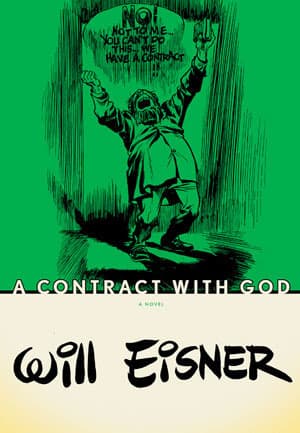
Will Eisner (1978)
Genre
Historical Fiction
Reading Time
180 min
Key Themes
See below
Sign in to track this book
In 1930s Dropsie Avenue, a rabbi's lost faith begins four stories that capture the Bronx's spirit in a graphic novel.
Frimme Hersh, a religious man on Dropsie Avenue, loses his faith when his adopted daughter, Rachel, dies suddenly from a fever. He had saved and raised Rachel, seeing her as a gift from God and a sign of his agreement with God. In his sadness and anger, Frimme scratches out his 'contract with God'—a stone tablet he made as a young man—on the tenement roof. He starts a cynical, materialistic life, becoming a harsh landlord who takes advantage of his tenants, leaving his spiritual path for money and bitterness.
Eddie, a young street singer with a good voice, lives in the same Dropsie Avenue building. He likes Marta, a rich woman who visits her grandmother there. Eddie is poor and has unfulfilled dreams, but he hopes to escape his situation with his music. He sings to Marta from the street, and for a short time, they have a secret romance. Marta, however, is just playing with him, using him as a temporary break from her rich life. She leaves him, going back to her world, leaving Eddie heartbroken and disappointed, his dreams of love and success again crushed by his surroundings.
Schmidt, the German superintendent of the Dropsie Avenue building, is a lonely, old man troubled by his hidden sexual desires and a past he wants to forget. He is especially interested in Rosie, a young dancer who often sunbathes on the roof. Schmidt secretly watches her, and his desires grow into a dangerous fantasy. He remembers his past in Germany, which suggests a darker history and adds to his inner struggle. His interest in Rosie leads to a disturbing act of watching and an attempt to get closer to her, showing his deep loneliness and the harmful nature of his unfulfilled wants.
This story follows four young, working-class Jewish women from the Bronx—Goldie, Becky, Daisy, and Florrie—who leave the city for a summer vacation at a 'cookalein' (a simple resort) in the Catskills. They are looking for romance and a temporary break from their normal lives. Each girl experiences a different part of summer love and disappointment: Goldie is seduced and left by an older man, Becky finds a brief romance with a musician, Daisy has a short, innocent flirtation, and Florrie watches it all with some doubt and longing. The summer ends with them going back to Dropsie Avenue, their romantic hopes mostly not met, but with shared memories of youthful hope and the mixed feelings of reality.
After their summer in the Catskills, Goldie, Becky, Daisy, and Florrie return to their lives on Dropsie Avenue. The short time of freedom and romance is over, and they must face their working-class lives. Their experiences leave them with memories and some sadness, but they mostly go back to their routines, perhaps a little wiser or more cynical about love and life. The 'cookalein' part shows how life on Dropsie Avenue often repeats, where dreams often meet reality, and escapes are temporary, always leading back to the daily struggles and hopes of the building's residents.
After years as a cynical, rich landlord, Frimme Hersh grows old and weak. Despite his money, he is still bothered by his past and the 'contract with God' he broke. He tries to find comfort or meaning in his last days, perhaps regretting leaving his faith. His death is a quiet, unclear end, not a moment of forgiveness. The original stone tablet, his 'contract,' is found among his things, leaving the reader to wonder if he ever truly made peace with his faith or if his life always showed a broken agreement. His story opens and closes the collection strongly, framing the bigger themes of faith, loss, and human struggle on Dropsie Avenue.
The Protagonist
Transforms from a man of deep faith to a cynical, wealthy landlord, haunted by his broken covenant.
The Supporting
Her brief life and sudden death serve as the primary catalyst for Frimme's transformation.
The Protagonist
Experiences a fleeting romance that ends in heartbreak, reinforcing his disillusionment with life.
The Supporting
Remains unchanged, serving as a catalyst for Eddie's temporary hope and ultimate heartbreak.
The Protagonist
His internal struggle with loneliness and desire intensifies but ultimately remains unresolved.
The Supporting
Remains largely oblivious to Schmidt's obsession, serving as a symbol of youthful vibrancy.
The Protagonist
Experiences a significant loss of innocence through a summer romance that ends in heartbreak.
The Supporting
Has a brief, less emotionally intense summer fling, returning to the city with a more practical outlook.
The Supporting
Observes and reflects on her friends' experiences, gaining a more cynical, yet insightful, view of romance.
The main theme, seen most clearly through Frimme Hersh, questions faith when tragedy happens. Frimme's 'contract with God' breaks when his adopted daughter dies, making him give up his religious devotion for cynicism and money. This theme looks at how people struggle to understand suffering and belief, and the deep sadness that can happen when core beliefs are broken. It suggests that faith is not always rewarded, and loss can change one's spiritual path permanently.
“A contract... A contract with God! There were witnesses! The Almighty and I! We signed it, with my blood! And my blood delivered! My soul! My very soul! To You! And You... You broke Your end of the contract!”
This theme is in all four stories, showing characters who hope for love, success, and escape, only to have those hopes ruined by the hard facts of their lives on Dropsie Avenue. Eddie dreams of fame and love but is left alone. The girls in 'Cookalein' look for romance that is short-lived and often disappointing. The building itself represents the limited chances that often stop these dreams, showing the difference between what people want and the often-harsh truth of daily life.
“The dream was over. He was still Eddie, the street singer, and the girl was gone.”
Many characters, especially Schmidt and Frimme Hersh, deal with deep loneliness. Schmidt's watching others comes from his inability to make real connections, making him observe from afar. Frimme, despite his money, lives alone, separated from his community and his old self after his tragedy. Even the shared experience of the 'cookalein' does not fully fix the loneliness each girl feels in her search for love, suggesting that connections can be brief and real closeness hard to find.
“His only contact with the world was through the peephole of his own loneliness.”
Dropsie Avenue is more than just a place; it is like a character, a small picture of city life in the Bronx in the early 1900s. The tenement building shows the crowded, connected, yet often isolating lives of its working-class residents. The stories together show common human struggles—love, loss, desire, faith, sadness, and the search for meaning—all happening within the specific social, economic, and cultural setting of this immigrant neighborhood. The city shapes and reflects the characters' lives.
“Dropsie Avenue... it was more than just a street. It was a world, an artery, a living thing that pulsed with the lives of its people.”
This theme is clearest in 'The Super' with Schmidt's troubled interest in Rosie, caused by his hidden desires and possibly a darker past. It looks at the hidden, often uncomfortable, parts of human sexuality, especially when it is not met or is twisted. In 'The Street Singer' and 'Cookalein', sexuality is shown more openly as a force in romantic pursuits, sometimes leading to joy, but often to exploitation, disappointment, and a loss of innocence, showing its complex and strong role in human relationships.
“He watched her... a hunger, a craving he couldn't name, growing inside him.”
A unifying setting that acts as a character and microcosm of urban life.
The tenement building on Dropsie Avenue is more than just a backdrop; it is a central unifying element across the stories. It represents the shared struggles and interconnected lives of the working-class immigrants in the Bronx. The building itself is a character, with its cramped apartments, communal spaces, and hidden corners where dreams and despair unfold. It symbolizes the confinement and opportunities (or lack thereof) faced by its inhabitants, acting as a microcosm for the larger urban experience and the human condition.
A narrative structure that connects disparate lives through a shared setting and themes.
Eisner employs a quartet of distinct, yet thematically linked, short stories. While each narrative focuses on different characters and plots, they are all set within or around Dropsie Avenue and explore common themes of faith, loss, desire, and disillusionment. This structure allows Eisner to present a multifaceted portrait of a community, showing how individual lives, though separate, contribute to a larger tapestry of human experience in a specific urban environment, creating a sense of collective narrative despite the episodic format.
A symbolic object representing faith, covenant, and its shattering.
The stone tablet, carved by Frimme Hersh, literally represents his covenant with God. Its physical existence and Frimme's act of scratching it out symbolize the breaking of his faith and his renunciation of the divine. It serves as a powerful visual and narrative metaphor for the fragility of belief and the profound impact of personal tragedy on spiritual conviction. The tablet's rediscovery at the end of Frimme's life underscores the lingering questions of faith and the unresolved nature of his despair.
Eisner's use of expressive visuals to convey emotion and deeper meaning.
Eisner's masterful artwork goes beyond merely illustrating the text; it functions as a primary plot device. He uses visual metaphors (e.g., the rain mirroring Frimme's tears, the oppressive shadows in Schmidt's apartment, the stark contrast between the tenement and Marta's world) and symbolic imagery (e.g., the rooftop as a place of both spiritual connection and despair, the street as a stage for unfulfilled dreams). The highly expressive faces and body language of his characters convey their inner turmoil and emotional states directly to the reader, enhancing the narrative's depth and impact.
“He knew that there was a contract. A contract with God. And that if he lived up to his end, God would live up to His.”
— Mendel's belief after tragedy strikes his family, reflecting the title's core theme.
“The rain came down, not in drops, but in sheets, washing away the dirt and the grime of the city... and the hope.”
— Describing the oppressive weather and Mendel's emotional state early in the story.
“He had renounced God, and God had renounced him.”
— Mendel's internal struggle and conclusion after the death of his adopted daughter.
“There was a loneliness in the city that could freeze the very marrow in one's bones.”
— A general observation about the isolating nature of city life, particularly for the characters on Dropsie Avenue.
“The street had its own rhythm, its own heartbeat, a pulse that never truly stopped.”
— Describing the vibrant, yet often harsh, life on Dropsie Avenue.
“Every man builds his own prison, and every man carries his own key.”
— A philosophical musing on self-imposed limitations and personal responsibility.
“She was a woman of the streets, but she had a heart that was purer than many who lived behind respectable doors.”
— Referring to Rosie, a prostitute, highlighting the book's nuanced character portrayals.
“The past is never truly past. It lives within us, shaping our present and our future.”
— A reflection on the enduring impact of personal history and memory.
“He learned that sometimes, the only way to survive was to become harder than the world around you.”
— Mendel's transformation and hardening as he adapts to his new life.
“Dropsie Avenue... a place where dreams came to die, and sometimes, to be reborn.”
— An evocative description of the setting, capturing its dual nature.
“The city was a beast, always hungry, always demanding its pound of flesh.”
— Depicting the oppressive and consuming nature of the urban environment.
“Love, he discovered, was a fragile thing, easily broken, but also capable of mending the most shattered souls.”
— A general observation on the complexities of love as explored through various characters.
“There are contracts made on paper, and contracts made in the heart. The latter are often the most binding.”
— A broader reflection on different forms of commitment and their true significance.
“He sought solace in the bottle, but found only a deeper emptiness.”
— A common theme of characters seeking escape from their pain through alcohol.
Ready to see how well you understood this book? Take our interactive quiz with 10 questions.
Biography coming soon.







