“The Exchange, Mr. Trevayne, is a market of speculation. Not a temple of justice.”
— Benjamin Weaver is explaining the nature of the stock exchange to a new client.

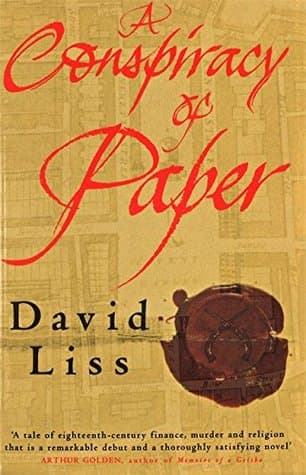
David Liss (2000)
Genre
Thriller / Historical Fiction / Mystery
Reading Time
500 min
Key Themes
See below
Sign in to track this book
In 18th-century London, an estranged Jewish ex-boxer investigates his father's suspicious death, entering a world of stock jobbers and hidden schemes, only to find himself in a conspiracy that threatens his own life.
Benjamin Weaver, a Jewish ex-boxer working as a 'thief-taker' in London, is estranged from his wealthy stock-jobber father, Adam. One evening, Benjamin's uncle, Abraham, calls him to Adam's home where his father is dead, supposedly by suicide. Adam's business partner, David Mendoza, and a physician confirm the suicide, but Benjamin's instincts and his uncle's doubts suggest otherwise. Despite his complicated feelings for his father, Benjamin agrees to investigate. He knows Adam's death could affect the family's honor and finances, especially with an election for a Bank of England directorship coming. His first questions lead him into London's new stock market, a world he had left.
Benjamin's investigation starts with questioning those closest to Adam. He speaks with David Mendoza, who seems too eager to call the death a suicide, and with other stock jobbers like Sir Francis Child, a powerful Bank of England director and Adam's rival. Benjamin also learns of a mysterious ledger his father kept, which is now missing. He suspects Adam was involved in secret dealings beyond his usual business. As he looks deeper, he meets resistance and veiled threats, suggesting powerful people want Adam's death to remain a closed case. He also learns of Adam's recent focus on a specific group of stock shares, which seems unlike him.
Benjamin spends time at Jonathan's Coffee-House, London's main stock trading spot, watching the busy activity and the complex dance of speculation. He learns about different types of shares, 'bulls' and 'bears,' and the risks and deceptions. He meets various people, from respected merchants to shady 'stock-jobbers' who profit from false information. He realizes his father was likely caught in a scheme larger and more dangerous than simple financial wrongdoing. His questions lead him to suspect Adam was investigating something himself, and that his death was a deliberate silencing rather than a desperate act.
Benjamin finds a link between his father and the South Sea Company, a powerful trading company also big in the stock market. He learns Adam had been secretly buying shares in a specific venture connected to the company, a move that surprised his associates. His investigation also leads him to a secret group, a 'club' of influential men who meet and discuss financial manipulations. Benjamin suspects this group is at the center of the conspiracy, using their power to control market prices and enrich themselves. He realizes his father's death is tied to uncovering their illegal activities.
As Benjamin's investigation continues, the risks grow. He is ambushed in dark alleys and gets anonymous warnings to stop his inquiries. These attacks confirm his belief that Adam was murdered and that powerful people want to protect their secrets. He realizes he is on a dangerous path, like his father's last days. His boxing skills and street smarts, from years as a thief-taker, help him fight off attackers. He becomes more determined to expose the truth, even as the danger to him grows, knowing he is now a direct threat to the conspirators.
Through careful investigation, Benjamin discovers the conspiracy's true nature: a plan to inflate a specific stock's value, creating an artificial 'bubble,' then selling shares at the peak, leaving investors ruined. He realizes his father was not just a victim but was trying to expose this fraud. The conspirators, including Sir Francis Child and David Mendoza, were arranging this manipulation for huge personal gain. The missing ledger, Benjamin concludes, contains evidence of this illegal activity, detailing the transactions and the identities of those involved, making it crucial.
With knowledge of the 'bubble' scheme and a growing understanding of the conspirators' identities, Benjamin prepares to confront them. He uses his connections and wits to gather the final evidence, including the missing ledger's location. He knows the conspirators will do anything to protect their reputations and ill-gotten gains. He plans a risky move to expose them publicly, knowing a direct confrontation could mean his end. He must rely on his intelligence and physical strength to outsmart these powerful men, who control the law and the market.
The climax happens during the election for a Bank of England directorship, where Sir Francis Child is a leading candidate. Benjamin, with his uncle and a few trusted allies, publicly reveals the stock manipulation scheme, using evidence from Adam's ledger. He exposes Child and Mendoza, detailing their fraud and his father's murder. The resulting chaos and public outrage threaten to dismantle the conspirators' power and financial empires. Benjamin's actions avenge his father and expose corruption in London's financial world.
The conspiracy's exposure leads to consequences for those involved. While some conspirators avoid full legal punishment due to their influence, their reputations are ruined, and their financial power lessened. David Mendoza flees, and Sir Francis Child's political hopes are shattered. Benjamin, having avenged his father, finds closure. He begins to reconcile with his family and understands his father better, realizing Adam was trying to do good. The experience strengthens Benjamin's identity, bridging his past as a boxer and his future as a man of principle.
Afterward, Benjamin thinks about the volatile financial world he has navigated. He understands that while the immediate crisis is over, human greed and the potential for market manipulation will remain. He recognizes that the 'paper' economy, with its abstract values and quick changes, is a powerful force that can create great wealth and ruin. His experiences give him a deeper understanding of the forces shaping London society and a clearer view of his place in it, a man always an outsider but now with a clearer purpose.
The Protagonist
Benjamin evolves from a cynical, solitary figure driven by a personal quest to a man who understands the systemic corruption of his society and finds a new sense of purpose and connection to his family.
The Deceased catalyst
Though deceased, Adam's character is revealed retrospectively as a man who, despite his flaws, was attempting to expose a significant fraud before his murder.
The Supporting
Abraham remains a steadfast moral compass, reinforcing Benjamin's commitment to justice and family honor.
The Antagonist
Mendoza is revealed as a primary architect of the financial fraud, ultimately exposed and facing ruin.
The Antagonist
Child's public reputation is shattered, and his political ambitions are thwarted by Benjamin's revelations.
The Supporting
Miriam remains a steadfast moral presence, offering Benjamin comfort and a potential future.
The Supporting
Captain Daniel remains a loyal friend, providing consistent support to Benjamin.
The Mentioned
Provides information but does not undergo significant development.
The novel shows how wealth and power in 18th-century London are built on deception and manipulation. The stock market is a place where appearances mislead, and fortunes rise or fall on rumor and fraud. Characters like Sir Francis Child and David Mendoza show how those in power exploit the system for personal gain, hiding their illegal acts behind respectability. Benjamin's journey reveals that the 'conspiracy of paper' is not just about financial tools but about the moral corruption of unchecked ambition, seen in the 'bubble' scheme where investors are deliberately misled.
“''Tis a world built on paper, Benjamin, and paper burns easily. But the men who hold the paper, they are harder to burn.”
At its heart, the novel is a quest for justice and revenge. Benjamin Weaver, first driven by a desire to avenge his father's murder and restore family honor, finds a wider injustice affecting many investors. His personal quest becomes a fight against corruption. While his methods are often violent and outside the law, his goal is to expose the truth and ensure powerful conspirators face consequences. The theme explores the line between personal revenge and wider societal justice, especially when official channels might be compromised by the very people Benjamin seeks to expose.
“My father's death was no accident, and I'll not rest until I find the hand that dealt it.”
Benjamin Weaver is an outsider. As a Jew in Christian London, an ex-boxer among gentlemen, and a thief-taker among the elite, he lives on society's edges. This outsider status gives him a unique view, letting him see hypocrisies and deceptions others might miss. His ability to move between social levels—from boxing rings to wealthy drawing rooms—gives him an unmatched position to uncover the conspiracy. This theme highlights how those outside the mainstream can often see the truth more clearly.
“I was a Jew, a fighter, a thief-taker. I saw the city from its shadows, and in those shadows, the truth often revealed itself.”
The novel examines the early stock market in 18th-century London, showing its instability, lack of rules, and openness to manipulation. It details the rise of concepts like 'bulls' and 'bears,' short selling, and 'bubbles' from speculation. The 'conspiracy of paper' refers to financial instruments' abstract nature and how they create wealth from nothing or defraud many. The story hints at parallels to modern financial crises, highlighting the lasting human elements of greed and fear that drive markets, making it a warning about financial ethics.
“The price of a share, Benjamin, is not its true worth, but what fools are willing to pay for it.”
Benjamin's journey is tied to his complicated relationship with his family, especially his estranged father, Adam. His investigation forces him to confront his past, his Jewish heritage, and the choices that led him away from the family business. By uncovering his father's secrets, Benjamin understands Adam better, accepting his own identity as both a Weaver and an independent man. The theme explores the tension between family duty and personal freedom, and how understanding one's roots can lead to a stronger sense of self, even if those roots involve secrets and betrayals.
“He was my father, and for all our differences, his blood ran in my veins. His death demanded an answer.”
A crucial physical object containing evidence of the financial conspiracy.
The missing ledger is a classic MacGuffin, a tangible item whose absence drives much of the initial investigation. It is believed to contain Adam Weaver's secret notes, transactions, and possibly the names of the conspirators involved in the stock manipulation scheme. The search for this ledger provides a clear objective for Benjamin, leading him through various dangerous encounters and revealing more about his father's final days. Its eventual recovery is pivotal, providing the concrete evidence needed to expose the powerful figures behind the fraud.
Benjamin Weaver's unique social position allows him to navigate different worlds and uncover hidden truths.
Benjamin Weaver's status as an outsider – a Jew, an ex-boxer, a 'thief-taker' – is a powerful plot device. It allows him access to both the lower echelons of London's criminal underworld and, through his family, the elite financial circles. This dual access is crucial for uncovering the conspiracy, as he can gather information from sources unavailable to others. His physical skills as a boxer also serve as a practical device, enabling him to survive the violent encounters that arise as he gets closer to the truth, while his intelligence allows him to piece together the complex financial puzzle.
18th-century London's nascent stock market and social structures are integral to the plot.
The historical setting of 18th-century London, particularly the volatile and unregulated world of its nascent stock market, functions almost as a character itself. The specific financial instruments, the social dynamics of coffee houses and exchanges, and the legal loopholes of the era are not just backdrop but are directly responsible for enabling the conspiracy. The 'bubble' scheme is historically plausible, rooted in the speculative fever of the time. This device grounds the thriller in a rich, authentic reality, making the stakes and the methods of manipulation feel particularly potent and relevant.
“The Exchange, Mr. Trevayne, is a market of speculation. Not a temple of justice.”
— Benjamin Weaver is explaining the nature of the stock exchange to a new client.
“Money, like blood, flows to the heart of the city, and from there, it is pumped to every extremity.”
— Weaver reflects on the economic lifeblood of London and its financial markets.
“Trust is a currency far more valuable than gold, and far more easily spent.”
— Weaver considers the betrayal he has experienced and the importance of trust in his dealings.
“Every man has his price, Mr. Trevayne, the trick is to find it.”
— Weaver, in his role as a 'thief-taker,' expresses his cynical view of human nature.
“The past is a stubborn ghost, always lingering, always demanding its due.”
— Weaver is haunted by his family's past and the events that led to his father's ruin.
“Truth, like a poorly bound book, often falls apart when examined too closely.”
— Weaver muses on the elusive nature of truth in the midst of his investigation.
“London is a city of shadows, where fortunes are made and lost in the blink of an eye, and reputations are as fragile as glass.”
— Weaver describes the perilous environment of 18th-century London's financial district.
“A man who knows nothing of the rules of the game is easily exploited by those who do.”
— Weaver reflects on the vulnerability of those unfamiliar with the workings of the stock market.
“Justice, in this city, is often a matter of who has the deepest pockets, not the cleanest hands.”
— Weaver observes the corruption inherent in London's legal and financial systems.
“Revenge, Mr. Trevayne, is a dish best served cold, and with a meticulous accounting.”
— Weaver alludes to his own motivations and the careful planning required for his objectives.
“The greatest lies are often built upon a foundation of inconvenient truths.”
— Weaver uncovers layers of deceit, realizing how partial truths are manipulated.
“Fear can make a man do things he would never otherwise consider, both good and ill.”
— Weaver observes the impact of fear on various characters throughout his investigation.
“In the world of trade, an honest man is a rare commodity, and often, an endangered one.”
— Weaver reflects on the prevalence of dishonesty in the financial world he navigates.
“To understand the present, one must first unravel the tangled threads of the past.”
— Weaver realizes the deep historical roots of the conspiracy he is investigating.
“Silence, Mr. Trevayne, can be a more powerful weapon than any spoken word.”
— Weaver advises discretion and the strategic use of withholding information.
Ready to see how well you understood this book? Take our interactive quiz with 10 questions.

David Liss is a critically acclaimed historical fiction author, known for his intricate plots and vivid portrayals of bygone eras. His debut novel, "A Conspiracy of Papers," was a finalist for the Edgar Award, and "The Coffee Trader" earned him the Barry Award for Best Historical Fiction. Liss masterfully blends suspense, history, and compelling characters into unforgettable narratives.







