BookBrief
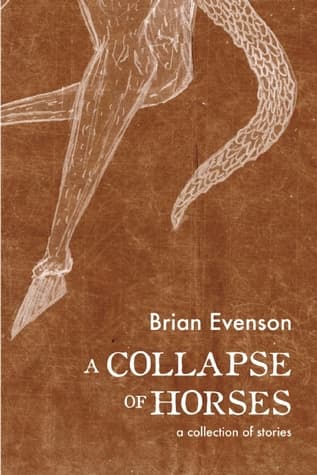
A Collapse of Horses cover
Archivist's Choice

A Collapse of Horses

Brian Evenson (2016)

Genre

Fantasy / Science Fiction

Reading Time

150 min

Key Themes

See below

Track Your Reading

Sign in to track this book

In Brian Evenson's 'A Collapse of Horses,' ordinary life shatters into the monstrous, as a stuffed bear's heartbeat echoes a dead infant and reality itself unravels.

Synopsis

In "A Collapse of Horses," a man named Narrator wakes in a field to find his wife gone, replaced by a horse. He struggles with the strange reality, questioning his sanity as the world around him subtly shifts. In "The Dust," a mining crew on a desolate planet faces an insidious, sentient dust that seeps through all defenses, slowly consuming and transforming them. Throughout the collection, characters encounter inexplicable phenomena: a stuffed bear that pulses with a life that isn't its own, a town named Reno that defies all attempts to approach it, and tunnels where reality unravels. Each story explores how fragile perception is and the terror of the unknown, leaving characters, and the reader, to confront the unsettling truth that the world is far more alien than they imagined.
Reading time
150 min
Difficulty
Medium
Pacing
Moderate
Mood
Surreal, Unsettling, Existential, Disturbing, Philosophical
✓ Read this if...
You enjoy surreal, philosophical horror and psychological thrillers that leave you questioning reality, with a focus on unsettling atmosphere over jump scares.
✗ Skip this if...
You prefer clear narratives with definitive resolutions, or are easily frustrated by ambiguity and existential dread.

Plot Summary

A Collapse of Horses

The narrator, Paul, sees horses collapsing in his yard, but his wife, Mary, and son, Peter, deny seeing them. This unsettling experience grows as Paul notices an inexplicable hole in the ceiling and strange, shifting patterns on the walls. His family dismisses his observations, saying he is stressed or hallucinating. Paul feels increasingly isolated in his own home, questioning his sanity as his reality differs sharply from theirs. The house itself seems to subtly warp, further disorienting him and deepening his paranoia, while Mary and Peter remain unaware or intentionally ignorant.

The Dust

On an alien planet, a team of miners, including the protagonist, fights a pervasive, sentient dust that infiltrates everything. The dust is not just a hazard; it seems to have a malevolent will, causing hallucinations, paranoia, and physical deterioration in those exposed. The miners report strange occurrences and unsettling visions, leading to a breakdown in morale and trust. The story details their futile attempts to contain or understand the dust, showing their growing desperation and the psychological toll of fighting an enemy that is both invisible and inescapable. The dust seems to absorb and replicate their fears, turning their own minds against them.

The Warren

The protagonist lives in a claustrophobic, underground warren with other inhabitants, all under strict rules and a constant sense of dread. He is haunted by the memory of a child, possibly his own, who was lost or taken. The warren's structure and social order are oppressive, with an unseen authority controlling their lives. He struggles with a fragmented sense of self and the chilling realization that memories can be altered or erased. The story explores his attempts to piece together his past and understand the truth about the warren and the fate of the children, fighting against the pervasive amnesia and the fear of the 'overseers.'

A Sudden Influx of Them

A woman lives in a house that gradually becomes infested by an inexplicable, ever-increasing swarm of small, black insects. Initially a nuisance, the insects quickly become an overwhelming presence, covering every surface and filling every crevice. Despite her desperate attempts to clean them, the insects multiply relentlessly, defying all logic and conventional pest control. Her isolation deepens as the infestation cuts her off from the outside world and consumes her living space. The story emphasizes her growing despair and the psychological horror of being invaded by something relentless and seemingly supernatural, turning her home into a living nightmare.

Reno

A man journeys to Reno, but no matter how long he drives or what direction he takes, the city always recedes. He meets other travelers who share similar experiences, trapped in a geographical paradox. The landscape around him shifts subtly and illogically, further disorienting him. The story explores his growing frustration and existential dread as his destination remains forever out of reach, suggesting a breakdown of spatial logic and the futility of his efforts. He becomes a prisoner of an impossible journey, his purpose dissolving with each mile he fails to cover towards Reno.

The Second Door

A man finds a hidden, second door in his house, one he's never noticed. When he opens it, he discovers it leads to a series of bizarre and unsettling environments rather than a normal room. Each time he opens the door, the space behind it changes, showing him strange, often disturbing, and sometimes dangerous views. His initial curiosity turns into a morbid fascination, and then fear, as he realizes the door is a portal to unknown, potentially malevolent realities. He struggles with the temptation to explore further versus the urge to seal it off, questioning the nature of his home and reality itself.

The Stuffed Bear

A woman, grieving the loss of her baby, finds comfort in a stuffed bear. However, she discovers that the bear has a faint, rhythmic heartbeat, eerily similar to an infant's. This discovery plunges her into a complex emotional state, mixing comfort with unease and dread. The heartbeat reminds her of her loss but also offers a perverse sense of connection. The story explores her psychological struggle to reconcile the inanimate object with the living sound, blurring the lines between grief, delusion, and the supernatural, turning the comforting toy into a source of unsettling horror.

The Adjudicator

The protagonist is in a sterile, disorienting environment, interrogated by an unseen 'Adjudicator.' The questions are abstract, philosophical, and personal, probing his identity. He struggles to provide satisfactory answers, as the Adjudicator's criteria for 'truth' are elusive and illogical. The process is dehumanizing and designed to break down his sense of self, leaving him questioning his own memories. The story highlights the horror of bureaucratic absurdity and the vulnerability of individual identity against an inscrutable, powerful system.

The Dishonored

In a desolate, post-apocalyptic landscape, the protagonist navigates a world with 'The Dishonored' – grotesque, mutated beings. These creatures are former humans, now deformed and driven by unknown, often violent, impulses. The man is a survivor, constantly on guard, trying to avoid or fight these abominations. The story focuses on the horror of their appearance and behavior, as well as the protagonist's struggle for survival and his internal conflict about the humanity in these creatures. It explores themes of decay, desperation, and the lingering threat of a world irrevocably altered by an unspecified catastrophe.

Body

The protagonist experiences his body parts detaching themselves, seemingly with a will of their own. First a finger, then an arm, then other organs, all become separate entities, capable of independent movement and even rudimentary communication. He observes his own detached parts existing separately from him, a grotesque and surreal experience that redefines his understanding of self and bodily integrity. The story explores his horror, confusion, and the existential crisis of watching his body disintegrate and live on without him, blurring the lines between life, death, and dismemberment.

Lord of the Rats

The narrator recounts his harrowing experience with a secretive cult that worships rats as divine or powerful entities. He describes their rituals, their unsettling devotion to the rodents, and the unsanitary conditions they embrace. The cult's beliefs involve a twisted reverence for the rats' ability to thrive in decay and darkness. The story builds a sense of claustrophobia and disgust, focusing on the protagonist's fear and revulsion as he becomes entangled with their practices, eventually fearing for his own safety and sanity as the cult's influence grows more sinister.

Principal Figures

Paul

The Protagonist

Paul's arc is one of escalating psychological torment and isolation, leading to a complete breakdown of his perceived reality.

The Miner (The Dust)

The Protagonist

He descends from a rational worker into a desperate survivor, increasingly paranoid and physically affected by the dust, losing his grip on reality.

The Inhabitant (The Warren)

The Protagonist

His arc involves a painful attempt to reconstruct his identity and memories, facing the horror of his lost past and the oppressive present.

The Woman (A Sudden Influx of Them)

The Protagonist

She begins as a determined individual, but her arc is a descent into despair and isolation as her home and life are irrevocably claimed by the insects.

The Traveler (Reno)

The Protagonist

He experiences a gradual shift from hopeful determination to profound existential dread and resignation as his journey proves endless.

The Man (The Second Door)

The Protagonist

His arc moves from mundane domesticity to confronting cosmic horror, as his home becomes a gateway to the unknown and terrifying.

The Grieving Mother (The Stuffed Bear)

The Protagonist

Her arc is a descent into a psychologically complex state of grief, where comfort and horror intertwine, challenging her perception of reality.

The Adjudicator

The Antagonist

The Adjudicator remains a constant, unchanging force of inscrutable power, its purpose never fully revealed.

The Survivor (The Dishonored)

The Protagonist

His arc is a continuous struggle for survival, marked by the constant horror of his environment and the eroding line between human and monster.

Themes & Insights

The Fragility of Reality and Perception

Many stories explore how easily an individual's perception of reality can be distorted or shattered, often without external validation. In 'A Collapse of Horses,' Paul's reality differs from his family's, making him question his sanity. 'Reno' presents a world where geographical laws break down, and 'The Dust' shows how environmental factors can induce hallucinations, blurring the line between what is real and what is imagined. This theme suggests that reality is not a fixed, objective truth but a subjective and vulnerable construct.

What if the world was not as he saw it? What if he was simply wrong?

Narrator, 'A Collapse of Horses'

Existential Dread and Isolation

A pervasive sense of existential dread and isolation runs through many narratives. Characters often find themselves alone against inexplicable or overwhelming forces, unable to communicate their experiences or find comfort. Paul in 'A Collapse of Horses' is isolated by his family's denial. The woman in 'A Sudden Influx of Them' is isolated by the insect infestation. This theme highlights the terror of being utterly alone in confronting incomprehensible horrors, leading to a deep sense of powerlessness and alienation from the world.

He felt utterly alone, as if the world had subtly shifted, leaving him on a different plane of existence.

Narrator, 'Reno'

The Body as a Site of Horror

The physical body is often presented as a source of grotesque horror and vulnerability. In 'Body,' the protagonist experiences his limbs detaching and living independently, a visceral disintegration of self. 'The Stuffed Bear' features a dead baby's heartbeat emanating from an inanimate object, a horrifying perversion of life. This theme explores the violation and breakdown of the physical self, turning the familiar into something alien and terrifying, challenging the very definition of being alive and whole.

His own flesh, once so intimately 'him,' now felt like a collection of strangers.

Narrator, 'Body'

Loss of Control and Agency

Characters frequently find themselves in situations where they have no control over their circumstances, their bodies, or even their minds. Whether it is the relentless dust in 'The Dust,' the endless journey in 'Reno,' or the bureaucratic absurdity of 'The Adjudicator,' agency is often stripped away. This theme underscores the terror of powerlessness, where individual will and effort are meaningless against forces that are either indifferent, malevolent, or incomprehensibly vast. It highlights the vulnerability of the individual in the face of an uncaring or hostile universe.

He tried to resist, but it was like trying to hold smoke. It simply was.

Narrator, 'The Adjudicator'

Plot Devices & Literary Techniques

Unreliable Narration

The reader's trust in the narrator's perceptions is consistently undermined.

Many stories employ unreliable narrators, making it difficult for the reader to discern what is objectively real versus what is hallucination, delusion, or a subjective experience. In 'A Collapse of Horses,' Paul's family denies his observations, forcing the reader to question his sanity. This device creates suspense and psychological horror by making the reader complicit in the narrator's deteriorating reality, fostering a sense of unease and uncertainty about the events unfolding.

Abrupt, Unexplained Phenomena

Strange events occur without logical cause or resolution.

Evenson frequently introduces bizarre and unsettling phenomena without providing any rational explanation or resolution. The collapsing horses, the ever-receding Reno, the sentient dust, or the second door leading to other realities are examples. This device heightens the sense of dread and cosmic horror, as it suggests a world where fundamental laws of nature can be arbitrarily broken, leaving characters (and readers) with no framework for understanding or coping with the inexplicable.

Psychological Gaslighting

Characters' perceptions are denied or dismissed by others, leading to self-doubt.

In several stories, characters are gaslighted by those around them, particularly in 'A Collapse of Horses' where Paul's wife and son deny seeing the strange events he describes. This device amplifies the protagonist's isolation and self-doubt, making them question their own sanity and further driving them into a state of psychological distress. It turns interpersonal relationships into another source of horror, as trust and validation are withheld.

Body Horror

The grotesque violation and disintegration of the human form.

Evenson frequently utilizes body horror, presenting unsettling transformations, mutilations, or unnatural occurrences involving the human body. 'Body,' where limbs detach and live independently, is a prime example. The 'Dishonored' are grotesque mutations, and the stuffed bear with a baby's heartbeat is a perversion of the body. This device creates visceral disgust and psychological shock, challenging the reader's comfort with the physical self and highlighting the fragility of human form and life.

Critical analysis

Notable Quotes

The feeling that something was amiss was not new to him, but it had rarely manifested with such a specific, almost physical, sensation of wrongness.

From the story 'A Collapse of Horses', describing the protagonist's growing unease with his reality.

He knew, or thought he knew, that the world was still there, but it felt as if a thin, almost invisible membrane had been stretched between him and it.

From 'A Collapse of Horses', illustrating the protagonist's sense of detachment.

The silence was not empty, but full of something trying to make itself heard, something that had no voice.

From 'The Dust', describing an oppressive, almost sentient silence.

He had always assumed that the past was fixed, but now it felt like something fluid, something that could be reshaped by the currents of his own mind.

From 'The Adjudicator', reflecting on the malleability of memory and personal history.

There were certain things, he thought, that once seen, could not be unseen, and once known, could not be unknown.

From 'The Punish Box', contemplating the irreversible nature of certain experiences or revelations.

The world had become a place of signs and portents, each one hinting at a meaning he could almost grasp but never quite hold.

From 'Curios', as a character struggles to interpret strange occurrences.

He felt as if he were watching himself from a great distance, a passive observer in his own unraveling.

From 'A Collapse of Horses', depicting a character's dissociative experience.

The landscape seemed to breathe, a slow, deliberate inhalation and exhalation that was both natural and deeply unsettling.

From 'The Accusation', describing an eerie, living environment.

He had always thought of darkness as an absence, but now he knew it was a presence, thick and palpable, with its own cold weight.

From 'The Blood Drip', exploring the physical sensation of darkness.

The most terrifying thing, he realized, was not the unknown, but the slow, dawning comprehension of something far worse than he had imagined.

From 'Cult of the Head', a character's chilling realization.

Every step he took felt like a betrayal of the ground beneath him, a violation of something ancient and inert.

From 'The Warren', conveying a character's profound sense of unease and guilt.

He found himself caught in a loop, a narrative that repeated itself with subtle, horrifying variations.

From 'The Wound', describing a character trapped in a recursive, nightmarish reality.

The world was full of false bottoms, he thought, and he was falling through them, one after another, with no end in sight.

From 'A Collapse of Horses', encapsulating the protagonist's descent into an unstable reality.

He had always believed in the solidity of things, but now everything felt like a temporary arrangement, ready to dissolve at any moment.

From 'The Echo Chamber', a character questioning the fundamental nature of reality.

The silence was not peace, but a holding of breath, a pause before something terrible began.

From 'The Dead Space', describing an ominous calm.

Quiz

Test Your Knowledge

Ready to see how well you understood this book? Take our interactive quiz with 10 questions.

10
Questions
~5
Minutes
?
Best Score

Key Questions (FAQ)

The collection consistently explores themes of existential dread, the porous boundary between reality and hallucination, and the unsettling nature of the unknown. Many stories feature characters grappling with a loss of control over their perceptions or environments, highlighting the terror inherent in not being able to trust one's own senses or the world around them.

About the author

Brian Evenson

Brian Evenson is an American author of experimental fiction, known for his unsettling and often bleak narratives. His notable works include the short story collection 'A Collapse of Horses' and the novels 'Last Days' and 'Song for the Unborn Dead.' Evenson's writing is characterized by its minimalist style, psychological depth, and exploration of themes like trauma, isolation, and the uncanny.