“What's it going to be then, eh?”
— The opening line, repeated throughout the novel, often before acts of violence or decision-making.

Anthony Burgess (2013)
Genre
Thriller / Science Fiction
Reading Time
350 min
Key Themes
See below
Sign in to track this book
In a dystopian future, a charismatic, ultraviolent teen enjoys his 'nadsat'-laced depravity until a State-mandated re-education program challenges his free will.
The story opens with Alex, a fifteen-year-old 'nadsat' (teenager), and his three droogs (friends) – Pete, Georgie, and Dim – at the Korova Milkbar, drinking drug-laced milk. They then begin a night of 'ultraviolence.' Their first victims are an old, scholarly man they beat and rob. Next, they drive to the countryside, assault a young couple, and steal their car. Later, they break into a writer's house (F. Alexander), savagely beat him, and gang-rape his wife. Back in the city, they confront a rival gang, leading to a brutal fight. Feeling a loss of control, Alex assaults Dim for insubordination. The droogs, tired of Alex's dominance, betray him during a home invasion, knocking him unconscious and leaving him for the police to arrest.
Alex is sentenced to fourteen years in prison for the murder of the woman during the home invasion (his droogs had abandoned him, leaving him to take the fall). While incarcerated, he maintains his violent tendencies, even orchestrating the murder of a cellmate. After two years, he learns of a new experimental treatment called the Ludovico Technique, which promises early release. Desperate to escape prison, Alex volunteers for the program, despite warnings from the prison chaplain. He is chosen as a guinea pig for the state-sponsored aversion therapy, hoping it will cure him of his criminal impulses and provide a path to freedom.
Alex is transferred to a medical facility where he undergoes the Ludovico Technique. Strapped to a chair with his eyes forced open by clamps, he is injected with a nausea-inducing drug while being shown films depicting extreme violence, rape, and other horrific acts. The drug causes him to associate these actions with intense physical sickness. A side effect of the treatment is that the background music in one of the films, Beethoven's Ninth Symphony, also becomes associated with the nausea. After two weeks, Alex is 'cured.' During a public demonstration, he cannot defend himself from abuse and feels violently ill at the sight of a beautiful woman, proving his conditioning is complete. He is deemed safe and released back into society.
Upon his release, Alex finds himself defenseless. His parents have rented out his room and show little sympathy. He encounters his old droogs, Dim and Georgie, who are now policemen and beat him severely in retaliation for past grievances. He then stumbles upon the house of the old man he and his droogs had beaten at the beginning of the book. The man, recognizing him, gathers other elderly men who viciously attack Alex. He is saved by two policemen, who turn out to be Dim and Georgie again. They take him to a remote location, beat him further, and leave him to drown, but he survives.
Badly injured and disoriented, Alex stumbles to a house and collapses on the doorstep. The owner, F. Alexander, the writer whose house Alex and his droogs had invaded and whose wife they had gang-raped, takes him in. F. Alexander, now a widower and confined to a wheelchair, does not recognize Alex. He is part of a political movement opposing the government and its coercive treatments like the Ludovico Technique, viewing them as an infringement on free will. He sees Alex as a victim of the state and sympathizes with his plight, offering him shelter and food, unaware of Alex's true identity and his role in his personal tragedy.
As Alex recovers, he overhears F. Alexander and his political associates discussing him, realizing they intend to use him as a symbol of the government's oppressive policies. While alone in the house, Alex begins to sing and remembers the melody of Beethoven's Ninth Symphony. This triggers the conditioned nausea and despair from the Ludovico Technique, causing him immense suffering. The memory of his past atrocities, now linked to his sickness, overwhelms him. In despair and self-loathing, Alex attempts suicide by jumping from a window. He survives the fall but is severely injured and ends up in the hospital, becoming a political tool for the opposition.
Alex awakens in a hospital bed, where he is visited by government officials, including the Minister of the Interior. Due to the political outcry surrounding his attempted suicide and the exposure of the Ludovico Technique's cruel effects, the government decides to reverse his conditioning. Alex undergoes further treatment to undo the aversion therapy, allowing him to listen to music and think about violence without suffering. The Minister apologizes for the state's actions and offers Alex a well-paying, respectable job, promising him a fresh start and a reintegration into society, effectively silencing him as a political pawn. Alex feels his old self returning.
With his conditioning reversed, Alex is once again able to enjoy music, particularly Beethoven, and contemplates violence without the debilitating sickness. The government gives him new clothes, a car, and money. He meets Pete, one of his former droogs, who is now married and has a respectable job, having grown out of his youthful delinquency. Alex initially feels a pang of envy and loneliness, seeing Pete's settled life. However, he quickly dismisses such thoughts, feeling the old urges for ultraviolence stirring within him. He envisions assembling a new gang of young boys, eager to resume his reign of terror and indulge in his violent fantasies, embracing his true nature once more.
In the original British edition (and restored in this edition), Alex, now eighteen, reflects on his past. He is still engaging in petty crimes with a new gang, but he finds less satisfaction in it. He sees Pete again, who is happily married with a child, and feels a sense of emptiness and a yearning for a similar, stable life. He realizes that the cycle of violence and youth must eventually give way to maturity and responsibility. He dreams of finding a wife, having a son, and settling down, understanding that the urge for ultraviolence is a phase of youth that he is now ready to outgrow, seeking genuine happiness and connection rather than fleeting thrills.
The Protagonist
Alex transforms from a free-willed, violent delinquent into a conditioned, helpless victim, then back to a state of free will, ultimately choosing a path of maturity and responsibility (in the original ending).
The Supporting
From a subservient droog to a vengeful policeman, Dim represents the cyclical nature of violence and the ease with which power dynamics shift.
The Supporting
Georgie evolves from a follower to a betrayer, then to an enforcer of the state, demonstrating a capacity for both disloyalty and conformity.
The Supporting
Pete transitions from a violent youth to a settled, responsible adult, embodying the potential for genuine rehabilitation and maturity.
The Supporting
From a victim of random violence, F. Alexander transforms into a political figure, driven by personal tragedy and ideological conviction.
The Antagonist
The Minister's character remains static, consistently prioritizing political control and public perception over individual rights or genuine justice.
The Supporting
The Chaplain maintains his moral convictions throughout, serving as the novel's primary voice of ethical concern regarding the Ludovico Technique.
The Supporting
Dr. Brodsky remains a static character, a symbol of amoral scientific progress and state control.
This is the central theme of 'A Clockwork Orange.' Burgess explores whether it is better for an individual to be inherently evil and possess free will, or to be forcibly conditioned into 'goodness' at the expense of their humanity. Alex's journey through the Ludovico Technique directly addresses this, as the state strips him of his ability to choose, rendering him a 'clockwork orange.' The prison chaplain argues that true morality requires choice, even the choice of evil, while the government prioritizes social order above all else, willing to sacrifice individual freedom for a crime-free society. F. Alexander's opposition also highlights the political dangers of such state intervention.
“What does God want? Does God want goodness or the choice of goodness? Is a man who chooses bad in some way better than a man who has good imposed upon him?”
The novel challenges conventional definitions of good and evil. Alex's 'goodness' after the Ludovico Technique is merely the inability to do evil, not a genuine moral choice, making it a superficial and dehumanizing state. His original capacity for extreme violence is presented as an inherent part of his youth and human nature, however abhorrent. Burgess suggests that true goodness must stem from an internal moral compass and the freedom to choose it, rather than being an imposed condition. The suffering Alex experiences when unable to defend himself, despite being 'good,' raises questions about the value of such a forced morality.
“The important thing is moral choice. Evil is an illness, and the state, in the name of the social good, is trying to cure it. But the cure is worse than the disease.”
The novel portrays a society grappling with youth delinquency and moral decay. Alex and his droogs represent a generation characterized by nihilistic violence, hedonism, and a rejection of societal norms. Their 'nadsat' slang further emphasizes their isolation and distinct subculture. The government's extreme response with the Ludovico Technique reflects a desperate attempt to control this breakdown in social order. The story suggests a cyclical nature of rebellion, as Alex, even after his 'cure' and subsequent de-conditioning, initially contemplates forming a new gang, indicating that the underlying issues of youth dissatisfaction and social fragmentation persist.
“We were four, and a Famous Four we were, and we'd been out to get the like of what we were now getting, a bit of the old ultra-violence.”
Both the individual and the state show the corrupting influence of power. Alex wields absolute power over his droogs, leading to their eventual betrayal and his downfall. More significantly, the government abuses its power through the implementation of the Ludovico Technique. It sacrifices individual rights and human dignity for social control and political expediency, transforming citizens into mere cogs in a machine. The Minister of the Interior's cynical manipulation of Alex for political gain, first as a 'cure' then as a 'victim' to be silenced, exemplifies the state's moral bankruptcy.
“When a man cannot choose, he ceases to be a man.”
A unique, Russian-influenced argot used by the youth.
Nadsat is a fictional argot, primarily derived from Russian words, used by Alex and his droogs. This linguistic device serves multiple purposes: it immediately establishes a distinct subculture for the youth, creating a sense of alienation from mainstream society and emphasizing their 'otherness.' It forces the reader to actively engage with the text, deciphering meaning and thus immersing them in Alex's world. It also highlights the generational gap and the breakdown of traditional communication, reflecting the social decay and fragmentation prevalent in the novel's dystopian setting.
Alex's subjective and biased account of events.
The story is told entirely from Alex's first-person perspective. This makes him an unreliable narrator, as his account is filtered through his own twisted morality, self-justifications, and subjective experiences. The reader is privy to his thoughts, his love for Beethoven, and his rationalizations for 'ultraviolence,' which creates a complex and disturbing intimacy. This device forces the reader to confront the protagonist's horrific actions directly, without authorial judgment, and to question the nature of good and evil through his eyes, even as his perspective is clearly biased and self-serving.
A fictional psychological conditioning method used by the state.
The Ludovico Technique is a central plot device, serving as the catalyst for Alex's transformation and the primary vehicle for exploring the novel's themes of free will and state control. This fictional aversion therapy involves forcing subjects to watch violent imagery while being injected with drugs that induce extreme nausea and discomfort. The technique effectively conditions Alex to become physically ill at the thought or sight of violence and sex. It represents the ultimate infringement on individual liberty, creating a 'good' person by stripping them of their moral choice, thus becoming a symbol of dehumanization and authoritarian overreach.
A recurring musical piece symbolizing Alex's refined tastes and later, his suffering.
Beethoven's Ninth Symphony acts as a powerful motif throughout the novel. Initially, it symbolizes Alex's deep, almost spiritual connection to art and beauty, contrasting sharply with his brutal actions and highlighting his complex, contradictory nature. During the Ludovico Technique, the symphony is inadvertently paired with the violent films and nausea, turning his greatest pleasure into a source of excruciating pain. This transformation underscores the cruelty of the conditioning, as it corrupts the one pure joy in Alex's life, demonstrating how the state's 'cure' destroys not just evil, but also genuine human appreciation.
“What's it going to be then, eh?”
— The opening line, repeated throughout the novel, often before acts of violence or decision-making.
“It's funny how the colors of the real world only seem really real when you viddy them on the screen.”
— Alex reflecting on his perception of reality versus mediated experiences.
“The important thing is moral choice. Evil has to exist along with good, in order that moral choice may operate.”
— The prison chaplain arguing against the Ludovico Technique.
“When a man cannot choose, he ceases to be a man.”
— The prison chaplain expressing his opposition to the state's conditioning methods.
“Oh, it was gorgeousness and gorgeosity made flesh.”
— Alex describing the ecstatic feeling of listening to Beethoven's Ninth Symphony.
“The attempt to impose upon man, a creature of growth and capable of sweetness, to ooze juicily at the last round the bearded lips of God, to attempt to impose, I say, laws and conditions appropriate to a mechanical creation, against this I raise my sword-pen.”
— F. Alexander, a writer, denouncing the government's oppressive methods.
“I was cured all right.”
— Alex's ironic statement after being subjected to the Ludovico Technique.
“It's a stinking world because it lets the young get on to the old like you done, and there's no law nor order no more.”
— An old man complaining about the youth violence to Alex and his droogs.
“The sweetest and most heavenly of activities partake in some measure of violence.”
— Alex musing on the connection between beauty and brutality.
“He has no real choice, has he? Self-interest, fear of physical pain, drove him to that grotesque act of self-abasement. Its insincerity was clearly to be seen. He ceases to be a wrongdoer. He ceases also to be a creature capable of moral choice.”
— The prison chaplain criticizing the Ludovico Technique's effects on Alex.
“We can destroy what we have written, but we cannot unwrite it.”
— F. Alexander reflecting on the consequences of actions and words.
“The not-self cannot have the bad, meaning they of the government and the judges and the schools cannot allow the bad because they cannot allow the self.”
— Alex's philosophical musing on societal control and individuality.
“It's a sin, using Ludwig van like that. He did no harm to anyone. Beethoven just wrote music.”
— Alex reacting to the use of Beethoven's music in the Ludovico Technique.
“The old veck began to make bolshy big threats and I gave him a tolk on the head and that shut him up.”
— Alex casually describing an act of violence during one of his escapades.
Ready to see how well you understood this book? Take our interactive quiz with 10 questions.
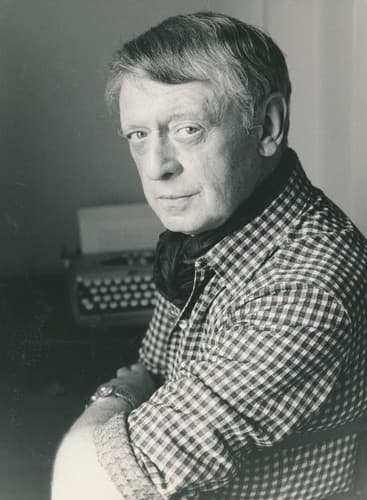
John Anthony Burgess Wilson, who published under the name Anthony Burgess, was an English writer and composer.







