“There are two kinds of people in the world, those who have power and those who want to have power.”
— Reflecting on the nature of ambition and control in the military and political landscape.

Mohammed Hanif (2008)
Genre
Literary Fiction / Politics / Historical Fiction / Mystery
Reading Time
300 min
Key Themes
See below
Sign in to track this book
In a dark comedy about political plots, a Pakistani Air Force pilot works with an odd group, including a hash-smoking American and a mango-loving crow, to kill dictator General Zia ul-Haq, only to learn many others also want him dead.
Flight Lieutenant Ali Shigri, a Pakistan Air Force pilot, cannot accept the official verdict of suicide for his father's death. His father, Colonel Shigri, a decorated officer, died under mysterious circumstances, and Ali rejects the government's explanation. Overwhelmed by grief and suspicion, Ali begins investigating, believing his father was murdered and that General Zia ul-Haq, Pakistan's dictator, was involved. This personal tragedy drives Ali to seek revenge, changing him from a dedicated officer to a determined, though amateur, plotter. He starts watching Zia's movements and habits, developing an elaborate, if somewhat naive, plan to kill the General.
Ali's roommate, Flight Lieutenant Obaid 'O.B.' ul-Haq, is a flashy and somewhat unaware character, more interested in cologne and women than military secrets. Despite his superficiality, O.B. is loyal to Ali. Without O.B.'s knowledge, Ali begins to subtly change their shared living space and O.B.'s routines to help his assassination plan. O.B.'s consistent, if odd, habits and his general unawareness provide cover for Ali's secret activities, making him an accidental accomplice. Ali often uses O.B.'s presence as a distraction or a way to get information and resources without immediately alarming superiors or other officers at Sargodha Air Base.
Ali intentionally becomes friends with Lieutenant St. Peter, a seemingly relaxed American officer at Sargodha Air Base. St. Peter, known for smoking hashish and his casual manner, is a signals intelligence expert who has access to sensitive information about General Zia's movements and security. Ali sees St. Peter as a key part of his plan, believing the American holds the details of the General's schedule and weaknesses. Their interactions, often involving shared hashish and casual talks, let Ali get important information without showing his true intentions, while St. Peter remains largely unaware of Ali's deadly goal.
General Zia ul-Haq, Pakistan's military dictator, is shown as a very paranoid and superstitious leader. He believes that various groups, both inside and outside the country, are planning his downfall. His paranoia shows in his obsession with security, his trust in astrologers and fortune-tellers, and his constant suspicion of those around him. The story reveals that Zia has indeed made many enemies through his harsh rule, including unhappy politicians, rival military groups, and even foreign powers. This widespread dislike creates a complex network of possible plotters, making it hard to tell who is actually trying to kill him and who is just a sign of his own fear.
A particularly smart crow, obsessed with mangoes, often seen around Sargodha Air Base, develops an unusual connection with Ali. This crow, named 'Jumbo' by Ali, becomes an accidental, yet surprisingly useful, part of Ali's complicated plan. Ali watches the crow's behavior and starts to include it in his scheme, using its natural instincts and love for mangoes as a possible distraction or even a way to deliver something. The crow adds a layer of dark humor and absurdity to the plot, showing the unexpected and almost silly elements that contribute to the events leading to Zia's death.
General Akram, a powerful and ambitious figure in the Pakistani military, disappears without a trace. His disappearance causes fear and speculation throughout the armed forces and the political world. Akram was known for thinking independently and potentially challenging Zia's power, making his vanishing highly suspicious. Ali, already deep in his own plot, sees Akram's disappearance as more proof of Zia's ruthless control and his willingness to remove any perceived threat. This event increases the tension and paranoia within the military, creating an even more unstable environment for Ali's plans.
General Zia is scheduled to fly on a C-130 Hercules aircraft, and a special shipment of Sindhri mangoes is loaded onto the plane. These mangoes, known for their sweetness, are a favorite of the General and are meant as a gift for a foreign leader. Ali, through his information gathering, learns about this shipment and recognizes its possible importance. He believes the mangoes could be a key part of his assassination plan, either to hide explosives or to distract security. The mangoes become a central point of the conspiracy, bringing together different parts of the plot in a darkly ironic way.
As Ali carefully plans his revenge, the story reveals he is not the only one planning General Zia's death. Many other individuals and secret groups, driven by their own reasons—political complaints, personal vendettas, or foreign interests—are also independently working toward the same goal. These parallel plots involve unhappy military officers, religious extremists, and even international spy agencies. Ali's detailed scheme, while personally important, is just one part of a larger, more chaotic set of assassination attempts, showing the widespread desire for Zia's removal and the many enemies he has made.
On August 17, 1988, General Zia ul-Haq boards the C-130 Hercules aircraft for what will be his last flight. On the plane are Zia, his top military leaders, the special mango shipment, and, unknown to him, multiple assassination plots. Ali Shigri, having started his own plan, watches from the ground, feeling a mix of anticipation and fear. The air is thick with tension as the plane, a symbol of Zia's absolute power, prepares for its journey. The coming together of various plotters and their methods creates an almost farcical situation, where the dictator is surrounded by an invisible, yet strong, network of doom.
Soon after takeoff, the C-130 carrying General Zia ul-Haq, the American ambassador, and many high-ranking Pakistani military officials, explodes in mid-air. The disaster leaves no survivors, causing shockwaves across Pakistan and the world. The immediate aftermath is one of chaos and confusion, with various ideas about the cause of the crash. Ali Shigri, seeing the explosion, must deal with the reality of his actions and the unclear success of his revenge. The explosion marks the story's peak, ending Zia's harsh rule and deeply affecting the characters and Pakistan's future.
After the C-130 crash, a chaotic and politically charged investigation begins. Many theories are offered, from mechanical failure to sabotage by foreign powers or internal enemies. The evidence is conflicting, and various groups try to manipulate the findings for their own purposes. Ali Shigri, despite his involvement, finds himself a minor figure in the official inquiry, which struggles to find a single, clear cause. The novel leaves the exact cause of the explosion unclear, suggesting that the truth might be too complex or inconvenient for one simple explanation, thus keeping the mystery at the heart of the event.
Following the explosion, Ali Shigri is left feeling very uncertain. His mission for revenge is technically done, but the way Zia died is complicated by the many other plotters. Ali grapples with the moral questions of his actions and the unclear nature of justice. His future in the Air Force, and in Pakistan, is uncertain. The story ends without a clear resolution for Ali, leaving his fate open. He is a man permanently changed by his quest, forever marked by the events surrounding the exploding mangoes and the dictator's fall.
The Protagonist
Ali transforms from a grief-stricken son to a determined, albeit ultimately ambiguous, avenger, grappling with the moral complexities of his actions.
The Antagonist
Zia's reign of terror culminates in his violent and ambiguous death, a consequence of his own oppressive rule and numerous enemies.
The Supporting
O.B. remains largely unchanged, a stable and oblivious presence amidst the surrounding chaos and conspiracy.
The Supporting
St. Peter serves as a static source of information, his fate tied to the larger political events but not undergoing significant personal change.
The Mentioned
As a deceased character, Colonel Shigri's arc is complete, but his legacy fuels the protagonist's journey.
The Supporting
General Akram's disappearance highlights the ruthlessness of Zia's regime and deepens the political intrigue.
The Supporting
Jumbo's arc is primarily functional, serving as an unusual and often humorous plot device.
The Mentioned
The astrologer's predictions contribute to Zia's paranoia, subtly influencing his decisions and path to destruction.
The novel shows General Zia's dictatorship as a mix of harsh control and ridiculous paranoia. His trust in astrologers, his obsession with security, and the many people plotting against him highlight how unstable and absurd absolute power can be. The story uses dark humor to show how a government built on fear ultimately becomes a tragicomic show, where even a crow obsessed with mangoes can play a part in a national plot. This theme appears in Zia's increasingly strange behavior and the many failed attempts on his life, such as the 'exploding mangoes' incident, which is both terrible and darkly funny.
“In a dictatorship, everyone is a conspiracy theorist, because everyone is right some of the time.”
Ali Shigri's entire drive comes from his wish to avenge his father's death, which he believes was a murder arranged by Zia's government. However, the novel makes the idea of justice complex by showing that Ali is just one of many who want Zia dead. The plane's explosion is the result of multiple, overlapping plots, making Ali's personal revenge unclear. The story questions whether true justice can ever be achieved when so many are involved and when the truth is hidden by political maneuvering and self-interest. Ali's struggle with the 'success' of his plot shows this ambiguity.
“Revenge is a dish best served... by a committee, apparently.”
The novel explores how hard it is to find truth, especially in a politically charged setting. The official explanation for Colonel Shigri's death is suicide, which Ali strongly disbelieves. Similarly, the cause of Zia's plane crash remains unclear, with various theories—mechanical failure, foreign powers, internal sabotage—all competing for belief. The story suggests that in a state full of corruption and paranoia, a single, clear truth is often impossible to find. Instead, a complex network of plots, rumors, and political agendas determines what is believed, leaving the actual events open to interpretation. This is clear in the unresolved mystery of the exploding mangoes.
“In Pakistan, the truth is like a mango: you peel it, and there's a stone inside that's hard to get rid of.”
Ali Shigri, a seemingly normal pilot, goes against the powerful military dictatorship of General Zia. His personal quest for revenge shows an individual trying to find justice within an oppressive and corrupt system. While Ali thinks he alone is responsible for his actions, the story reveals that the 'system' itself has internal disagreements and outside pressures, making it vulnerable from many sides. This theme looks at the limits of what one person can do against huge political forces, suggesting that sometimes, the system's own flaws lead to its downfall, rather than a single heroic act.
“You can kill a man, but you can't kill an idea, especially if that idea is 'kill the dictator'.”
General Zia's reliance on astrologers and his belief in fate conflict with the many deliberate attempts on his life, including Ali's. The novel plays with the idea of whether Zia's death was bound to happen, a result of his actions, or caused by specific choices made by individuals like Ali. The many overlapping plots suggest a chaotic interaction of free will, where many different people contribute to an outcome that seems fated. This uncertainty makes the reader wonder if Zia was simply 'due' to die, or if the combined will of his enemies ultimately sealed his fate.
“Some men are born to rule, others are born to die by exploding mangoes.”
The story is told from a subjective, often darkly humorous, and sometimes ambiguous perspective.
The narrative perspective, primarily Ali Shigri's, is subjective and infused with his personal biases and dark humor. While Ali is the central figure, the omniscient narrator occasionally interjects with historical context or broader observations, blurring the lines of what is definitively true. The ambiguity surrounding the precise cause of Zia's death also contributes to this, as the 'truth' is never fully revealed, leaving room for doubt and interpretation. This device enhances the mystery and comedic elements, forcing the reader to question the reality presented.
The reader is aware of multiple conspiracies while characters remain oblivious to the full scope.
Dramatic irony is prevalent throughout the novel, particularly concerning General Zia and Obaid. The reader is privy to Ali's assassination plot, and later, the existence of multiple other plots, while Zia remains largely unaware of the extent of the danger he is in (though he is paranoid). Obaid is completely oblivious to Ali's true intentions. This creates tension and dark humor, as the audience anticipates the inevitable clash of these forces, making the characters' actions and dialogue ironic in light of the larger, hidden truths.
Subtle hints and prophecies allude to Zia's eventual demise.
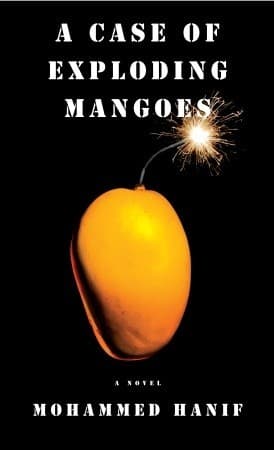
The novel employs foreshadowing through various means, including Zia's astrologer's ominous predictions, the repeated discussions of past political assassinations, and Ali's meticulous planning. These elements build suspense and a sense of impending doom for Zia. For instance, the very title 'A Case of Exploding Mangoes' directly foreshadows the explosive nature of Zia's death and the ironic role of the fruit, even before the specific details are revealed, creating a sense of inevitability around the dictator's fate.
The use of dark comedy and satire to critique political power and human folly.
Mohammed Hanif employs black humor and satire to critique the absurdity of dictatorship, military life, and the human condition. The eccentric characters, the farcical elements of the conspiracy (like the crow), and the casual brutality are often presented with a dry, ironic wit. This device allows the author to address serious political themes and historical events without resorting to overly solemn tones, making the critique more poignant and memorable. It highlights the ridiculousness inherent in absolute power and the desperate measures taken by those living under it.
“There are two kinds of people in the world, those who have power and those who want to have power.”
— Reflecting on the nature of ambition and control in the military and political landscape.
“The only thing worse than being a spy is being a spy who can't spy.”
— Ali, a young air force officer, contemplates his ineffectiveness and the absurdity of his situation.
“History is written by the victors, and in this country, the victors keep changing their minds.”
— A cynical observation about the shifting narratives and political instability in Pakistan.
“Sometimes a mango is just a mango, and sometimes it's a metaphor for exploding dictators.”
— Playing on the central metaphor of the novel, hinting at the layers of meaning behind the 'exploding mangoes'.
“In a country where everyone is a suspect, no one is a suspect.”
— A commentary on the pervasive paranoia and lack of accountability in a totalitarian regime.
“You can't kill a dictator with a smile, but you can definitely make him suspicious.”
— Highlighting the subtle and psychological warfare in a world of political intrigue.
“We are all just trying to get by, even the generals.”
— A moment of shared humanity and vulnerability, even amongst those in positions of immense power.
“The problem with living in a country like ours is that you never know if you're living in a tragedy or a comedy.”
— Reflecting on the dark humor and tragicomic nature of life under an authoritarian government.
“Fear is a very effective tool, especially when it's self-inflicted.”
— Exploring the internal mechanisms of control and the way individuals contribute to their own oppression.
“Every secret comes with a shelf life. After that, it's just gossip.”
— A pragmatic view on the transient nature of secrets and their eventual exposure.
“When you have nothing left to lose, you have everything to gain.”
— A sentiment of desperation and the potential for radical action when pushed to the brink.
“God works in mysterious ways, but the ISI works in even more mysterious ways.”
— A humorous jab at the notorious Pakistani intelligence agency and its opaque operations.
“The only thing predictable about this country is its unpredictability.”
— A concise summary of the volatile and chaotic political landscape described in the novel.
“Even the most powerful men are afraid of something, usually something very small.”
— Underscoring the vulnerabilities of dictators and the seemingly insignificant triggers of their downfall.
Ready to see how well you understood this book? Take our interactive quiz with 10 questions.
Biography coming soon.







