“A man without a gun is just a man. A man with a gun is a invader.”
— The power dynamics and threat of violence in the Kingston ghettos.

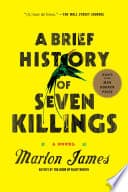
Marlon James (2014)
Genre
Literary Fiction / Historical Fiction / Mystery
Reading Time
1200 min
Key Themes
See below
Sign in to track this book
Through assassins, drug lords, ghosts, and CIA agents, Marlon James reconstructs the chaotic aftermath of the 1976 assassination attempt on Bob Marley, tracing its violent ripples across decades and continents.
On December 3, 1976, just two days before the Smile Jamaica concert, a group of seven gunmen, led by Josey Wales, enters the compound of the Singer (a thinly veiled Bob Marley) in Kingston. The attack is brutal and chaotic, with machine guns blazing. The Singer is wounded in the arm, his wife, Miss I, is shot in the head, and his manager, Don G, is also injured. Several others present are also hurt. The gunmen, many of whom are members of the Storm Posse from Copenhagen City, act on orders from higher powers, including local politicians and potentially the CIA, to destabilize the political climate in Jamaica ahead of the general election. The attack leaves a lasting scar on the Singer and the nation, fueling paranoia and fear.
Despite the assassination attempt, the Smile Jamaica concert proceeds on December 5, 1976. The Singer performs, his arm in a sling, a symbol of resilience. However, the political landscape remains volatile. Gangs like the Storm Posse, aligned with the JLP, and the Shower Posse, aligned with the PNP, continue their violent turf wars, often orchestrated by politicians who arm and fund them. Detective Arthur George Kincaid investigates the shooting, facing pressure and obstruction from both sides of the political divide, making progress nearly impossible. The attack further entrenches the divisions within Kingston, with residents living in fear of retaliatory violence.
Following the assassination attempt and the concert, the Singer leaves Jamaica for London, seeking safety. His departure creates a power vacuum in the political and cultural landscape. In his absence, Josey Wales, a ruthless and ambitious gang leader, consolidates his control over Copenhagen City and expands his influence. He becomes a key figure in the drug trade and political violence, commanding fear and loyalty. His rise is marked by brutality, including the rape of Nina Burgess, a young woman from Waterhouse, which changes her life and sets her on a path of survival and escape.
After the traumatic events in Jamaica, including the rape by Josey Wales and the pervasive violence, Nina Burgess decides to leave her homeland. She eventually makes her way to New York City, seeking refuge and a chance to escape her past. In New York, she changes her name to Dorcas Kelly and tries to build a new life, working as a prostitute and navigating the city's harsh realities. Despite her efforts to distance herself from Jamaica, the trauma of her experiences and the ghosts of her past continue to haunt her, shaping her identity and choices in her new environment.
The narrative reveals the involvement of the CIA in Jamaican politics, particularly through agents like Alex Pierce. Pierce and his colleagues are tasked with destabilizing the socialist government of Michael Manley and preventing the spread of communism in the Caribbean. They fund and arm certain gangs, including those associated with the JLP, exacerbating political violence. The assassination attempt on the Singer is part of a larger, complex web of international intrigue and local power struggles, with the CIA pulling strings behind the scenes, often with unintended and devastating consequences for the Jamaican people.
In the 1980s, Josey Wales and several members of his Storm Posse relocate to New York City, primarily the Bronx, to capitalize on the crack cocaine trade. They establish a drug empire, using the same ruthless tactics they employed in Jamaica. Josey's power grows, and he becomes a major player in the New York underworld, commanding respect and fear. His operations are vast and violent, involving drug trafficking, murder, and intimidation. This period highlights the global reach of Jamaican gang violence and the transplantation of its dynamics to a new urban landscape.
Barry Stryker, a Rolling Stone journalist, becomes obsessed with the attempted assassination of the Singer. He travels to Jamaica, interviewing various figures, including politicians, gang members, and ordinary citizens affected by the violence. His pursuit of the truth is relentless, but dangerous, as he delves deeper into the murky world of Jamaican politics and organized crime. Stryker's narrative provides an outsider's perspective on the events, highlighting the complexities and contradictions of the situation, and the difficulty of uncovering the full truth in a society riddled with secrets and fear.
Throughout the narrative, the ghost of Papa-Lo, a revered elder and former leader of the Storm Posse, frequently appears, offering commentary and insight into the unfolding events. Papa-Lo, who was killed by Josey Wales, represents a moral compass and a connection to older traditions and values. His spectral presence highlights the spiritual dimension of the violence and the lingering impact of past actions. He observes the descent of his former protégé, Josey, into depravity, lamenting the loss of community and the pervasive evil that has gripped his people and their land.
The crack cocaine epidemic of the 1980s is a central theme, illustrating its devastating effects on individuals and communities, particularly in the Bronx. The drug fuels the violence perpetrated by Josey Wales and his crew, leading to countless deaths, addictions, and the breakdown of social structures. The novel portrays the lives of addicts, dealers, and those caught in the crossfire, showing how the allure of quick money and the desperation of poverty contribute to the cycle of violence. This period marks an escalation in the brutality and scope of the gang's operations.
Years later, many characters, including Josey Wales and Nina Burgess (now Dorcas Kelly), find themselves back in Jamaica, under different circumstances. Josey returns to escape the pressure of the American authorities, while Dorcas seeks to confront her past and find some measure of peace. The return to the island brings a reckoning, as old scores are settled and the long-term consequences of their actions come to light. The narrative explores themes of justice, retribution, and the inescapable nature of one's past, as the characters are forced to confront the legacies of violence they created or endured.
Josey Wales, having returned to Jamaica, continues to operate with his characteristic ruthlessness, but his power begins to wane. He becomes increasingly paranoid and isolated. His eventual demise is violent and protracted, a fitting end for a character who lived by the sword. His death is not a simple act of justice, but rather a culmination of years of violence, betrayal, and the unraveling of his empire. His end marks a significant turning point in the novel, symbolizing the potential, however faint, for a new chapter in the lives of those he terrorized.
Even after the deaths of key figures like Josey Wales, the shadows of the past continue to loom over Jamaica. Political violence, drug trade, and personal traumas have left an indelible mark on the country and its people. Characters like Dorcas Kelly, though having survived, carry the scars of their experiences. The novel concludes by emphasizing that while specific events may end, their repercussions resonate through generations, highlighting the difficulty of truly escaping a violent history and the complex interplay between individual choices and broader societal forces.
The Antagonist
From a rising gang enforcer in Kingston, Josey transforms into a major drug lord in New York, only to face a violent reckoning upon his eventual return to Jamaica.
The Supporting
Nina transforms from a vulnerable victim in Jamaica to a hardened survivor and observer in New York, eventually seeking closure and a measure of peace upon her return.
The Mentioned
From an iconic figure of peace targeted by violence, he becomes a symbol of resilience and a catalyst for change, albeit one who must leave his homeland for safety.
The Supporting
As a ghost, Papa-Lo's arc is one of posthumous observation and lamentation, bearing witness to the destruction of his community and the corruption of his former protégé.
The Supporting
Kincaid's arc is one of persistent, yet ultimately unfulfilled, pursuit of justice in a corrupt system, leading to disillusionment and a recognition of the limits of his power.
The Supporting
Pierce's arc remains largely static, reflecting his unchanging cynical worldview and his role as an agent of external forces, detached from the human consequences of his actions.
The Supporting
Stryker's arc involves a deep immersion into the violence and corruption of Jamaica, leading to a profound, if incomplete, understanding of the country's complex realities.
The Supporting
Kim's arc focuses on her struggle for survival and her enduring loyalty in the harsh world of New York's sex trade, offering a contrast to Dorcas's more complex journey of escape and reckoning.
The Supporting
Weeper's arc is one of gradual internal decay and increasing torment, culminating in a desire to escape the violence that has defined his life, though his fate remains tied to Josey's.
Violence is the dominant force throughout the novel, showing up in political assassinations, gang warfare, drug-related killings, and sexual assault. It is not just an external force but deeply embedded in the characters' lives, shaping their identities and destinies. From the attempted murder of the Singer to the brutal acts committed by Josey Wales and his posse in both Kingston and New York, violence is portrayed as cyclical and inescapable. Characters are both perpetrators and victims, showing how it dehumanizes individuals and tears apart communities. The novel suggests that violence, once unleashed, takes on a life of its own, leaving a lasting legacy of trauma.
“You can't go to war and not expect to get hurt. And you can't go to war and not expect to hurt somebody.”
The novel details how political corruption within Jamaica, coupled with the covert interference of foreign powers like the CIA, worsens the country's instability and violence. Politicians arm and fund gangs for electoral gain, turning communities into battlegrounds. The CIA's efforts to destabilize the socialist government of Michael Manley are shown to have devastating consequences, fueling the very conflicts they claim to be preventing. This theme highlights how individual lives are pawns in larger geopolitical games, and how the pursuit of power, both local and international, can lead to widespread suffering and moral decay.
“Nobody wanted to admit that the war was not between the JLP and the PNP, but between the United States and Jamaica.”
Many characters in the novel struggle with their identities, often attempting to reinvent themselves to escape their pasts or adapt to new circumstances. Nina Burgess's transformation into Dorcas Kelly in New York is an example, as she tries to shed the trauma of Jamaica. However, the novel suggests that true escape is often elusive, and the past continues to haunt and shape present identities. Characters are forced to confront the legacies of their actions and experiences, demonstrating the complex interplay between self-perception, societal roles, and the indelible marks of history and trauma. Changing a name or location doesn't necessarily erase who one is.
“You can change your name, but you can't change your blood.”
The novel explores the complex and often blurred lines between good and evil, suggesting that few characters are purely one or the other. Even the most brutal figures, like Josey Wales, have moments of internal conflict or are products of their harsh environments. Conversely, those who strive for good, like Detective Kincaid, often face insurmountable obstacles. The presence of Papa-Lo's ghost, a former gang leader who now laments the violence, further complicates this theme, suggesting a moral reckoning even after death. The book posits that evil is a pervasive force, capable of corrupting individuals and societies, and that redemption is a difficult, often unattainable, path.
“Evil is not a thing. It's a choice.”
Through its multi-vocal narrative, the novel emphasizes the subjective nature of truth and the power of individual stories and collective memory. Each character's perspective offers a piece of the larger puzzle, often contradicting or complementing others. The journalist Barry Stryker's quest highlights the difficulty of constructing a definitive narrative, especially when faced with conflicting accounts, secrets, and the political manipulation of information. The lingering presence of ghosts like Papa-Lo shows how the past continues to speak and demand attention, making memory a living, active force that shapes the present and the future. The novel itself is an act of collective storytelling.
“Everybody have a story. And everybody story is different from the next.”
The story is told through the shifting perspectives of over a dozen characters.
This device allows James to present a kaleidoscopic view of the events surrounding the Singer's assassination attempt and its aftermath. Each chapter is narrated by a different character, including gang members, CIA operatives, journalists, prostitutes, and even ghosts. This fragmented approach creates a rich, complex tapestry, highlighting the subjective nature of truth and offering diverse insights into the motivations and experiences of individuals across different social strata and geographical locations. It also builds suspense and allows the reader to piece together the larger narrative from various, often conflicting, viewpoints.
The story jumps backward and forward in time across three decades.
The novel does not follow a strict chronological order, frequently moving between 1976, the 1980s, and the early 1990s. This non-linear structure creates a sense of historical depth and demonstrates the long-lasting repercussions of past events. It allows James to reveal information gradually, building suspense and showing how the seeds of violence sown in one era blossom into devastating consequences in another. This device also mirrors the fractured memories and experiences of the characters, emphasizing that the past is never truly past.
The characters speak in authentic Jamaican Patois and other distinct voices.
James extensively uses Jamaican Patois and specific vernaculars for his characters, lending authenticity and a powerful sense of place and culture to the narrative. This device immerses the reader in the characters' worlds, reflecting their social class, education, and regional origins. It also serves to differentiate the characters' voices, making each one distinct and memorable. While initially challenging, the rich language deepens the reader's understanding of the characters' identities and experiences, making the dialogue vibrant and evocative.
A deceased character provides commentary and perspective from the afterlife.
The inclusion of Papa-Lo, a ghost, as one of the narrators is a unique and significant plot device. His spectral presence adds a mystical and spiritual dimension to the otherwise gritty realism of the novel. Papa-Lo offers a detached yet deeply personal commentary on the unfolding events, lamenting the moral decay and violence he observes. He serves as a moral compass and a link to older traditions, providing historical context and a sense of judgment from beyond the grave, underscoring the enduring impact of past actions and the spiritual weight of violence.
“A man without a gun is just a man. A man with a gun is a invader.”
— The power dynamics and threat of violence in the Kingston ghettos.
“Every man has a weakness, and every man has a fear. And the clever man, he find them both.”
— Character thoughts on manipulation and understanding human nature to gain advantage.
“The past is never dead. It's not even past. It's just a different kind of present.”
— Reflecting on the enduring impact of history and past events on the present.
“Nobody born bad. We just born, and then we learn good or bad.”
— A character contemplating the origins of evil and human nature.
“Sometimes a man gotta do what a man gotta do. Even if what a man gotta do is kill another man.”
— A common justification for violence and survival in harsh environments.
“The problem with Jamaica is that everybody wants to be a don, but nobody wants to be a leader.”
— A critique of the social and political structure of Jamaica, particularly regarding power.
“You don't just walk away from a thing like that. It follows you. It sits on your shoulder and whispers in your ear.”
— The lasting psychological trauma of witnessing or participating in violence.
“The dead don't stay dead. They just move to a different kind of living.”
— A character's spiritual or philosophical view on death and the afterlife.
“Money don't make you happy. But it sure make misery easier to deal with.”
— A pragmatic view on the role of wealth in alleviating suffering.
“Fear is a powerful thing. It can make you do things you never thought you would.”
— Exploring the motivating force of fear in human actions and decisions.
“We all got secrets. Some just bigger than others.”
— A general observation about the hidden lives and complexities of individuals.
“A gun is a tool. It ain't good or bad. It's the man holding it.”
— Debating the nature of weaponry and the responsibility of the individual.
“The truth is a complicated thing. It got many faces, and sometimes it don't want to be seen at all.”
— Reflecting on the elusive and multifaceted nature of truth in a complex narrative.
“You can't escape where you come from. Not really. It's always a part of you.”
— A character's reflection on identity and the indelible influence of one's origins.
Ready to see how well you understood this book? Take our interactive quiz with 10 questions.

Marlon James may refer to:Marlon James (novelist), Jamaican writer, winner of the 2015 Man Booker Prize Marlon James (footballer), Vincentian retired footballer







