“Spartans! Ready your breakfast and eat hearty... For tonight, we dine in hell!”
— King Leonidas addresses his 300 Spartans before the final battle at Thermopylae.


Frank Miller (1999)
Genre
Fantasy / Historical Fiction
Reading Time
90 min
Key Themes
See below
Sign in to track this book
Facing Persian invasion, King Leonidas and 300 Spartans make a stand, their strength and will the last defense against tyranny.
The story begins with King Leonidas of Sparta, a strong warrior, thinking about his training and the Spartan way. News arrives about the coming invasion by the large Persian Empire, led by King Xerxes. Leonidas talks to the Ephors, Sparta's five elders, who are influenced by the Oracle. The Oracle, a young, deformed girl, gives a prophecy saying Sparta must not go to war during the holy festival of Carneia, or the gods will be angry. Leonidas sees the Ephors' corruption and the Oracle's manipulation by Persian money. He ignores their order and decides to march with 300 of his best warriors, calling their mission a 'walk' to avoid directly breaking the law.
Leonidas, with his 300 Spartan guards, all fathers with sons to carry on their names, leaves Sparta. Queen Gorgo, Leonidas's wife, says goodbye, understanding the seriousness of his mission. As they march towards Thermopylae, the 'Hot Gates,' Arcadian soldiers, led by Daxos, meet them and offer support. The Arcadians are many, but not as well-trained or equipped as the Spartans, a fact Leonidas notes with gratitude and practical assessment. The combined Greek forces get ready to hold the narrow pass against the huge Persian army.
At Thermopylae, Leonidas and his men set up their positions. The large Persian army soon arrives, a seemingly endless group of soldiers, beasts, and warriors from across their empire. King Xerxes, a powerful, heavily adorned figure, sends a messenger to demand Sparta's surrender, offering wealth and power for submission. Leonidas, in a famous act of defiance, kicks the messenger into the 'Pit of Death,' saying, 'This is Sparta!' He makes it clear the Spartans will not give up, setting the stage for battle and strengthening their resolve to fight to the last man for their freedom.
The battle starts, and the Spartans, using the narrow pass to counter the Persian numbers, form a strong phalanx. They destroy the first waves of Persian infantry, including the 'slave soldiers,' with their training, discipline, and weapons. The Persians, despite their numbers, cannot break the Spartan shield wall. Leonidas and his men fight fiercely, surprising the Persian commanders. The first day ends with many Persian losses and the Spartan line holding firm, showing their strong resolve and good tactics.
On the second day, Xerxes, angry about his losses, sends in his 'Immortals' – his personal guard, feared throughout the empire. The Immortals, though strong, also fall to the Spartan's disciplined tactics and the narrow land. Xerxes then uses war beasts, including rhinos and elephants, against the Greek lines. Even these creatures are eventually beaten by the Spartans' teamwork and individual courage. Ephialtes, a deformed Spartan outcast seeking acceptance, approaches Leonidas, offering his help, but Leonidas rejects him because he cannot hold the shield wall. This decision will have serious results.
Filled with anger and a wish for acceptance, Ephialtes, the deformed Spartan Leonidas rejected, is approached by Xerxes's commanders. Tempted by promises of wealth, women, and a uniform, Ephialtes reveals a secret goat path that goes around the main pass of Thermopylae. This path, known only to locals, would let the Persians flank the Greek forces, making their strategic advantage useless. His betrayal changes the battle, deciding the fate of Leonidas and his 300.
Leonidas learns that Ephialtes has betrayed them and the Persians are now using the goat path, threatening to surround the Greek forces. Seeing their position is now impossible, Leonidas decides to order the Arcadians and other Greek allies to retreat, saving their lives to fight later. He and his 300 Spartans, with a few remaining Thespians who refuse to leave, prepare for their final, glorious stand. This act allows the other Greeks to escape and tell the story of Spartan bravery back to their cities.
With Persians attacking from front and rear, the 300 Spartans are surrounded. They fight with great ferocity, causing many casualties to the Persian army even in their final moments. Leonidas, though badly wounded by arrows, keeps fighting, inspiring his remaining men. In a final, defiant act, he throws his spear at Xerxes, narrowly missing him and scratching his face. The Spartans are eventually overwhelmed by the sheer number of enemies, falling one by one, but not before becoming legends.
While the battle happens at Thermopylae, Queen Gorgo speaks to the Spartan Council. She confronts a Persian messenger who tries to belittle Leonidas's actions and demand Sparta's surrender. Gorgo gives a strong, passionate speech, reminding the council of Spartan honor, freedom, and the sacrifice made by Leonidas and his men. Her words, with the news of the heroic stand, ignite the spirit of the Spartan people and other Greek city-states, convincing them to unite and fight the Persian threat.
The story ends with Dilios, the one-eyed Spartan sent back by Leonidas to tell their story, speaking to a large united Greek army a year later. He tells the story of Thermopylae, focusing on the bravery and sacrifice of Leonidas and the 300. His speech strengthens the Greek forces, who are now inspired to fight for their lives, for the memory of the fallen, and for Greece's freedom. The final panels show the Greeks charging into the Battle of Plataea, ready to face the Persians and avenge the 300. This battle saw the Persian army defeated and driven from Greece.
The Protagonist
From a king bound by law, he becomes a defiant leader, sacrificing himself to ignite a larger war for Greek freedom, transforming into a legend.
The Supporting
From a supportive queen, she becomes a powerful political voice, ensuring her husband's sacrifice is not in vain.
The Supporting
From a warrior fighting alongside his king, he becomes the living memory and inspirational voice of the 300's sacrifice.
The Antagonist
He begins as an unchallenged god-king, but his ego is bruised by Spartan defiance, ultimately leading to his empire's defeat.
The Supporting
From a rejected Spartan seeking belonging, he becomes a despised traitor, forever remembered for his betrayal.
The Supporting
He fights bravely and dies heroically, becoming a symbol of the individual Spartan's sacrifice.
The Supporting
He joins the fight with his men, ultimately retreating at Leonidas's command to fight another day, carrying the memory of the Spartans' sacrifice.
The Mentioned
She remains a static, manipulated figure, serving as a plot device to highlight corruption and Leonidas's defiance.
The Supporting
He attempts to undermine the war effort but is ultimately exposed and killed by Queen Gorgo.
This is the main conflict of '300.' Sparta, shown by Leonidas and his 300, stands for freedom, self-rule, and a hard but honorable way of life. Persia, under Xerxes, shows tyranny, slavery, and the control of all people by a 'god-king.' The battle at Thermopylae is a clash of ideas. Leonidas's defiance, his 'This is Sparta!' kick, and the Spartans' willingness to die rather than kneel, all show their commitment to freedom against Persian control.
“Freedom isn't free. It costs a great deal. And the 300 paid for it in blood.”
The story is about ultimate sacrifice for a cause. Leonidas and his 300 Spartans knowingly march to their deaths, not foolishly, but to gain time, inspire their countrymen, and create a legend. Their sacrifice at Thermopylae is not a defeat but a spark, bringing the rest of Greece together to fight. Dilios's role as storyteller shows the importance of legacy, ensuring the Spartans' bravery is remembered and inspires future generations and the eventual win at Plataea.
“We are but 300... but we are enough. We are Sparta!”
Dilios, the one-eyed Spartan, is told by Leonidas to return and tell the story of the 300. His narration frames the comic, turning a historical defeat into an epic, mythical tale. The film notes that the 'truth' of the battle is less important than the 'truth' of its impact and inspiration. The exaggerated images, the larger-than-life characters, and the dramatic telling all raise the event beyond mere history, creating a powerful myth that unites and motivates the Greek forces for their eventual win.
“A new age has begun. An age of freedom. And all will know that 300 Spartans gave their last breath to defend it!”
The contrast between the disciplined Spartan phalanx and the large, diverse, but often chaotic Persian army is a repeated theme. The Spartans, though greatly outnumbered, hold the narrow pass for days because of their training, discipline, and use of the land. This theme shows that quality and good tactics can initially overcome sheer numbers. It shows the Spartan way of life, where every man is a warrior, compared to the Persian army's use of conscripts and less unified units.
“A single Persian arrow could blot out the sun. Our battle will be fought in the shade.”
Corruption is clear in the Spartan Ephors, who are swayed by Persian money and make the Oracle give prophecies against war. This shows internal weaknesses in Greek society. The clearest example is Ephialtes's betrayal, caused by his anger and wish for acceptance. His act of showing the secret path directly leads to the Spartans' end. This theme shows that outside threats are often helped by internal weaknesses and moral failures, making the Spartans' ultimate sacrifice even more moving.
“This is where we hold them! This is where we fight! This is where they die!”
The story is primarily told through the subjective lens of Dilios.
The entire narrative is framed as Dilios's recounting of the Battle of Thermopylae, addressed to the unified Greek army before the Battle of Plataea. This allows for heroic exaggeration, mythologizing, and a focus on the emotional and inspirational aspects of the story rather than strict historical accuracy. Dilios's perspective shapes the audience's understanding of events, emphasizing the Spartans' bravery and the Persians' monstrousness, effectively turning a historical event into a powerful legend meant to inspire. This narrative choice underscores the theme of storytelling's power.
Exaggerated art style to convey epic scale and intensity.
Frank Miller's distinctive art style employs extreme visual hyperbole, from the towering, god-like portrayal of Xerxes to the grotesque deformities of some characters and the sheer, overwhelming scale of the Persian army. The use of highly stylized, almost sculptural figures, dramatic lighting, and stark contrasts in color (often sepia tones with splashes of blood red) amplifies the epic and mythical feel of the story. This visual language is crucial in conveying the superhuman effort and sacrifice of the Spartans, making the battle feel larger than life and more impactful than a literal depiction.
A critical geographical feature that equalizes the numerical disparity.
The narrow pass of Thermopylae, the 'Hot Gates,' is a crucial plot device. Its geographical constraints (a narrow strip of land between mountains and the sea) negate the Persians' overwhelming numerical advantage. This allows the 300 Spartans to form an impenetrable phalanx, holding back an army of millions for days. The pass is not just a battleground but a character in itself, dictating tactics and highlighting the Spartans' strategic genius in choosing where to make their stand. The discovery of the secret goat path, bypassing this choke point, is the ultimate turning point.
Symbolic acts of defiance establishing the Spartans' unyielding will.
The 'Pit of Death' is a literal and symbolic hole in Sparta into which emissaries are cast. Leonidas's act of kicking the Persian emissary into it, declaring 'This is Sparta!', is a powerful moment of defiance. It's not just a rejection of Persian demands but a declaration of Spartan identity and an unyielding commitment to freedom. This act serves as an opening salvo, setting the tone for the entire conflict and establishing Leonidas's resolute character. It's an iconic moment that encapsulates the Spartan spirit of resistance against overwhelming odds.
“Spartans! Ready your breakfast and eat hearty... For tonight, we dine in hell!”
— King Leonidas addresses his 300 Spartans before the final battle at Thermopylae.
“Give them nothing! But take from them everything!”
— Leonidas's defiant response to Persian demands for surrender.
“A new age has begun, an age of freedom, and all will know, that 300 Spartans gave their last breath to defend it!”
— Dilios narrating the legacy of the Spartans after the battle.
“The world will know that free men stood against a tyrant, that few stood against many, and before this battle was over, even a god-king can bleed.”
— Leonidas rallying his men against Xerxes and the Persian army.
“Spartan, come back with your shield, or on it.”
— A traditional Spartan saying, emphasizing no retreat in battle.
“This is where we hold them! This is where we fight! This is where they die!”
— Leonidas choosing the narrow pass of Thermopylae as the battleground.
“We are at war, my queen. And in war, we must make sacrifices.”
— Leonidas explaining to Queen Gorgo the necessity of his departure.
“The enemy outnumber us a paltry three to one, good odds for any Greek.”
— Stelios, a Spartan soldier, mocking the Persian numerical advantage.
“You there, Ephialtes. May you live forever.”
— Leonidas's bitter curse to the traitor Ephialtes who betrayed the Spartans.
“We Spartans have descended from Hercules himself. Taught from birth that we are born of war.”
— Leonidas explaining Spartan heritage and warrior ethos to Xerxes's envoy.
“The Persian is not so different from us. Speak, and he will listen.”
— A Persian envoy attempting to negotiate before the battle.
“Remember this day, men, for it will be yours for all time.”
— Leonidas inspiring his soldiers before engaging the Persians.
“It is not the walls that make the city, but the men who defend them.”
— A reflection on Spartan strength and unity over physical fortifications.
Ready to see how well you understood this book? Take our interactive quiz with 10 questions.
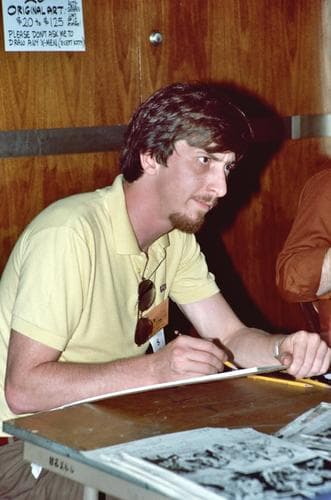
Biography coming soon.







