“Everything was perfectly swell. There were no prisons, no slums, no insane asylums, no cripples, no poverty, no wars. All diseases were conquered. So was old age.”
— Opening description of the utopian society.

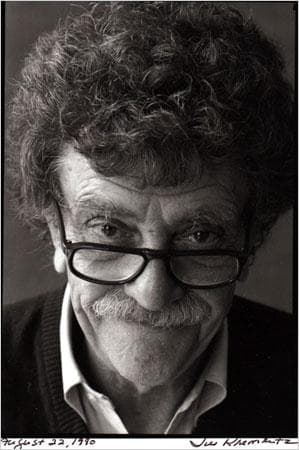
Kurt Vonnegut Jr. (2012)
Genre
Fantasy / Science Fiction
Reading Time
15 min
Key Themes
See below
Sign in to track this book
In a future where the population is strictly controlled and life is traded for life, a man grapples with the morality of bringing a child into existence when it means someone else must die.
The story opens in the Federal Bureau of Termination's waiting room at a Chicago Lying-In Hospital. Edward Wehling Jr. is anxiously awaiting the birth of his triplets. In this future world, overpopulation has been solved by a strict population control policy, no one can be born unless someone volunteers to die. For every birth, a death must occur, maintaining a stable global population of forty million. Wehling is stressed because he needs three volunteers for his three children, and only his grandfather has volunteered so far. He is speaking with a Dr. Hitz, the hospital's Chief Obstetrician, who supports the system, and an orderly named Leora Duncan, who is admiring a mural depicting the 'perfect' society.
Leora Duncan, a 93-year-old orderly, is carefully cleaning the waiting room and admiring a mural painted by the artist Louis Le Rue. The mural depicts a serene, utopian society where people are smiling, well-dressed, and seemingly content, with the Federal Bureau of Termination at its center. Leora, a strong supporter of the population control system, expresses her gratitude for the system that has brought such order and peace to the world. She tells Dr. Hitz and Wehling that she believes it's a beautiful world, praising the efficiency and the perceived happiness of its citizens, all thanks to the work of the Federal Bureau of Termination and the general population's willingness to volunteer for termination.
Edward Wehling Jr. is increasingly agitated as he still needs two more volunteers for termination to allow his other two children to live. Dr. Hitz, while sympathetic in a detached way, reminds Wehling of the strict rules. He suggests that Wehling could volunteer himself if he wanted to save his children, a proposition Wehling finds abhorrent. Wehling's grandfather, a volunteer, is already scheduled for termination. The system forces individuals into unimaginable choices, showing the cold, utilitarian logic that underpins this 'perfect' society. The tension grows as Wehling grapples with the ethical dilemma.
The nurse enters the waiting room to announce the successful birth of Wehling's triplets, three healthy boys. This news, while joyous in any other context, only deepens Wehling's despair. He now has three lives dependent on three deaths, and only one volunteer confirmed. The nurse, unaware of his internal torment, offers congratulations. Wehling knows that if he cannot find two more volunteers, two of his sons will be taken away and terminated, as per the law. The happy occasion is overshadowed by the grim reality of the world's population control.
Leora Duncan continues her work, cleaning the waiting room, and talking with Dr. Hitz about the beauty of their world. She praises the 'efficiency' of the system, stating that it has eliminated war, poverty, and disease, creating a harmonious society. She expresses her contentment with her long life and her admiration for those who volunteer for termination, seeing it as the ultimate act of civic duty. Her perspective shows the indoctrination within this society, where death is not mourned but celebrated as a necessary component of societal balance, further contrasting with Wehling's personal anguish.
Dr. Hitz mentions that the artist of the mural, Louis Le Rue, is still alive and, in fact, 201 years old. He is currently on the waiting list for termination, having lived an exceptionally long life. This detail shows the system's reach, even celebrated artists must eventually volunteer. Leora expresses delight at the thought of such a long life, reinforcing the idea that longevity is a reward for contributing to society, and termination is an honorable end. This also subtly introduces the idea that even those who have lived to extreme old age must eventually make way for new life.
Driven to the brink of madness by the impossible choice and the efficiency of the system, Edward Wehling Jr. snaps. He pulls out a revolver and, in a moment of desperate rage, shoots Dr. Hitz, the Chief Obstetrician, and then Leora Duncan, the orderly. His act is not one of malice, but of a desperate father creating two 'vacancies' for his children. The sudden violence shatters the calm of the hospital waiting room and the illusion of the 'perfect' society. Wehling's actions are a direct, though tragic, response to the dehumanizing logic of population control.
After shooting Dr. Hitz and Leora Duncan, Edward Wehling Jr. then turns the gun on himself, creating a third vacancy. He has sacrificed himself to ensure all three of his sons can live. The scene is now one of tragedy and silence. A moment later, the telephone rings. It is the Federal Bureau of Termination calling to confirm the three new vacancies, now available for Wehling's triplets. The impersonal nature of the call, even in the face of such violence, shows the chilling efficiency and detachment of the system, which simply registers deaths as statistics, fulfilling its quota.
The story concludes with the phone call from the Federal Bureau of Termination, which operates under the number '2BR02B' (a play on Shakespeare's 'To be or not to be'). The immediate acceptance of the three new deaths as valid 'vacancies' for the triplets shows the cold, bureaucratic nature of the system. Wehling's desperate act, while ensuring his children's survival, does nothing to dismantle or question the underlying principles of population control. The world, with its forty million inhabitants, will continue its cycle of mandated death for new life, with the mural of the 'perfect' society still adorning the wall.
The Protagonist
Starts as an anxious, law-abiding citizen and ends as a murderer and suicide, driven by an impossible ethical dilemma to save his children.
The Supporting
Remains consistently a proponent and enforcer of the population control system until his unexpected demise.
The Supporting
Remains a staunch, cheerful supporter of the system until her sudden, violent death.
The Mentioned
No direct arc, as he is only mentioned, but his impending termination symbolizes the system's universal reach.
The Supporting
His arc is completed before the story begins, having already volunteered for termination.
The Supporting
No specific arc; she serves as a plot device to deliver critical information.
The story shows how a system designed for societal 'efficiency' can strip individuals of their humanity. The Federal Bureau of Termination, with its impersonal 'vacancies' and 'volunteers,' reduces human lives to mere statistics. Wehling's anguish is treated as an inconvenience by Dr. Hitz, and Leora Duncan celebrates death as a civic duty. The cold, utilitarian logic of population control prioritizes the collective over individual suffering, culminating in Wehling's desperate act to reclaim his children's right to exist, outside of the system's calculations.
“''But how in hell,' Wehling wanted to know, 'can a man be expected to make time for that sort of thing?' 'We ask the best of you, sir,' said Dr. Hitz, 'the very best.'”
Vonnegut critiques the pursuit of a 'perfect' society, revealing its flaws and cruelties. The world of '2BR02B' has eliminated war, poverty, and disease through extreme population control, yet it has sacrificed individual freedom, emotional depth, and moral integrity. The mural depicting a serene, smiling populace is a constant, ironic reminder of the superficiality of this 'utopia.' The story suggests that such an ordered world, achieved through the negation of fundamental human rights, is ultimately a dystopia in disguise, where human life is no longer inherently valuable.
“'It was a beautiful world,' said Leora Duncan, 'and we were all so happy.'”
At its core, the story explores questions of life, death, and the right to choose. In this society, the 'choice' to live is conditional upon another's 'choice' to die. Wehling's struggle shows the moral dilemma when the state dictates such fundamental aspects of existence. His violent act, though shocking, is a desperate assertion of his children's right to life and his own agency in a world that denies it. The title itself, '2BR02B,' directly references Shakespeare's soliloquy on existence, showing the story's central theme of being or not being, but under the chilling specter of state control.
“''2BR02B,' the telephone number of the Federal Bureau of Termination, was printed in black on every public telephone. It was the only number you could dial without being charged.”
The story shows how easily a population can be taught to accept even the most horrific policies as normal and beneficial. Leora Duncan, a cheerful elderly orderly, fully embraces the system, viewing termination as a noble act. Dr. Hitz calmly enforces the rules, without moral qualms. This widespread acceptance, even celebration, of population control shows the power of propaganda and societal conditioning. Only Wehling, driven by the instinct of parenthood, breaks from this collective delusion, revealing the true cost of such widespread ideological conformity.
“'Every time somebody is born, somebody has to die,' she said. 'It's a beautiful world.'”
The central institution enforcing population control.
The Federal Bureau of Termination (FBT) is the dystopian government agency responsible for maintaining the global population at exactly forty million. It serves as the primary antagonist, a faceless bureaucracy that dictates life and death. Its phone number, '2BR02B,' is a direct reference to Shakespeare, highlighting the story's central theme. The FBT symbolizes the ultimate overreach of state power, where human life is treated as a commodity to be balanced and controlled, stripped of its inherent value. Its pervasive presence underscores the suffocating control of the government.
A propaganda tool depicting the 'perfect' society.
The mural, painted by Louis Le Rue, adorns the waiting room of the Federal Bureau of Termination. It depicts a serene, utopian society with smiling, well-dressed people, symbolizing the 'peace' and 'order' achieved through population control. This artwork functions as a powerful piece of propaganda, constantly reinforcing the perceived benefits of the system. Its idealized imagery stands in stark contrast to Wehling's despair and the grim reality of the 'vacancies' being created, serving as an ironic visual commentary on the superficiality of the 'perfect' world.
A direct allusion to Shakespeare, highlighting the central theme of existence.
The title of the story, '2BR02B,' is the phone number for the Federal Bureau of Termination and a phonetic play on Hamlet's famous soliloquy, 'To be or not to be.' This direct literary allusion immediately establishes the story's central theme: the question of existence and the value of life in a world where it is regulated by the state. It frames the entire narrative within a philosophical debate about life and death, choice and fate, and underscores the profound moral implications of the dystopian society Vonnegut has created. It's a stark, memorable symbol of the story's core conflict.
A narrative device to heighten the protagonist's impossible dilemma.
The birth of triplets, rather than a single child, serves as a crucial plot device to amplify Edward Wehling Jr.'s predicament. If he had only one child, his grandfather's sacrifice would have sufficed. The need for three 'vacancies' forces Wehling into an impossible situation, escalating his desperation to the point of violence. This choice by the author heightens the tension and dramatically underscores the inherent cruelty and dehumanizing nature of the population control system, pushing Wehling to a breaking point that a single birth might not have achieved.
“Everything was perfectly swell. There were no prisons, no slums, no insane asylums, no cripples, no poverty, no wars. All diseases were conquered. So was old age.”
— Opening description of the utopian society.
“The Federal Bureau of Termination was right next door to the hospital.”
— Describing the proximity of the termination facility to the hospital.
“If you're going to live on this planet, you've got to be willing to make room for newcomers.”
— A character explaining the population control policy.
“I'm going to be a grandfather for the first time, and I'm going to kill myself.”
— A man celebrating his grandchild's birth by volunteering for termination.
“The waiting list for a volunteer was about a year long.”
— Describing the demand for termination volunteers.
“It was a bright, clean, cheerful place. It was painted white, and it was full of plans for the future.”
— Describing the Federal Bureau of Termination.
“I'm not going to kill myself. I'm going to stay alive and just keep making trouble.”
— A character rejecting the societal expectation to volunteer for termination.
“The only way you can get competent medical attention is to produce a volunteer for termination.”
— Explaining the requirement for medical care in the society.
“We're all in this together, by golly.”
— A character expressing solidarity in the face of the population control system.
“The service was free, and the waiting room was clean and air-conditioned.”
— Describing the termination facility's amenities.
“I'm going to do what a man has to do.”
— A character preparing to volunteer for termination.
“There were no buttons to push, no switches to throw. The machine did it all.”
— Describing the automated termination process.
“It's a beautiful world.”
— A character's ironic remark about the society.
“The only thing that wasn't perfect was the people.”
— A subtle critique of the utopian society's human element.
Ready to see how well you understood this book? Take our interactive quiz with 10 questions.
Biography coming soon.







