“The past is obdurate.”
— Jake Epping's realization about the resistance of history to change.

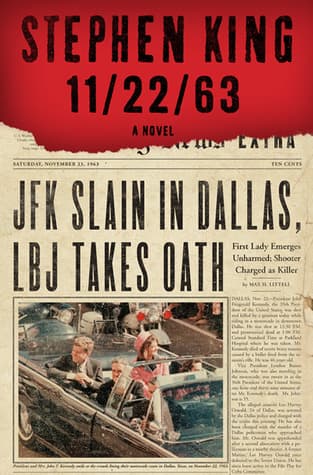
Stephen King (2011)
Genre
Thriller / Fantasy / Historical Fiction / Mystery / Science Fiction
Reading Time
17-20 hours
Key Themes
See below
Sign in to track this book
A high school teacher finds a diner portal to 1958. He goes on a mission to stop JFK's assassination, but his biggest challenge may be choosing between saving history and the woman he loves in a past that resists change.
Jake Epping, a high school English teacher in Lisbon Falls, Maine, is shown a time portal by his friend Al Templeton, who owns Al's Diner. The portal, in Al's pantry, always leads to 11:58 AM on September 9, 1958. Al, dying of lung cancer, says he has used the portal many times, trying to stop John F. Kennedy's assassination. He explains that each trip resets the timeline, meaning any changes he made are undone if he goes back. Al, having spent years in the past gathering information, is too sick to continue and asks Jake to take over. Jake, at first doubtful, is convinced after a short trip to 1958, where he saves the Dunning family from Harry's abusive father, an event Harry wrote about in a student essay. This act affects Jake and strengthens his commitment to Al's mission.
Jake Epping, now using the name George Amberson, returns to 1958 with a detailed plan and resources from Al. He quickly learns that the past 'pushes back,' causing small problems or big obstacles when he tries to change things. His first big test comes when he tries to save the Dunning family again, more completely. He confronts Frank Dunning, leading to a fight where Frank is killed. While this saves the family, Jake experiences the 'push back' through a series of accidents. He decides to live in Jodie, Texas, to watch Lee Harvey Oswald and build a stable life while waiting for 1963. He gets a job as a high school English teacher, using his future knowledge, especially in sports betting, to fund his long stay.
Jake (as George Amberson) settles into his new life in Jodie, Texas. He becomes a liked teacher at Jodie High School and makes friends. He meets Sadie Dunhill, the school librarian. Sadie is smart, kind, and beautiful, and Jake falls in love with her, despite his secret mission and knowing his life in the past is temporary. Their relationship grows, and Jake finds happiness he had not known in his original timeline. He struggles with the ethics of his deception, knowing he cannot fully share his true identity or mission with Sadie. The 'past' continues to exert subtle pressure, but his life with Sadie provides stability amidst his unusual circumstances.
As 1963 nears, Jake knows it is time to focus on Lee Harvey Oswald. He moves to Fort Worth, Texas, keeping his relationship with Sadie, who now works for the Fort Worth library system. He rents a room in a boarding house near Oswald's known homes and begins close observation of Oswald. He watches Oswald's volatile marriage to Marina, his unstable personality, his communist views, and his interactions with others. Jake becomes sure that Oswald is a lone wolf, driven by a need for recognition, and that he will act alone in the assassination attempt. This period is tense as Jake struggles with the moral issues of his mission and the possible results of changing history.
Jake stops Oswald's attempt to kill General Edwin Walker, a test run for the JFK assassination. This works, but it leads to a violent confrontation with Oswald. In the chaos, Jake is seriously hurt, and Sadie, who followed him out of worry, finds his hidden apartment and the evidence of his watching Oswald. Overwhelmed, Sadie first struggles to understand Jake's story about time travel and his mission. However, her love for him, Jake's explanations, and the amount of evidence convince her. She becomes his confidante and helps with his mission, despite the danger and the personal toll it takes on her.
While Jake recovers from his injuries, Sadie's abusive ex-husband, Johnny Clayton, finds her. Johnny is disturbed and had previously disfigured Sadie. He confronts Sadie and Jake, holding them hostage. In a desperate fight, Jake kills Johnny, but Sadie is severely wounded, losing an eye. This event further connects Jake and Sadie, but also shows the dangers and 'push back' of the past. Jake is affected by Sadie's suffering, feeling guilt for bringing her into his dangerous world. Their love deepens during the trauma, and Sadie's resolve to help Jake stop the JFK assassination strengthens, despite her injuries and lasting scars.
With November 22, 1963, getting close, Jake and Sadie finalize their plan. They know the exact route of the presidential motorcade through Dealey Plaza and the precise timing of Oswald's actions from the Texas School Book Depository. They plan their approach carefully, considering all possibilities. Sadie, despite her recent injuries and trauma, remains determined to support Jake. They know the big risks, not only from Oswald but also from the 'past' itself, which tries to stop Jake. Tension builds as they prepare for the day, knowing that history's fate, and possibly their own lives, depends on them.
On November 22, 1963, Jake and Sadie are near the Texas School Book Depository. As the presidential motorcade approaches, Jake acts. He runs into the building, confronting Lee Harvey Oswald on the sixth floor. A struggle happens, with Oswald trying to fire at the motorcade, but Jake stops him. During the fight, Sadie, who came to help, is shot and killed by a stray bullet, likely from Oswald's gun. Jake, heartbroken by Sadie's death, stops Oswald from firing at President Kennedy. The assassination is prevented, but at a huge personal cost to Jake.
Afterward, Jake is seen as a hero. Oswald is arrested, and President Kennedy is safe. However, the world that results is not the good one Jake had imagined. While some things are better, the 'past' has pushed back with unexpected and terrible results. The world becomes unstable, with widespread earthquakes, environmental problems, and political unrest. Changing such a big historical event has created a ripple effect that destabilizes the entire timeline. Jake realizes that stopping the assassination, though well-meant, has caused far greater chaos than the original timeline. The 'butterfly effect' has happened in a terrifying way, proving Al's earlier warnings about the past's resistance.
Facing a worsening world and knowing his actions caused it, Jake decides to reset the timeline. He goes back to the portal in Lisbon Falls, Maine, knowing that re-entering will undo all his changes, including his life with Sadie and her existence. It is a heartbreaking choice; he sacrifices the love of his life and his heroic act to save the world from his interference. Before he steps through, he talks one last time with the Yellow Card Man, a mysterious figure who seems to guard the timeline. The Yellow Card Man confirms his decision is necessary and that changing fixed points is dangerous. With a heavy heart, Jake steps back into the portal, returning to his original present.
Jake returns to his original 2011, where Kennedy was killed, and Sadie never existed in his personal history. The world is as he left it, stable but without the deep love he knew. He feels Sadie's loss deeply. Later, at an event in Lisbon Falls, he sees an elderly woman honored for her community work. He recognizes her as Sadie Dunhill, now an old woman who lived a full life without him. He approaches her and, without revealing their shared past in a different timeline, asks her to dance. They share a beautiful, silent moment, a dance that goes beyond time and loss, allowing Jake to honor the love they shared in a world that no longer exists, finding a bittersweet end.
The Protagonist
Jake transforms from a cautious observer of history to an active participant, finding love and purpose, only to ultimately sacrifice it all to restore the timeline. He learns the profound lesson that some things are meant to be.
The Supporting
Sadie evolves from a cautious woman with a painful past to a courageous and devoted partner, embracing an impossible truth and sacrificing her life for love and a cause she believes in.
The Supporting
Al's character is largely static, serving as the catalyst and initial guide for Jake, his experiences and convictions driving the plot forward even after his death.
The Antagonist
Oswald's character is largely static, his trajectory towards the assassination a predetermined path that Jake desperately tries to divert.
The Supporting
Harry's arc is brief but impactful, serving as a symbol of the potential good that can come from altering the past, and a personal connection for Jake.
The Supporting
Marina's arc is one of enduring abuse and hardship, culminating in her survival and eventual life after Oswald's actions.
The Antagonist
Johnny's character is a static force of evil, his reappearance serving as a major obstacle and source of trauma for Jake and Sadie.
The Mentioned
The Yellow Card Man has no personal arc but serves as a consistent, enigmatic warning system for Jake.
The Supporting
Deke's arc is largely static, serving as a symbol of the pleasant, ordinary life Jake builds in the past.
This theme looks at the big and often bad results of changing history. Jake's first success in saving the Dunning family is compared to the global instability that comes from stopping the JFK assassination. The 'past pushes back' with more violent means, showing that changing fixed points in time can cause unexpected chaos. This theme suggests that some events, even sad ones, are important for the timeline's stability, and that trying to 'fix' history can lead to worse outcomes.
“The past does not want to be changed. It is dangerous to change the past.”
Jake's mission is tied to his growing love for Sadie Dunhill. Their relationship is the emotional center of the novel, showing the personal cost of his historical intervention. Jake repeatedly faces the choice between his mission and his love, ultimately sacrificing Sadie's life to save the world, and then sacrificing their shared existence to reset the timeline. This theme explores the idea that love can last through time, even if it cannot stay in one timeline, and that the biggest acts of love often involve great personal sacrifice.
“I loved Sadie Dunhill. I loved her with a passion that made me feel like a hero in an old movie, and I loved her with a terror that made me feel like a child lost in a dark forest.”
The novel brings out a strong feeling for the late 1950s and early 1960s, showing it as a simpler, more innocent time before the cultural changes of later decades. Jake at first finds charm and comfort in the past, enjoying the food, music, and community. However, this good view is balanced by the realities of the era, including racism, sexism, and the constant threat of violence. The book explores how we often romanticize the past and that while there were good parts, it also had flaws and darkness.
“It was America, back when America was still pretty good. Back when people still said 'gosh' and 'golly' and meant it.”
A main tension in the novel is the debate between destiny and free will. Al believes history can be changed, while the 'past pushing back' suggests a determined force. Jake's attempts to change events are met with more resistance, implying that certain 'fixed points' in time are very hard, if not impossible, to change without bad results. The book suggests that major historical events, like the JFK assassination, might be fated, and trying to change destiny can lead to chaotic, unintended outcomes, questioning how much control humans have over history.
“Some things are fixed. Some things are not. The assassination... that's a fixed point.”
The novel looks at the nature of evil through Lee Harvey Oswald. Instead of showing him as part of a big plot, King shows him as a product of his own inner problems: narcissism, paranoia, and a desperate need for importance. This suggests that evil can often be common, coming from individual psychological issues rather than complex schemes. The book also explores how Jake, in trying to fight this evil, must face his own capacity for violence and the moral issues of his mission.
“He was just a sad, angry little man who wanted to be a big man. And he was going to do it by killing the biggest man in America.”
A fixed portal to a specific point in the past, always resetting upon re-entry.
The 'rabbit hole' is the physical time portal located in Al Templeton's diner pantry. Its unique rules — always leading to September 9, 1958, at 11:58 AM, and resetting the timeline each time someone re-enters — are crucial to the plot. This device establishes the stakes, allowing Jake multiple attempts but ensuring that each 'run' is a fresh start, making his commitment to staying in the past for years a necessity. It also cleverly allows for the exploration of multiple 'what-if' scenarios without complicating the narrative with branching timelines, as only the most recent trip's changes persist until the next reset.
A metaphysical force resisting changes to the timeline.
This is a recurring motif and a major antagonist in itself. Whenever Jake attempts to alter a significant event, the 'past' actively resists him through a series of increasing coincidences, accidents, and obstacles. These can range from minor annoyances like flat tires to life-threatening events like car crashes or a sudden illness. This device externalizes the inherent difficulty and danger of time travel, adding a layer of supernatural suspense and reinforcing the theme that some historical events are 'fixed points' that are not meant to be changed, regardless of human intention.
Mysterious figures who warn against tampering with the past.
The Yellow Card Men (and similar figures) are enigmatic, recurring characters who appear near the portal and offer cryptic warnings to those who travel through time. They are often disheveled and seem to be on the periphery of society, yet possess an unnerving awareness of the time-travelers' actions. They serve as a symbolic representation of the 'past pushing back' on a more cosmic, almost sentient level. Their presence adds to the mystery and supernatural elements of the story, hinting at unseen forces that govern the fabric of time and space, reinforcing the idea that humanity is not meant to meddle with history.
Integration of real historical figures and events into the fictional narrative.
King meticulously weaves real historical events, figures, and cultural details of the late 1950s and early 1960s into the fictional narrative. This includes detailed accounts of Lee Harvey Oswald's life, the political climate, pop culture references, and the specific events leading up to the JFK assassination. This device grounds the speculative fiction in a sense of realism, making the 'what if' scenario more compelling and believable. It allows the reader to experience history through Jake's eyes, adding depth and authenticity to his mission and the world he inhabits.
“The past is obdurate.”
— Jake Epping's realization about the resistance of history to change.
“If you want to kill a man, you have to cut off his head.”
— Jake's grim determination to stop Lee Harvey Oswald.
“We never know which lives we influence, or when, or why.”
— Reflection on the unintended consequences of time travel.
“The past harmonizes with itself.”
— Observation of how events align to resist alteration.
“Sometimes the universe throws you a rope.”
— Jake finding unexpected help in his mission.
“Life turns on a dime.”
— Comment on how small moments can change everything.
“The obdurate past doesn't want to be changed.”
— Reiteration of the past's resistance to Jake's actions.
“You can't change the past without changing the future.”
— Warning about the ripple effects of time travel.
“Love is a uniquely portable magic.”
— Jake's thoughts on his relationship with Sadie Dunhill.
“The past is a puzzle, and the pieces don't always fit.”
— Jake struggling to understand historical events.
“We're all time travelers, moving forward at the same speed.”
— Philosophical musing on the nature of time.
“The butterfly effect is not just a theory; it's a warning.”
— Reference to the chaos caused by small changes.
“Sometimes the right thing is the hardest thing to do.”
— Jake's moral dilemma in altering history.
“History is a wheel, and we are all caught in its spokes.”
— Metaphor for humanity's entanglement with past events.
Ready to see how well you understood this book? Take our interactive quiz with 10 questions.

Stephen Edwin King is an American author of horror, supernatural fiction, suspense, crime, science-fiction, and fantasy novels. Described as the "King of Horror", his books have sold more than 350 million copies as of 2006, and many have been adapted into films, television series, miniseries, and comic books. King has published over 65 novels/novellas, including seven under the pen name Richard Bachman, and five non-fiction books. He has also written approximately 200 short stories, most of which have been published in book collections.







